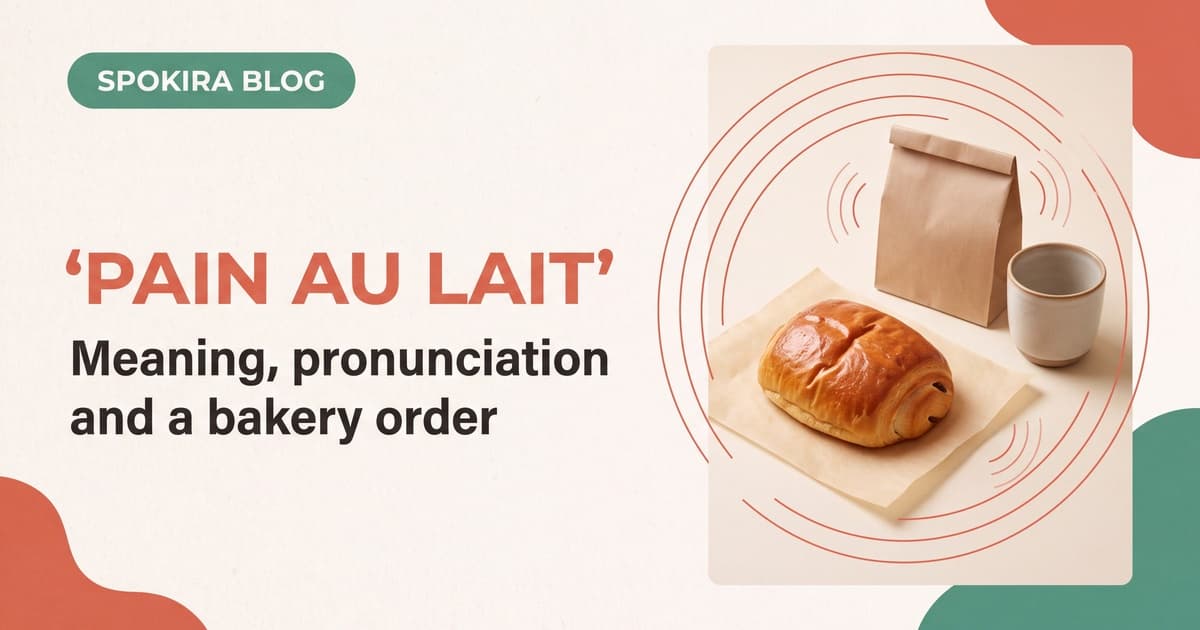
The pain au lait meaning is a small, soft French milk bun. At a bakery counter, you might buy one for breakfast, a snack, or to eat with a coffee. The useful part is being able to ask for it without turning three short words into a long pronunciation problem.
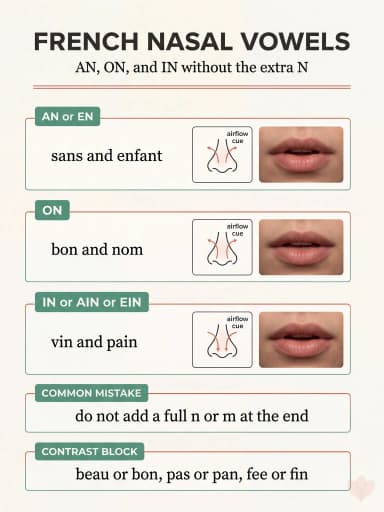
Say it /pɛ̃ o lɛ/. A friendly English-style reminder is "pahn oh leh," but use that only as a cue. The French version has a nasal vowel in pain, a clean /o/ in au, and an open /ɛ/ in lait. There is no final /n/ sound between pain and au.
Quick answer: pain au lait meaning
Pain au lait means milk bun or a small milk-enriched bread roll. Literally, it is "bread with milk," but "milk bun" is usually the better bakery translation. In French, ask for un pain au lait when you want one, or deux pains au lait when you want two.
| French | IPA | What to remember |
|---|---|---|
| un pain au lait | /œ̃ pɛ̃ o lɛ/ | one small milk bun |
| deux pains au lait | /dø pɛ̃ o lɛ/ | two small milk buns |
| Je voudrais un pain au lait, s'il vous plaît. | /ʒə vu.dʁɛ œ̃ pɛ̃ o lɛ sil vu plɛ/ | I would like a pain au lait, please. |
You may see them round or elongated, and individual bakeries make them differently. The stable idea is a soft small bun made with milk-enriched dough. Larousse defines pain au lait as a small elongated bun with a smooth crust made from milk-enriched brioche-like dough; the Académie française also lists petit pain au lait among ordinary bread terms.
If a baker offers several kinds of bread, do not assume pain au lait means a sliced supermarket loaf or a baguette with milk on the side. It names the bun itself. It can be lightly sweet, but it is not automatically a dessert and it is not a fixed synonym for every kind of brioche.
Pain au lait pronunciation: say /pɛ̃ o lɛ/ in three parts
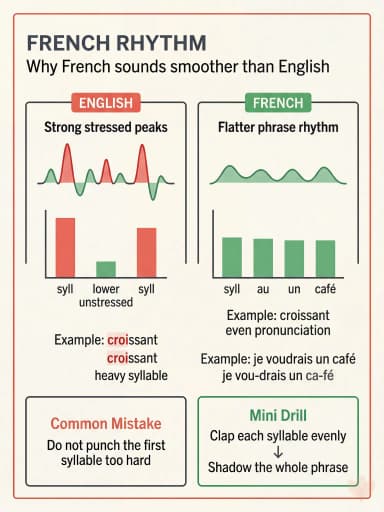
The pain au lait pronunciation is /pɛ̃ o lɛ/. Give each word a clear job, then connect them without English-style stress. The phrase is short enough to practice as one whole sound unit.
| Part | IPA | Practical cue | Do not say |
|---|---|---|---|
| pain | /pɛ̃/ | Start with a plain p, then hold one nasal vowel | "payn" or "pain" with a released /n/ |
| au | /o/ | A short, rounded "oh" | "ow" as in English cow |
| lait | /lɛ/ | A light leh with an open vowel | "lay" or "late" |
Pain: the nasal vowel is the hard part
In pain, the spelling ai + n creates one nasal vowel: /ɛ̃/. Your tongue does not need to close for an English /n/ at the end. Keep the vowel going and allow some air through your nose. Then stop the sound cleanly.
That last point matters. English speakers often hear the letter n and add one because English words such as pain finish with a clear consonant. French does not do that here. The University of Texas's French Interactive phonetics guide uses the useful contrast panne/pain: the first has an audible consonant, while pain has a nasal vowel.
Try this contrast aloud:
panne /pan/
pain /pɛ̃/
Do not chase a perfect imitation on the first try. Your first target is simpler: let the vowel carry the nasal quality, and do not add a separate /n/.
Au and lait: two short vowel targets
The au in au is /o/, like a clean, rounded "oh." It is not the English diphthong in cow. Keep it still and brief.
The ai in lait is /ɛ/, close to "eh" in a careful English bed. It is not the vowel in English late. Say leh, not lay.
Those two tiny words are where a familiar-looking French phrase can drift into English. If your pain is good but you say "ow lay," the phrase still loses its shape. Practice the three targets together: /pɛ̃/ | /o/ | /lɛ/.
Phrase rhythm: no pause and no invented liaison
French does not need a heavy beat on one word here. Let the phrase move in three small sound groups:
pain | au | lait
/pɛ̃ | o | lɛ/
Then close the gaps:
pain au lait
/pɛ̃ o lɛ/
There is no liaison that turns the phrase into "pain-no-lait." The vowel in pain is nasal, but it does not release an /n/ before au. This differs from expressions such as bon appétit, where a final consonant becomes audible in liaison. Keep pain au lait as one memorized sound, not as a spelling rule you rebuild at the counter.
For a wider workout on this sound family, use the French nasal-vowel practice guide. If several French vowels still blur together, the broader French pronunciation guide for English speakers will give you a better map before you return to this phrase.
A useful simplified cue
Think "pahn oh leh," with the middle vowel held very short. It is only a bridge: leave English spelling behind and move toward the French sound. The IPA /pɛ̃ o lɛ/ and a native recording are the targets.
Before the drill, listen to this pain au lait recording by a speaker from France. It is a user-contributed native-speaker example, not an official pronunciation standard, so use it as one clear model and compare it with the IPA above.
Ready to practice a real bakery order?
Spokira helps you shadow short French lines, record yourself, and fix one sound at a time until the phrase feels available in a real conversation.
Pain au lait meaning in a cafe or bakery
You will most often say pain au lait in a boulangerie or cafe, usually when you are choosing breakfast or something small to take away. The most useful grammar is pleasantly simple: pain is masculine, so one is un pain au lait. The plural is des pains au lait or, after a number, deux pains au lait.
The easiest order to use
Start with a greeting, name the item, and finish politely:
Bonjour, un pain au lait, s'il vous plaît.
Hello, one milk bun, please.
That is enough. You do not need a formal sentence for every bakery purchase. If you want a gentler full sentence, say:
Bonjour, je voudrais un pain au lait, s'il vous plaît.
Hello, I would like a milk bun, please.
Je voudrais is polite and widely useful. The short version is just as normal when the line is moving quickly.
If you want more than one
Use a number before the plural noun:
Je vais prendre deux pains au lait, s'il vous plaît.
I'll have two milk buns, please.
Trois pains au lait, s'il vous plaît.
Three milk buns, please.
The spelling changes to pains, but the final s is silent. Do not add an /s/ sound at the end of pains unless the next word creates a separate, genuine connection in a larger sentence.
Helpful bakery follow-ups
| French | Natural English | When it helps |
|---|---|---|
| Vous en avez encore? | Do you have any left? | The display looks nearly empty. |
| C'est pour emporter. | It's to take away. | You are not eating there. |
| Je peux avoir un sachet? | May I have a bag? | You need to carry it. |
| Avec un café, s'il vous plaît. | With a coffee, please. | You are adding a drink. |
| Merci, bonne journée! | Thanks, have a good day! | You are leaving. |
Be careful with one easy mix-up: un pain au lait is a bun, while un café au lait is coffee with milk. The pronunciation pattern au lait stays /o lɛ/; the noun before it changes what you are ordering.
For a full exchange, use the French cafe conversation practice script. It gives you the surrounding language, including greeting, payment, and the little repair moments that happen at a busy counter. The French for travel guide is useful if the bakery is only one stop in a wider day out.
The small grammar that makes your order flexible
You do not need a grammar lesson before buying a bun, but two patterns give you more control immediately. Pain is masculine, so the singular is un pain au lait. Its plural is des pains au lait, though a number replaces des: deux pains au lait, trois pains au lait, and so on.
| What you need | French | Sound note |
|---|---|---|
| One bun | un pain au lait | /œ̃ pɛ̃ o lɛ/ |
| The bun on display | le pain au lait | /lə pɛ̃ o lɛ/ |
| Some milk buns | des pains au lait | /de pɛ̃ o lɛ/ |
| Two milk buns | deux pains au lait | /dø pɛ̃ o lɛ/ |
Notice what stays calm in all four lines: pain au lait. The spelling changes from pain to pains in the plural, but the final s is silent. You still hear /pɛ̃ o lɛ/, not an extra “z” or “s.”
This is also why it helps to learn the phrase as a chunk. You can swap the article or number without rethinking its vowels. Say un pain au lait, then deux pains au lait, then trois pains au lait. If the middle of the phrase stays stable, your order will stay clear even when you change the quantity.
What the baker may ask next
The next question is often short. You do not need to catch every word perfectly; listen for the choice you need to make.
Baker: Autre chose?
Anything else?
You: Non, merci.
No, thank you.
Baker: Sur place ou à emporter?
For here or to take away?
You: À emporter, s'il vous plaît.
To take away, please.
Baker: Ça vous fera trois euros.
That will be three euros.
You: Voilà, merci. Bonne journée!
There you go, thanks. Have a good day!
Do not worry if a baker speaks faster than the neat script on a page. Your job is to recognize the practical fork in the conversation, then answer with the short phrase you already rehearsed. That is much easier than trying to translate the whole exchange in your head.
A short pain au lait ordering drill
The goal is not to recite a food list. It is to make one small order easy enough to say when someone is waiting for your answer.
First, build the sound
Say the phrase five times with a short pause between each repetition:
pain au lait
/pɛ̃ o lɛ/
On reps one and two, slow down slightly. On reps three through five, let it be one line. Record the fifth repetition if you can. Listen for two things only: did pain end in an /n/, and did lait drift toward "lay"?
Then, add the useful frame
Repeat this three times:
Bonjour, un pain au lait, s'il vous plaît.
Now remove the text and say it once from memory. If you freeze, do not start over with a longer sentence. Return to un pain au lait, s'il vous plaît, then add bonjour back in.
Finish with a two-line bakery scene
Baker: Bonjour!
You: Bonjour, je vais prendre deux pains au lait, s'il vous plaît.
Baker: Voilà.
You: Merci, bonne journée!
Run it twice. On the second pass, change deux to trois or add avec un café. Small changes force you to retrieve the phrase instead of only echoing it. That is the part that carries over when you are actually ordering.
If you want a repeatable speaking routine around short scripts like this, the French speaking practice guide will help you turn a few good lines into a five-minute daily habit.
Common pain au lait pronunciation mistakes
Adding an /n/ after pain
The most common error is "payn oh lay," with a full consonant after the first word. Keep /pɛ̃/ nasal and let au begin directly after it: /pɛ̃ o/. There is no /n/ bridge.
Turning au into English "ow"
French au is stable: /o/. Round your lips a little and avoid the glide. One short "oh" is more useful than an exaggerated vowel.
Saying lait like "late"
End with /lɛ/, not /leɪ/. The final t is silent, but the vowel is not a long English "ay." Think leh and stop there.
Over-stressing the first word
French rhythm is smoother than English word stress. You do not need to punch PAIN and swallow the rest. Keep all three words audible, then use the phrase inside the order. Clear and calm beats theatrical.
Treating the phrase as a test
At a bakery, the point is communication. If the first attempt feels clumsy, slow down, point politely if needed, and repeat the noun phrase. A short repair is normal. The next repetition is where your mouth learns.
The takeaway
The pain au lait meaning is a small French milk bun. In a bakery, ask for un pain au lait, s'il vous plaît. The key pronunciation is /pɛ̃ o lɛ/: one nasal vowel in pain, a short /o/ in au, and lait ending in /ɛ/.
Practice the noun phrase first, then put it in a real order. You do not need a perfect bakery accent. You need a phrase you can retrieve, say clearly, and use before the person behind the counter has moved on.