You hear someone say touche, perhaps after a clever comeback, and it feels like a neat little French flourish. The catch is that touche meaning in French is wider and more ordinary than the English borrowing suggests. It can refer to a hit in fencing, a physical touch, a keyboard key, an artist's brushwork, or a point that lands exactly where it should.
For an English speaker, the practical question is not whether you can deploy it at a dinner party. It is what you will understand when a French person says touche, touché, or ça me touche. This guide separates those forms, gives you the sound, and ends with a short drill. Say the examples out loud. Recognition is nice; being able to answer is better.
Touche meaning in French: the quick answer
Touche is usually a feminine noun, pronounced /tuʃ/. Its most visible meaning is a hit or point in fencing. Depending on the setting, it can also mean a keyboard key, a touch of paint, a line at the side of a sports field, or a small distinctive contribution. Touché is the past participle of toucher, pronounced /tuʃe/, and means "hit," "touched," or, in English-style banter, "fair point."
| Form | Sound | Basic job | Useful example |
|---|---|---|---|
| touche | /tuʃ/ | noun | Une touche en escrime |
| touché | /tuʃe/ | past participle / exclamation | Tu m'as touché |
| toucher | /tuʃe/ | infinitive verb | Ne pas toucher |
| ça me touche | /sa mə tuʃ/ | emotional reaction | That moves me |
The spelling looks deceptively simple. The final letters change the meaning and the rhythm. That is why it helps to train the word as a tiny family rather than a one-off loanword.
Touche meaning in French: a hit, contact, or point
At its centre, touche comes from toucher, "to touch." The historical record gives the noun several paths: an object used to touch, an action or blow, and later specialized uses in music, sport, painting, and machines. The CNRTL etymology for touche documents those older senses instead of pretending there was one magical origin story.
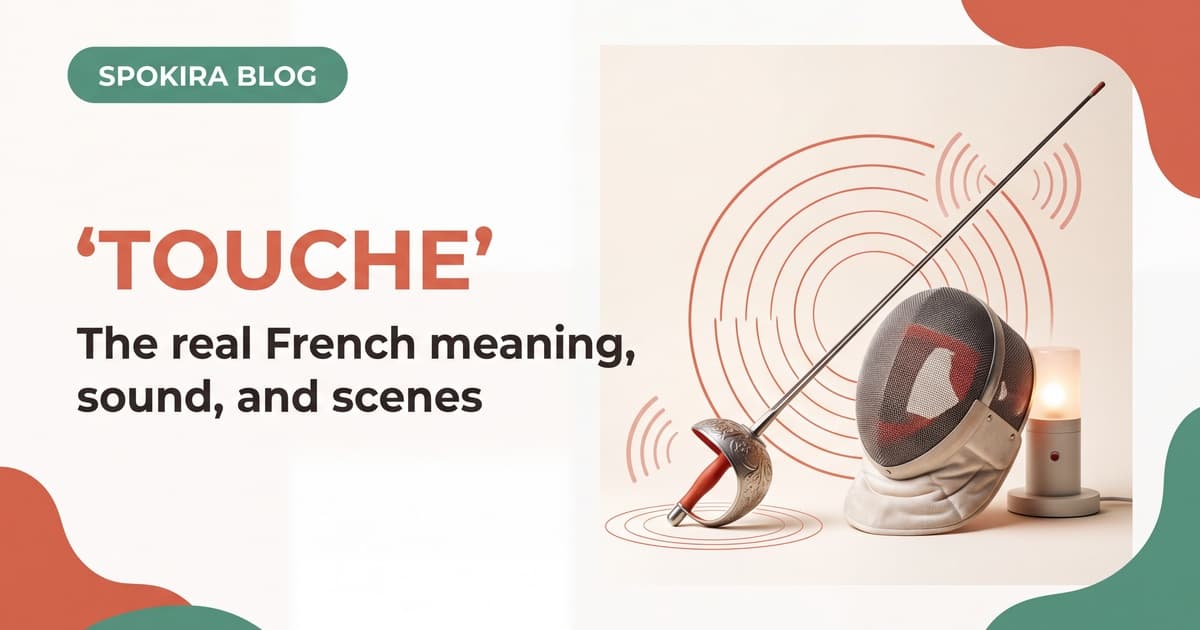
In fencing, a touche is an eligible hit. This is the use English speakers often know because a successful hit is traditionally called out with the same brisk word. The Académie française's explanation of épée, fleuret, and sabre notes that a touch has different valid target areas by weapon. You do not need fencing expertise to understand the basic image: someone has reached the target.
Elle a marqué une touche au dernier moment.
She scored a touch at the last moment.
Outside sport, French has many concrete senses. A piano has des touches (keys). An artist can have une touche légère (a light touch). On a football or rugby field, la touche is the sideline and, by extension, the ball going out there. The Académie entry collected by CNRTL records these specialized meanings, including the keyboard and painting senses.
That variety is useful because it gives you a memory hook. Touche always carries an idea of contact, a point of contact, or a way something is applied. It does not mean every English use of “touch,” though. Start with the complete phrase you hear rather than translating the noun in isolation.
Touche versus touché: one missing accent, a different grammar job
Here is the distinction worth keeping straight:
- Touche is a noun. It may be a point, key, stroke, or sideline.
- Touché is the past participle of toucher. It agrees when it describes a person or object: elle est touchée, la balle a touché le mur.
- Tu touches is a present-tense verb form: "you touch" or "you are touching."
In an English conversation, people say “touché” to concede a sharp observation. In French, you can hear touché! in a playful exchange, especially when someone has made a point. But it is not a magic all-purpose French retort. A warmer, more ordinary reply might be c'est pas faux (that's not wrong), tu marques un point (you have a point), or simply oui, c'est vrai.
Tu dis que je suis toujours en retard, mais tu n'es pas prêt non plus.
Touché. On y va?
Use it with friends when the tone is light. Do not say it after someone has raised a real problem at work or told you that you hurt them. A clever word can sound evasive if it replaces an honest response.
How to pronounce touche and touché
The good news: French touche begins with a sound English speakers already know. The danger: adding an English-style ending or stressing the first syllable too hard.
Touche is /tuʃ/: roughly “toosh,” but shorter and cleaner. The ou is the French /u/ in vous, not the vowel in English “touch.” The final che is /ʃ/, as in English “sh.” There is no extra vowel after it.
Touché is /tuʃe/: “too-shay.” The accented é is a closed /e/. Make it one flowing unit, not “too-SHAY!” with a theatrical English stress. French rhythm generally puts weight toward the end of a phrase, not on a single word in the English way.
| Word | IPA | Common English-speaker slip | Better cue |
|---|---|---|---|
| touche | /tuʃ/ | “tutch” | Hold a rounded /u/, then release /sh/ |
| touché | /tuʃe/ | “TOO-shay” | Keep both syllables even; let /e/ finish cleanly |
| toucher | /tuʃe/ | “too-CHERR” | Final -er is /e/, not English /ər/ |
| tu touches | /ty tuʃ/ | losing the French u in tu | Round your lips forward for /y/ |
The last row matters. In tu touches, the first tu has the French /y/ sound, which is not the /u/ in touche. If you are still building that contrast, use the French u versus ou practice drill. It prevents a small vowel blur from following you into many basic verbs.
Five everyday phrases built around toucher
Most real-life usefulness comes from the verb. Learn these as ready-made chunks, not as a giant dictionary entry.
1. Ne touchez pas!: don't touch!
You will see this on museum signs, medical equipment, and anything fragile. It is plural or polite singular. With a friend or a child, you might say ne touche pas!.
Attention, ne touchez pas à la peinture fraîche.
The little word à matters. Toucher quelque chose is physically touching something. Toucher à quelque chose can mean interfering with it, handling it, or altering it. Context carries the fine distinction.
2. Ça me touche: that moves me
This is emotional, not physical. If a friend says something generous, gives you a thoughtful gift, or tells a moving story, you can say ça me touche. It is sincere but not overblown.
Ton message m'a vraiment touché.
If you identify as a woman, write touchée. In speech, both sound the same: /tuʃe/. That is a nice reminder that French grammar can matter on the page without changing every sound.
3. Ça ne me touche pas: it doesn't concern me / it doesn't affect me
This phrase can be neutral, firm, or chilly. Cette décision ne me touche pas directement means the decision does not concern me directly. Said about criticism, it can mean “I do not care,” so listen to the situation.
Le nouveau règlement touche tous les étudiants.
Here toucher means “affect” or “concern.” It is a useful formal-neutral verb, especially in news or work conversations.
4. Toucher du doigt: see or grasp something clearly
The literal image is “touch with a finger.” Figuratively, toucher du doigt un problème means to get very close to understanding or identifying it. It is more literary than comprendre, so recognize it before you rush to use it.
Avec cet exemple, on touche du doigt la difficulté.
In a normal conversation, là, je comprends mieux le problème will sound easier and just as clear.
5. Une petite touche de…: a small touch of something
This one is practical for describing food, clothes, and decoration. Une petite touche de citron is a hint of lemon. Une touche de rouge is a touch of red. It is not limited to art.
J'aime cette veste: la touche de vert est discrète.
Notice that petite and discrète make the statement modest. French often uses these small softeners when describing style. You do not have to sound dramatic to sound natural.
When does touché! sound natural in a French conversation?
The short answer: when both people are playing. It works after a gentle contradiction, a teasing observation, or an argument you are happy to concede. Think of it as a smile in word form.
It is less natural when you want to show agreement. If someone gives you useful advice, choose tu as raison or je n'y avais pas pensé. If they call out a factual mistake, say oui, exact. Those responses do more than perform a witty retreat.
| Situation | Natural response | Why |
|---|---|---|
| A friend catches your contradiction | Touché! | Playful concession |
| A colleague gives a valid correction | Oui, tu as raison. | Direct and professional |
| Someone shares hurt feelings | Je comprends. Je suis désolé(e). | Takes the feeling seriously |
| You agree with a good point | C'est vrai. | Plain and versatile |
This is one reason expressions are worth learning in scenes. A dictionary tells you a possible meaning. A scene tells you whether the word helps the other person feel heard. For more reaction phrases that actually fit conversation, try French reactions that sound natural.
A three-minute touche speaking drill
Your goal is to switch without hesitation between /tuʃ/ and /tuʃe/. Do this aloud, preferably while recording one take on your phone.
- Build the contrast. Say touche, touché, touche, touché five times. Keep touche short; let touché finish with /e/.
- Add a sentence frame. Repeat: Ça me touche. Then: Ton message m'a touché. Do not separate m'a touché into stiff individual words.
- Choose a real response. Imagine a friend says, “You always buy dessert and say you will share it.” Answer: Touché, c'est vrai. Then say it again as Oui, c'est vrai. Notice the difference in mood.
- Use a physical context. Say: Ne touche pas à ça, c'est fragile. Keep the final pas à linked smoothly.
- Record and compare. Listen for an invented vowel after /ʃ/. If you hear “toosh-uh,” repeat the word alone, then put it back in the sentence.
One useful correction
Do not chase a dramatic French accent on touché. The win is a clean ending and a relaxed rhythm. If the word fits naturally into the sentence, it will sound far better than a spotlight performance.
If recording yourself makes you freeze, start with one line. The French speaking practice guide explains how to move from a written phrase to a usable answer. For the final /ʁ/ in longer toucher phrases, the daily French R drill is a focused next step.
Common mistakes with touche and how to fix them
Mistake: treating touche as only an English comeback. Fix it by learning one noun phrase, such as une touche de citron, and one verb phrase, such as ça me touche. The word will stop feeling borrowed.
Mistake: saying touché whenever you agree. Use it for playful concession. For serious agreement, tu as raison is clearer.
Mistake: pronouncing the ou like English “uh.” In touche, round your lips and say the vowel in French nous. Do not confuse it with the front-rounded vowel in tu.
Mistake: forgetting the accent in writing. Touche and touché are both real words, but not interchangeable. The accent marks the /e/ ending and signals the participle.
Mistake: memorizing a definition but never responding. Use one tiny exchange. An expression becomes available when your mouth has already travelled the route a few times.
Practice French phrases until the response comes out
Spokira gives you short native-speaker clips, a place to record, and focused feedback on the sound or rhythm to repair next.
For one more compact record-and-repeat exercise, practice French speaking with Spokira after the drill.
The takeaway
Touche is a real French noun with a family of concrete and figurative uses. In fencing, it is a hit. In a keyboard, it is a key. In design, it can be a small accent. Touché is the related “hit” form you may hear in friendly banter, but French also gives you more useful everyday lines: ça me touche, ne touche pas, and ça me concerne.
Pick one scene today. Say Ça me touche, merci after an imaginary kind message, or Ne touche pas à ça, c'est fragile in a museum. Repeat it until the phrase has a rhythm, not just a translation. That small bit of mouth training is how French starts feeling available when you need it.
Continue with the meaning and real French use of c'est la vie.