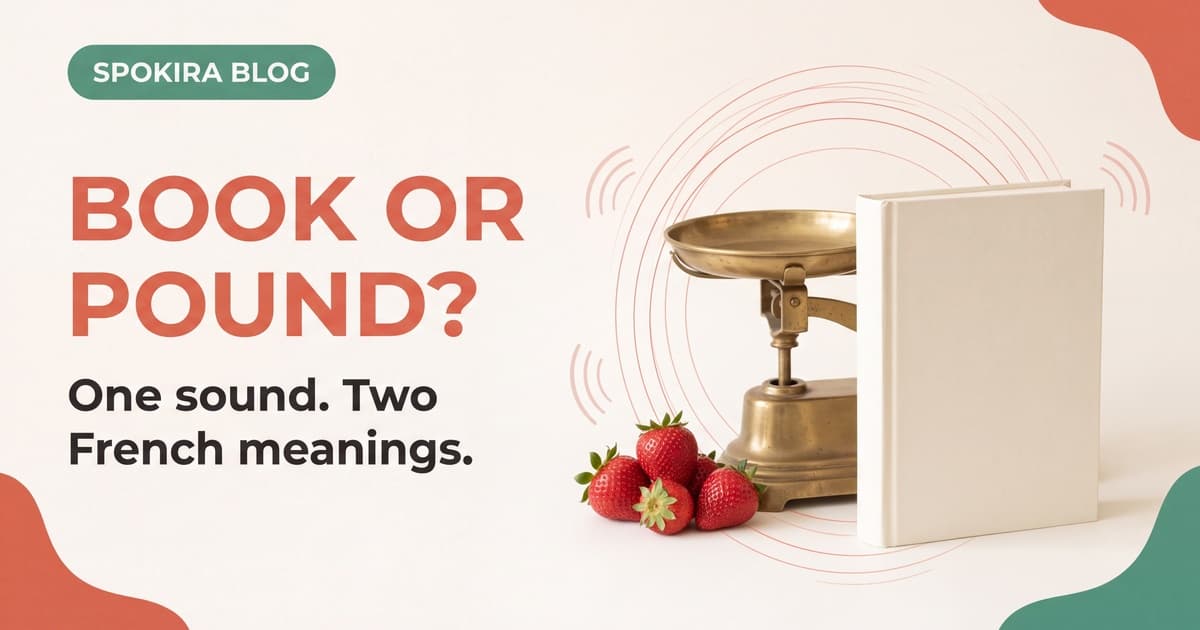
A French livre can be a book or a pound. The article tells you which one. Un livre is masculine and usually means “a book.” Une livre is feminine and refers to a unit of weight or a currency, depending on the phrase. The good news is that both sound the same: /livʁ/.
That same pronunciation is exactly why this word causes trouble. You may hear livre in a bookshop, at a market, in a history class, or in a conversation about British money. The word itself will not rescue you. The article, the number, and the rest of the phrase will.
For A2–B1 French, do not memorize a clever fact about homonyms and move on. Learn a few complete chunks: un livre intéressant, une livre de fraises, la livre sterling. Then the gender, meaning, and rhythm arrive together when you need them.
Livre meaning and pronunciation: the quick answer
| Form | Gender | Standard pronunciation | Usual meaning | Example |
|---|---|---|---|---|
| un livre | masculine | /livʁ/ | a book | Je cherche un livre en français. |
| une livre | feminine | /livʁ/ | a pound / a weight unit | Je voudrais une livre de tomates. |
| la livre sterling | feminine | /livʁ stɛʁ.liŋ/ | the pound sterling | La livre sterling est la monnaie du Royaume-Uni. |
| des livres | plural, context decides gender | /livʁ/ | books or pounds | J'ai acheté des livres. / Deux livres de pommes, s'il vous plaît. |
The Académie française’s entry for masculine livre begins with the familiar meaning: a work made to be read. Its separate feminine livre entry covers weights and currencies. Those are two different nouns with the same spelling and sound, not one noun that randomly changes gender.
The fastest decision rule is simple:
- un / le / ce livre: expect a book, a volume, or sometimes a ledger.
- une / la / cette livre: expect a quantity, weight, or currency.
- a number + livres + de: expect a quantity: deux livres de cerises.
How do you pronounce livre?
The standard pronunciation of livre is /livʁ/. It is one syllable. There is no pronounced final e, and there is no extra “uh” after the r.
A simplified cue, with an important limit
For an English-speaking learner, try “leevr,” one quick beat. Start with an “ee”-like vowel, keep the v, and finish with a light French R. Say it as one compact shape: leevr.
That cue is only a bridge. It is not a replacement for IPA or for listening. English “ee” is often longer than French /i/, and the English R is made in a different place. Do not turn the word into “lee-ver,” “liver,” or “leave-er.” The written e is silent in ordinary speech.
| Part | IPA | Learner cue | What to avoid |
|---|---|---|---|
| li- | /li/ | short, clear “lee” | the lax vowel in English liver |
| -v- | /v/ | ordinary v | dropping it so the word becomes lir |
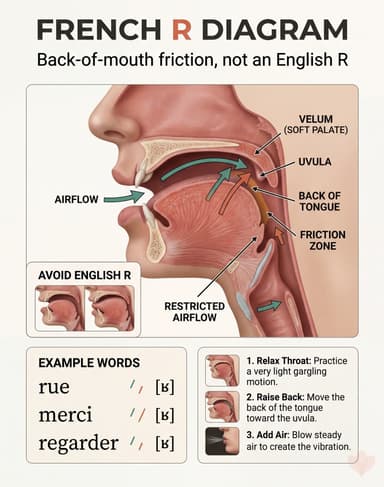
| -re | /ʁ/ | light back-of-mouth friction | adding “ruh” or using a heavy English R |
The final sound is the part worth practicing, but do not force it. In standard French, /R/ is generally uvular, farther back than an English R; the International Phonetic Association’s French illustration describes that target in its French sound overview. A quiet, repeatable sound is more useful than a dramatic growl. If the word falls apart at the end, use the dedicated French R practice drill rather than trying to fix every part of French pronunciation at once.
Say the plural the same way
Livre and livres are normally both /livʁ/. The final s in livres is silent.
That means the plural alone does not settle the meaning. Listen for the sentence around it:
J'ai acheté deux livres.
I bought two books.
J'ai acheté deux livres de pommes.
I bought two pounds of apples.
The small phrase de pommes removes the ambiguity. This is a useful listening habit: when a French word has two possible meanings, wait for the noun, verb, or number around it before committing to an English translation.
For a wider map of sounds that English spelling habits can distort, keep French pronunciation for English speakers nearby. For now, one clean target is enough: /livʁ/, one syllable, no final vowel.
Un livre: the masculine word for a book
Most of the time, un livre means “a book.” It can be a novel, cookbook, textbook, children’s book, or any work you read as a book. It is masculine: un bon livre, le livre, ce livre, mon livre.
| French chunk | Natural English | When you might say it |
|---|---|---|
| un livre intéressant | an interesting book | recommending a read |
| un livre de cuisine | a cookbook | talking about food or recipes |
| un livre de poche | a paperback | browsing a bookshop |
| le livre que je lis | the book I am reading | everyday conversation |
| un livre en français | a book in French | looking for reading practice |
Tu lis quoi en ce moment?
Je lis un livre sur Paris.
Vous avez ce livre en format poche?
Do you have this book in paperback?
The Académie française’s masculine entry also includes senses such as a collection of records or accounts. You may see livre de comptes in business or history. Do not let that broader dictionary range distract you from the core chunk. For daily life, start with un livre = a book.
Gender is part of the word, not a decoration
French noun gender gets easier when you store the article with the noun. Do not add livre to a flashcard by itself. Save un livre and say a phrase with it.
- un livre drôle
- ce livre est long
- je cherche un livre facile à lire
That habit matters here because gender carries meaning. If you say une livre when you mean a book, your grammar has pointed your listener toward a quantity or currency before the rest of your sentence arrives. The remedy is not to panic about gender. It is to build the article into your first memory of the noun. The French noun-gender guide has a practical routine for doing exactly that.
Une livre: weight, pounds, and money
Une livre is a feminine noun. In contemporary French, it can refer to a unit of weight, a historic French monetary unit, or the currency unit in names such as la livre sterling.
At a market: une livre is usually 500 grams in France
In France, une livre used for food is conventionally 500 grams, or half a kilogram. The Académie explicitly gives une livre de fruits and une livre de viande for this current use. That is why a French market request can look familiar to an English speaker and still mean a different quantity from an imperial or US pound.
Je voudrais une livre de fraises, s'il vous plaît.
I would like 500 grams of strawberries, please.
On prend une demi-livre de beurre?
Shall we get 250 grams of butter?
This is a context-sensitive word, not a conversion trick to use everywhere. The CNRTL entry for feminine livre records different historical and regional values, including the 500-gram modern French sense and a Canadian use tied to 453.59 grams. If you are buying food in France, kilograms and grams are often clearer anyway. If a shop uses la livre, follow the local convention or ask for the quantity in grams.
Currency: la livre sterling and historical French money
La livre sterling is the British pound sterling. In an ordinary conversation about UK money, say the full phrase when you need precision:
Ça coûte vingt livres sterling.
It costs twenty pounds sterling.
The feminine word also names the former French livre, a unit of account before the franc, and it appears in the names of other currencies. In a novel, museum caption, or history lesson, cent livres may therefore mean a monetary amount, not a stack of books or a basket of fruit. The Académie’s feminine entry distinguishes that historical French money from livre sterling and other modern currency names.
You do not need to learn every old unit to use French well. Just notice the pattern: currency uses the feminine noun. La livre sterling is not a special exception to memorise separately; it belongs with une livre.
Listen for the article, then the noun after it
With livre, context does the heavy lifting. Hear un livre and think “book.” Hear une livre de… and wait for the food. Hear livre sterling and think currency. The pronunciation stays /livʁ/ throughout.
Useful livre phrases you can actually use
These phrases put the meaning into a scene. Read both columns aloud, then cover the English and retrieve the French.
| French | Meaning | Useful situation |
|---|---|---|
| Je cherche un livre facile à lire. | I am looking for an easy book to read. | Bookshop or library |
| Tu peux me conseiller un livre? | Can you recommend a book? | Asking a friend |
| J'ai oublié mon livre à la maison. | I left my book at home. | Class or study group |
| Une livre de tomates, s'il vous plaît. | 500 grams of tomatoes, please. | Market or greengrocer |
| Deux livres de pommes. | Two pounds of apples. | Buying produce |
| La livre sterling est forte aujourd'hui. | The pound sterling is strong today. | Talking about currency |
| Ce roman coûte douze livres sterling. | This novel costs twelve pounds sterling. | UK price context |
Notice that livre can appear twice with different meanings in the same conversation:
Ce livre coûte douze livres sterling.
This book costs twelve pounds sterling.
That sentence is not a trick. It is a useful reminder to listen for the surrounding words: ce marks the masculine book; sterling identifies the feminine currency.
If you are preparing for everyday interactions, add the market phrase to your French travel speaking practice. It is more useful than practicing a long vocabulary list in silence. You can also turn each phrase into a small speaking prompt: look at an imaginary book, a bag of fruit, or a price tag and answer without reading.
Turn word knowledge into speaking practice
Spokira helps you rehearse short French scenes with native-speaker shadowing and clear feedback, so useful words come out when the conversation is moving.
Common mistakes with livre
Treating the English-looking word as English liver
Livre is not English “liver.” Keep the vowel /i/ clear and do not add an English -er ending. A short “leevr” cue is closer, provided you remember it is only a cue.
Pronouncing the final e
In normal speech, livre has one syllable: /livʁ/. Avoid lee-vruh. The same goes for livres: the final s stays silent.
Using the wrong article when you mean a book
Say un livre, not une livre, for a book. If gender feels slippery in the moment, launch the whole chunk: je cherche un livre. The article is part of the pronunciation rehearsal, not a grammar label you add later.
Assuming every livre is an English pound
In France, une livre de fromage commonly means 500 grams, not 454 grams. In currency, livre sterling means pound sterling. In older texts, the value can be historical. Ask what is being measured or priced before doing any conversion.
Pausing before the R
Do not say lee...vr. Keep the word moving. Slow practice is useful, but the sound needs to stay attached to the vowel. Start with li-vr, then bring it back to one beat.
Livre meaning and pronunciation: a three-minute speaking drill
You can recognize the spelling. Now train your mouth to make the meaning available quickly.
Minute 1: build the sound
Say /livʁ/ five times at a calm pace. Record the fifth one. Your check is simple: one syllable, clear v, no “uh” after the R. Do not chase a perfect R. Chase a stable word shape.
Then alternate:
un livre
une livre
un livre
une livre
The word does not change. The article does.
Minute 2: attach meaning
Look away from the text and answer these prompts aloud:
- You want a novel: Je cherche un livre.
- You are at a market: Je voudrais une livre de tomates.
- You are discussing UK money: La livre sterling.
Repeat the prompt that made you hesitate. Add one detail of your own: a genre, a fruit, or a price. That little variation makes the phrase more likely to show up in a real conversation.
Minute 3: run the contrast in a tiny scene
Shadow this exchange three times. On the last round, speak both parts without looking.
A: Tu lis quoi?
B: Un livre sur la cuisine française.
A: Ah, et tu achètes quoi au marché?
B: Une livre de tomates.
Finish with one clean take on your phone. If the two meanings blur, do not repeat the word louder. Repeat the article plus the phrase: un livre sur... / une livre de.... This is the kind of short retrieval work that turns “I know that word” into “I can actually say it.” For a broader routine built around those short reps, see the French speaking practice guide. When you want a structured next session, practice spoken French with Spokira.
FAQ: livre in French
Is livre masculine or feminine?
Both, but they are different nouns. Un livre is masculine and usually means “book.” Une livre is feminine and refers to a weight or a currency. Use the article as your first clue.
Does livre have a different pronunciation when it means pound?
No. The usual pronunciation is /livʁ/ for both nouns. Meaning comes from grammar and context, not from a different vowel or ending.
How do you pronounce livres?
Usually /livʁ/, the same as singular livre. The final s is silent. Des livres de poésie means “books of poetry”; deux livres de pommes means “two pounds of apples.”
Is a French livre exactly one English pound?
Not in the common contemporary French food sense. The Académie gives une livre as 500 grams, half a kilogram. An English-system pound is about 453.6 grams, and historical or regional uses vary. State the amount in grams when precision matters.
The version to remember
Keep just three sound-and-meaning chunks at first: un livre for a book, une livre de fruits for a 500-gram quantity in France, and la livre sterling for the currency. Each contains the clue you need.
Say them once today, then use one in a made-up sentence tomorrow. Small contrasts like this are where French becomes easier to hear and easier to speak. You do not need a separate pronunciation for each meaning. You need the article, the context, and one steady /livʁ/.