Leaving a French conversation can feel strangely high-stakes. You have managed the greeting, ordered the coffee, perhaps even asked a question, and then your brain reaches for one word: bye. French gives you several choices, and the best one depends on whether you are speaking to a cashier, a friend, a colleague, or someone you truly may not see again.
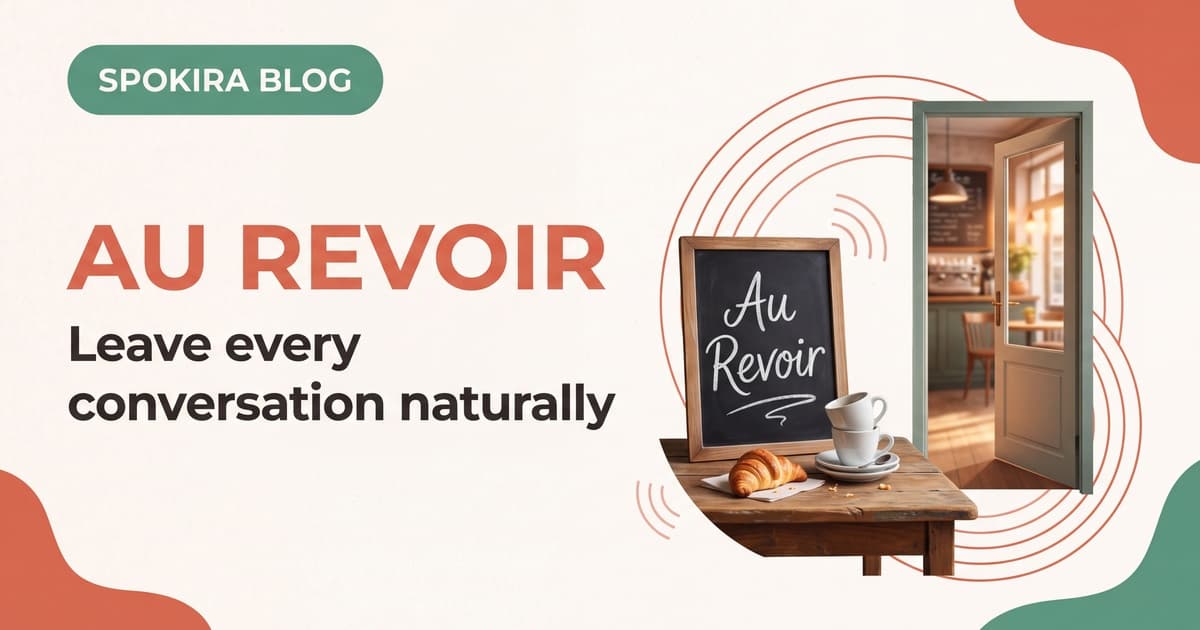
For most situations, the answer is reassuringly simple: use au revoir. It is the dependable goodbye in French. Salut is a casual hello and goodbye. À bientôt, bonne journée, and à demain add a useful wish or a next meeting. Adieu is not your everyday exit line.
This final guide in Spokira’s Practical French Expressions series turns a list of farewells into small exits you can say naturally. The goal is to leave a conversation warmly, not to find the fanciest word.
Quick answer: how do you say goodbye in French?
| French phrase | Closest English | Best setting |
|---|---|---|
| Au revoir | goodbye | almost anywhere |
| Salut | bye | friends and informal peers |
| À bientôt | see you soon | when you expect to meet again |
| À demain | see you tomorrow | tomorrow is genuinely likely |
| Bonne journée | have a good day | shops, services, colleagues |
| Bonne soirée | have a good evening | leaving late afternoon/evening |
| Adieu | farewell | solemn or likely final separation |
The Académie’s historical dictionary records au revoir as a polite formula for taking leave, literally tied to seeing someone again (Académie française via CNRTL, revoir). You do not have to promise a scheduled reunion when you say it. It is simply the normal social closing.
Au revoir: the safe default
Use au revoir with strangers, shop staff, neighbours, teachers, colleagues, and friends. It is polite without being distant.
Merci beaucoup. Au revoir. Thank you very much. Goodbye.
Au revoir, madame. Bonne journée. Goodbye, ma’am. Have a good day.
IPA: /o ʁə.vwaʁ/ Cue: oh ruh-vwahr
The phrase has three light movements. Au is one closed oh. Keep the middle re weak, not a full English “ray.” Finish with voir, where the lips round into vwa and the French r sits at the back of the mouth. You do not need to roll it.
A 45-second pronunciation drill
Say the phrase in three steps: au... re... voir. Then join it without adding pauses: au revoir. Finally put it into an actual exit:
- Merci, au revoir.
- Au revoir, bonne journée.
- D’accord, à bientôt. Au revoir.
Record the third line once. The goal is a smooth rhythm, not an exaggerated French r. If you can say it warmly and clearly, it is ready for a shop or phone call.
Salut: hello and goodbye, but only when casual fits
Salut works at both ends of an informal conversation. You can arrive with salut! and leave with salut!. CNRTL explicitly notes its familiar use as an equivalent of bonjour or au revoir (CNRTL, salut).
Salut, ça va? Hey, how are you?
Bon, je dois y aller. Salut! Okay, I have to go. Bye!
Use it with friends, classmates, people your age in a relaxed setting, and familiar colleagues. In a first interaction with a shop worker, doctor, older neighbour, or interviewer, start and finish with bonjour / au revoir instead. That is not about being stiff. It gives the encounter the right frame. See polite vs rude French for more of these everyday choices.
Add a time phrase when you know the next meeting
French farewell phrases often make the next contact visible. They are easy wins because they turn a one-word goodbye into a friendly full response.
À bientôt: see you soon
Use à bientôt when a future meeting is plausible but not scheduled. You might say it to a neighbour, a classmate, or a regular café worker.
Merci, à bientôt!
Do not treat bientôt as a contractual promise. It is warm and open-ended.
À plus tard and à plus
À plus tard means “see you later.” In informal speech, à plus is common. It is friendly, but casual. Use the full phrase when you are still getting comfortable; your listener will understand it anywhere a future meeting is likely.
À demain, à lundi, and à la semaine prochaine
These are useful when the date is certain:
À demain!, See you tomorrow!
À lundi!, See you Monday!
À la semaine prochaine!, See you next week!
Specific language sounds more natural than saying “see you soon” when you already know the plan.
Bonne journée and bonne soirée: a small polite finish
If you leave a bakery at 10 a.m., bonne journée is perfect. If you leave a restaurant at 9 p.m., use bonne soirée. You can say either alone, but they combine well with au revoir.
Merci, au revoir, bonne journée.
Bonne soirée, à bientôt.
The phrases are short but matter. They show that you have finished the exchange rather than walking away after your request. If you are travelling, pair this routine with the basic scripts in French for travel: greeting, request, merci, farewell.
Adieu: why you should not use it for a normal goodbye
Adieu is understood, but it is emotionally loaded. CNRTL explains that ordinary au revoir gradually replaced it in common use, leaving adieu for a final separation, solemn tone, or strong affect (CNRTL, adieu).
That means adieu can appear in songs, films, historical scenes, or a dramatic breakup. It is not what you say when getting off the bus or leaving a café. A French speaker might use it jokingly after a minor disaster, but that joke works only because the normal meaning is weighty.
If your English brain offers “farewell,” adieu may be right. If it offers “bye,” choose au revoir or salut.
Use the ordinary phrase first
When you do not know the relationship or register, end with merci, au revoir. It is more useful than a dramatic alternative and almost never wrong.
Three exits to practice aloud
Leaving a shop
You: Merci beaucoup. Cashier: De rien. You: Au revoir, bonne journée.
This is the classic safe pattern: thanks, response, goodbye, good wish.
Leaving a friend
You: Bon, je dois y aller. Friend: D’accord, à plus tard! You: Salut!
The casual language matches the relationship. Notice that the goodbye does not need to be elaborate.
Finishing a planned meeting
Colleague: On se revoit lundi? You: Oui, à lundi. Bonne soirée!
Specific time plus a good wish feels polished and natural.
Five-minute farewell practice
- Say au revoir five times slowly, then five times inside merci, au revoir.
- Choose a morning scene and say bonne journée.
- Choose an evening scene and say bonne soirée.
- Create two planned exits: à demain and à lundi.
- Record the shop dialogue and one casual dialogue. Compare the level of formality, not just the sounds.
For the fifth minute, switch the word before the farewell: oui, à demain; d’accord, à bientôt. This connects today’s guide to yes in French and makes the exchange feel like a conversation rather than an isolated phrase.
Practice complete French exchanges, not isolated words
Spokira gives you short real-life scripts, native audio, and pronunciation feedback so greetings and farewells are ready when you need them.
Common mistakes
Using adieu for every goodbye. It sounds theatrical or final in ordinary life. Keep it for cases that really are farewell.
Using salut with every stranger. It is friendly but informal. Au revoir is more reliable when the relationship is unknown.
Forgetting the greeting at the beginning. A good exit feels better after a good entry. In a shop: bonjour first, then merci, au revoir.
Saying a time phrase that is not true. À demain implies tomorrow. If you do not know when you will meet, à bientôt is safer.
Making the French r the whole task. Listeners need your phrase and tone more than a perfect r. Keep the rhythm smooth and keep going.
FAQ
Is au revoir formal?
It is polite and neutral, not stiff. You can use it with nearly anyone.
Can salut mean both hello and goodbye?
Yes. Its context and position in the exchange show which one it means. Keep it for informal settings.
What should I say to a waiter or cashier?
Merci, au revoir, bonne journée is excellent in daytime. In the evening, switch to bonne soirée.
Is à bientôt a promise to see someone soon?
No. It expresses a friendly hope or expectation, not a fixed appointment. Use a specific phrase such as à lundi when the plan is known.
The one line to take with you
If you remember only one goodbye in French, make it merci, au revoir. It fits a train station, bakery, hotel, office, and first meeting. Add bonne journée when you want warmth; save salut for people you know; leave adieu to the dramatic moments.
Practice one complete exit aloud today. That small routine makes a real interaction feel more finished, and it gives you one less place to freeze when the conversation is going well.
One calm, complete closing line is always better than rushing away mid-conversation.
More goodbye-in-French situations
One reason farewells feel difficult is that French often uses the departure phrase as a final kindness. You do not need to invent anything. Match the wish to the moment.
| Situation | A natural exit |
|---|---|
| Leaving a morning appointment | Merci, au revoir, bonne journée. |
| Leaving a friend before dinner | Salut, bonne soirée! |
| Leaving work on Friday | Bon week-end, à lundi! |
| Ending a phone call | D'accord, merci beaucoup. Au revoir. |
| Leaving someone you will see soon | À bientôt, prends soin de toi. |
Read the table aloud as if you were there. Then change one detail: leaving on Tuesday becomes à demain only if tomorrow is really the next meeting. If you are uncertain, à bientôt keeps things warm without making a false promise.
A short closing role-play
You: Merci pour votre aide. Receptionist: Je vous en prie. You: Au revoir, bonne journée. Receptionist: Au revoir.
Now repeat it with a friend: Bon, je dois filer. Salut, à plus! The grammar is almost nothing. The difference is the relationship. Practicing both versions helps you hear the register before you speak.
When an exit needs one extra sentence
You can soften a quick departure with one simple reason: Je dois y aller, j'ai un train; je vous laisse, bonne soirée; on se tient au courant, à bientôt. These are useful when you do not want to vanish abruptly. Keep the reason short. The farewell still does the closing work.
If you are nervous about a phone call, write the last line first. Say it once before you dial: Merci pour votre temps. Au revoir. Knowing how you will leave makes it easier to begin.
Goodbye in French on messages and calls
Written French also changes the farewell slightly. In a quick message to a friend, à plus, à tout à l'heure, or bisous may fit the relationship. In a work message, a simple bonne journée or à bientôt is warmer than copying a formal letter ending into chat. Email closings have their own conventions, so do not assume that salut is a universal sign-off.
On a phone call, give the other person a clear ending. Bon, je vous laisse. Merci encore, au revoir is courteous and easy to hear. With a friend, je te laisse, à plus is enough. The first phrase announces that you are closing; the farewell does the final work.
Practice an exit with a reason
Say each line as one smooth unit:
- Je dois y aller, j'ai rendez-vous. Au revoir.
- Je te laisse, je prends le métro. Salut!
- Merci pour l'appel. À bientôt.
The reason is optional, but it can make a departure feel less abrupt. Keep it true and short. You are not asking permission to leave; you are simply closing the exchange with care. To make the line automatic, practice the full closing exchange aloud.
Next in the series: what touché means in French and how to pronounce it.