Polite vs rude French is not a list of magic words. It is mostly about reading the relationship, opening an interaction properly, and choosing a request that fits the moment. When you are unsure, start with bonjour, use vous, and make your request clear. That will carry you through far more situations than a very formal sentence learned by heart.
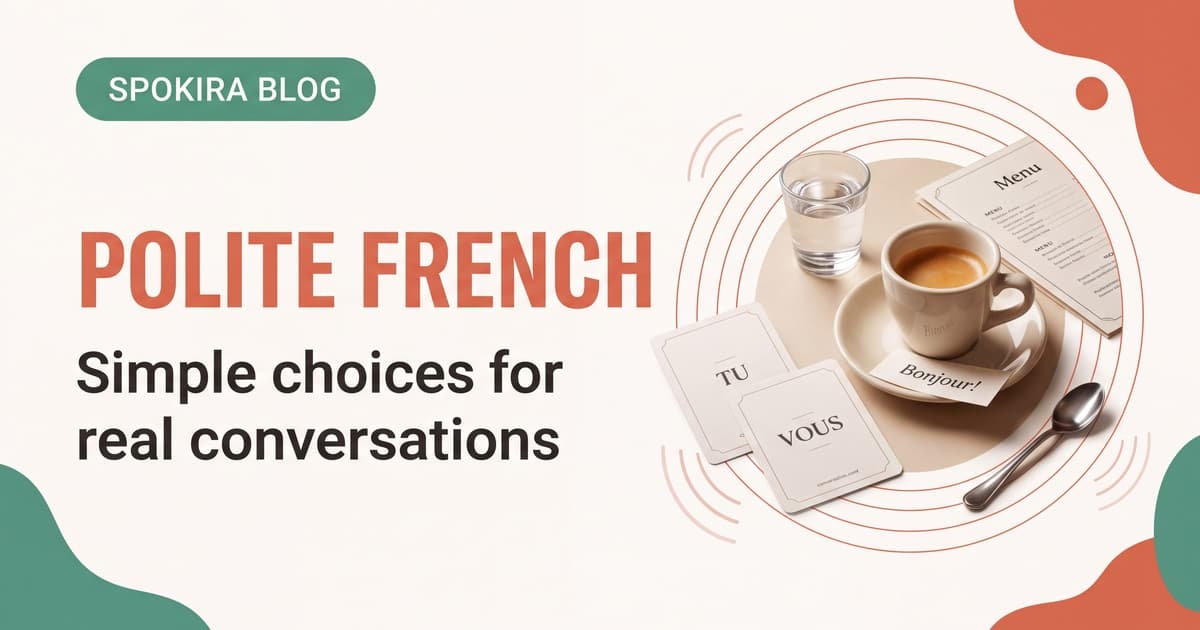
The big dividing line is tu versus vous. The Académie française explains that pronoun choice marks familiarity or respect: tu signals close familiarity, while vous signals distance or someone you do not know. That is useful guidance, not a reason to panic. French speakers expect learners to be careful, not perfect.
Here is the practical comparison: what sounds courteous, what can land abruptly, and what to say when you do not know the social temperature yet.
Polite vs rude French: begin with vous when you do not know
With an adult you have just met, a shop worker, a neighbour you do not know, a doctor, a client, or an older relative, use vous. Move to tu when the other person offers it or the group clearly uses it. Larousse defines tutoiement as the use of tu among friends or people one knows well (Larousse).
Starting with vous does not make you cold. It gives the other person room to choose the distance. Starting with tu can be completely normal in a young, informal setting, but it can also feel like you skipped a step. If you guess wrong, the repair is easy:
On peut se tutoyer? Can we use tu with each other?
Or, if someone invites the switch:
Oui, avec plaisir. Yes, gladly.
Polite vs rude French phrases at a glance
The middle column is worth learning first. It is neither stiff nor overly casual.
| Situation | Polite or safe default | Neutral, everyday French | Can sound abrupt without context |
|---|---|---|---|
| Entering a shop | Bonjour, madame / monsieur | Bonjour | Walking in with only your request |
| Asking for help | Excusez-moi, est-ce que vous pourriez m'aider? | Excusez-moi, vous pouvez m'aider? | Aidez-moi. |
| Ordering | Bonjour, je vais prendre un café, s'il vous plaît. | Un café, s'il vous plaît. | Un café. with no greeting or softener |
| Asking someone to repeat | Pardon, pourriez-vous répéter, s'il vous plaît? | Pardon, vous pouvez répéter? | Répétez. |
| Saying no | Désolé, je ne vais pas pouvoir. | Non, pas cette fois. | Non. with no explanation in a delicate moment |
| Interrupting | Excusez-moi de vous interrompre... | Pardon, juste une question... | Attendez. |
| Disagreeing | Je ne suis pas tout à fait d'accord. | Je ne suis pas sûr(e). | C'est faux. |
RFI's teaching material separates familiar, neutral, and formal registers; the useful lesson is that politeness is not the same thing as sounding highly formal all day (RFI Français facile). Neutral French plus a greeting and a softener is often exactly right.
Tu vs vous: the choice that changes the whole sentence
This comparison matters because verbs, possessives, and commands all change with the pronoun. You do not need to make every sentence elaborate. You only need one reliable pattern.
| Meaning | With vous | With tu |
|---|---|---|
| How are you? | Comment allez-vous? | Comment vas-tu? |
| Can you help me? | Vous pouvez m'aider? | Tu peux m'aider? |
| Where do you live? | Vous habitez où? | Tu habites où? |
| Please sit down | Asseyez-vous, s'il vous plaît. | Assieds-toi, s'il te plaît. |
| What do you think? | Qu'en pensez-vous? | Qu'en penses-tu? |
Use vous for one person when you need respectful distance. It also means "you all," so do not mistake it for a special form reserved for formal French. When you are speaking to two friends, vous venez? is simply the plural.
The most common learner mistake is treating tu as friendly in every setting and vous as unfriendly in every setting. Neither is true. A warm bonjour, vous allez bien? can feel much friendlier than a rushed tu veux quoi?
Why bonjour matters more than you expect
In many French interactions, especially in shops, waiting rooms, apartment buildings, and service counters, a greeting marks the start of the exchange. It is not empty decoration. It tells the other person you have recognized them before asking them to do something.
Compare these two arrivals at a bakery:
Une baguette.
Bonjour, une baguette, s'il vous plaît.
The words you want are almost identical. The second version feels cooperative because it opens the social door first. You do not need an ornate formula. Bonjour and merci do real work.
At the end, try Merci, bonne journée! For evening, use bonne soirée. If you are leaving a small shop, that final line is usually more natural than an extended farewell.
Requests: direct grammar is not automatically rude
English learners sometimes bury a French request under layers of "would you mind possibly..." French can be more direct in structure without being impolite. The tone, greeting, pronoun, and softener carry a lot of the social meaning.
The grammar still affects register. The guide to French question forms in conversation shows when an intonation question, est-ce que, or inversion fits the relationship and setting.
| Need | Safe French | Why it works |
|---|---|---|
| Directions | Excusez-moi, pour aller à la gare, s'il vous plaît? | A polite opener plus a clear goal |
| A repeat | Pardon, vous pouvez répéter? | Direct question, softened by pardon |
| The bill | L'addition, s'il vous plaît. | A normal service formula |
| A favour | Est-ce que tu peux m'aider deux minutes? | Friendly but clear with tu |
| A formal request | Pourriez-vous m'envoyer le document? | Conditional adds distance and care |
S'il vous plaît is useful, but do not sprinkle it after every clause. One well-placed s'il vous plaît is better than a nervous string of polite markers. For café and shop language, these alternatives to je voudrais show how everyday French can be both brief and polite.
Commands and urgency: change the shape, not only the tone
The imperative is not forbidden. You will hear regardez, attendez, and venez constantly. It can sound rude when you use it to order a stranger around without a reason or softener.
Here are practical swaps:
- Instead of Attendez!, try Attendez une seconde, s'il vous plaît.
- Instead of Donnez-moi ça., try Vous pouvez me donner ça, s'il vous plaît?
- Instead of Fermez la porte., try Vous pouvez fermer la porte, s'il vous plaît?
- Instead of Écoute., with someone you do not know, try Excusez-moi, j'aimerais vous expliquer...
Urgency is different. If a child is about to run into traffic, you do not need a polished conditional: Attention! Arrête-toi! is the right French. Politeness should not slow down a safety warning.
Saying no without sounding cold
French has no requirement to turn every refusal into a long apology. But a small cushion helps when the request matters to the other person.
| Context | Blunt | Better fit |
|---|---|---|
| You cannot attend | Non. | Désolé, je ne vais pas pouvoir venir. |
| You disagree | Tu as tort. | Je ne le vois pas comme ça. |
| You do not understand | Je comprends rien. | Pardon, je n'ai pas bien compris. |
| You want someone to stop | Arrête. | Tu peux arrêter, s'il te plaît? |
| You need time | Je sais pas. | Je ne sais pas encore, je te redis. |
The better-fit versions are not fake. They give context and leave room for the other person to respond. That is especially useful when you are speaking a second language and want to avoid sounding sharper than you mean.
Disagreement: do not translate an English debate style word for word
C'est faux can be accurate, but it is a hard stop in an ordinary conversation. Use it for a factual correction only when you are ready to show why. Most daily disagreements need less force.
Try these instead:
- Je ne suis pas tout à fait d'accord., I do not completely agree.
- Je ne suis pas sûr(e)., I am not sure.
- Je comprends ce que tu veux dire, mais..., I see what you mean, but...
- De mon côté, je l'ai vécu autrement., For my part, I experienced it differently.
If you freeze before a response, use a holding phrase such as Attends, je réfléchis or Je vois ce que tu veux dire. These phrases for buying time in French help you slow the exchange without going silent.
The two-second politeness check
Before asking a stranger for something, run this tiny sequence: Bonjour + excusez-moi + clear request. You do not need a perfect sentence. You need a respectful opening and a request they can answer.
Work, friends, and travel: the default changes
With friends and peers: tu is common, and shorter requests are normal. Still use s'il te plaît when you are asking for effort. Friendly does not mean careless.
At work: watch the room before copying it. Some teams move to tu on day one; others keep vous with managers, clients, or newer colleagues. When unsure, begin with vous. Let the more established person suggest tu if they want it.
When travelling: bonjour first, vous with adults you do not know, then a clear request. That is enough for cafés, hotels, stations, pharmacies, and museums. You do not need to imitate slang to sound natural. For the core phrases, see French for travel.
With children: adults commonly use tu with children. But a child deserves the same greeting and patient tone as anyone else. Respect is more than the pronoun.
Small words that soften a sentence
You do not need to rebuild every request with the conditional. A few small words change the feel of an ordinary sentence:
| Small word | What it does | Example |
|---|---|---|
| bonjour | Opens the interaction | Bonjour, je cherche la sortie. |
| excusez-moi | Gets attention respectfully | Excusez-moi, c'est par où? |
| pardon | Repairs or interrupts lightly | Pardon, je n'ai pas entendu. |
| s'il vous plaît | Softens a request | Une carafe d'eau, s'il vous plaît. |
| merci | Closes the exchange well | Merci beaucoup, bonne journée. |
| un peu | Makes a request or criticism less hard | Vous pouvez parler un peu moins vite? |
Notice that none of these words replaces basic clarity. If you need the platform number, say so. If you did not understand, ask for repetition. The polite version is not vague; it is clear and considerate at the same time.
What to do when someone uses tu with you first
Usually, follow their lead. If a shop worker, classmate, or colleague says tu peux..., you can answer with tu unless the setting makes that feel clearly out of place. Do not switch back and forth in the same exchange because you are anxious. Pick the form the conversation has established and keep going.
There are exceptions. A client may use tu while you choose vous, or a younger person may use vous with an older person who has offered tu. Social relationships are not a grammar worksheet. The key is not to police the other person's choice. Match where you comfortably can, and use On peut se tutoyer? if you want an explicit reset.
Text messages and emails need a different opening
Spoken French can be brief because tone does some of the work. A written message has less help. Begin with a greeting in any message to someone you do not know well.
| Message type | Useful opening | Useful closing |
|---|---|---|
| A friend | Salut Camille, | À bientôt! |
| A new colleague | Bonjour Camille, | Bonne journée, |
| A client or official contact | Bonjour Madame Dupont, | Cordialement, |
| A quick follow-up | Bonjour, je me permets de revenir vers vous... | Merci d'avance pour votre retour. |
Do not overcorrect into a letter that sounds copied from a legal template. In ordinary professional French, a clear subject, a greeting, one concrete request, and a closing are enough. When you need help asking for information rather than giving an answer, these natural follow-up questions are a useful next step.
If you sound too direct, repair it simply
Everyone has a clipped moment, especially when they are navigating a new language. Do not make it bigger than it is. A quick repair restores the tone:
- Pardon, je voulais dire: est-ce que vous pouvez...?
- Excuse-moi, ça sonnait un peu direct.
- Je suis désolé(e), je n'ai pas voulu être impoli(e).
Then continue. The repair itself is evidence of care. Most people will respond to that more warmly than to a long explanation of your French level.
A five-minute drill for polite French
Train the phrases as quick interactions, not isolated translations.
- Say: Bonjour, excusez-moi, vous pouvez m'aider?
- Add a real need: Je cherche la station de métro la plus proche.
- Record the two lines once.
- Repeat with tu: Salut, tu peux m'aider deux minutes?
- End both versions: Merci beaucoup, bonne journée!
Listen for the difference in pace, not only grammar. The vous version is not supposed to sound robotic. The tu version is not supposed to sound careless. Both should sound like a person speaking to another person.
The habit that keeps you out of trouble
When in doubt, be a little more formal for the first sentence and relax once the relationship is clear. Open with bonjour. Use vous. Make the request simple. Say merci.
That is not a rigid etiquette performance. It is a reliable way to show goodwill while you are still learning the local rhythm. Then keep listening. Real French becomes easier when you notice how people around you greet, request, refuse, and invite closeness.
Practice these small exchanges out loud with Spokira. Short spoken repetitions help politeness feel automatic, so you can pay attention to the person in front of you rather than hunting for the next word.
Practice the French you will actually say
Build short speaking habits with native audio and feedback, from polite travel requests to everyday conversations.