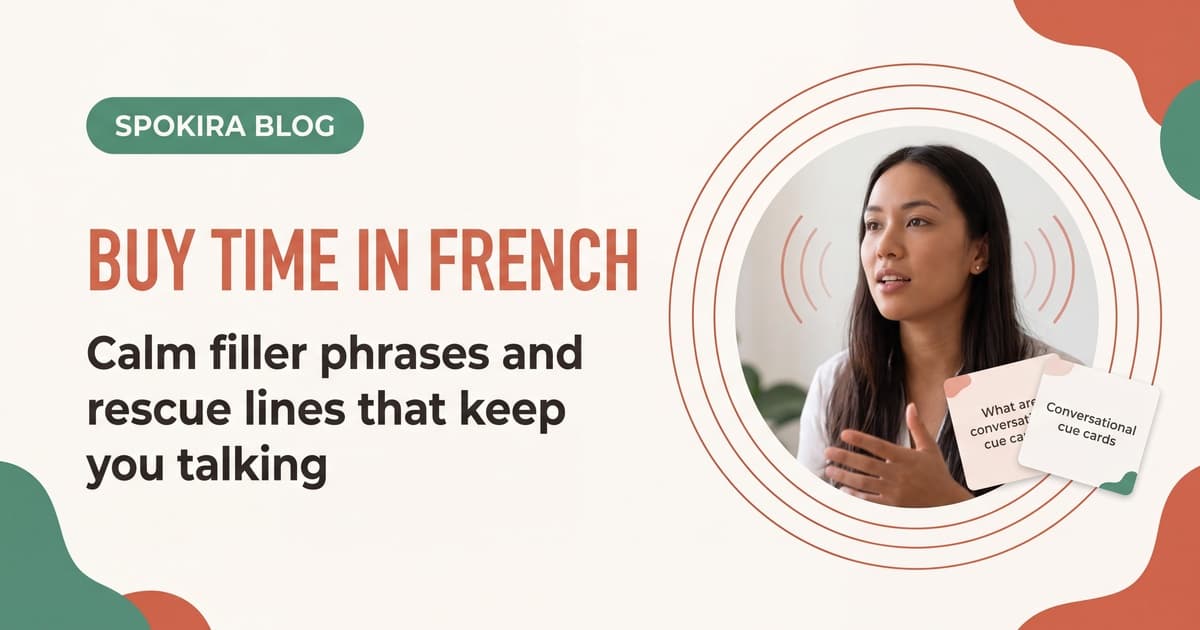
If you freeze in French, the problem is often not that you know nothing. The problem is that you need two seconds and the conversation keeps moving.
That is why buy time in French is a real speaking skill. You are not trying to sound dramatic, clever, or “native.” You are trying to stay in the turn long enough to say something useful.
This guide shows you exactly how to do that. You will learn which French filler phrases actually help, which ones make you sound more stuck, and how to train a small set of rescue lines until they come out automatically.
Quick answer: how do you buy time in French?
To buy time in French without sounding stuck:
- signal that you are still talking,
- use one short filler phrase you can say smoothly,
- move into a sentence frame you already know,
- ask a small follow-up or clarification question if needed,
- practice those chunks until they become automatic.
This matters because spoken interaction is not only about perfect vocabulary. The Council of Europe’s CEFR Companion Volume, updated in 2020, treats turn-taking, compensation, and repair as part of real communicative ability, not as embarrassing backup behavior (Council of Europe, 2020).
So if you need one second before the rest of your sentence arrives, that does not mean you are failing. It means you need better conversation glue.
Why buying time is a speaking skill, not a bad habit
Many learners think filler phrases are sloppy. In reality, the issue is not whether you use them. The issue is whether you use them well.
Second-language researchers usually group this under communication strategies: practical moves speakers use when language resources are not fully available yet. Kennedy and Trofimovich’s 2016 research timeline gives simple examples like paraphrasing a missing word or repeating part of the other person’s sentence to stay engaged (Cambridge, published online September 23, 2016).
That matters for French because real conversation does not pause while you search your memory. If you say nothing, the silence gets heavy very fast. If you use a calm bridge phrase, the moment stays social instead of turning into a breakdown.
There is another reason chunks help. A 2022 paper in Frontiers in Psychology found that formulaic sequences can support oral fluency and reduce pausing when speakers retrieve them as whole units rather than building them word by word (Yu, 2022). In plain English: short ready-made phrases are faster than inventing everything from scratch.
That is the whole logic of this article. You do not need twenty random French filler words. You need a few reliable chunks that keep your mouth moving while your brain catches up.
Which French phrases buy time without sounding awkward?
The safest buy-time phrases do one of four jobs:
- they show you are thinking,
- they soften a restart,
- they open a simpler sentence,
- they hand part of the pressure back to the other person.
Here is the useful distinction:
- good buy-time phrases sound like part of normal conversation,
- bad buy-time habits sound like panic, apology, or silence.
The best beginner-safe categories
These are the easiest categories for A2-B1 learners.
1. Thinking signals
Use these when you need one beat:
- Alors...
- Voyons...
- Bonne question...
- Attends une seconde...
They tell the other person you are still in the conversation.
2. Restart softeners
Use these when your first version is messy and you want to continue naturally:
- Je veux dire...
- En fait...
- Enfin...
- Le truc, c'est que...
These are useful because they let you repair without fully stopping.
3. Easy sentence frames
Use these when you want to move from hesitation into an answer:
- Je pense que...
- En général...
- Pour moi...
- Le problème, c'est que...
This is often better than holding a filler too long. The goal is not just to delay. The goal is to delay briefly, then continue.
4. Turn-sharing moves
Use these when you need to keep the exchange alive while reducing pressure:
- Et toi ?
- Tu vois ce que je veux dire ?
- Comment tu dirais ça ?
- Tu peux répéter un peu plus lentement ?
If your bigger problem is missing words, pair this article with How to Paraphrase in French When You Forget a Word. If the whole interaction collapses when you hesitate, also read How to Keep a French Conversation Going When Your Mind Goes Blank.
If you can buy time but still sound flat while the other person is talking, How to Show You're Listening in French covers the listener cues and follow-up moves that make your French sound more engaged.
The best buy-time phrases for A2-B1 learners
Do not memorize a giant filler-word list. Learn a small kit you can actually say under pressure.
| Situation | French phrase | What it does | Safer register note |
|---|---|---|---|
| You need one second | Alors... | Opens a pause without sounding dramatic | Works in many everyday situations |
| You are collecting your thoughts | Voyons... | Signals thinking | Slightly deliberate, but clear |
| You need a soft restart | Je veux dire... | Lets you repair naturally | Very useful in spoken French |
| You want to reframe | En fait... | Helps you correct or refine | Common and flexible |
| You need to slow the turn | Attends une seconde... | Buys a brief pause | Best in casual conversation |
| You want to keep talking with simple structure | Je pense que... | Moves you into an answer | Safe and neutral |
| You want help without quitting | Comment tu dirais ça ? | Invites support | Good when rapport is friendly |
| You need the other person to share the turn | Et toi ? | Hands back the conversation briefly | Excellent pressure-release move |
What these phrases sound like in real conversation
Instead of this:
- silence
- euh... euh... euh...
- désolé, je ne sais pas...
Try this:
Question: Tu fais quoi ce week-end ?
Answer: Alors... je pense que je vais voir des amis, et peut-être aller au marché.
Question: Pourquoi tu apprends le français ?
Answer: Bonne question... en fait, je veux voyager plus facilement et parler avec ma belle-famille.
Question: Qu'est-ce que tu cuisines souvent ?
Answer: Voyons... je veux dire, pas grand-chose de compliqué, mais je fais souvent des pâtes et des légumes.
Notice what is happening. The filler phrase is short. It buys one beat. Then the speaker moves into a real sentence.
That is the target.
Better Goal
Do not try to eliminate every pause. Try to make your pauses look intentional and easy to continue from.
What makes you sound stuck instead of natural?
Buying time helps only when it stays short and purposeful.
These are the three habits that usually make learners sound more frozen, not less.
1. Stretching euh too long
Euh is real French. You will hear it everywhere. But if it becomes your only rescue move, it keeps you suspended in the gap instead of helping you cross it.
One quick euh is normal. Five seconds of euhhhh feels like you are waiting for the perfect sentence to appear.
Replace long hesitation with a chunk:
- Alors...
- En fait...
- Je veux dire...
Those chunks create direction, not just delay.
2. Apologizing for every pause
Many learners say:
- désolé...
- pardon...
- je suis nul...
That usually makes the moment heavier. It also steals time you could have used to keep speaking.
A pause is not a social emergency. Treat it like a normal part of speech.
3. Translating silently for too long
If you are still building the sentence in English first, buy-time phrases will not fully save you. They help most when they lead into chunks you already own.
That is why How to Stop Translating in Your Head When Speaking French matters here. The less you translate word by word, the more useful your rescue lines become.
Should you copy every French filler word you hear?
No. Some fillers are common in native speech, but that does not mean they are the best first choice for a learner.
Your first goal is not to sound ultra-colloquial. Your first goal is to sound clear, calm, and easy to follow. That is why safer chunks like alors, en fait, je veux dire, and je pense que are better starting points than trying to imitate every clipped, mumbled, or highly casual filler you hear in fast native conversation.
Use this rule:
- if a phrase helps you continue clearly, keep it,
- if a phrase only fills silence but does not lead into an answer, drop it,
- if a phrase feels too slangy to use confidently, leave it for later.
This is the same logic Spokira uses for speaking drills. You build from stable, reusable chunks first. Naturalness grows on top of control, not instead of it.
A 10-minute drill to make buy-time phrases automatic
The point is not to understand the phrases. The point is to be able to say them when your brain is busy.
Here is a simple 10-minute routine.
Minute 1-2: choose 5 core chunks
Start with:
- Alors...
- Je veux dire...
- En fait...
- Je pense que...
- Et toi ?
If you only train five, they start to become available faster.
Minute 3-4: shadow them with real rhythm
Say each chunk 10 times out loud. Keep the rhythm smooth and relaxed.
Then put them into tiny answers:
- Alors... je pense que oui.
- En fait... pas vraiment.
- Je veux dire... c'est compliqué.
If you want a deeper explanation of why this works, see Why Shadowing Works for French.
Minute 5-7: do cue-based recall
Write small prompts:
- weekend plans
- why you study French
- favorite meal
- last trip
- work or study
Look at one prompt and answer immediately using one buy-time phrase first.
Example:
- prompt: favorite meal
- answer: Alors... en général, mon plat préféré, c'est le curry.
This matters because you are training the transition from hesitation into speech, not just reciting isolated words. If freezing is a bigger issue for you, add one round from French Conversation Freeze Drill.
Minute 8-9: roleplay one short dialogue
Use a simple scenario such as a cafe, a train station, or meeting someone new.
If you need a ready-made scenario, use French cafe conversation practice.
Your rule is simple:
- every answer must begin with one trained chunk,
- you are not allowed to go silent for more than two seconds,
- if you get stuck, ask a small question back.
Minute 10: record one take
Record yourself answering three random questions.
Then check:
- Did the filler phrase come out fast?
- Did it lead into a sentence?
- Did you overuse one phrase?
- Did you sound calmer than usual?
This is where Record Yourself in French Without Cringing helps. You are not listening for perfect French. You are listening for smoother recovery.
Train your mouth, not your panic response
Practice short French speaking drills with shadowing, recording, and AI feedback that shows you what to fix next.
A simple buy-time system for real conversations
If you want one repeatable formula, use this:
- short bridge phrase,
- easy sentence frame,
- one concrete idea,
- small follow-up if needed.
Here is what that looks like:
- Alors... je pense que ce serait une bonne idee.
- En fait... le probleme, c'est le temps.
- Je veux dire... c'est un peu difficile a expliquer.
- Voyons... c'est une sorte de festival. Et toi, tu y es deja alle ?
This system works because it removes the blank middle. You are no longer waiting for a perfect sentence to appear. You are moving through a known path.
That is also why this article fits together with /how-to-practice-spoken-french and /practice-speaking-french-app: good speaking practice is not just vocabulary growth. It is learning how to recover, continue, and sound usable in real time.
Final takeaway
If you want to buy time in French without sounding stuck, do not chase exotic filler words. Train a handful of calm, useful chunks that keep the conversation alive.
Start with alors, je veux dire, en fait, je pense que, and et toi ?. Use them in short answers. Shadow them. Recall them from prompts. Record them until they feel normal.
That is how you move from “I froze again” to “I needed a second, but I kept talking.”
If you want guided practice that turns those chunks into real speaking habits, Spokira’s French speaking practice app is built for exactly that gap: short daily speaking reps, native shadowing, and feedback on what to fix next.