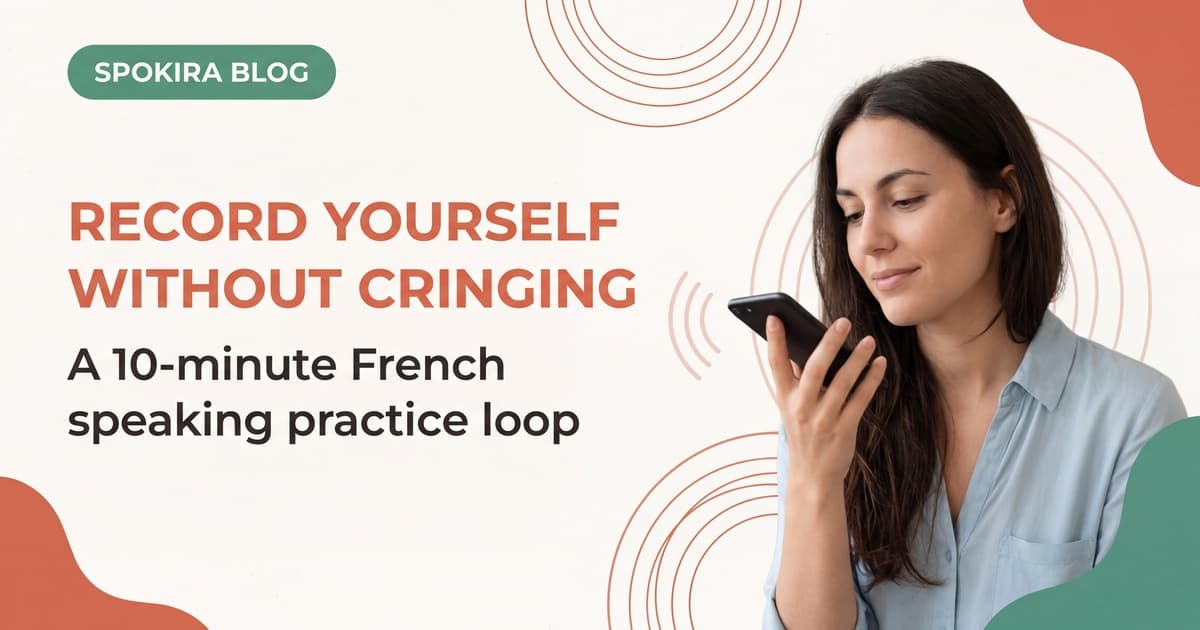
You know the sentence in your head. Then you hear your own recording and think, "Nope. I sound terrible."
That reaction is normal. It is also the exact reason this works. Recording improves faster when you stop judging your voice and start scoring your output with a simple method.
This guide gives you a clear 10-minute record-review loop. You will record short lines, replay them with one focus, and fix one thing at a time. No perfection spiral. No random self-criticism. Just measurable progress.
If you need the big picture first, start with the French Speaking Practice: The Complete Guide. Then use this page as your daily execution system.
Quick answer: what is the best way to record yourself in French?
Use a 3-pass loop on one short response:
- Record one 15-30 second answer.
- Replay once for flow only.
- Replay once for one sound issue.
- Replay once for rhythm and chunking.
- Re-record the same answer and compare.
Why this method works:
- Retrieval practice improves long-term recall better than restudy in classic testing-effect research by Roediger and Karpicke (2006) (PubMed).
- Short, repeated sessions outperform cramming in spacing-effect evidence from Cepeda et al. (2006) (PubMed).
- CEFR interaction descriptors show fluency includes speed, continuity, and repair, not just grammar knowledge (Council of Europe CEFR Companion Volume, 2020).
If your goal is daily output consistency, combine this loop with the 5-minute French output routine.
Why recording yourself feels so uncomfortable and why that is useful
Most learners are not afraid of French. They are afraid of hearing themselves in French.
When you record yourself, you lose the illusion that "I basically know it." You hear pauses, dropped endings, and rhythm breaks. That can feel rough, but it gives you clean feedback.
Without recordings, you rely on memory of your own performance. Memory is biased. You remember the best run, not the average run.
With recordings, you get evidence:
- How many times you paused
- Where your sentence broke
- Which sounds collapsed under speed
- Whether your second attempt was actually better
That is why recording is not punishment. It is visibility.
If you freeze before pressing record, use the first 60 seconds as a warm-up:
- Say one easy line out loud twice.
- Record a throwaway take that you promise to delete.
- Start the real take immediately after.
This removes pressure from "my first take must be good." Your first take is data, not a performance.
Coach Rule
Do not ask, "Do I sound good?" Ask, "What is one fix I can repeat in the next take?"
Record-review setup: the 10-minute loop
You do not need new tools. You need a repeatable sequence.
Minute 0-1: choose one prompt you can answer
Pick one question from a real scenario:
- "What did you do this morning?"
- "Can you order coffee and ask for the bill?"
- "How do you ask for directions to the station?"
If you need practical scripts, pull lines from French for travel speaking drills and keep them short.
Target length: 15-30 seconds. Longer clips make review noisy.
Minute 1-2: prep your target sentence map
Write 3-5 chunks, not a full paragraph.
Example map:
- Bonjour, je voudrais un cafe.
- C est pour ici.
- Et l addition, s il vous plait.
Chunking helps you keep momentum when a word fails. You can recover into the next chunk instead of restarting.
Minute 2-3: record take 1 without stopping
Record one full pass. Keep moving. Do not restart mid-sentence.
The goal is not clean audio. The goal is a baseline.
Minute 3-5: replay pass 1 for flow only
Listen once and ignore pronunciation detail.
Score only flow:
- 2 = mostly continuous
- 1 = a few long pauses
- 0 = frequent breakdowns
Write one note, max 8 words. Example: "pause before verbs every sentence."
Minute 5-7: replay pass 2 for one sound issue
Pick one sound target. Only one.
Good targets:
- French "r"
- final consonant carryover from English
- unstable vowel in key word
If you need a refresher on sounds, use French pronunciation for English speakers.
Record the exact word that failed and say it 5 times in isolation, then 3 times in a phrase.
Minute 7-8: replay pass 3 for rhythm and chunking
Now ignore single sounds and listen for grouping.
Ask:
- Did I stress every word equally?
- Did I link short function words smoothly?
- Did the line feel spoken, not read?
A classroom study reported that shadowing and oral reading can improve prosodic control in connected speech (Language Education and Technology Journal).
Minute 8-10: record take 2 and compare
Re-record the same response with your one chosen fix.
Compare take 1 vs take 2 on three numbers:
- Flow (0-2)
- Target sound (0-2)
- Rhythm (0-2)
Done. Session complete.
If you want a stronger retrieval block before recording, run one clip from the 1 clip, 15 reps drill.
To sharpen rhythm before your next recording, add one short round from French shadowing technique and then return to your own prompt.
Scorecard: what to check in every replay
Most self-recording fails because learners try to evaluate everything at once.
Use this focused scorecard instead.
| Metric | What to listen for | Typical mistake | Fast correction |
|---|---|---|---|
| Flow | Can you keep speaking through small errors? | Restarting after each miss | Continue sentence, fix after |
| Retrieval speed | Do key words arrive quickly? | Long planning pauses | Use chunk prompts, not full script |
| Rhythm | Do phrases sound grouped? | Word-by-word delivery | Mark phrase chunks with slashes |
| Sound target | Is one chosen sound improving? | Switching targets every take | Keep same sound for 3 sessions |
| Recovery | Can you repair and continue? | Silence after interruption | Use bridge lines ("Je veux dire...") |
Use one rule: if your total is below 5/10, keep the same prompt tomorrow.
30-second post-session audit
End every session with this quick audit. Keep it short so you actually do it.
- Did I complete two takes for this prompt?
- Did I keep one clear target for this session?
- Did my second take improve at least one score point?
- What will I repeat in tomorrow's block?
If you cannot answer these in 30 seconds, your session was probably too complex. Reduce prompt length and return to basics.
What should you record when you have no teacher?
Record prompts that match real conversation pressure. Avoid random monologues.
Prompt type 1: daily recap
30 seconds on what you did today.
Why it works: high repetition of common verbs and time phrases.
Prompt type 2: role-play response
Answer one likely travel or social prompt:
- ordering food
- asking for directions
- checking into a hotel
If that is your goal, connect your sessions with French for travel speaking practice.
Prompt type 3: opinion in two sentences
Give one opinion and one reason:
- "Je prefere le train parce que..."
- "Je pense que ce film est..."
Why it works: trains connectors and repair under light complexity.
Prompt type 4: constrained response
Answer with one condition:
- include one past tense line
- include one question
- include one repair phrase
Constraints simulate real pressure and improve recovery speed.
A full example session you can copy tonight
Use this practical prompt:
"You are in a cafe and need to order, confirm, and pay."
Step 1: chunk map
- Bonjour, je voudrais un cafe creme.
- C est pour ici.
- Est ce que je peux payer par carte?
Step 2: take 1 baseline
Record without stopping.
Common result: good first line, slow second line, breakdown on "payer par carte."
Step 3: review notes
- Flow: 1/2
- Sound target: /r/ in "carte" unclear
- Rhythm: flat stress on every word
Step 4: micro-fix
Do 5 reps of:
- "par carte"
- "payer par carte"
- full third line
Then mark chunks with slashes:
"Est ce que / je peux payer / par carte?"
Step 5: take 2
Re-record same script.
Typical improvement:
- fewer pauses
- cleaner final phrase
- smoother chunk transitions
You are not aiming for perfect accent in one day. You are training stable output under pressure.
If this still feels hard, compare your process to Talkpal vs Spokira, FluentU vs Spokira, and Mondly vs Spokira to see how guided rep loops differ from chat-only or input-heavy systems.
How many times per week should you record yourself?
Four short sessions beats one long session for most A2-B1 learners.
Recommended minimum:
- 4 days per week
- 10 minutes per session
- 2 takes per prompt
- 1 target fix per session
Why not one 60-minute session?
Because your attention drops, your feedback quality drops, and you stop hearing the same pattern clearly. Spacing evidence supports distributed practice over massed practice for durable learning (Cepeda et al., 2006, PubMed).
Use this weekly ladder:
| Day | Focus | Prompt length | Success target |
|---|---|---|---|
| 1 | Baseline + scoring | 15 sec | complete 2 takes |
| 2 | Same prompt, cleaner flow | 20 sec | +1 flow point |
| 3 | New prompt, same sound target | 20 sec | stable sound in key word |
| 4 | Interruption recovery | 25 sec | restart within 2 seconds |
| 5 | Variation day | 25-30 sec | add one variation without freeze |
On weeks when you are busy, maintain one tiny session from the 5-minute French output routine instead of skipping completely.
What if you hate your voice in recordings?
This is the biggest blocker, so handle it directly.
Reframe 1: your voice is a training signal, not your identity
Your recorded voice sounds different because bone conduction changes how you hear yourself live. That discomfort is expected and fades with repetition.
Reframe 2: compare only to your previous take
Do not compare to native audio in the same minute you are learning. Compare take 2 to take 1.
Reframe 3: use objective labels
Replace emotional labels:
- "I sound bad" -> "Flow 1/2, rhythm 0/2"
- "This is embarrassing" -> "Need one chunking pass"
Reframe 4: cap replay count
Do not replay one take 12 times. Limit to 3 analytical passes.
Too many replays shifts you from practice to self-criticism.
Reframe 5: keep one tiny win log
After each session, write one sentence:
- "Started answer faster today."
- "Recovered after pause without switching to English."
- "Final phrase cleaner than yesterday."
This gives your brain evidence of progress, which keeps the habit alive.
Confidence Rule
Train your mouth, not your streak. One focused fix per session is enough.
Common mistakes in self-recorded output practice
Mistake 1: recording different prompts every day
Fix: keep the same prompt for 2-3 sessions when score is low.
Mistake 2: fixing five things at once
Fix: one sound or one rhythm issue per session.
Mistake 3: reading full scripts word by word
Fix: speak from chunk notes, not a full paragraph.
Mistake 4: deleting every imperfect take
Fix: keep baseline takes for 7 days so you can hear trend lines.
Mistake 5: no recovery practice
Fix: add one interruption and force a bridge line.
If freezing is your core issue, run the conversation freeze drill on alternate days.
FAQ
How long should each recording be?
Start with 15-30 seconds. Short clips make scoring clear and reduce overthinking.
Should I transcribe my recording?
Not in every session. Transcribe once or twice a week for pattern checks. Daily sessions should stay fast.
Is this enough without a tutor?
Yes for consistency and self-correction at A2-B1 level. You can add tutor feedback later, but your daily output habit should not depend on tutor availability.
What is a realistic result after 2 weeks?
Most learners notice faster start time, fewer restarts, and more stable rhythm on familiar prompts. CEFR-style fluency gains come from repeated production and repair, not passive study alone (CEFR Companion Volume).
Bottom line
If speaking French still feels fragile, do not wait for motivation. Build a recording loop you can run in 10 minutes.
Output quality improves when you measure what matters: flow, retrieval speed, rhythm, and recovery. Two takes. Three replay passes. One fix.
Do this four days a week and your speech will feel less like a test and more like a skill you can use.
Ready for guided French output practice?
Spokira gives you native clips, structured rep loops, and instant feedback so your daily recordings turn into real conversation confidence.