You know this moment. You start a sentence in French, then your mind stalls halfway through. You know the words when you read or listen, but they disappear when you need them fast.
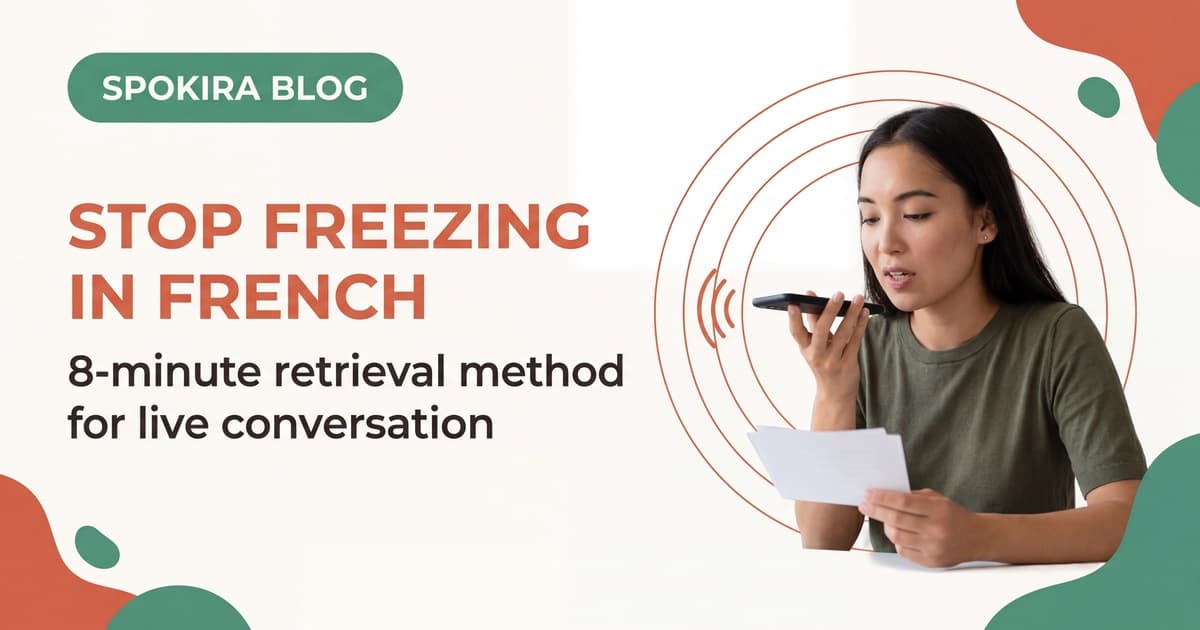
That gap is exactly where smart anti-freeze training matters. Not more passive study. Not another grammar worksheet. You need drills that train retrieval under pressure, the skill of pulling words out quickly while your mouth keeps moving.
In this guide, you will get a practical anti-freeze system you can run in 8 minutes a day. You will also get phrase ladders, rescue lines, and a weekly plan you can repeat. If you are around A2-B1 level, this is designed for you.
If you want the full foundation first, read French Speaking Practice: Complete A2-B1 Guide. This post goes narrower: one specific problem, one repeatable fix. For scenario-specific retrieval reps, pair this with French cafe conversation practice after your anti-freeze warm-up.
Quick answer: how to stop freezing when speaking French
If you freeze mid-sentence, use this sequence daily:
- Build a 6-line micro-script for one scenario.
- Shadow it for rhythm using one native clip.
- Speak it from memory with a countdown timer.
- Add a pressure twist (faster pace or small variation).
- Use rescue lines instead of stopping when you blank.
- Record one final run and score your flow.
Do this for 7 days on the same scenario before switching topics. Daily distributed practice is generally more reliable than occasional cramming for long-term retention, which is consistent with large spacing-effect syntheses in verbal recall research (Cepeda et al., 2006). Retrieval-practice studies also show that active recall beats additional restudy for long-term retention, which is exactly the mechanism this drill trains under speaking pressure (Karpicke and Blunt, 2011).
Why you freeze even when you "know" French
Most learners who freeze are not lazy and not untalented. They are simply over-trained in recognition and under-trained in retrieval.
Recognition is what happens when text or audio gives you clues. Retrieval is what happens when there are no clues and you still have to speak. Real conversation is retrieval-first.
For A2-B1 learners, this mismatch is common in CEFR descriptors. The CEFR Companion Volume (Council of Europe, 2020) notes that B1 speakers may keep going, but pauses for lexical and grammatical planning can still be very noticeable.
Your brain is juggling three things at once when speaking:
- lexical retrieval (finding the word)
- syntax assembly (building the sentence)
- motor execution (producing French sounds and rhythm)
When one of these slows down, you pause, fill with "euh...", or switch to English. The fix is not to "think harder." The fix is to lower cognitive load through pattern rehearsal.
The anti-freeze mistake most learners make
Most learners train speaking like this:
- They study many new phrases every day.
- They switch topics too quickly.
- They only practice when they feel ready.
- They restart from the beginning after one mistake.
This feels productive, but it does not train flow under pressure.
Instead, run conversation drills with constraints:
- same context for one week
- limited phrase set
- timed output
- rescue strategy when stuck
This turns speaking into a trainable motor skill, not a daily confidence test.
The 8-minute anti-freeze drill
This is the core routine. Use it exactly as written for one week before you customize.
Minute 0-1: Pick one scenario and one goal
Choose one real-life context:
- ordering in a cafe
- asking for directions
- introducing yourself to a colleague
- checking in at a hotel
Set one output goal for today, for example:
- "Finish 6 lines without stopping."
- "Use two linking words without blanking."
- "Recover with a rescue line when stuck."
Minute 1-2: Build your 6-line micro-script
Write six short lines you can actually use. Keep each line simple. Avoid grammar experiments.
Example (cafe):
- Bonjour, je voudrais un cafe, s'il vous plait.
- Plutot un cafe creme, en fait.
- Est-ce que je peux m'asseoir ici?
- Je prends aussi un croissant.
- L'addition, s'il vous plait.
- Merci, bonne journee.
You are not writing literature. You are building a retrieval track.
Minute 2-4: Shadow for rhythm, not perfection
Play a native clip and shadow your six lines with matching rhythm. If you need sources, use short, clear audio such as RFI's Journal en francais facile.
Rules:
- keep speaking when you miss a word
- stay with the beat of the line
- repeat the same sequence 3 to 5 times
If you want deeper method detail, use why shadowing works for French.
For evidence-based context, controlled L2 speaking-training studies show that speaking-based methods including shadowing and reading aloud can improve working-memory-related performance compared with non-speaking controls (Hasegawa et al., 2021).
Minute 4-6: Pressure ladder (memory runs)
Put notes away. Speak from memory with time pressure.
| Round | Constraint | Goal |
|---|---|---|
| 1 | Normal pace | Complete all 6 lines |
| 2 | 10% faster | Keep flow despite mistakes |
| 3 | Add one variation | Swap one noun or verb |
| 4 | No restart rule | Recover in real time |
No restart rule is critical. If you blank, use a rescue line and continue.
Minute 6-7: Rescue line reps
A rescue line keeps conversation alive while your brain catches up. Memorize these now:
- "Attendez, je reformule." (Wait, let me rephrase.)
- "Comment dire..." (How do I say...)
- "Je veux dire..." (I mean...)
- "Pouvez-vous repeter, lentement?" (Can you repeat, slowly?)
Practice each line 3 times. Then insert one rescue line into your script on purpose.
Minute 7-8: Record and score
Record one final run of your script from memory.
Score 0-2 for each metric:
- Flow: did you keep moving?
- Retrieval: did key words come on time?
- Recovery: did you use rescue lines instead of stopping?
- Clarity: were you understandable?
Track score daily. In practice, many learners can see clearer recovery patterns within the first week once they stop restarting and track consistent metrics.
Train Retrieval, Not Just Recognition
Spokira gives you short French speaking practice packs with native shadowing clips, record-and-compare loops, and targeted feedback on what to fix next.
A 7-day french speaking practice plan for zero-freeze output
Use one scenario for the full week. Do not switch early.
| Day | Focus | Constraint | Success metric |
|---|---|---|---|
| 1 | Build script | Read allowed | 1 full run |
| 2 | Rhythm | Shadow only | 3 smooth reps |
| 3 | Memory | Notes removed | 2 no-stop runs |
| 4 | Speed | 10% faster | Keep clarity |
| 5 | Variation | Swap details | No long pauses |
| 6 | Interruption | Partner asks one question | Recover with rescue line |
| 7 | Simulation | Full roleplay | 3 stable runs |
By Day 7, you should at least have clearer baseline metrics: fewer restarts, shorter long pauses, and more deliberate recovery.
Phrase ladders that prevent mid-sentence collapse
A phrase ladder helps you scale complexity without freezing.
Ladder 1: Buying something
- Base: Je voudrais un cafe.
- Add detail: Je voudrais un cafe creme, s'il vous plait.
- Add change: En fait, plutot un the.
- Add constraint: Sans sucre, si possible.
- Add close: Merci, c'est parfait.
Ladder 2: Asking directions
- Base: Excusez-moi, ou est la gare?
- Add follow-up: C'est loin d'ici?
- Add clarification: A pied ou en metro?
- Add recovery: Attendez, je reformule.
- Add confirmation: Donc, deux rues a droite?
Ladder 3: Social opening
- Base: Bonjour, je m'appelle Alex.
- Add context: Je suis ici pour le travail.
- Add question: Vous venez d'ici?
- Add reaction: Ah d'accord, interessant.
- Add bridge: Je veux dire, je visite pour une semaine.
Practice each ladder from short to long, then long to short. This trains both expansion and compression under pressure.
How to practice french speaking when anxiety spikes
Anxiety is a performance variable, not a character flaw. Use this protocol when panic rises:
- Slow exhale for 4 seconds before speaking.
- Start with a memorized opener, not a fresh sentence.
- Use one rescue line early if your speed drops.
- Return to your core script instead of improvising everything.
You are not trying to impress anyone. You are trying to stay in motion.
A practical benchmark system (weekly)
Track these four numbers once a week:
- Time-to-first-word: seconds before you begin speaking
- Longest pause: your biggest blank in seconds
- Restart count: how often you restart from line 1
- Recovery count: how often you recover with a rescue line
Target trend over 4 weeks:
- time-to-first-word decreases
- longest pause decreases
- restart count decreases
- recovery count initially rises, then stabilizes
That pattern means your system is working.
Common freeze triggers and exact fixes
Trigger 1: You translate from English first
Fix: memorize ready-made chunks. Speak chunks, not word-by-word assemblies.
Use: "Je voudrais...", "Est-ce que je peux...", "Je veux dire...", "Donc..."
Trigger 2: You over-focus on grammar while speaking
Fix: split sessions.
- speaking block: flow and retrieval only
- review block: grammar corrections after recording
Trigger 3: You use too much new vocabulary at once
Fix: hold 80% familiar language, 20% new language.
This keeps your cognitive load manageable.
Trigger 4: You never rehearse interruptions
Fix: add interruption drills on Days 5-7.
Have a partner or timer interrupt with prompts:
- "Pourquoi?"
- "Plus precisement?"
- "Vous pouvez repeter?"
Your goal is recovery, not perfect content.
Internal resources to make this easier
For broader speaking systems, start with French speaking practice guide.
For pronunciation bottlenecks that also cause freezing, use French pronunciation for English speakers and French accent errors with fast drills.
For daily consistency, pair this drill with the 5-minute French speaking routine.
If you are comparing tools for structured audio and speaking loops, see:
- Spokira vs Babbel
- Spokira vs Busuu
- Spokira vs FluentU
- Spokira vs Talkpal
- Spokira vs Speak. com
- Spokira vs Mondly
For open-conversation tradeoffs, this Spokira vs Talkpal comparison breaks down where free-form chat helps and where guided retrieval still wins.
What this method will and will not do
What it will do:
- reduce mid-sentence blanks
- speed up word retrieval in familiar scenarios
- improve recovery during live conversation
- build confidence through repeatable wins
What it will not do alone:
- give instant fluency
- replace broad vocabulary growth
- replace real conversation exposure forever
Think of this as your anti-freeze engine. It gets you moving. Then you layer wider conversation practice on top.
How to scale this french speaking practice after week one
After the first week, keep the same drill architecture but change only one variable at a time. Week 2 can keep the same scenario while you increase speed slightly. Week 3 can keep timing steady while adding one new follow-up question per run. Week 4 can keep phrase difficulty constant while introducing one live conversation partner check.
This one-variable progression helps you keep confidence while still increasing difficulty. If you change topic, speed, and vocabulary at the same time, freeze risk usually spikes. If you scale one dimension at a time, your retrieval system stays stable and your speaking quality improves measurably.
Conclusion: train the freeze point directly
Most learners try to solve freezing with more studying. That rarely works. The problem happens in live output, so your training must happen in live-like output.
Use this anti-freeze framework for one week on one scenario. Keep the rules tight: limited script, timed retrieval, no restart, rescue lines, daily recording. This is how you move from "I know the words" to "I can say them under pressure."
Ready for Guided French Speaking Practice?
Practice with native clips, run record-and-repeat loops, and get clear feedback so you always know your next fix.
FAQ
How long before I stop freezing mid-sentence?
Many learners notice faster recovery within 7 days if they practice daily. Stable automaticity usually needs multiple weeks of repeated scenario drills.
Should I do this drill before or after grammar study?
Do the drill first when your energy is high. Save grammar correction for post-practice review.
What if I blank completely in the middle of a line?
Use a rescue line immediately and continue. Do not restart. Restarting trains perfectionism, not conversation survival.
Can beginners use this method?
Yes, if you shrink the script to 3-4 lines and keep vocabulary basic. The structure still works.
Can I use AI chat for this?
Yes, but keep the anti-freeze constraints. Free chat alone often lacks repetition and pressure control. Combine this method with structured conversation practice.