You've been studying French for years. You know the grammar. You've memorized vocabulary. You can read articles and understand movies.
But when someone speaks French to you in real life? You freeze. The words won't come. Your brain knows French, but your mouth doesn't.
Shadowing fixes part of this.
The French shadowing technique is one of the most reliable ways to turn passive knowledge into actual speaking. This page explains why shadowing works for French, what it trains, and how to do it without wasting reps. For the full overview of every solo speaking method and which one fits your bottleneck, see the French speaking practice hub. If you want a specific weekly schedule, use our French speaking practice guide. If your shadowing is consistent but still feels slow, use this timed shadowing routine for french speaking speed. If you need a practical setup for players, recorders, looping, and review, use our guide to the best shadowing tools for French. If you want a product page built around this workflow, review French shadowing app for rhythm and prosody. If you are comparing tools more broadly, review Best App to Practice Speaking French (A2-B1), Best French Pronunciation Apps for A2-B1 Learners (2026 Ranking), Shadowing.app vs Spokira, and Speechling vs Spokira.
Quick plan: French shadowing in 5 steps
The 5-Step Method
- Find audio: Native French speaker at your level
- Listen once: Get familiar with rhythm and meaning
- Shadow 10+ times: Speak along simultaneously, matching sounds
- Record yourself: Compare to the original
- Repeat daily: Consistency beats intensity
Now let's break down exactly why this works and how to do it right.
What Is French Shadowing?
Shadowing is a language learning technique where you listen to native French speakers and immediately repeat what they say, mimicking their pronunciation, intonation, and rhythm as closely as possible.
Unlike traditional repetition exercises where you listen, pause, and then repeat, shadowing happens almost simultaneously with the original audio. You're speaking just a split second behind the native speaker, like an echo or a shadow.
Think of it like this: if the native speaker's voice is their shadow on the ground, your voice should be following right behind it, matching every contour.
Shadowing vs. Other Speaking Practice Methods
| Method | What It Trains | Pros | Cons |
|---|---|---|---|
| Shadowing | Pronunciation, rhythm, muscle memory | Solo practice, builds physical skills, develops ear | No conversation, needs audio materials |
| Conversation | Real-time thinking, vocabulary recall | Authentic interaction | Expensive, anxiety-inducing, scheduling |
| Repetition drills | Individual sounds | Focused practice | Misses natural rhythm, boring |
| Reading aloud | Pronunciation | Easy access to material | No model to follow, may reinforce errors |
Shadowing uniquely trains both your ear (perception) and your mouth (production) simultaneously. It's the closest you can get to having a native speaker's timing model inside your head.
The Science Behind Why Shadowing Works
Shadowing isn't just a language learning trick, it's grounded in cognitive science and motor learning research.
1. Speaking Is a Motor Skill
Speaking French isn't primarily a knowledge problem, it's a motor skill problem. Like playing piano or shooting a basketball, speaking requires training specific muscles to move in precise, coordinated ways.
Your mouth and tongue must learn new positions:
- The French "u" [y] requires lip rounding with a high front tongue
- The French "r" [ʁ] comes from the back of the throat
- Nasal vowels require lowering the soft palate
These movements don't exist in English. (For a detailed breakdown of these sounds, see our guide to French pronunciation for English speakers.) Your mouth has never made them before. Shadowing provides the intensive repetition needed to build muscle memory for these foreign movements.
A classroom study on Japanese learners found that oral reading and shadowing both improved prosodic reading, with shadowing especially useful for connected-speech timing (J-Stage). Additional phonetics research also reports gains in speech rhythm control from shadowing-based intervention (Onsei Kenkyu, 2015). Broader pronunciation-training evidence also points in the same direction, with a large overall effect across 65 studies (PubMed, 2025). When you shadow the same phrases repeatedly, mouth movements become more automatic, freeing attention for meaning.
2. The Perception-Production Link
There's a direct connection between how well you hear sounds and how well you produce them. When you shadow, you're training both systems simultaneously.
Phonological research shows that learners who practice shadowing develop better phonetic perception, they can hear subtle differences between sounds that other learners miss. This improved perception then feeds back into better production.
It's a virtuous cycle: better listening → better speaking → better listening → better speaking.
The Perception-Production Loop
When you shadow, you're not just practicing speaking, you're also training your ear. Studies show that learners who shadow develop better ability to hear subtle sound differences, which then improves their production.
3. Prosodic Absorption
French has a completely different rhythm and melody than English:
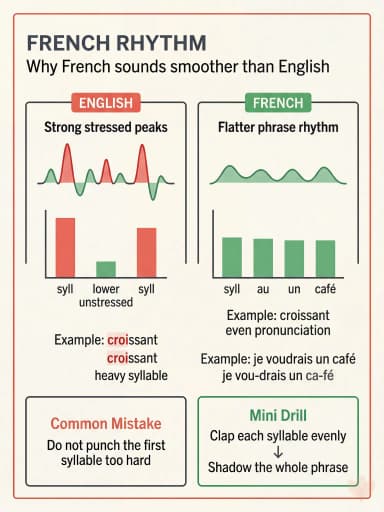
- French is syllable-timed: Each syllable takes roughly the same amount of time
- English is stress-timed: Stressed syllables are longer, unstressed syllables are compressed
This rhythmic difference is one of the biggest reasons English speakers sound foreign in French, even when their individual sounds are correct. Shadowing naturally trains you to adopt French prosody because you're matching the native speaker's rhythm in real-time.
You don't have to consciously think about French intonation. You absorb it by copying it.
4. Reduced Cognitive Load
When you shadow, you're not constructing sentences or retrieving vocabulary. You're simply copying what you hear. This reduces cognitive load and lets you focus entirely on pronunciation and rhythm.
Once those physical skills are automated through shadowing, you can transfer them to spontaneous speech, where you need cognitive resources for other things.
Shadowing vs AI conversation for French
If your main decision is shadowing versus AI conversation for French, the difference is simple: shadowing trains timing, sound imitation, and phrase rhythm; AI conversation trains turn-taking and response generation. Most A2-B1 learners improve faster when shadowing comes first and open conversation gets layered on top later.
How do you practice french shadowing step by step?
Step 1: Choose Your Audio Material
Not all audio is suitable for shadowing. Look for:
Content criteria:
- Native French speakers (not non-native teachers)
- Clear, natural speech at moderate pace
- Topics and situations relevant to your goals
- Appropriate difficulty (you should understand 70–80% on first listen)
Technical criteria:
- High audio quality
- Single speaker (avoid overlapping conversations)
- Transcripts available (helpful but not essential)
Good sources:
- Podcasts for French learners (InnerFrench, FrenchPod101)
- French audiobooks with accompanying text
- French YouTube videos with subtitles
- Language learning apps with shadowing features (like Spokira)
Avoid:
- Fast-paced radio or TV news
- Multiple speakers talking over each other
- Poor audio quality recordings
- Content far above your level
Step 2: First Listen (Comprehension Pass)
Before you start shadowing, listen to the audio once or twice for comprehension.
- Don't worry about repeating yet
- Focus on understanding the general meaning
- Note any words or phrases you don't recognize
- Get familiar with the rhythm and flow
This step primes your brain for what's coming. Shadowing works better when you have some comprehension, even if it's not perfect.
Step 3: Chunk the Material
If you're working with material longer than 30 seconds, break it into chunks:
- Beginner (A2): 5–10 second chunks
- Intermediate (B1): 15–30 second chunks
- Advanced (B2+): 30–60 second chunks
Shorter chunks allow for more repetition. It's better to shadow 10 seconds 20 times than 60 seconds 3 times.
Step 4: The Shadowing Process
Now for the actual technique:
Phase A: Simultaneous Shadowing
- Play the audio
- Start speaking immediately when you hear sound, don't wait for pauses
- Match the speaker's pace, pronunciation, and intonation as closely as possible
- Keep going even if you make mistakes
- Repeat 5–10 times
Phase B: Recorded Shadowing
- Record yourself shadowing
- Listen back and compare to the original
- Identify specific sounds or patterns that differ
- Shadow again, focusing on those weak points
- Repeat until you hear improvement
Phase C: Solo Production
- Turn off the audio
- Try to reproduce the phrase from memory
- Check against the original
- Note any differences
Step 5: Progressive Practice
As you improve, increase the challenge:
Week 1–2: Short phrases (5–8 words)
- Focus on accuracy over speed
- Use the same material repeatedly
- Perfect individual sounds before moving on
Week 3–4: Longer phrases (8–15 words)
- Start working on connected speech
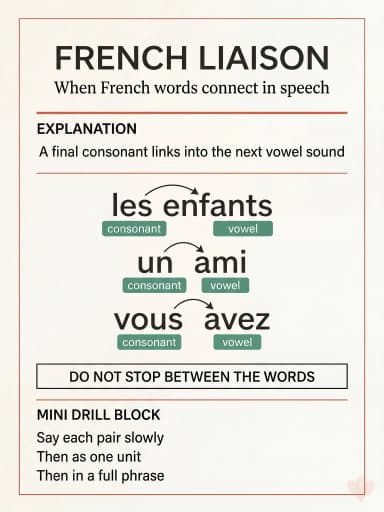
- Practice liaison and enchaînement
- Increase your shadowing speed
Month 2+: Paragraphs and conversations
- Shadow continuous speech for 30+ seconds
- Work on maintaining rhythm over longer stretches
- Practice with faster audio
Ready to Try Shadowing with Feedback?
Spokira gives you phoneme-level pronunciation analysis on every phrase, so you know exactly what to fix.
Common Shadowing Mistakes (And How to Fix Them)
These errors can slow your progress. Avoid them. (Also see our guide to common French pronunciation mistakes for sound-specific issues.)
Mistake 1: Waiting Too Long to Start
The problem: You listen to several words before starting to speak, turning shadowing into delayed repetition.
Why it matters: Delayed repetition uses different cognitive processes than simultaneous shadowing. You lose the real-time matching that builds rhythm and prosody.
The fix: Start speaking the instant you hear sound. Your first attempts will be messy, that's fine. The goal is to sync with the speaker, not to be perfect.
Mistake 2: Prioritizing Understanding Over Mimicry
The problem: You focus on understanding what's being said rather than copying how it sounds.
Why it matters: Shadowing trains your mouth, not your vocabulary. Comprehension is secondary during the shadowing itself.
The fix: Treat the audio like music. You don't need to understand the lyrics to sing along. Focus entirely on matching the sounds, rhythm, and melody.
Mistake 3: Using Material That's Too Difficult
The problem: The audio is so far above your level that you can't keep up or understand anything.
Why it matters: If you can't follow the audio at all, you'll just make noise without learning. Some comprehension aids the process.
The fix: Choose material where you understand at least 60–70% on first listen. Ideally, the vocabulary and grammar should be mostly familiar; the challenge should be in the speaking, not the comprehension.
Mistake 4: Not Recording Yourself
The problem: You shadow but never listen back to evaluate your performance.
Why it matters: Your brain hears what it expects to hear, not what you actually said. Without recordings, you can't accurately assess your pronunciation.
The fix: Record at least one shadowing session per day. Compare to the original. Note specific differences. Target those differences in your next session.
Mistake 5: Inconsistent Practice
The problem: You shadow intensively for a week, then skip two weeks, then try again.
Why it matters: Motor skills require consistent reinforcement. Sporadic practice doesn't build muscle memory effectively.
The fix: 10 minutes daily beats 70 minutes once a week. Set a non-negotiable time for shadowing, morning routine, lunch break, commute, and stick to it.
Consistency is more important than perfection. A messy 10-minute session every day will improve your French faster than a perfect hour-long session once a week.
Mistake 6: Never Moving to Spontaneous Speech
The problem: You only ever shadow. You never try to speak French spontaneously.
Why it matters: Shadowing builds the physical foundation, but you need to transfer those skills to unscripted speech.
The fix: After shadowing practice, spend 2–3 minutes speaking freely. Describe your day, narrate what you see, or practice a conversation scenario. Use the rhythms and sounds you've been shadowing.
French Shadowing Scripts for Real Situations
Here are sample scripts for common situations. Shadow these until they feel automatic, then use them in real life. (For a complete travel preparation plan, see French for Travel: Speak Confidently in 7 Days.)
Script 1: Café Conversation
Ordering:
"Bonjour! Je voudrais un café crème et un croissant, s'il vous plaît."
Asking for the check:
"L'addition, s'il vous plaît."
Complimenting:
"C'était délicieux, merci beaucoup."
Shadow focus: Liaison in "un~croissant," the "s'il" connection, natural rhythm of polite requests.
Script 2: Getting Directions
Asking:
"Excusez-moi, je cherche la station de métro. Est-ce que c'est loin d'ici?"
Understanding the response:
"D'accord, tout droit, puis à gauche après la boulangerie. Merci beaucoup!"
Shadow focus: Question intonation, nasal sounds in "loin" and "boulangerie," connected speech.
Script 3: Meeting Someone New
Introduction:
"Bonjour, je m'appelle [name]. Enchanté de vous rencontrer."
Small talk:
"Je suis américain(e). J'habite à Paris depuis six mois. J'apprends le français."
Responding:
"Ah, c'est intéressant! Vous habitez dans quel quartier?"
Shadow focus: The French "r" sounds, smooth transitions between phrases, natural conversational rhythm.
Script 4: At Work
Starting a meeting:
"Bonjour à tous. Merci d'être venus. On peut commencer?"
Giving an opinion:
"À mon avis, cette approche serait plus efficace pour notre projet."
Asking for clarification:
"Pardon, je n'ai pas bien compris. Pouvez-vous répéter, s'il vous plaît?"
Shadow focus: Professional register, maintaining rhythm in longer sentences, nasal vowels.
Script 5: Travel and Transportation
Buying a ticket:
"Bonjour, je voudrais un aller-retour pour Lyon, s'il vous plaît. Le prochain train part à quelle heure?"
On the train:
"Excusez-moi, cette place est libre?"
Arriving:
"Pardon, c'est bien l'arrêt pour le centre-ville?"
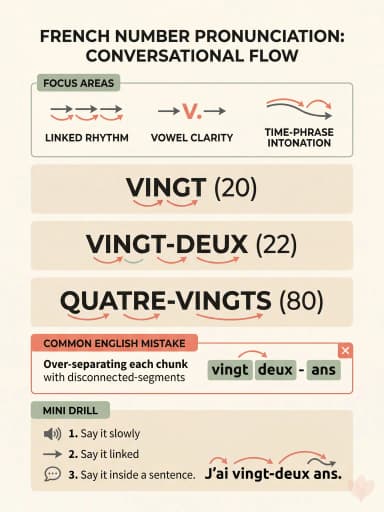
Shadow focus: Number pronunciation, question intonation, liaison patterns.
DIY Shadowing vs. Guided Shadowing in Spokira
You can absolutely practice shadowing on your own with podcasts, videos, and other free resources. But there are meaningful differences between DIY and guided approaches.
DIY Shadowing
Pros:
- Free or low cost
- Unlimited content options
- Flexible, use any material you enjoy
Cons:
- No feedback on pronunciation accuracy
- May reinforce errors without knowing
- Requires self-discipline to structure practice
- Hard to track progress objectively
Best for: Motivated self-learners who already have basic pronunciation foundations and can self-assess reasonably well.
Guided Shadowing with Spokira
Pros:
- AI-powered pronunciation feedback at the phoneme level
- Curated content for specific situations
- Structured progression from easy to hard
- Visual comparison to native pronunciation
- Progress tracking to see improvement
Cons:
- Subscription cost
- Content limited to available situations
Best for: A2–B1 learners who want targeted feedback, structured practice, and clear progress metrics.
How Spokira's Approach Works
At Spokira, we designed our shadowing practice specifically for the gap between "knowing French" and "speaking French":
1. Situation-Based Content Instead of random sentences, we organize shadowing around real situations: ordering at a café, navigating the métro, meeting someone new. You practice what you'll actually need to say.
2. Native Audio First Every phrase comes from native French speakers recorded in context. You shadow real French, not textbook French.
3. AI Pronunciation Analysis Our AI analyzes your speech at the phoneme level. It shows exactly which sounds differ from native pronunciation and how to correct them.
4. Visual Feedback See a visual representation of your pronunciation compared to the native target. Identify patterns. Track improvement over time.
5. Progressive Difficulty Start with short phrases and build to longer, more complex speech. The system adapts to your progress.
Building a Shadowing Routine
Shadowing works best as part of a broader French speaking practice routine. Here's how to structure your sessions. For targeted spin-offs, use the 8-minute anti-freeze speaking drill and this listening-to-speaking transfer method.
The Minimum Effective Dose: 10 Minutes Daily
If you can only commit to 10 minutes per day, structure it like this:
Minutes 1–2: Warm-up
- Lip trills (brrr sound)
- Say the French vowels: a, e, i, o, u, é, è, ê, eu, ou
- Tongue loosening exercises
Minutes 3–8: Shadowing Practice
- Pick one piece of audio (15–30 seconds)
- Shadow it 10–15 times
- Focus on matching rhythm and sounds
Minutes 9–10: Recording Check
- Record yourself shadowing once
- Listen back
- Note one specific thing to improve tomorrow
The Serious Learner: 30 Minutes Daily
Minutes 1–5: Warm-up and Review
- Physical warm-up (lips, tongue)
- Review yesterday's material from memory
- Shadow it a few times to reinforce
Minutes 5–20: New Material Practice
- Work through 60–90 seconds of new audio
- Break into chunks
- Shadow each chunk until comfortable
- Record and evaluate
Minutes 20–25: Focused Problem-Solving
- Identify one sound that's giving you trouble
- Practice it in isolation
- Practice it in words
- Practice it in the context of today's material
Minutes 25–30: Free Speaking
- Use today's phrases in original sentences
- Describe something using similar language
- Practice a mock conversation
Weekly Structure
Monday–Friday: Regular shadowing practice (10–30 minutes)
Saturday: Review week's material
- Go through everything you shadowed this week
- Record yourself on each piece
- Note overall progress and problem areas
Sunday: Rest or light exposure
- Watch French content passively
- Listen to French podcasts without shadowing
- Let your brain consolidate
Measuring Your Shadowing Progress
How do you know if shadowing is working?
Short-Term Markers (1–4 Weeks)
- Phrases you've shadowed feel easier to produce
- You notice French rhythm patterns in other contexts
- Your recorded speech sounds more natural over time
- You catch yourself using shadowed phrases spontaneously
Medium-Term Markers (1–3 Months)
- Native speakers understand you more easily
- You can produce French sounds without conscious effort
- Your speaking "flow" improves even with new material
- You notice pronunciation errors in your own speech immediately
Long-Term Markers (3+ Months)
- Your accent moves noticeably toward native patterns
- Strangers comment that your French sounds good
- You can shadow complex, fast material
- Speaking French feels physically comfortable, not effortful
Objective Measurement
If you want data:
- Record yourself reading a standard text (same text every time)
- Do this weekly or monthly
- Compare recordings over time
- Consider using pronunciation assessment tools for objective scores
Compare Shadowing Apps Before You Commit
If you want to benchmark Spokira against other options, start here:
- Spokira vs Pimsleur for shadowing versus audio-lesson flow
- Spokira vs Shadowing.app for shadowing-method depth
- Spokira vs FluentU for video input versus active shadowing
- Spokira vs Mondly for guided missions versus repetition depth
- Spokira vs Parle for accent-coach feedback versus structured loops
- Spokira vs Talkpal for open conversation versus shadowing reps
Get Started Today
Shadowing is simple, effective, and something you can start right now:
- Find audio: Pick any native French audio at your level
- Choose 30 seconds: Don't overwhelm yourself
- Shadow 10 times: Focus on matching sounds and rhythm
- Record once: Listen back and compare
- Repeat daily: Consistency beats intensity
Your mouth has never been trained to speak French. That's the missing piece, not more vocabulary, not more grammar. Physical speaking practice.
Shadowing provides that practice in the most efficient form possible: direct imitation of native speakers with intensive repetition.
Accelerate Your Shadowing Practice
Get AI-powered feedback on every phrase. See exactly where your pronunciation differs from native speakers and how to improve.
Your brain might already know French. Now let's teach your mouth.