Every French learner makes pronunciation mistakes—it's a natural part of the learning process. But some errors are so common among English speakers that they're almost universal. The good news? Once you're aware of these patterns, you can actively work to correct them.
If you're looking for a comprehensive deep-dive into French sounds, check out our complete French pronunciation guide for English speakers. This article focuses on the five most common mistakes and quick fixes.
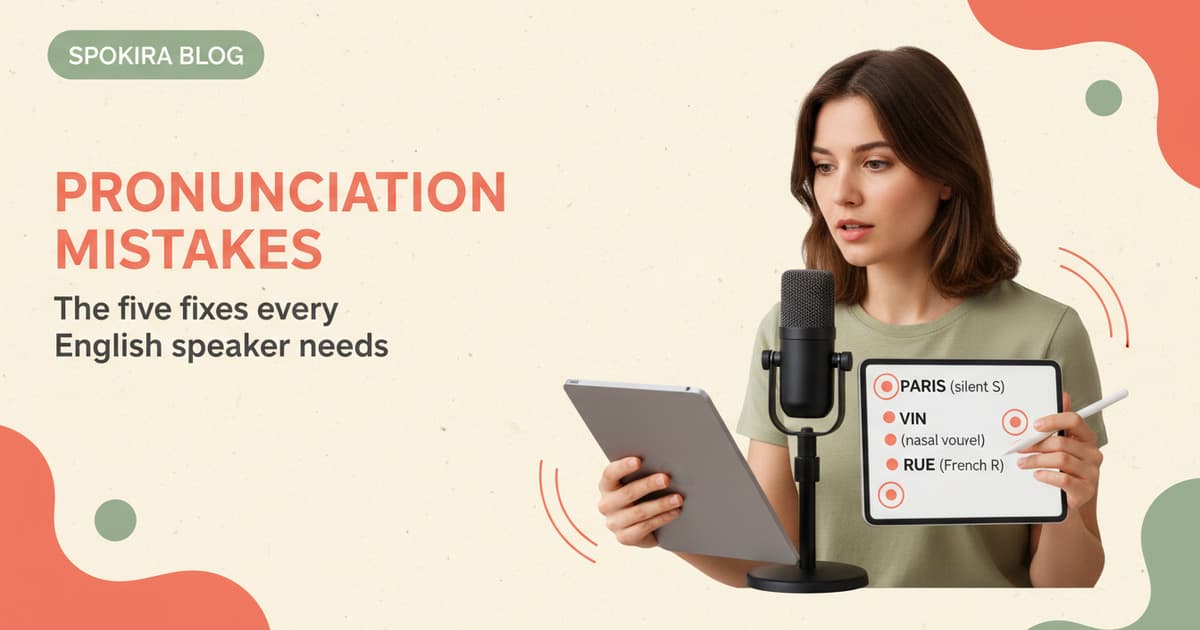
Here are the five most common French pronunciation mistakes and practical strategies to fix them.
1. Pronouncing Silent Letters
French is notorious for its silent letters. Unlike English, where most letters are pronounced, French leaves many letters silent—particularly at the ends of words.
The Mistake
English speakers often pronounce letters that should be silent:
- "Petit" becomes "peh-TEET" instead of "puh-TEE"
- "Beaucoup" becomes "bow-KOOP" instead of "bow-KOO"
- "Parlez" becomes "par-LEZ" instead of "par-LAY"
The Fix
Learn the general rules:
- Final consonants are usually silent (except C, R, F, L—remember "CaReFuL")
- The letter "e" at the end of words is typically silent
- The combination "ent" at the end of verbs is silent
The CaReFuL Rule
Remember which final consonants ARE pronounced with the mnemonic CaReFuL: C, R, F, and L are typically pronounced at the end of French words. Everything else is usually silent.
Practice with audio and shadow native speakers to internalize these patterns naturally.
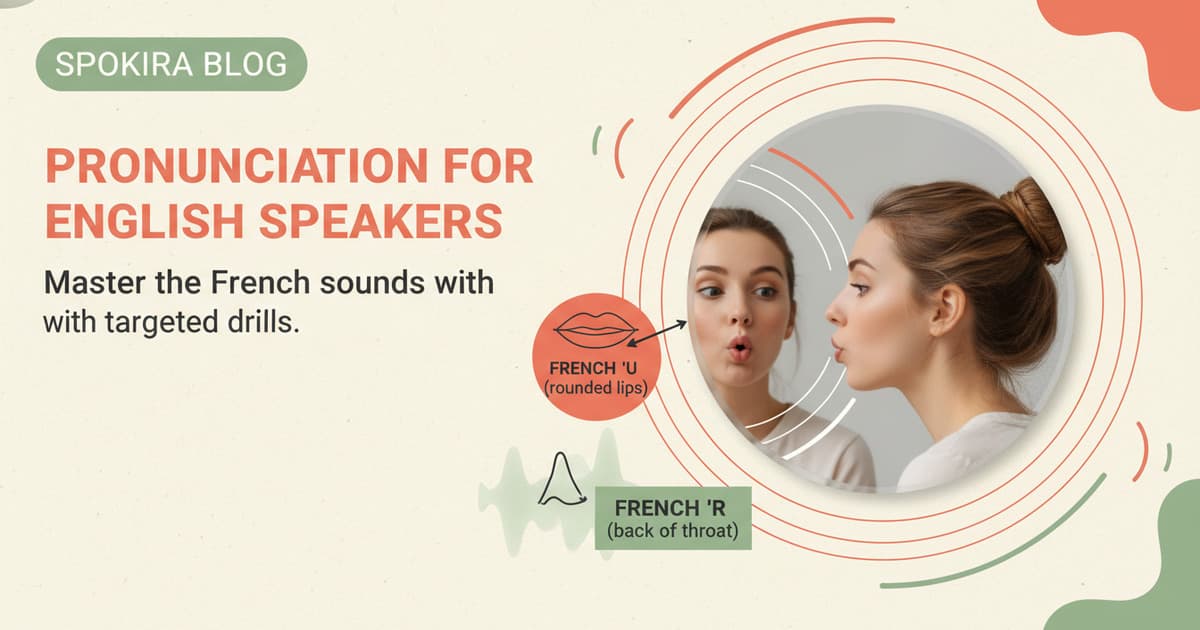
2. The French "R" Sound
The French "r" is one of the most distinctive sounds in the language, and it's completely different from the English "r."
The Mistake
English speakers tend to use their familiar "r" sound, produced at the front of the mouth with the tongue tip. The French "r" is a uvular fricative, produced at the back of the throat.
The Fix
Try these exercises:
- Gargle with water and notice the back of your throat vibrating
- Make a gentle "clearing your throat" sound—this is close to the French "r"
- Practice words like "rouge," "Paris," and "rue" while focusing on keeping your tongue flat and relaxed
The sound should feel like it comes from the same place as a "k" or "g" sound, but with friction instead of a full stop.
3. Nasal Vowels
French has four nasal vowels that don't exist in English. These sounds are produced by allowing air to flow through both the mouth and nose.
The Mistake
English speakers either:
- Add an "n" or "m" sound after the vowel
- Skip the nasal quality entirely
So "bon" becomes "bonn" or just "bow" instead of the proper nasal sound.
The Fix
The key is to let air flow through your nose WITHOUT pronouncing the following "n" or "m":
- Practice humming while holding a vowel sound
- Place a finger under your nose—you should feel air for nasal vowels
- Listen and shadow native speakers extensively
The Four Nasal Vowels
- an/en: "France," "content"
- on: "bon," "maison"
- in/ain/ein: "vin," "pain"
- un: "un," "brun" (merging with "in" in modern French)
4. The French "U" vs "OU"
French distinguishes between two sounds that don't have equivalents in English: the "u" (as in "tu") and "ou" (as in "tout").
The Mistake
English speakers often pronounce both as "oo" (like in "food"), making "tu" and "tout" sound identical.
The Fix
For the French "u":
- Say "ee" as in "feet"
- Keep your tongue in that exact position
- Round your lips tightly as if saying "oo"
The result is a sound that combines the tongue position of "ee" with the lip position of "oo." Practice with word pairs:
- "tu" (you) vs "tout" (all)
- "su" (known) vs "sous" (under)
- "rue" (street) vs "roue" (wheel)
Practice These Sounds with AI Feedback
Spokira gives you phoneme-level pronunciation analysis so you know exactly which sounds need work.
5. Liaison and Enchainement
French words flow together in connected speech through liaison (linking a normally silent consonant to the next word) and enchainement (connecting a pronounced consonant to the following vowel).
The Mistake
English speakers tend to pronounce each word separately with small pauses between them, which sounds choppy and unnatural.
The Fix
Learn common liaison patterns:
- "Les amis" = "lay-za-mee" (the "s" connects to "amis")
- "Un ami" = "uh-na-mee" (the "n" connects)
- "Petit ami" = "puh-tee-ta-mee" (the "t" connects)
Practice entire phrases as single units rather than individual words. Shadowing is particularly effective here because you naturally pick up the connected speech patterns.
Bringing It All Together
The common thread in fixing all these pronunciation issues is active listening and imitation. Reading about French sounds helps, but nothing replaces actually hearing native speakers and practicing reproduction.
This is exactly why we built Spokira around the shadowing method. Rather than just teaching you rules, we help you train your ears and mouth through consistent practice with native audio and AI-powered feedback.
Your Action Plan
- This week: Focus on one pronunciation area at a time
- Daily: Spend 5-10 minutes shadowing native speakers
- Regularly: Record yourself and compare to native audio
Perfect pronunciation isn't the goal—clear, confident communication is. Native speakers will understand you even with an accent. But working on these common mistakes will make you more easily understood and boost your confidence.
Keep Learning
- Deep dive into sounds: French Pronunciation for English Speakers — detailed mouth positions and exercises for every difficult sound
- Build speaking skills: French Speaking Practice Guide — a complete guide for A2–B1 learners
- Travel prep: French for Travel — speak confidently on your trip in 7 days
Ready to Fix Your French Pronunciation?
Get AI-powered feedback on every sound you make. See exactly where you differ from native speakers and how to improve.