You're going to France. You've studied some French, maybe Duolingo, maybe a class years ago, maybe just picked things up. You know enough to recognize words.
But when you imagine actually speaking to a waiter, asking for directions, or buying a train ticket? Panic sets in.
This french for travel guide is for you. It's a practical 7-day speaking challenge designed to get you confidently speaking French in the situations you'll actually encounter on your trip.
No grammar drills. No vocabulary lists. Just the specific phrases you need, practiced until they feel automatic.
Quick answer: How to prepare french for travel in one week
If you only have one week, run one speaking scenario per day and keep the same loop: learn 8-12 phrases, shadow them, do one memory run, and record one final take. Prioritize greetings, ordering, directions, hotels, and emergency lines. This french for travel structure builds faster retrieval than passive review because you rehearse exactly what you need to say under time pressure.
If cafe interactions are your immediate bottleneck, use this dedicated French cafe conversation practice script as your Day 2 scenario block.
For many A2-B1 learners, this is the right target: enough functional language for predictable travel situations, even with pauses under pressure (Council of Europe, 2020, CEFR Companion Volume).
Why "Knowing" French Isn't Enough for Travel
You might already "know" how to order coffee in French. You've seen it in textbooks, heard it in videos, maybe even passed a test on it.
But there's a massive gap between recognizing a phrase and producing it under pressure, when a real French person is looking at you expectantly, when there's a line behind you, when your brain suddenly goes blank.
This gap exists because:
- Your mouth hasn't practiced the sounds: French pronunciation is physically different from English
- You haven't rehearsed under time pressure: Real conversations don't give you 30 seconds to remember the word
- Passive knowledge ≠ active production: active recall reliably outperforms extra review for durable recall (Karpicke and Blunt, 2011, PubMed), and distributed practice is generally more reliable than cramming (Cepeda et al., 2006, Psychological Science)
The solution isn't more studying. It's speaking practice, specifically, practicing the exact phrases you'll need until they become automatic.
The 7-Day French for Travel Speaking Challenge
This french for travel challenge focuses on one situation per day. By the end, you'll have practiced the core scenarios you'll encounter in France.
Day 1: Greetings and Politeness
French daily interactions are highly ritualized around greetings and politeness. The right greeting can transform your interactions.
Essential phrases to practice:
| French | English | When to use |
|---|---|---|
| Bonjour | Hello (day) | Every interaction, entering a shop, café, etc. |
| Bonsoir | Good evening | After ~6pm |
| Au revoir | Goodbye | Leaving anywhere |
| S'il vous plaît | Please | Every request |
| Merci | Thank you | After receiving anything |
| Merci beaucoup | Thank you very much | When you want to emphasize gratitude |
| Excusez-moi | Excuse me | Getting attention, passing someone |
| Pardon | Sorry/Excuse me | Bumping into someone, interrupting |
Practice dialogue:
You: Bonjour! Shopkeeper: Bonjour, madame/monsieur. You: [browse, then leave] You: Au revoir, bonne journée! Shopkeeper: Au revoir!
Why this matters: In France, walking into a shop without saying "Bonjour" is considered rude. This simple greeting changes how people treat you.
Today's task:
- Practice each phrase 10 times, focusing on pronunciation
- Record yourself saying the dialogue
- Listen back and compare to native speakers
Day 2: Café and Restaurant Basics
You'll eat out every day in France. These phrases will get you through any café or restaurant.
Arriving:
| French | English |
|---|---|
| Une table pour deux, s'il vous plaît | A table for two, please |
| Est-ce qu'il y a une table libre? | Is there a free table? |
| On peut s'asseoir ici? | Can we sit here? |
Ordering:
| French | English |
|---|---|
| Je voudrais... | I would like... |
| Je prends... | I'll have... |
| Un café, s'il vous plaît | A coffee, please |
| Un café crème | Coffee with milk |
| Un thé | A tea |
| De l'eau, s'il vous plaît | Water, please |
| Une carafe d'eau | A carafe of tap water |
Food basics:
| French | English |
|---|---|
| Un croissant | A croissant |
| Un sandwich | A sandwich |
| Une salade | A salad |
| Le plat du jour | The daily special |
| L'addition, s'il vous plaît | The check, please |
Practice dialogue:
Waiter: Bonjour, vous désirez? You: Bonjour! Je voudrais un café crème et un croissant, s'il vous plaît. Waiter: Très bien. [Later] You: L'addition, s'il vous plaît. Waiter: Voilà. You: Merci. Au revoir!
Pronunciation focus: Practice "Je voudrais" until it flows naturally. The "r" sound and the "ai" at the end need work for most English speakers. Learn more about why shadowing works for French pronunciation.
Today's task:
- Shadow the ordering phrases 10 times each
- Practice the full dialogue with yourself
- Vary your order (café, thé, different foods)
Day 3: Getting Around - Metro and Directions
Navigation is essential. These phrases will get you from A to B.
Asking for directions:
| French | English |
|---|---|
| Excusez-moi, où est...? | Excuse me, where is...? |
| Je cherche... | I'm looking for... |
| C'est loin d'ici? | Is it far from here? |
| C'est par où? | Which way is it? |
Understanding directions:
| French | English |
|---|---|
| Tout droit | Straight ahead |
| À gauche | To the left |
| À droite | To the right |
| Au coin | At the corner |
| À côté de | Next to |
| En face de | Across from |
| Première rue | First street |
| Deuxième rue | Second street |
Metro/transportation:
| French | English |
|---|---|
| Où est la station de métro? | Where is the metro station? |
| Un ticket, s'il vous plaît | One ticket, please |
| Un carnet, s'il vous plaît | A book of 10 tickets, please |
| C'est quelle ligne pour...? | Which line for...? |
| Je dois changer où? | Where do I change? |
Practice dialogue:
You: Excusez-moi, je cherche la tour Eiffel. C'est par où? Stranger: Alors, vous allez tout droit, puis à gauche à la deuxième rue. You: C'est loin d'ici? Stranger: Non, c'est à dix minutes à pied. You: Merci beaucoup!
Pronunciation focus: Practice the nasal sounds in "loin" and "direction." Practice "gauche" (the French "g" + "au" sound). Avoid common French pronunciation mistakes English speakers make.
Today's task:
- Practice direction phrases until automatic
- Shadow the dialogue multiple times
- Practice asking directions to different places (la gare, le musée, l'hôtel)
Day 4: Shopping and Numbers
Whether you're at a market or a boutique, you'll need these phrases.
Essential shopping phrases:
| French | English |
|---|---|
| Combien ça coûte? | How much does it cost? |
| C'est combien? | How much is it? |
| Je peux payer par carte? | Can I pay by card? |
| Je prends ça | I'll take this |
| Je regarde, merci | I'm just looking, thanks |
| Vous avez ça en...? | Do you have this in...? |
| Trop cher | Too expensive |
Numbers you need:
| Number | French | Pronunciation tip |
|---|---|---|
| 1 | un | nasal "uh" |
| 2 | deux | like "duh" |
| 3 | trois | "trwah" |
| 4 | quatre | "katr" |
| 5 | cinq | nasal "sank" |
| 10 | dix | "deess" |
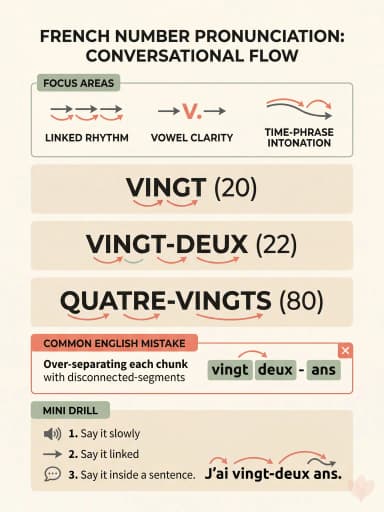
| 20 | vingt | nasal "van" |
| 50 | cinquante | "san-KAHNT" |
| 100 | cent | nasal "sahn" |
For prices, you'll hear things like:
- "Trois euros cinquante" (€3.50)
- "Vingt-cinq euros" (€25)
- "Quatre-vingts euros" (€80)
Practice dialogue:
You: Bonjour! C'est combien, ça? Vendor: Quinze euros. You: D'accord, je le prends. Je peux payer par carte? Vendor: Oui, bien sûr. You: Merci, au revoir!
Today's task:
- Practice numbers 1–100 until fluent
- Practice price listening (have someone quiz you)
- Shadow shopping dialogues
Day 5: Accommodation and Check-in
Hotel interactions are predictable, perfect for preparation.
Check-in phrases:
| French | English |
|---|---|
| J'ai une réservation | I have a reservation |
| Au nom de... | Under the name of... |
| Pour deux nuits | For two nights |
| Une chambre double | A double room |
| Avec petit-déjeuner | With breakfast |
| À quelle heure est le petit-déjeuner? | What time is breakfast? |
During your stay:
| French | English |
|---|---|
| Le wifi, c'est quoi le code? | What's the wifi code? |
| Il y a un problème avec... | There's a problem with... |
| ... la climatisation | ... the air conditioning |
| ... la douche | ... the shower |
| Vous pouvez m'aider? | Can you help me? |
Check-out:
| French | English |
|---|---|
| Je voudrais régler | I'd like to check out |
| Vous acceptez les cartes? | Do you accept cards? |
| Merci pour le séjour | Thanks for the stay |
Practice dialogue:
You: Bonjour, j'ai une réservation au nom de [your name]. Receptionist: Oui, une chambre double pour trois nuits? You: C'est ça. À quelle heure est le petit-déjeuner? Receptionist: De sept heures à dix heures. You: Parfait, merci.
Today's task:
- Practice check-in dialogue until smooth
- Shadow the phrases for problems (you'll want these ready)
- Practice with your actual reservation details
Day 6: Emergency Phrases and Survival French
These phrases might save your trip, practice them so they're automatic if you need them.
When you don't understand:
| French | English |
|---|---|
| Je ne comprends pas | I don't understand |
| Pardon, pouvez-vous répéter? | Sorry, can you repeat? |
| Plus lentement, s'il vous plaît | More slowly, please |
| Comment dit-on... en français? | How do you say... in French? |
| Vous parlez anglais? | Do you speak English? |
Getting help:
| French | English |
|---|---|
| J'ai besoin d'aide | I need help |
| Où sont les toilettes? | Where are the restrooms? |
| Je suis perdu(e) | I'm lost |
| J'ai perdu mon... | I lost my... |
| ... portefeuille | ... wallet |
| ... téléphone | ... phone |
| ... passeport | ... passport |
Medical/emergency:
| French | English |
|---|---|
| J'ai besoin d'un médecin | I need a doctor |
| Où est la pharmacie? | Where is the pharmacy? |
| J'ai mal à... | I have pain in... |
| Appelez la police | Call the police |
Practice scenario:
Imagine you're lost. Practice this exchange:
You: Excusez-moi, je suis perdu. Je cherche mon hôtel, l'Hôtel de Paris. Stranger: [speaks fast French] You: Pardon, plus lentement, s'il vous plaît. Je ne comprends pas bien. Stranger: [speaks slower] You: Merci beaucoup!
Today's task:
- Practice "I don't understand" phrases until automatic
- Shadow emergency phrases (you want these in muscle memory)
- Practice the "slow down" request, you'll use it
- Build confidence through daily speaking practice
Day 7: Putting It All Together
Today, simulate a full day in France using everything you've learned.
Morning scenario: Hotel breakfast
You: Bonjour! Je voudrais un café et un croissant, s'il vous plaît.
Mid-morning scenario: Getting directions
You: Excusez-moi, où est le musée d'Orsay? [Practice understanding: "Tout droit, puis à gauche..."] You: Merci beaucoup!
Lunch scenario: Café ordering
You: Bonjour! Une table pour une personne, s'il vous plaît. You: Je prends le plat du jour et une carafe d'eau. You: L'addition, s'il vous plaît.
Afternoon scenario: Shopping
You: Bonjour! C'est combien, ça? You: Je le prends. Je peux payer par carte?
Evening scenario: Restaurant
You: Bonsoir! Vous avez une table pour deux? You: Je voudrais le menu, s'il vous plaît. You: Excellent, merci. Au revoir, bonne soirée!
Full day practice:
- Run through all scenarios in sequence
- Record yourself
- Time yourself, how smoothly can you do it?
- Identify any phrases that still feel awkward
Essential French for Travel Pronunciation Tips
1. Always Say "Bonjour"
This single word transforms how French people respond to you. Practice it until it's automatic when you enter any space.
2. The "R" Doesn't Have to Be Perfect
French speakers will understand you even with an English "r." Don't let the perfect be the enemy of the good. A slightly-off "r" with confident delivery beats a mumbled attempt at perfection.
3. Link Your Words
French words flow together. "Je suis américain" sounds like "zhuh-swee-zah-may-ree-can." Practice phrases as units, not individual words.
4. Nasal Vowels Matter
The sounds in "bon," "vin," and "un" don't exist in English. Practice these nasal vowels specifically using articulation examples like the University of Texas French Interactive Phonetics guide (UT Austin); they make a big difference in comprehension.
For more detailed pronunciation guidance, read our French pronunciation guide for English speakers.
What If You Freeze?
It will happen. You'll blank on a word. Someone will speak too fast. You'll forget what you practiced.
Have these backup phrases ready:
- "Pardon, je ne parle pas bien français." (Sorry, I don't speak French well.)
- "Plus lentement, s'il vous plaît." (More slowly, please.)
- "Comment?" (What?), casual way to ask for repetition
And remember:
- French people appreciate when you try
- Most people in tourist areas speak some English
- A smile and "Désolé" goes a long way
- You're allowed to use gestures and pointing
The goal isn't perfection. It's confident imperfection.
Making the Most of Your Practice Time
The 10-Minute Daily Method
If you're busy preparing for your trip, you can still make progress with just 10 focused minutes per day of french for travel practice:
Minutes 1–3: Review
- Say yesterday's phrases from memory
- Check any you forgot
Minutes 3–8: New material
- Learn today's situation phrases
- Shadow each one 5–10 times
- Focus on the sounds, not just the words
Minutes 8–10: Dialogue practice
- Run through a complete interaction
- Record if possible
The Weekend Intensive
If you have more time, do 30–60 minutes:
First 20 minutes: Shadowing
- Work through multiple situations
- Focus on naturalness and flow
Next 20 minutes: Scenario practice
- Role-play complete interactions
- Vary the situations
- Practice recovering from mistakes
Final 20 minutes: Review and record
- Go through everything you've learned
- Record yourself
- Note what needs more work
How Spokira Helps You Master French for Travel
Spokira is built for exactly this use case: french for travel learners who "know" some French but need to actually speak it.
Situation Packs
We've organized practice around the exact scenarios you'll encounter:
- Café conversations: Ordering, paying, small talk
- City navigation: Asking directions, using transit
- Social introductions: Meeting people, basic conversation
- Daily essentials: Shopping, hotels, emergencies
AI Pronunciation Feedback
When you practice with Spokira, you get instant feedback on your pronunciation. You'll know if your "bonjour" sounds right before you try it in a real café.
Native Audio Shadowing
Every phrase is recorded by native French speakers. You shadow real French, not textbook French.
Progress Tracking
See exactly which phrases you've mastered and which need more work. Perfect for focused pre-trip practice.
Your Pre-Trip Action Plan
One week before your trip:
- Start the 7-day challenge above
- Practice 10–30 minutes daily
- Focus on café and directions first
Three days before:
- Run through all scenarios in sequence
- Record yourself and listen back
- Identify weak spots and drill them
Day before:
- Light review only
- Focus on confidence, not perfection
- Get excited!
On your trip:
- Use every opportunity to practice
- Start every interaction with "Bonjour"
- Don't be afraid to ask people to slow down
- Celebrate your wins, no matter how small
Beyond Survival French
Once you've mastered basic french for travel phrases, you might find yourself wanting more. That's great! Here's what to explore next:
- Deeper conversations: Talking about yourself, your trip, your impressions
- French culture: Understanding why French people communicate the way they do
- Continued practice: Building on your foundation with regular speaking practice
For more on building lasting French speaking skills, check out our complete guide to French speaking practice.
If you are choosing between app workflows before your trip, compare Spokira vs FluentU to see the difference between video-first input and guided speaking reps.
Frequently Asked Questions About French for Travel
What are the most important French phrases for travelers?
The most essential phrases are greetings (Bonjour, Au revoir), politeness (S'il vous plaît, Merci), ordering food (Je voudrais...), asking directions (Où est...?), and emergency phrases (Je ne comprends pas). Our 7-day challenge covers all 50+ phrases you'll actually use in real travel situations.
How many French phrases do I need to know for travel?
You can handle most travel situations with 50-75 essential phrases. Focus on high-frequency scenarios: greetings, café/restaurant, directions, shopping, and accommodation. Quality practice of these core phrases beats memorizing hundreds of rarely-used words.
Do I need to speak French to travel to France?
No, but speaking even basic French dramatically improves your experience. While many French people speak some English (especially in tourist areas), making an effort with French phrases shows respect and opens up warmer interactions. Starting every conversation with "Bonjour" changes how locals respond to you.
How long does it take to learn French for travel?
With focused daily practice, you can learn essential travel French in 7-10 days. This isn't fluency, it's practical speaking ability for common situations. 10-30 minutes daily of speaking practice (not passive study) is enough to feel confident ordering food, asking directions, and handling basic interactions.
What's the difference between 'Bonjour' and 'Bonsoir'?
"Bonjour" means "hello" and is used during the day (morning through late afternoon). "Bonsoir" means "good evening" and is used after approximately 6pm. In French culture, always greet people when entering shops, cafés, or any space, it's considered essential politeness.
Can I get by with English in Paris and France?
Yes, especially in Paris and major tourist areas, many people speak English. However, always try French first. Start with "Bonjour" and "Pardon, parlez-vous anglais?" (Do you speak English?) before switching to English. This shows respect and significantly improves how people treat you.
What should I say if I don't understand French?
Use these three essential phrases: "Je ne comprends pas" (I don't understand), "Plus lentement, s'il vous plaît" (More slowly, please), and "Pardon, pouvez-vous répéter?" (Can you repeat?). Practice these until automatic, you'll use them often, and French people appreciate when you're trying.
Start Today
You don't need perfect French for travel success. You need to be able to say "Bonjour," order food, and ask for directions, confidently.
That's totally achievable in 7 days with focused french for travel practice.
Here's what to do right now:
- Start Day 1 of the challenge above
- Practice for 10 minutes
- Come back tomorrow for Day 2
Your trip will be transformed by even basic French speaking ability. French people respond completely differently to tourists who make an effort.
Ready To Practice Travel French Daily?
Get guided speaking loops, pronunciation feedback, and short scenario drills so your French is usable by your travel date.
Bon voyage!