English speakers learning French face a unique challenge: the two languages share thousands of words but almost none of the same sounds.
That familiar-looking word on the page? It sounds completely different when a French person says it. And your English-trained mouth doesn't naturally produce French sounds.
This French pronunciation guide for English speakers breaks down exactly which sounds you need to master, how to position your mouth to make them, and practical exercises to train your pronunciation. If you want a shorter physical-cue version focused on what English speakers usually miss, use French pronunciation mouth position cues for the sounds English speakers miss. If you only need the biggest errors first, start with high-impact French accent errors. If your main vowel problem is the front-rounded contrast, go straight to the focused French U vs OU pronunciation practice drill. If your listening breaks down when French stops sounding "standard," use French accents around the world after this sound map. If you are already comparing tools, use French pronunciation app buyer checklist, Speechling vs Spokira, and Busuu vs Spokira once you finish the sound map.
Quick Plan: Master French Pronunciation
Your 5-Step Plan
- Identify your weak sounds, French "u," "r," nasal vowels, or "eu"
- Practice mouth positions daily, 5 minutes of targeted sound drills
- Shadow native speakers, 10 minutes mimicking French audio
- Record and compare, Track your progress weekly
- Get AI feedback, Use tools like Spokira to catch errors you can't hear
The rest of this guide breaks down exactly how to do each step.
Why Is French Pronunciation Hard for English Speakers?
Even though French and English share many cognates, their sound systems and timing patterns differ enough that English-speaking habits transfer poorly.
The result:
- French has 15–16 vowel sounds; English has about 14–15, but they're different vowels
- French has no word stress the way English does; syllables are more evenly timed
- French connects words through liaison and enchaînement, while English separates them
- French uses sounds that simply don't exist in English (nasal vowels, the French "u," the uvular "r")
Your English-speaking mouth has been trained for years to make English sounds. Retraining it for French requires deliberate practice, not just exposure.
That focus pays off. A 2025 meta-analysis across 65 pronunciation-training studies (2,793 learners) reported a large overall advantage for trained groups versus controls (PubMed).
The Fundamental Difference: Tension
Before diving into specific sounds, understand this key difference:
French is spoken with more tension in the mouth and lips than English.
English speakers tend to speak with relaxed lips and a somewhat lazy tongue. French requires:
- Lips more rounded and protruded for many vowels
- Tongue position more precise and consistent
- Mouth generally more forward in position
When practicing French pronunciation, think "tense and forward" compared to English's "relaxed and back."
Quick Reference: French Sounds English Doesn't Have
| French Sound | IPA | English Has It? | How to Make It | Example Words |
|---|---|---|---|---|
| French "u" | [y] | ❌ No | Say "ee" + round lips tightly | tu, rue, salut |
| French "r" | [ʁ] | ❌ No | Soft gargling at throat | rouge, Paris, très |
| Nasal "an" | [ɑ̃] | ❌ No | Lower soft palate, air through nose | France, pendant |
| Nasal "on" | [ɔ̃] | ❌ No | Lower soft palate, air through nose | bon, maison |
| Nasal "in" | [ɛ̃] | ❌ No | Lower soft palate, air through nose | vin, pain |
| French "eu" (closed) | [ø] | ❌ No | Say "ay" + round lips | deux, bleu |
| French "eu" (open) | [œ] | ❌ No | Say "eh" + round lips loosely | peur, heure |
The French Sounds English Speakers Struggle With Most
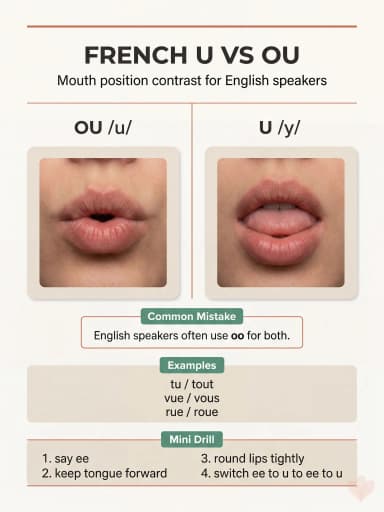
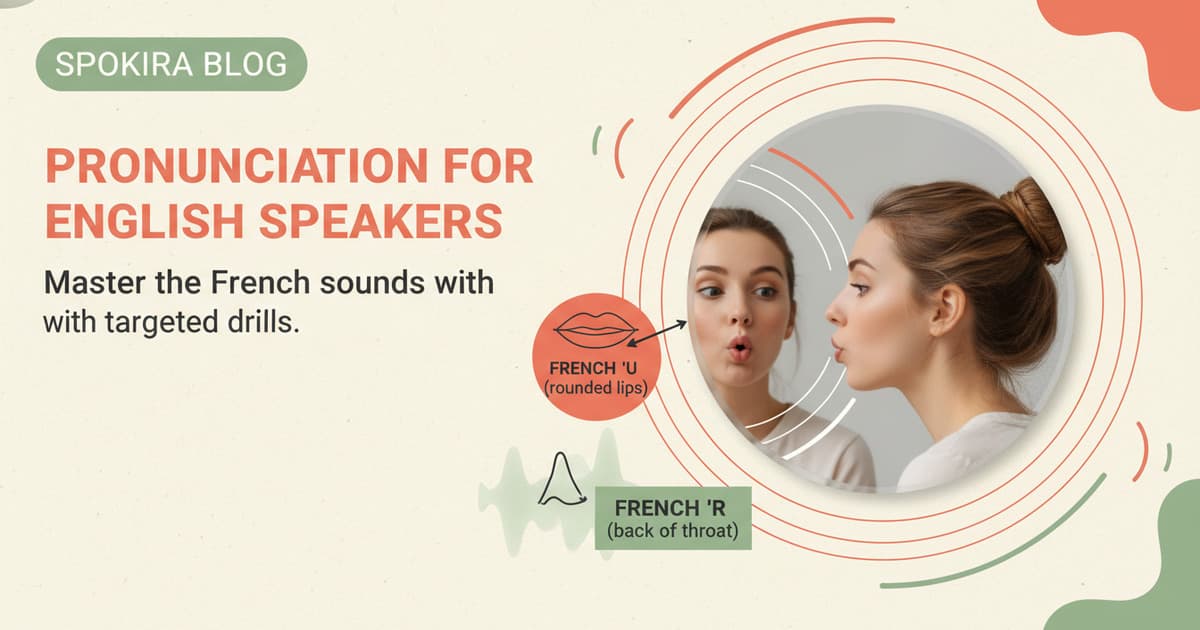
1. The French "U" [y]
The sound: This vowel appears in words like "tu" (you), "rue" (street), and "plus" (more).
(Phonetic symbols in this guide use the International Phonetic Alphabet, the standard for representing speech sounds.)
Why it's hard: English doesn't have this sound. English speakers usually substitute "oo" (as in "food"), but that's the French "ou" sound, a completely different vowel.
How to make it:
- Say "ee" as in "feet", note your tongue position (high and forward)
- Keep your tongue in exactly that position
- Now round your lips tightly, as if you're about to whistle
- The resulting sound is the French "u"
Key insight: The tongue position is "ee" but the lip position is "oo."
Practice words:
- tu (you)
- rue (street)
- salut (hi)
- voiture (car)
- sur (on)
Contrast practice (u vs. ou):
- tu (you) vs. tout (all)
- su (known) vs. sous (under)
- rue (street) vs. roue (wheel)
- vu (seen) vs. vous (you formal)
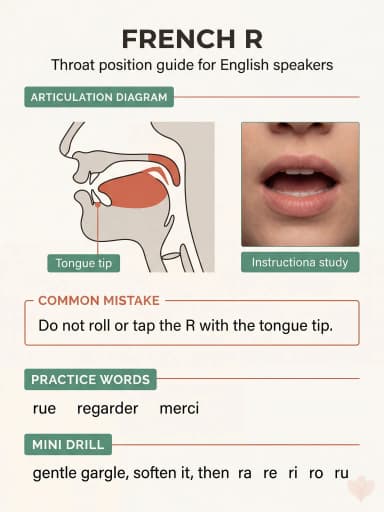
2. The French "R" [ʁ]
The sound: The French "r" appears in countless words: "rouge" (red), "Paris," "très" (very), "France."
Why it's hard: The English "r" is made at the front of the mouth with the tongue tip. The French "r" is made at the back of the throat, it's a completely different mechanism.
If you want a visual articulation reference, see the University of Texas French Interactive Phonetics page on la consonne /R/.
How to make it:
- Make a gentle "gargling" sound, this activates the back of your throat
- Now make that gargling sound softer and more fricative (like a gentle throat clearing)
- The sound comes from the same place as "k" or "g," but with friction instead of a complete stop
Key insight: Your tongue tip does nothing. Keep it relaxed and low, behind your bottom teeth. All the action is at the back of your throat.
Common mistakes:
- Using the English "r" (sounds distinctly American)
- Making it too harsh (like you're clearing phlegm)
- Trilling it like Spanish "rr" (that's the wrong type of "r")
Practice words (start with "r" at the end, which is easier):
- finir (to finish)
- pour (for)
- sur (on)
Then practice "r" at the beginning:
- rouge (red)
- rue (street)
- regarder (to look)
Then practice "r" between vowels:
- Paris
- très (very)
- France
For a structured two-week routine focused only on this sound, use French R sound practice: mouth-position cues + daily drill.
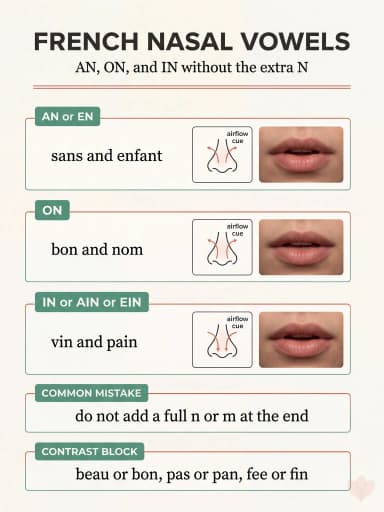
3. Nasal Vowels
The sounds: French has four nasal vowels that don't exist in English:
- [ɑ̃] as in "France," "pendant" (during)
- [ɔ̃] as in "bon" (good), "maison" (house)
- [ɛ̃] as in "vin" (wine), "pain" (bread)
- [œ̃] as in "un" (one), though this is merging with [ɛ̃] in modern French
If nasal contrasts are your main blocker, use this focused nasal vowels French practice drill for AN/EN/ON/IN before returning to full-sound-system sessions.
Why they're hard: English has no nasal vowels. When English speakers see "an" or "on," they pronounce the vowel followed by an "n" sound. In French, the "n" or "m" is silent, it just signals that the vowel is nasalized.
How to make nasal vowels:
- Lower your soft palate (the back of the roof of your mouth) to let air flow through your nose
- Do NOT pronounce the "n" or "m"
- The nasality is in the vowel itself, not a separate consonant
Test yourself: Put a finger under your nose while saying a nasal vowel. You should feel air. Now say "bon", if you feel a burst of air at the end, you're adding an "n" sound (wrong). The air should flow continuously during the vowel.
Practice by contrast:
- "beau" (beautiful) vs. "bon" (good), the only difference should be nasality
- "sa" (her) vs. "sans" (without)
- "fait" (done) vs. "fin" (end)
Common nasal spellings:
- an, am, en, em → [ɑ̃]: France, pendant, ensemble
- on, om → [ɔ̃]: bon, maison, nom
- in, im, ain, aim, ein, eim, yn, ym → [ɛ̃]: vin, pain, plein
- un, um → [œ̃] or [ɛ̃]: un, parfum
4. The French "EU" Sounds [ø] and [œ]
The sounds: Two related vowels that appear in words like:
- [ø] (closed): "deux" (two), "bleu" (blue), "peu" (little)
- [œ] (open): "peur" (fear), "heure" (hour), "sœur" (sister)
Why they're hard: English doesn't have either sound. Speakers typically substitute "uh" or "oo."
How to make [ø] (the closed version):
- Say "ay" as in "say"
- Keep your tongue in that position
- Round your lips into a small, tight circle
- The sound is between "ay" and "oo"
How to make [œ] (the open version):
- Say "eh" as in "bed"
- Keep your tongue in that position
- Round your lips loosely (less tight than [ø])
Key insight: The difference between [ø] and [œ] is like the difference between [e] (closed "é") and [ɛ] (open "è"), just with rounded lips.
Practice:
- deux (two)
- bleu (blue)
- peur (fear)
- heure (hour)
- jeune (young)
5. Liaison and Enchaînement
The concept: In French, words flow together. Final consonants that are normally silent get pronounced when the next word starts with a vowel (liaison), and all final consonants connect to following vowels (enchaînement).
Why it's hard: English speakers pronounce each word separately with small pauses. This makes French sound choppy and unnatural.
Liaison examples:
- les amis → "lay-za-mee" (the "s" connects)
- nous avons → "noo-za-vohn" (the "s" connects)
- un ami → "uh-na-mee" (the "n" connects)
- petit ami → "puh-tee-ta-mee" (the "t" connects)
Enchaînement examples:
- elle aime → "eh-lehm" (the "l" of "elle" connects to "aime")
- une amie → "oo-na-mee" (the "n" of "une" connects)
How to practice:
- Stop thinking of French as individual words
- Think of phrases as single units of sound
- Shadow native speakers to absorb these patterns naturally
Key insight: If you can hear pauses between your words, you're probably not connecting them enough.
Mouth Position Guides
For Front Rounded Vowels (u, eu)
Position your mouth as if:
- You're about to whistle
- You're saying "ooh" to a cute baby
- Your lips are forming a small, tight circle
Your tongue should be:
- High and forward in your mouth
- Almost touching your bottom front teeth
- Tense, not relaxed
For Nasal Vowels
Lower your soft palate by:
- Imagining you're about to yawn
- Pretending you have a slight cold
- Making a humming sound with your mouth open
The airflow should be:
- Continuous through your nose
- Not blocked at any point
- Free of any "n" or "m" sound at the end
For the French "R"
Position your mouth:
- With your tongue tip down behind your bottom teeth
- With the back of your tongue raised toward your soft palate
- As if you're about to gargle or clear your throat very gently
Daily Pronunciation Exercises
Exercise 1: Minimal Pair Drills (5 minutes)
Practice these pairs, focusing on the exact difference:
u vs. ou:
- tu / tout
- su / sous
- rue / roue
- vu / vous
Nasal vs. oral vowels:
- beau / bon
- mot / mon
- pas / pan
- fée / fin
é vs. è:
- été (summer) / était (was)
- thé (tea) / très (very)
Exercise 2: Sound Isolation (5 minutes)
Pick one difficult sound and practice it in isolation:
For "u":
- Say "ee" and hold it
- Round your lips while holding the tongue position
- Alternate: ee-ü-ee-ü-ee-ü
- Practice in words: tu, rue, salut, voiture
For "r":
- Gargle gently
- Reduce the gargle to a soft friction
- Add vowels: ra, re, ri, ro, ru
- Practice in words: rouge, rue, très, Paris
Exercise 3: Shadowing Practice (10 minutes)
Find a native French audio source (French shadowing practice, podcast, or Spokira) and:
- Listen to a phrase
- Immediately repeat it, mimicking every sound
- Focus on rhythm and connection, not just individual words
- Repeat each phrase 5–10 times until it feels natural
This exercise trains your mouth muscles AND your ear simultaneously.
Exercise 4: Recording and Comparison (5 minutes)
- Choose 5 sentences from your learning material
- Record yourself saying them
- Listen to the native audio
- Compare specific sounds
- Note one thing to improve and practice it
See Which Sounds Need Work
Spokira's AI pronunciation coach gives you instant phoneme-level feedback on every sound, so you know exactly what to fix.
Common Pronunciation Errors to Avoid
1. Pronouncing Silent Letters
French has many silent letters, especially at word endings.
Wrong: petit → "peh-TEET" Right: petit → "puh-TEE"
Wrong: beaucoup → "bow-KOOP" Right: beaucoup → "bow-KOO"
Rule of thumb: Final consonants are usually silent, except C, R, F, L (remember: "CaReFuL").
The CaReFuL Rule
Remember which final consonants ARE pronounced: C, R, F, L. Everything else is usually silent at the end of French words.
If you want the shorter version that prioritizes the highest-impact connected-speech rules, use French pronunciation rules that matter for speaking clarity. It condenses final consonants, liaison, vowel stability, and prosody into one 14-day practice sequence.
For a deeper dive, read our guide on common French pronunciation mistakes.
2. English Word Stress
English stresses certain syllables. French doesn't, each syllable has roughly equal emphasis, with a slight rise on the final syllable of a phrase.
Wrong: CRO-iss-ant (stress on first syllable) Right: croi-SSANT (even syllables, slight emphasis on final)
3. Diphthongs Where There Are None
English vowels often "glide" into other sounds (diphthongs). French vowels are pure, they don't move.
Wrong: "beau" → "bow" (glides from "o" to "w") Right: "beau" → "bo" (pure "o" sound, no glide)
4. Separating Words
French words flow together. If you pronounce each word separately, you'll sound choppy and foreign.
Wrong: "les | amis | sont | ici" (pauses between words) Right: "lay-za-mee-sohn-tee-see" (connected flow)
How Do You Practice French Pronunciation Effectively?
Principle 1: Active Listening Before Speaking
Before you can produce a sound correctly, you need to hear it correctly. Many pronunciation errors stem from perception errors, you literally can't hear the difference.
Train your ear by:
- Listening to minimal pairs and identifying which is which
- Focusing on one sound at a time during listening practice
- Comparing your recordings to native audio closely
Principle 2: Exaggerate at First
When learning a new sound, exaggerate it. Your "exaggerated" version is probably closer to correct than your "normal" attempt.
If you're learning the French "u":
- Round your lips more than feels natural
- Push them forward like you're pouting
- Make the sound feel weird
Over time, you'll naturally moderate to a normal level, but you'll maintain the correct positioning.
Principle 3: Practice in Context
Isolated sounds are important for learning, but pronunciation ultimately happens in connected speech.
Once you can produce a sound in isolation:
- Practice it in single words
- Practice it in phrases
- Practice it in full sentences
- Practice it in a structured French speaking practice plan
Principle 4: Get Feedback
Pronunciation practice without feedback can reinforce errors. You need some way to know if you're improving.
Options:
- Record yourself and compare to native audio
- Use pronunciation apps with AI feedback
- Work with a tutor periodically
- Have native speakers point out specific errors
Building Pronunciation Into Your Routine
The 15-Minute Daily Pronunciation Routine
Minutes 1–5: Warm-up
- Lip trills (brrr sound)
- Tongue exercises (touch each tooth, circle your mouth)
- Say the French vowels in order: a, e, i, o, u, é, è, ê, eu, ou
Minutes 5–10: Focused Practice
- Pick one difficult sound
- Practice it in isolation, then in words, then in phrases
- Use a mirror to check your mouth position
Minutes 10–15: Shadowing
- Shadow native audio for 5 minutes
- Focus on rhythm, connection, and overall flow
- Don't stop to analyze, just mimic
Weekly Pronunciation Check-In
Once a week:
- Record yourself reading a standard text
- Listen back critically
- Identify your top 2–3 pronunciation issues
- Make those your focus for the coming week
How Spokira Helps With French Pronunciation
Traditional pronunciation practice has a fundamental problem: you can't accurately assess your own pronunciation. Your brain hears what it expects to hear, not what you actually said.
Spokira solves this with AI-powered pronunciation feedback:
Phoneme-Level Analysis
Our AI breaks down your speech into individual sounds (phonemes) and compares each one to native pronunciation. You see exactly which sounds are correct and which need work, not just whether the overall word was "right" or "wrong."
Visual Feedback
See a visual representation of your pronunciation compared to the native target. Identify patterns in your errors and track improvement over time.
Targeted Practice
Spokira identifies your specific weak points and provides focused practice on those sounds. No more wasting time on sounds you've already mastered.
Native Audio Shadowing
Every lesson includes high-quality native audio designed for shadowing practice. Build muscle memory for correct pronunciation through repetition with real French speakers.
Choose By Goal
If you are choosing an app and want the shortest path:
- Use French pronunciation app for overall sound clarity and feedback depth.
- Use app to practice speaking French for daily output and response-speed training.
- Use French accent training app for targeted accent-correction loops.
Compare Spokira With Other Pronunciation Apps
If you are comparing options for ongoing pronunciation training, start with:
- Spokira vs Speechling for coach feedback versus instant AI analysis
- Spokira vs Parle for pronunciation-coaching depth
- Spokira vs Babbel for course structure versus speaking correction
- Spokira vs Talkpal for pronunciation precision versus open conversation
Start Improving Your French Pronunciation Today
French pronunciation isn't about talent, it's about training. Your mouth can learn to make any sound with enough targeted practice.
Ready to use these pronunciation skills in real situations? Our French for travel guide gives you practical phrases you can practice.
Here's your action plan:
- Identify your weakest sounds from the list above
- Practice 15 minutes daily using the routine provided
- Get regular feedback through recording, AI tools, or tutors
- Be patient, pronunciation improvement is gradual but real
Get AI Feedback on Your Pronunciation
See exactly where your pronunciation needs work and how to fix it. Spokira analyzes every sound you make.
Your mouth can learn French. It just needs the right training.