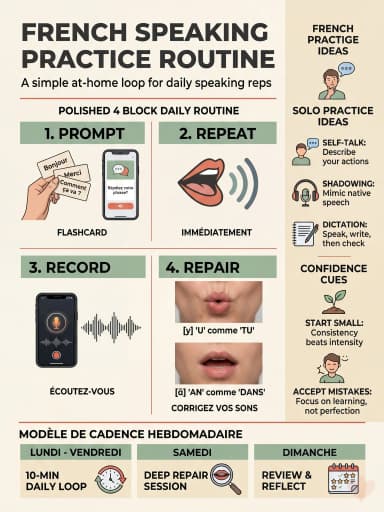
Most French learners do not need more tips. They need a repeatable week.
That is the job of this page. If you already know you need to practice speaking and want a clear calendar for the next seven days, start here. If you are still deciding which solo method fits your bottleneck, use the French speaking practice alone hub instead. That page compares methods. This page gives you the schedule.
Quick answer: what is the best French speaking practice plan?
For most A2-B1 learners, the best French speaking practice plan is a 7-day loop built around four things:
- Short daily shadowing for rhythm and pronunciation
- Timed recall for retrieval speed
- One focused pronunciation repair block
- One or two low-pressure transfer sessions so practice carries into real speech
That structure fits the A2-B1 stage well because CEFR descriptors for A2 and B1 spoken production and interaction emphasize short formulaic speech, hesitation, repair, and familiar situations. In other words: you do not need a massive curriculum first. You need repeated reps on familiar speaking tasks.
Why this plan works:
- Retrieval practice improves durable access better than extra review alone, as Karpicke and Blunt reported in 2011 (PubMed).
- Distributed sessions beat cramming for long-term retention, according to Cepeda and colleagues' 2006 review (PubMed).
- Pronunciation training produces meaningful gains overall; a 2025 meta-analysis across 65 studies found a large positive effect on L2 phonetic competence (PubMed).
Who this 7-day plan is for
This plan is a good fit if:
- You can understand beginner-to-intermediate French but freeze when speaking
- You are around A2-B1 and need more output, not more grammar theory
- You want a weekly routine you can repeat without deciding from scratch every day
- You learn best with short, structured reps
This plan is not the best page for you if your main question is:
- "Which solo method should I choose first?"
- "How can I practice speaking French alone at home?"
- "Should I use shadowing, recording, AI feedback, or conversation bots?"
For those questions, use the solo French speaking practice hub. It owns the method-selection intent.
The 7-day French speaking practice routine
Each day takes about 15-20 minutes. If you only have 5 minutes, use the 5-minute French output routine and keep the same order of priorities.
| Day | Main goal | Core block | Time |
|---|---|---|---|
| 1 | Set your baseline | Record, diagnose, pick one scenario | 15 min |
| 2 | Build sound and rhythm | Shadow short phrases | 15 min |
| 3 | Build retrieval speed | Recall without audio | 15 min |
| 4 | Repair one error pattern | Pronunciation drill | 15 min |
| 5 | Extend the scenario | Longer phrase chains | 15-20 min |
| 6 | Transfer under light pressure | Guided self-talk or short conversation | 15-20 min |
| 7 | Measure and reset | Re-record, compare, plan next week | 15 min |
Day 1: Baseline and setup
Your only job on day 1 is to stop guessing.
- Record yourself speaking French for 60-90 seconds on a familiar topic.
- Listen once and write down the main friction point.
- Choose one scenario for the week: introductions, cafe ordering, asking directions, or travel basics.
- Pick 3-5 short phrases from that scenario.
Use one scenario all week. That constraint matters. Random topics feel productive, but they spread your repetitions too thin. If you choose cafe ordering, this French cafe conversation practice script gives you a ready-made sequence with variation and repair drills.
If you are not sure what to diagnose, start with French pronunciation for English speakers and 5 accent errors that block clarity.
Day 2: Shadowing foundation
Day 2 is about copying, not inventing.
Use native audio and shadow the same 3-5 phrases 10 or more times each. Match:
- timing
- vowel length
- liaison and linking
- overall melody
Do not stop to analyze grammar mid-rep. The goal is to make your mouth more automatic.
If you want the full reasoning behind this method, read why shadowing works for French. If you want the actual player, recorder, and loop setup behind this day, use best shadowing tools for French. If you want product options built around this method, see best apps to practice speaking French and the French shadowing app alternatives.
Day 3: Retrieval from memory
Now remove the support.
Listen to each phrase once, then turn the audio off and say it from memory. Track:
- longest pause
- full restarts
- whether you keep the rhythm without the native model
This is where many learners discover the real bottleneck. They can repeat, but they cannot retrieve quickly enough to speak.
If freezing is your main issue, move this day to the front of the week and add the French conversation freeze drill. If you want a tighter protocol, use the 1-clip, 15-rep output drill.
Day 4: Pronunciation repair
Do not "work on pronunciation" in general. Repair one thing.
Good targets:
- French /R/
- /u/ versus /y/
- nasal vowels
- final-consonant carryover from English
- pacing that sounds clipped or overly stressed
Run the correction loop in this order:
- Isolated sound
- One word
- Two-word phrase
- Full phrase from your scenario
If you need a targeted repair block, use the French R daily drill, the nasal vowels practice routine, or this clarity-first breakdown of French pronunciation rules that matter for speaking clarity. If you want guided feedback, the French pronunciation app page and French accent training app page help you choose the right tool.
Day 5: Scenario expansion
Keep the same scenario, but stretch it.
If the week is about ordering at a cafe, move from:
- one request
- to one follow-up question
- to one clarification
- to one closing phrase
That gives you a mini speaking chain instead of isolated sentences.
Examples:
- "Je voudrais un cafe, s'il vous plait."
- "Sur place ou a emporter?"
- "Sur place."
- "Je peux payer par carte?"
If your goal is travel speaking, pair this with French for travel: speak confidently in 7 days.
Day 6: Low-pressure conversation transfer
This is the bridge day. You are not trying to have a brilliant conversation. You are testing whether the week transfers.
Pick one:
- 3 minutes of guided self-talk using the week's phrases
- one recorded roleplay
- one short AI conversation using only the week's scenario
- one language exchange or tutor session with a narrow goal
Keep the pressure low and the scope narrow. A short, successful transfer session is better than a broad conversation that sends you back into survival mode.
If you are evaluating tools for this stage, use the speaking app buyer framework and compare pages like Talkpal vs Spokira, Babbel vs Spokira, Busuu vs Spokira, Duolingo vs Spokira, FluentU vs Spokira, and Speak vs Spokira.
Day 7: Review and reset
Repeat the same recording from day 1.
Then compare:
- pauses
- clarity
- rhythm
- how much prompting you need
You are looking for concrete movement, not perfection.
At the end of day 7, choose next week's focus:
- same scenario, faster delivery
- same scenario, cleaner pronunciation
- new scenario, same method
That decision turns one week into a repeatable system.
Repeat The Week, Not Just The Session
Most learners improve when they repeat the same weekly structure for 3-4 cycles. Keep the scaffolding stable and change only the scenario or the main bottleneck.
How to adapt the plan to your bottleneck
| If your main problem is... | Emphasize | Reduce |
|---|---|---|
| Freezing in conversation | Day 3 and Day 6 | Day 5 complexity |
| Weak pronunciation | Day 2 and Day 4 | Live conversation length |
| Speaking too slowly | Timed shadowing for speed on Days 2-3 | New vocabulary |
| Sound-specific errors | Daily repair block | Broad scenario changes |
| Inconsistent daily practice | 5-minute routine | Optional extras |
If you are still unsure which method matches your bottleneck, go back to the solo practice hub. That page is designed for diagnosis first, schedule second.
Mistakes that break a weekly French speaking plan
Changing methods every day
Method-hopping feels fresh, but it makes progression hard to measure. Keep the same weekly skeleton.
Practicing too broadly
"French conversation" is too vague. "Cafe ordering with one clarification question" is trainable.
Adding live conversation too early
Conversation is useful, but it is not the only path. If your mouth still cannot produce the phrases cleanly, more live pressure usually leads to more avoidance.
Confusing effort with transfer
A session can feel hard without helping speech carry over. Track transfer by re-recording the same prompt each week.
Where Spokira fits in this weekly routine
Spokira fits best on Days 2, 4, and 6:
- Day 2: native audio for structured shadowing
- Day 4: phoneme-level feedback to isolate what changed
- Day 6: guided scenario practice that stays narrow enough to transfer
That makes it a good match for learners who want solo reps with correction, not just open-ended chat.
Run This 7-Day Speaking Loop With Feedback
Practice one scenario, get pronunciation feedback, and track whether your speaking is actually getting easier week to week.
FAQ
How many weeks should I repeat this French speaking practice plan?
Usually 3-4 weekly cycles is enough to see whether the structure works for you. Keep the framework stable and rotate the scenario or the primary error pattern.
Can I use this plan if I only study at home?
Yes. The plan works well as a home routine because most of the week is solo. Day 6 can stay solo too if you use guided roleplay or recorded prompts.
Should I add grammar study to this plan?
Only as a support layer. This page is for output training. If grammar is blocking one scenario, fix that point, then return to speaking reps.
What is the difference between this page and /french-speaking-practice?
This page is the weekly execution plan. The /french-speaking-practice page is the solo-method selection hub. Use that page when you need to choose a method. Use this page when you need a calendar.