You understand French. You can read menus, follow conversations, even catch jokes in French films. But when someone actually speaks to you? Your mind goes blank. The words won't come. You freeze.
This gap between understanding and speaking is normal. Your brain knows French, but your mouth doesn't. The fix isn't more vocabulary lists or grammar drills. It's a 5-minute French output drill that trains your mouth to produce the sounds you already recognize.
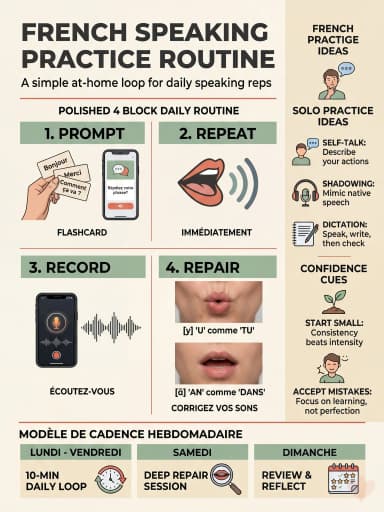
This daily French output routine gives you a drill you can do anywhere. Four steps. No apps required. No conversation partner needed. Just you, your voice, and five minutes of focused practice. If your main blocker is pace, not habit, use this timed shadowing routine for french speaking speed. If your blocker is one specific sound, use this French R sound practice drill.
If you are comparing app workflows around this same routine, the most useful head-to-head pages are Spokira vs Babbel, Spokira vs Duolingo, Spokira vs Mondly, Spokira vs Pimsleur, Spokira vs Shadowing.app, and Spokira vs Speechling.
Quick plan: The 4-step routine
The Daily Drill
- Shadow a native clip (1-2 min)
- Record yourself (1 min)
- Fix one sound (1 min)
- Repeat tomorrow
That's it. Five minutes. The secret isn't complexity. It's consistency.
Why 5-minute French output drills beat hour-long sessions
Most language advice tells you to practice 30 minutes, an hour, or more. But for speaking specifically, short daily sessions beat occasional long ones.
Here's why:
Speaking is a motor skill. Your mouth needs to learn new positions, new movements, new rhythms. Motor skills develop through frequent repetition, not marathon sessions. A pianist practices scales daily, not once a week for three hours.
Your brain consolidates overnight. Research on motor learning shows that skills improve between practice sessions, not just during them. Daily practice gives your brain more opportunities to consolidate what you've learned.
Short sessions are sustainable. You'll actually do five minutes. An hour-long session becomes "I'll do it tomorrow." Tomorrow becomes next week. Next week becomes never.
Focused beats scattered. Five minutes of speaking out loud trains your mouth more than 30 minutes of passive listening. Active practice creates muscle memory. Passive exposure doesn't.
Five minutes today beats an hour next week. Every time.
Step 1: French shadowing routine (1-2 minutes)
Shadowing is the core of these French speaking exercises. It is simple, repeatable, and practical for busy learners.
What shadowing actually means
Shadowing means repeating what you hear while you hear it. Not after. Simultaneously.
You're not pausing the audio, then repeating. You're speaking along with the native speaker, like a shadow following their movements. Match their rhythm. Match their tone. Match their pace.
Don't stop to "get it right." Keep going. Perfection isn't the goal. Training your mouth is.
For a deeper dive into why this works, see our French shadowing method explained.
What to shadow
Pick 3-5 short phrases from a single scenario. Don't jump between topics. Repetition within a context builds faster recall.
Good starting scenarios:
- Ordering at a cafe
- Asking for directions
- Introducing yourself
- Making small talk
Here's a cafe ordering set you can use today:
| French | English | Focus |
|---|---|---|
| Je voudrais un cafe, s'il vous plait. | I'd like a coffee, please. | Rhythm + liaison |
| Un cafe creme, s'il vous plait. | A coffee with cream, please. | Nasal vowel in "creme" |
| L'addition, s'il vous plait. | The check, please. | French "L" + liaison |
| Merci beaucoup. | Thank you very much. | French R |
| Bonne journee! | Have a nice day! | Nasal vowel + final "ee" |
How to shadow (the actual drill)
- Play the native audio
- Start speaking immediately, not after the phrase ends
- Match the speaker's speed, even if you mumble some words
- Repeat the same 3-5 phrases 5-10 times
- Don't pause between repetitions
If you don't have native audio, use free resources like "One Thing in a French Day" (5-minute podcast episodes) or RFI's "Journal en Francais Facile."
Step 2: Record yourself (1 minute)
This is the step most learners skip. Don't.
Recording yourself does three things apps and tutors can't:
It exposes blind spots. You think you're pronouncing "merci" correctly until you hear the playback. The gap between what you think you sound like and what you actually sound like is often shocking the first time.
It creates evidence of progress. Save your recordings. Compare week 1 to week 4. Hearing your improvement builds confidence that the practice is working.
It builds self-awareness. Over time, you'll start hearing mistakes in real-time, before you even play back the recording. This self-correction skill transfers to live conversations.
How to do it
- Open your phone's voice memo app
- Record yourself saying the same phrases you just shadowed (30-60 seconds)
- Play it back immediately
- Compare to the native clip
- Note ONE thing that sounds different
One thing. Not five. Not everything. One.
Maybe your "R" sounds too harsh. Maybe you're not connecting "un ami" smoothly. Maybe the rhythm feels choppy. Pick the most obvious mismatch and move to step 3.
Step 3: Fix one sound (1 minute)
Here's where most pronunciation advice fails: it tries to fix everything at once.
The "one sound" rule works better. Pick the single most noticeable difference between your recording and the native speaker. Focus your energy there. Scattered effort produces scattered results.
Common sounds to target
English speakers typically struggle with the same French sounds. Rotate through these weekly:
| Sound | Example Words | Quick Fix |
|---|---|---|
| French R | merci, rue, regarder | Gargle from the back of your throat, not a tongue roll |
| French U | tu, rue, plus | Round your lips tightly, then try to say "ee" |
| Nasal vowels | un, bon, vin, pain | Let air flow through your nose while saying the vowel |
| Liaison | un ami, les enfants | Connect the final consonant to the next vowel smoothly |
| French "ou" vs "u" | vous vs vue, tout vs tu | "Ou" = round lips relaxed. "U" = round lips tight + "ee" |
For a complete breakdown of these sounds and fixes, see French Pronunciation for English Speakers and 5 Common French Pronunciation Mistakes.
The one-minute fix drill
- Say the target sound in isolation, 5 times (just the sound: "rrrr" or "uuuu")
- Say it in a single word, 5 times ("merci, merci, merci...")
- Say it in the full phrase, 3 times ("Merci beaucoup. Merci beaucoup. Merci beaucoup.")
That's it. One minute. One sound. Move on.
You're not trying to perfect the sound today. You're training your mouth to produce it more naturally over time. The improvement comes from daily repetition, not single-session intensity.
Get Instant Feedback on Your Sounds
Spokira's AI analyzes your pronunciation at the phoneme level, so you know exactly which sounds to fix next.
Step 4: Repeat tomorrow
The fourth step is the simplest and most important: do it again tomorrow.
Consistency beats intensity for motor skill development. Your mouth needs daily repetition to build the muscle memory that makes French sounds automatic.
Why repetition works
When you first learn a phrase, retrieving it requires conscious effort. You have to think about each word, each sound.
With enough repetition, retrieval becomes automatic. The phrase comes out without thinking. This is what you need for real conversations, where you don't have time to construct each sentence from scratch.
Exact rep counts vary by learner, but the direction is clear: active retrieval improves delayed recall versus re-study (Roediger and Karpicke, 2006, PubMed), and spaced daily practice is generally more reliable than cramming (Cepeda et al., 2006, Psychological Science). Daily practice gets you there faster than weekly marathons.
Stack it onto an existing habit
The easiest way to build a new habit is to attach it to one you already have:
- After morning coffee: Shadow while the coffee cools
- During your commute: Audio-only shadowing (no recording while driving)
- Before bed: Wind down with 5 minutes of French practice
- After brushing teeth: Build it into your morning routine
Pick one anchor. Same time, same trigger, every day.
Sample 7-day routine: Travel French
Here's a complete week using this method, focused on French travel speaking scenarios:
| Day | Scenario | Phrases to Shadow | Sound Focus |
|---|---|---|---|
| 1 | Cafe ordering | Je voudrais..., L'addition..., Merci | French R |
| 2 | Cafe ordering (repeat) | Same phrases | Liaison |
| 3 | Asking directions | Ou est...?, Tournez a gauche/droite | Nasal vowels |
| 4 | Asking directions (repeat) | Same phrases | French U |
| 5 | Introductions | Je m'appelle..., Enchante | Intonation |
| 6 | Introductions (repeat) | Same phrases | French R |
| 7 | Review | Mix of all phrases | Your weakest sound |
Notice the pattern: introduce new phrases, then repeat them the next day. Repetition within the same scenario builds faster recall than jumping to new material.
Common French speaking practice mistakes to avoid
Practicing silently in your head. Speaking is physical. If your mouth isn't moving, you're not training it. Say the words out loud, even if you feel silly.
Trying to be perfect. Done beats perfect. A sloppy repetition that you actually do is worth more than a perfect repetition you're "planning to do later."
Skipping the recording step. This is where the real feedback happens. Without hearing yourself, you can't identify what needs fixing.
Changing phrases every day. Novelty feels productive but slows progress. Stick with the same phrases for at least 2-3 days before moving on.
Practicing for an hour once a week. Short daily French practice beats 35 minutes weekly. Your mouth needs daily repetition to build muscle memory.
What this routine will NOT do
Let's be honest about limitations:
- It won't make you fluent in a week. Fluency requires vocabulary, grammar, and live conversation practice that goes beyond this routine.
- It won't give you a "perfect" accent. But it will make you easier to understand, which matters more than sounding native.
- It won't replace conversation practice. Real conversations require improvisation this drill doesn't train. But it gives you ready phrases to use when those conversations happen.
- It won't choose an app for you. This page is a routine guide, not an app buyer comparison.
What it WILL do
- Build a sustainable daily habit. Five minutes is small enough to do every day, which is what your mouth needs.
- Train your mouth to produce French sounds. The physical skill of speaking French improves with this drill.
- Give you phrases ready for real situations. Cafe ordering, directions, introductions. You'll have these ready when you need them.
- Build confidence before speaking with people. Practice privately so you can perform publicly.
For a comprehensive approach to French speaking practice, see the French speaking practice hub and the 7-day plan for A2-B1 learners.
If you need to evaluate tools, use the dedicated app to practice speaking french buyer guide. This article stays focused on execution of the daily 5-minute routine.
Take the next step
You now have everything you need to start: a 4-step routine, ready-to-use phrases, and a weekly schedule.
The method is simple. The challenge is doing it daily.
If you are selecting tools around this routine, start with Best App to Practice Speaking French (A2-B1) and Best French Pronunciation Apps (2026).
Ready to Build Your Speaking Habit?
Spokira gives you native clips organized by scenario, recording tools to compare your voice, and pronunciation feedback on exactly what to fix.
FAQ
Can I really improve my French speaking in just 5 minutes a day?
Yes, for pronunciation and speaking confidence. Five minutes of focused, out-loud practice trains your mouth more effectively than 30 minutes of passive listening. Motor skills require frequent, short repetitions rather than occasional long sessions.
What if I don't have native audio clips to shadow?
Free options include "One Thing in a French Day" (5-minute podcast episodes), RFI's "Journal en Francais Facile" (simplified news), and YouTube channels like "Francais Authentique." Look for audio with transcripts so you can check your understanding.
How long until I notice improvement?
Most learners notice smoother pronunciation within 2 weeks of daily practice. Confidence in real conversations typically takes 4-6 weeks. Save your recordings from week 1 and compare to hear the progress.
Should I use a transcript while shadowing?
Start without one to train your ear. After 3-5 repetitions of "blind" shadowing, add the text to clarify any words you missed. This sequence trains both listening and speaking.
What if I miss a day?
Start again the next day. Don't try to "make up" missed days with longer sessions. Consistency matters more than perfection. Five minutes today is always better than "I'll do 15 minutes tomorrow."
How is this different from just listening to French?
Listening is passive. Shadowing is active. When you speak out loud, you're training your mouth to produce sounds, not just your ear to recognize them. This physical practice is what builds the muscle memory needed for real conversations.