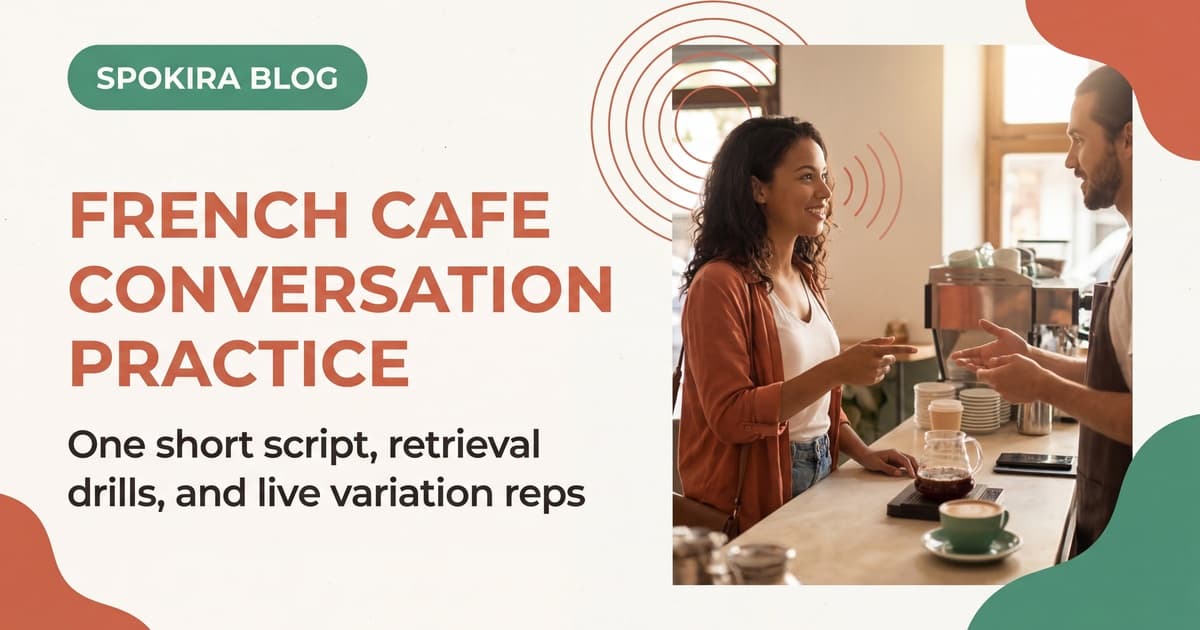
If you can read French cafe phrases but still freeze at the counter, your problem is usually not vocabulary. It is retrieval under pressure.
That is why french cafe conversation practice should be script-first and recall-first. You need one short sequence you can run automatically, then adapt in real time.
This guide keeps french cafe conversation practice narrow on purpose: one scenario, one script, one repetition system.
In this guide, you will get:
- A practical cafe script built for A2-B1 learners
- A drill progression from reading to automatic recall
- Variation modules for common real-world changes
- A 14-day plan to make the script stable in live settings
Sources in this article were web-verified on March 11, 2026, including the CEFR Companion Volume (2020), retrieval-practice evidence from PNAS, spacing evidence from Psychological Science, and French liaison guidance from the Académie française.
If you freeze mid-sentence often, start with Stop freezing mid-sentence in French: retrieval drills, then return here for scenario-specific reps.
Quick answer: what is the fastest french cafe conversation practice routine?
Use one short script and train it in six rounds:
- Read slowly with clean pronunciation
- Repeat at natural speed with rhythm
- Hide the text and answer from cues
- Swap one detail per rep (size, milk, takeaway)
- Run a 30-second no-text roleplay
- Record one take and score clarity
This works because speaking performance improves when practice emphasizes retrieval instead of passive review. In the 2008 PNAS study by Karpicke and Roediger, repeated retrieval produced much stronger long-term retention than repeated study alone (PNAS, 2008).
For scheduling, short daily repetitions beat occasional marathon sessions. Cepeda et al. (2006) showed that retention improves when study is spaced over time, with timing effects tied to the test interval (Psychological Science, 2006).
One-Script Rule
For 14 days, keep one core cafe script and train variations around it. Do not rotate five unrelated dialogues.
Why french cafe conversation practice fails for many learners
Most learners train cafe language in a way that looks productive but does not transfer.
The core issue is that french cafe conversation practice often becomes phrase collecting instead of speaking automation.
Common traps:
- memorizing 40 phrases with no retrieval pressure,
- practicing only while looking at text,
- rehearsing perfect lines with no variation,
- skipping rhythm and linking in connected speech.
In a real cafe, you do not get full prep time. You hear a question, process options, decide quickly, and speak. If training does not include that pressure, recall breaks.
The CEFR Companion Volume frames spoken interaction as co-constructed action, not isolated sentence production. You need turn-taking, clarifying, and repairing skills under time pressure, even at lower levels (Council of Europe, 2020).
The core french cafe conversation practice script (A2-B1)
Use this as your base script. Keep it short enough to repeat 20+ times.
Think of this as your base unit for french cafe conversation practice under pressure.
Version A: order + clarify + close
You: Bonjour, je voudrais un cafe allonge, s'il vous plait.
Staff: Sur place ou a emporter?
You: A emporter, s'il vous plait.
Staff: Avec du lait ou sans lait?
You: Sans lait. Et un verre d'eau, si possible.
Staff: D'accord. Ce sera tout?
You: Oui, merci. Je peux payer par carte?
Staff: Oui, bien sur.
What this script trains
- greeting and polite opener,
- order statement,
- fast response to binary questions,
- one extra request,
- payment confirmation and close.
It is intentionally compact. Your goal is automatic control of this flow, not perfect coverage of every cafe scenario.
If you need a larger daily routine around this, use French speaking practice plan (A2-B1).
Pronunciation cues that make your cafe script easier to understand
You do not need accent perfection to be clear. You need stable high-impact cues.
Focus on:
- Final consonant control: do not overpronounce silent endings.
- Liaison timing where required: keep connected flow in common chunks.
- Question prosody: short rises for yes/no checks.
The Académie française distinguishes obligatory, optional, and forbidden liaison contexts; use that framework to avoid linking everywhere (Académie française).
For a broader pronunciation framework, see French pronunciation rules that matter for speaking clarity.
Step-by-step french cafe conversation practice that builds automatic recall
Step 1: map the script into cue cards, not full lines
Create eight cue cards with minimal prompts:
- greet + order
- sur place / emporter
- milk preference
- extra request
- payment method
- close politely
- ask to repeat
- quick self-repair
Each cue should trigger a line family, not one rigid sentence.
Step 2: run controlled repetition first
Do three rounds with text visible:
- Round 1: slow, precise pronunciation
- Round 2: natural speed, consistent rhythm
- Round 3: one breath-group focus per turn
For rhythm support, pair with Sound more natural fast: rhythm and intonation practice.
Step 3: switch to hidden-text retrieval
Now close the script.
Run 10 cue-only reps:
- read cue,
- speak full line,
- check if meaning and politeness stayed intact.
If you stall for over three seconds, give yourself the first 2-3 words, then continue. That keeps retrieval effort high without full collapse.
Step 4: add one live variable per repetition
Use a variation wheel:
- drink type,
- size,
- milk/no milk,
- dine-in/takeaway,
- card/cash,
- one extra request.
Only change one variable per rep at first. When stable, change two.
Step 5: train repair moves explicitly
Real interactions need repair language. Add these lines to every session:
- Pardon, vous pouvez repeter?
- Plus lentement, s'il vous plait.
- Je veux dire... (self-correction)
This reduces panic when you miss one word.
Step 6: finish with a 30-60 second no-text roleplay
Set a timer and roleplay both sides or practice with a partner/tool. No restarts.
Then record one take. For review method, use Record yourself in French without cringing.
French cafe conversation practice variations for real life
Once the base script is stable, train these micro-scenarios.
At this stage, french cafe conversation practice is about controlled variation, not improvising everything from scratch.
Variation 1: unavailable item
Staff: Desole, on n'a plus de croissants.
You: D'accord, dans ce cas, je prends un pain au chocolat.
Variation 2: clarification request
Staff: Vous voulez un grand ou un moyen?
You: Un moyen, s'il vous plait.
Variation 3: noisy environment
You: Pardon, je n'ai pas bien entendu. Vous pouvez repeter?
Variation 4: payment issue
Staff: La carte ne passe pas.
You: Ah d'accord. Je peux payer en especes.
Train each variation as a 20-second branch off your core script, then return to baseline.
Want Daily Speaking Prompts With Feedback?
Practice short French scenario scripts with AI feedback on clarity, rhythm, and pronunciation.
14-day french cafe conversation practice plan
Use one 12-minute session per day.
| Days | Main focus | Success check |
|---|---|---|
| 1-3 | Core script accuracy | Complete script with text at natural speed |
| 4-6 | Cue-only retrieval | 10 reps with fewer than 2 stalls |
| 7-9 | Variable swaps | 8 reps with one variable change each |
| 10-12 | Repair language | 3 smooth recoveries in no-text roleplay |
| 13-14 | Live simulation | 60-second roleplay without restart |
Daily template:
- 2 min: script warm-up with text
- 3 min: cue-only retrieval
- 3 min: variation swaps
- 2 min: no-text roleplay
- 2 min: record and score
Spacing matters more than session length. Keep the streak tight and short rather than trying occasional long practices (Cepeda et al., 2006).
For a broader weekly structure, combine this with the 5-minute French speaking routine.
Scoring rubric for automatic recall in cafe situations
Score each final take from 0-2 on four dimensions.
- Retrieval speed: no long stalls
- Clarity: pronunciation + pacing understandable
- Interaction control: responds to questions naturally
- Repair quality: recovers after missed input
Total score: 0-8.
Interpretation:
- 0-3: still text-dependent
- 4-6: functional but fragile under noise
- 7-8: ready for live use in normal settings
If score plateaus, simplify again: one script, one branch, one repair line.
Common mistakes in french cafe conversation practice (and fixes)
Mistake 1: practicing only the customer lines
Fix: include expected staff questions in every rep.
Mistake 2: switching scripts too often
Fix: keep one script for at least 14 days.
Mistake 3: avoiding retrieval struggle
Fix: close text after warm-up and use cue-only reps.
Mistake 4: no pronunciation pass
Fix: run one daily pass focused on rhythm and linking.
Mistake 5: no repair training
Fix: memorize and drill 2-3 repair lines until automatic.
If conversation pressure is your main blocker, pair this article with French for travel: speak confidently in 7 days.
Extended french cafe conversation practice scripts you can rotate
After your base script is stable, rotate between three advanced-but-manageable templates. Keep the same training logic: read, retrieve, vary, then roleplay.
Script B: dine-in order with timing constraint
You: Bonjour. Je n'ai pas beaucoup de temps. Je peux avoir un cafe filtre rapidement, s'il vous plait?
Staff: Oui. Vous prenez quelque chose a manger avec?
You: Oui, un croissant. C'est possible de l'avoir tout de suite?
Staff: Oui, pas de probleme. Vous reglez maintenant ou apres?
You: Je regle maintenant, par carte.
Staff: Parfait. Installez-vous, on vous appelle.
You: Merci beaucoup.
What this script trains:
- urgency language without sounding rude,
- ordering food + drink in one flow,
- payment-timing clarification,
- polite close in a faster interaction.
Script C: allergy and ingredient clarification
You: Bonjour. Je suis allergique aux noix. Est-ce qu'il y en a dans ce gateau?
Staff: Non, pas dans celui-ci. Mais il peut y avoir des traces.
You: D'accord, merci de me le dire. Dans ce cas, je vais prendre juste un cafe.
Staff: Tres bien. Sur place ou a emporter?
You: Sur place, s'il vous plait.
Staff: D'accord.
This version trains:
- sensitive-information clarity,
- follow-up decision after new info,
- concise safer-choice response.
Script D: correction and re-order after misunderstanding
You: Bonjour, je voudrais un the vert.
Staff: Un cafe latte?
You: Pardon, non. Je veux dire: un the vert, sans sucre.
Staff: Ah d'accord, un the vert sans sucre.
You: Oui, c'est ca. Merci.
This is a high-value script because misunderstandings happen often in noisy places. If you can recover calmly, your confidence rises quickly.
How to run french cafe conversation practice with a partner (or AI)
Solo practice builds foundation, but partner-style turns improve timing and adaptability.
Use these three partner modes:
- Predictable mode: partner reads expected staff lines in fixed order.
- Shuffle mode: partner changes question order (
sur place, then payment, then milk). - Disruption mode: partner adds one unexpected issue (out-of-stock, background noise, repeat request).
Rules for each mode:
- keep turns short,
- no grammar explanations during reps,
- mark only one error type per run,
- repeat the whole script once after feedback.
If you practice with AI, ask for strict roleplay constraints:
- one question at a time,
- natural speed phrasing,
- at least one clarification per dialogue,
- final correction summary in English after roleplay.
This keeps the session close to real interaction instead of turning into passive translation.
Automatic recall checkpoints at Day 3, 7, and 14
Use checkpoint tests so you know if your practice is transferring.
Day 3 checkpoint (stability)
Goal: complete core script with text hidden and no full stop.
Pass criteria:
- max two hesitations over three seconds,
- clear greeting, order, payment close,
- at least one polite softener (
s'il vous plait,merci).
Day 7 checkpoint (variation control)
Goal: run five roleplays where each has one changed variable.
Pass criteria:
- no meaning breakdown during variable swap,
- repair phrase used correctly at least once,
- rhythm remains natural enough for easy listener tracking.
Day 14 checkpoint (live readiness)
Goal: complete 60-second simulation with two disruptions.
Pass criteria:
- no restart,
- successful clarification or correction after disruption,
- interaction reaches a clean close.
If you miss the Day 14 threshold, do not jump to a new scenario. Repeat the same script block for one more week with lower speed and tighter cue cards.
French cafe conversation practice FAQ
Should I memorize exact lines or improvise from day one?
Memorize one strong base script first. Improvisation works better after a core sequence is automatic.
How many new phrases should I add each week?
Add 4-8 high-frequency phrase chunks at most. Too much novelty weakens recall under pressure.
Is pronunciation or vocabulary more important in cafe situations?
For short service interactions, retrieval speed + clarity usually matter more than advanced vocabulary. Use simple words you can produce reliably.
What if I understand staff but cannot answer quickly?
That is a retrieval gap, not just a listening gap. Increase cue-only speaking reps and practice fixed response frames.
Can I train this in five minutes a day?
Yes for maintenance, but 10-12 minutes daily is better for building automatic recall from scratch.
Final takeaway
The fastest path to better cafe French is not collecting more phrases. It is turning one practical script into automatic recall.
Start with a short order-and-clarify flow, train cue-based retrieval daily, and add small variations only after the base is stable. Keep repair lines ready so one missed word does not break the whole interaction.
With a focused 12-minute routine, most A2-B1 learners can move from text-dependent practice to usable live performance within two weeks.
If you want guided repetition with feedback, start with Spokira's speaking practice tools and run this exact script as your first scenario block.