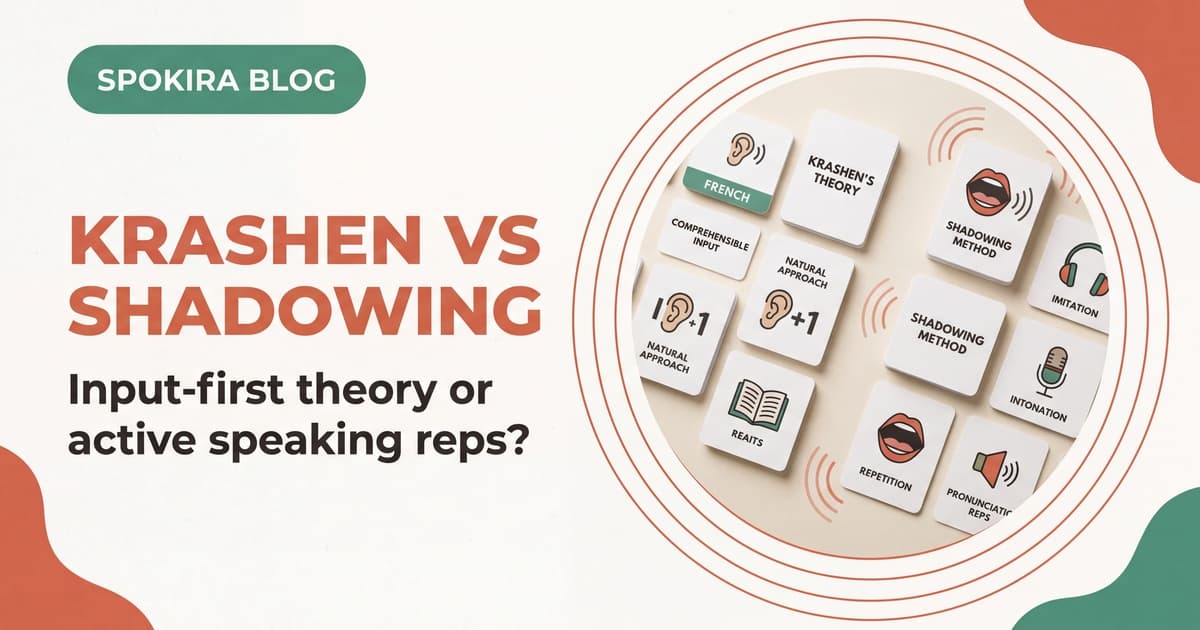
If you are weighing Krashen vs shadowing for French, you are really asking a bigger question: should you spend more time understanding the language, or more time saying it out loud?
That question matters for French learners too. Dreaming is one of the clearest modern examples of a comprehensible input system, and shadowing is one of the clearest examples of an active speaking drill. Put them side by side and you get the exact tension many adult learners feel: "If input is how acquisition happens, why do I still freeze when I need to speak?"
The short version is this. Dreaming-style CI follows Stephen Krashen's input-first view closely. Shadowing does not. But shadowing trains something that input-heavy learners often need sooner than they want to admit: pronunciation, timing, and mouth-level automaticity.
So this is not a clean good-vs-bad comparison. It is a job-description comparison. One method builds your internal model of the language. The other helps your mouth catch up to that model.
If you are already stuck in the familiar "I understand more than I can say" phase, start with understand French but can't speak and why shadowing works for French. Then come back here for the theory and the tradeoffs.
Krashen vs shadowing for French: quick answer
Use this rule:
- Choose Dreaming-style comprehensible input if your main problem is that the language still sounds blurry, fast, or exhausting.
- Choose shadowing if you already understand decent chunks but still sound slow, flat, or hesitant when you speak.
- Use both if you want the strongest long-term setup. Input gives you language to work with. Shadowing helps you deliver it under time pressure.
The practical mistake is treating them as interchangeable. They are not.
Dreaming-style CI is an input system. Shadowing is an imitation drill. One is mainly about understanding messages. The other is mainly about reproducing sound, rhythm, and phrasing in real time.
What did Krashen actually mean by comprehensible input?
Krashen's 1982 book Principles and Practice in Second Language Acquisition lays out the five ideas people usually associate with his theory:
- Acquisition-learning distinction: subconscious acquisition matters more for fluent use than consciously memorizing rules.
- Natural order hypothesis: language features are not acquired in whatever order the textbook presents them.
- Monitor hypothesis: explicit grammar knowledge can edit output, but it does not generate fluent speech.
- Input hypothesis: we acquire language by understanding messages that are slightly beyond our current level.
- Affective filter hypothesis: anxiety, low confidence, and other emotional barriers can block useful input from turning into acquisition.
The one that matters most in the Krashen vs shadowing for French debate is the input hypothesis. In Krashen's 2020 summary of "optimal input", he argues very directly that we acquire language from understanding what we hear and read, not from speaking or writing first. In that view, fluent output is a result of acquisition, not the engine that causes it.
That is why Krashen's work became such a clean foundation for video-first learning systems. If understandable input is the main driver, then your first job is not to perform. Your first job is to understand a lot.
This is also why so many adult learners find Krashen emotionally convincing. It offers relief from the usual classroom pressure. You do not need to force yourself into shaky early output just to feel like you are "really studying." You can build comprehension first.
There is something important to say here, though: Krashen's framework is influential, but it is not the only serious view in second-language research. Later sections of this article get into where output-based arguments push back.
How does Dreaming apply Krashen's theory?
Dreaming's method page is unusually explicit about its intellectual roots. It says the method was developed from decades of research associated with Krashen and defines comprehensible input as language that is meaningful, understandable, and slightly challenging.
In practice, Dreaming turns that into a few concrete rules:
- find content where you understand the majority of the message
- keep consuming understandable material that gets gradually harder
- focus on meaning instead of drilling grammar
- track hours of input as the main progress metric
Dreaming's FAQ gets even more specific. It currently recommends aiming for about 80% of the overall meaning, not 80% of every word. That detail matters because it stops learners from turning CI into another perfectionist project. You are not supposed to pause every ten seconds and dissect the sentence. You are supposed to stay with the message.
The other striking part of the FAQ is its stance on speaking. Dreaming says that speaking does not result in acquisition, warns that early speaking can push learners to build a distorted internal version of the language, and recommends waiting until later in the roadmap before doing much speaking practice.
This is about as Krashen-aligned as a modern language product can get.
It also explains why Dreaming works so well for certain learners:
- people who panic when they try to speak too early
- people who need a sustainable daily routine
- people whose listening is far behind their ambitions
- people who quit when language study feels like constant correction
If your current problem is "the language still sounds like noise," Dreaming's approach makes a lot of sense.
If your current problem is "I can follow the video but I still cannot answer fast," the answer changes.
What does shadowing train that input alone often misses?
Shadowing is simple to describe and hard to do well. You listen to a short piece of audio and repeat just behind the speaker with as little delay as possible.
That sounds like output practice, but it is a very specific kind of output practice. You are not inventing sentences from scratch. You are borrowing a native model and trying to match:
- segmental sounds
- rhythm
- intonation
- linking
- pacing
- breath timing
That makes shadowing much more physical than a normal speaking exercise. It is not only about whether you know the sentence. It is about whether your mouth can execute it cleanly.
This is the blind spot in a lot of input-only routines. You may hear French often enough to recognize the phrase instantly, but your mouth still has weak control over the timing and sound pattern.
Dreaming's own FAQ quietly admits part of this. When it discusses when to start speaking, it says that later speaking practice helps you learn to use the muscles in your mouth to produce sounds accurately and at a normal pace. That is a useful concession because it shows the disagreement is not really "speaking never matters." It is "speaking matters, but later and in smaller doses than many learners think."
Research outside the Dreaming ecosystem points the same way. Izumi and colleagues' 1999 study on the output hypothesis found that producing language can help learners notice gaps in their knowledge. In a 2002 follow-up study on output, input enhancement, and noticing, output-plus-input conditions outperformed comprehension-only exposure for the target form being studied. That does not prove that output replaces input. It does suggest that trying to produce language can sharpen attention and improve later learning.
For pronunciation specifically, the evidence is stronger than many CI purists like to say. A 2025 meta-analysis in the Journal of Speech, Language, and Hearing Research reported a large positive overall effect for second-language phonetic training across 65 studies and 2,793 learners. And Yoko Mori's 2011 study on shadowing with oral reading found improvement in rhythm, intonation, and final lengthening.
So if you want a clean sentence here, it is this:
Shadowing is not the main engine of acquisition in Krashen's framework, but it is a very plausible engine for pronunciation control and faster spoken delivery.
Krashen vs shadowing: side-by-side
| Feature | Dreaming-style CI | Shadowing |
|---|---|---|
| Main category | comprehensible input | active imitation drill |
| Core task | understand messages | repeat audio immediately |
| Main payoff | comprehension, vocabulary in context, feel for the language | pronunciation, rhythm, timing, fluency under pressure |
| Stress level | usually lower | usually higher |
| Best use case | building the system | activating the system |
| Best stage | beginner through intermediate | late beginner onward, once lines are understandable |
| Biggest risk | staying passive after your bottleneck changes | copying material you do not really understand |
| Krashen alignment | very high | low to mixed |
That table is the whole article in miniature.
Dreaming-style CI is strong when you need more language in your head.
Shadowing is strong when you need better access to language already partly in your head.
Where does the input-vs-output debate stand now?
A lot of internet arguments make this sound more dramatic than it is.
Krashen's position is clear: input drives acquisition. Dreaming takes that seriously. Output-heavy critics, meanwhile, usually point out that adult learners often need speaking, writing, or interaction to notice what they cannot yet do.
The strongest practical reading of the research is not that input lost and output won. It is that input and output are solving different problems.
Input is still the foundation because without enough understandable language, you do not have much to retrieve, imitate, or adapt. But output can do useful work:
- it exposes retrieval gaps
- it reveals pronunciation weak points
- it raises your attention to form
- it tests whether recognition can survive time pressure
This is why the cleanest adult-learning advice is usually staged, not ideological.
At the beginning, heavy comprehensible input is often the highest-return move.
Later, especially around A2-B1, more input by itself may stop fixing the main bottleneck. You understand more each month, but your speaking barely moves. That is usually the moment when shadowing or some other constrained output drill starts paying off.
If you want the broader method-order discussion, read comprehensible input, shadowing, SRS, or conversation: what first? and can you learn French with videos alone?.
Krashen vs shadowing for French learners in practice
Here is the part people actually need.
If you are learning French and using Dreaming as your model for CI, do not copy the philosophy mechanically. Copy the useful part: lots of understandable language, low friction, and patience. Then add just enough output when your bottleneck changes.
If you are a true beginner
Stay mostly input-first.
- watch or listen to easy, highly understandable French
- build a feel for common sentence patterns
- do only tiny amounts of speaking if it helps motivation
- avoid forcing long conversations too early
At this stage, shadowing should stay short, slow, and narrow. Think one or two travel phrases, not a full daily speaking block.
If you are around A2 and understand more than you can say
This is where many learners waste months.
They keep piling on input because the theory still sounds right. But the symptom is no longer "I do not understand enough." The symptom is "my mouth is late."
That is when shadowing becomes useful.
A good starting point:
- Watch or listen to 10-20 minutes of understandable French.
- Pull one short clip or one short dialogue from that content.
- Shadow it 10-20 times.
- Say it once without the audio.
- Change one detail and say the new version.
That last step matters. It stops shadowing from becoming pure mimicry and starts turning it into flexible speech.
If you need a fully structured version, use French shadowing practice: one clip, 15-30 spoken reps and how to practice spoken French: complete A2-B1 system.
If you are already intermediate
Do not ask whether Dreaming-style CI or shadowing is "better." Ask what is failing today.
Use this shortcut:
- If native or learner-friendly French still feels hard to follow, increase input.
- If you understand but still freeze, increase shadowing and recall.
- If your pronunciation is muddy, use shadowing plus recording.
- If your speech is accurate but slow, add retrieval and scenario drills.
There is no credible universal ratio like "80/20" that works for every learner in every phase. Use ratios as temporary tools, not as religion.
A Better Rule Than 80/20
Keep input high enough that the language keeps growing. Add enough shadowing that your mouth stops lagging behind your ears.
Use Input Without Staying Passive
Build a French routine that starts with understandable input and then turns it into shadowing, recall, and speech you can actually use.
Final verdict: input first, shadowing second
If you strip away the branding and the online arguments, the answer to Krashen vs shadowing for French is not especially mysterious.
Dreaming-style comprehensible input is better for acquisition through understanding. It is a practical, modern expression of Krashen's input-first view. It lowers stress, scales well, and works especially well when you still need more language in your system.
Shadowing is better for delivery. It helps with pronunciation, rhythm, and turning comprehension into something you can say at speed.
So if you have to choose one method at the very start, choose the one that makes the language understandable. But once you can follow short, useful lines, do not stay passive just because the theory sounds elegant.
That is where many adult learners get stuck. They protect the acquisition phase so hard that they never train the performance phase.
The better sequence is:
- understand a lot
- shadow short, clear lines
- recall them without help
- vary them in real situations
That is usually how you move from "I know what they said" to "I can actually say it too."
If you want a product flow built around that bridge, try Spokira's speaking practice system or start a free trial. If you want the bigger comparison between story input and active speaking drills, read story-based learning vs shadowing for French.