French learners waste a lot of time not because they are lazy, but because they pick methods in the wrong order.
They start conversation before they have enough language to use. Or they keep doing input long after input has stopped fixing the main problem. Or they build giant flashcard decks without any plan for turning those words into speech.
So the useful question is not which method is best in the abstract. It is this: what should French learners do first?
This guide gives a stage-by-stage answer for four common methods: comprehensible input, shadowing, SRS, and conversation practice.
What should French learners do first? Quick answer
For most learners:
- start with comprehensible input and a small base of useful phrases
- add SRS only for the vocabulary you actually keep meeting
- add shadowing once you can follow short phrases with meaning
- add conversation or scenario output once you can produce short chunks without collapsing
If you want the narrower threshold question only, use when should you start shadowing for French.
Stephen Krashen's 2020 piece on optimal input defends the idea that acquisition starts from understanding what we hear and read (Krashen, 2020). That is why input belongs early.
But that does not mean output waits forever. The output-hypothesis literature argues that trying to produce language can make learners notice gaps in what they know (Izumi et al., 1999). And retrieval plus spacing research keeps showing that recall strengthens later access better than endless restudy (Roediger & Karpicke, 2006; Cepeda et al., 2006).
So the right answer is not "input only" or "speak from day one." It is staged progression.
Stage 1: true beginners should start with input and tiny amounts of memory work
If you are a true beginner, the first job is simple: stop French from sounding totally opaque.
At this stage, do mostly:
- slow or learner-friendly listening
- easy reading
- subtitled short-form content
- a very small phrase deck if it helps
Do not do much:
- open conversation
- random shadowing of fast native content
- giant flashcard systems
Why? Because beginners need understanding first. If you cannot follow the line at all, shadowing becomes noise-copying and conversation becomes panic.
Stage 2: early learners should add shadowing before they add open conversation
Once you can understand short everyday lines, shadowing becomes useful.
This is the point where French learners should do something active, but not too open-ended yet.
Shadowing works well here because it:
- keeps a native model present
- reduces the pressure of inventing from scratch
- trains rhythm and timing
- starts the input-to-output bridge
If you skip this step and jump straight into conversation, you often get hesitant speech with poor timing and lots of translation lag.
That is why I would put shadowing before open conversation for most learners who are around A1-A2.
Stage 3: use SRS only where it supports the other methods
SRS is useful, but it is easy to overrate because it feels measurable.
In practice, this usually means Anki or another spaced-repetition flashcard app. Anki is popular because it schedules reviews based on what you remembered and what you missed, so common phrases stay alive longer without forcing you to review everything every day.
It is best used for:
- words and phrases you keep meeting in input
- lines you want available for speaking
- weak spots you repeatedly miss in retrieval drills
For French learners, that usually works best when the cards come from real use:
- phrases from videos or podcasts
- lines you want to say in conversation
- sentence cards built from mistakes you made
It works much worse when SRS becomes a separate hobby. If you spend all your time feeding a deck and none of your time listening or speaking, the method has taken over the goal.
It is not the best first focus because memory storage is only one part of language use.
If your deck keeps growing while your speaking stays flat, the deck is no longer the limiting factor.
Stage 4: add conversation when you can already produce small chunks
Conversation becomes useful when you have enough material to survive a few turns without full breakdown.
That threshold is different for everyone, but the pattern is consistent. Conversation helps most when you already have:
- a small set of familiar phrases
- some pronunciation stability
- at least a little retrieval speed
At that point, conversation gives you:
- unpredictability
- repair practice
- turn-taking
- emotional pressure that drills cannot fully simulate
This is also where CEFR thinking helps. The 2020 Companion Volume frames early speaking growth around simple functional exchanges and predictable tasks, not perfect spontaneity (Council of Europe, 2020).
If you are stuck, choose by bottleneck instead of by ideology
French learners often get trapped in method ideology.
They ask:
- "Should I do only comprehensible input?"
- "Should I only speak from day one?"
- "Should I use Anki every day?"
Those questions are too broad.
A better question is:
What is the main thing breaking right now?
Use this shortcut:
| Bottleneck | Best first move |
|---|---|
| French still sounds too fast and blurry | more comprehensible input |
| You understand but sound stiff | shadowing |
| You keep forgetting useful phrases | SRS plus retrieval |
| You know the line but cannot say it on time | retrieval drills |
| You can drill well but freeze with people | conversation transfer |
That is usually more useful than arguing about the "best method" in general.
A simple order that works for most self-learners
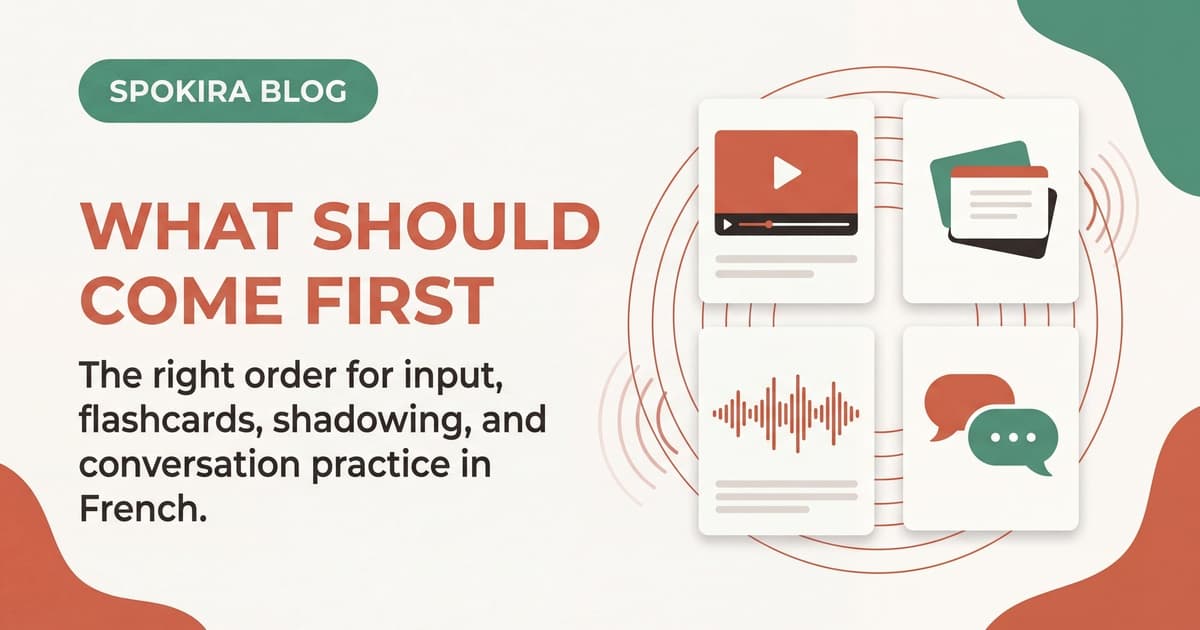
If you want one clean sequence, use this:
- Input first
- Small memory support second
- Shadowing third
- Retrieval fourth
- Conversation transfer fifth
That does not mean you fully finish one before touching the next. It means each method enters when it can do useful work.
Example progression
Weeks 1-4:
- mostly input
- tiny phrase review
Weeks 4-8:
- keep input high
- add shadowing
- keep memory support small
Weeks 8-12:
- add retrieval drills
- start low-pressure conversation or scenario practice
After that:
- keep the methods that still fix real problems
- cut the ones that are just giving you the feeling of work
What French learners should not do first
There are a few low-efficiency moves that show up repeatedly:
- building a 3,000-card deck before you can use 50 phrases comfortably
- forcing long conversations before you can retrieve short lines
- shadowing audio that is too hard to understand
- using video-only learning once you already know the main issue is speaking
Those mistakes are common because they look serious. They just are not always well timed.
The best "first" method changes over time
This is the part people miss. "What should French learners do first?" has a different answer at different stages.
At the beginning, input usually wins. At the middle stage, shadowing and retrieval become much more important. At the point where you need live transfer, conversation starts to matter more.
That is why the right method order is dynamic, not fixed forever.
Use the Right French Method at the Right Time
Build a daily speaking routine that starts from input but moves into shadowing, retrieval, and real output before you plateau.
So what should French learners do first?
Start with enough comprehensible input to make French feel legible. Then add shadowing and retrieval earlier than most input-only learners expect. Add conversation when you have enough chunks to make it productive.
That sequence is usually what keeps self-study from turning into either passive consumption or premature speaking chaos.
If you are already past the beginner stage and still unsure, the best next pages are French speaking practice, the weekly speaking plan, and the anti-freeze retrieval drill.