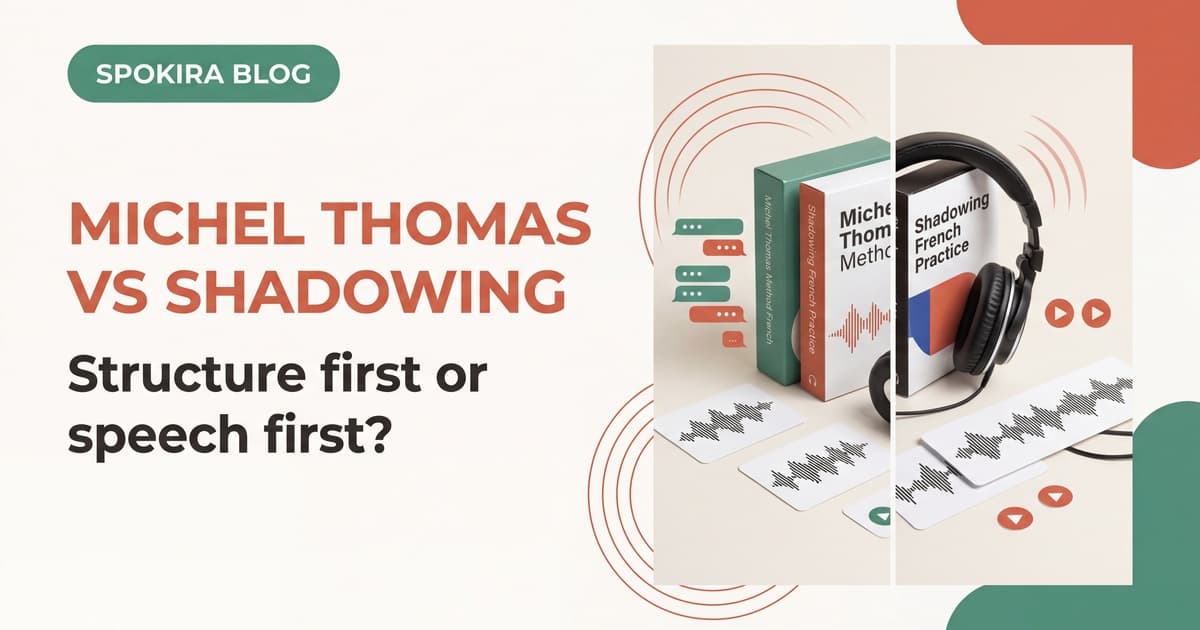
If you are comparing Michel Thomas vs shadowing for French, the fastest answer is this: Michel Thomas helps you build sentences; shadowing helps you sound better saying them.
That is why learners often confuse the two. Both are audio-based. Both can be done alone. Both feel more practical than staring at grammar tables. But they train different parts of the problem.
Michel Thomas is a guided, slow-paced teaching method. Shadowing is a mimicry technique. One gives you structure and reduces panic. The other trains rhythm, timing, and delivery.
So the real question is not "Which one is better?" It is "Which bottleneck are you trying to fix?"
If you want the broader map of where shadowing fits among other study methods, use French learning methods ranked for A2-B1 or the stage-by-stage guide to what French learners should do first.
Michel Thomas vs shadowing for French: quick answer
- Use Michel Thomas if you are a true beginner and still need help forming basic French sentences.
- Use shadowing if you already understand some French but still sound stiff, slow, or foreign when you speak.
- Use Michel Thomas first, then shadowing if your grammar confidence is low but your goal is eventually to speak with better flow.
- Do not expect Michel Thomas to fix your accent.
- Do not expect shadowing to teach sentence structure from zero.
At a glance: Michel Thomas vs shadowing
| Feature | Michel Thomas Method | Shadowing |
|---|---|---|
| Primary focus | sentence building and grammar through guided audio | pronunciation, rhythm, timing, and flow |
| Core move | pause, think, then construct | repeat almost simultaneously |
| Pace | slow and teacher-led | fast and imitation-led |
| Materials | Michel Thomas courses | short native or learner-friendly audio clips |
| Best fit | beginners, anxious grammar learners, travel prep | A2-B1 learners, accent work, output transfer |
| Main strength | makes structure feel usable quickly | makes spoken French feel less flat and less delayed |
| Main risk | can feel too controlled later on | can become parroting if the audio is too hard |
What the Michel Thomas method actually trains
Michel Thomas is not immersion in the usual sense. It is a highly guided teaching format.
On the official French page, Hachette describes Foundation French as an 8-hour beginner course with "no books, exercises, memorizing or homework" and says that by the end you should be able to understand and speak basic French (Michel Thomas French). The same official ecosystem also layers later products like Language Builder, Intermediate, and Insider's French, which tells you a lot about the method: it is structured, sequential, and scaffolded.
The course design matters even more than the marketing line. On an official Michel Thomas course page, the company explains that you join a teacher and two students in a live lesson, then build responses by listening and "thinking out answers for yourself." It also describes the method as language broken into sequential building blocks so you can construct more complex sentences step by step (Michel Thomas course page).
That is why Michel Thomas works well for learners who:
- panic when they see grammar explanations
- need sentence structure more than accent work
- like having a teacher carry the lesson
- want to feel early wins without memorizing lists
What it does especially well is remove the blank-page feeling. You are not being asked to invent French from nowhere. You are being walked through sentence construction in a controlled order.
That makes Michel Thomas a pedagogical method first. It teaches you how French is put together.
What shadowing actually trains
Shadowing does almost the opposite.
Instead of slowing French down and explaining it, shadowing asks you to keep up with speech and copy it in real time. You listen to a line, then repeat just behind the speaker, trying to match their rhythm, intonation, vowel quality, and pacing.
That is why shadowing is less about understanding rules and more about training your mouth and ear together.
Research on shadowing is not French-specific, but the pattern is useful. A 2011 study in Language Education & Technology found gains in prosody when shadowing was paired with oral reading in an EFL context (Mori, 2011). A 2015 paper in the Journal of the Phonetic Society of Japan reported that shadowing/repeating training appeared to improve rhythm in learner speech (Rongna, Hayashi, Kitamura, 2015). And a 2025 meta-analysis of second-language phonetic training found a large positive overall effect for phonetic training across 65 studies (Yao et al., 2025).
That does not mean shadowing does everything. It means shadowing is strongest when your real problem is:
- English-timed rhythm
- flat intonation
- hesitation on familiar phrases
- slow transition from listening to speaking
If that sounds like your situation, go deeper with Why shadowing works for French and the full French speaking practice guide.
Michel Thomas vs shadowing: the biggest differences
The biggest difference is not audio versus audio. It is construction versus imitation.
Michel Thomas is pause-and-think
Michel Thomas gives you time to build a sentence. The pace is intentionally slow. The teacher explains why the sentence works, then nudges you toward the answer.
That is great if your problem is:
- "I do not know how to put the sentence together."
- "Grammar explanations make me shut down."
- "I need a calm beginner method."
Shadowing is keep-up-and-copy
Shadowing removes the pause. You are not stopping to analyze. You are trying to stay close enough to the audio that French starts to feel physical, not just intellectual.
That is great if your problem is:
- "I know the phrase, but it comes out badly."
- "My French still sounds English."
- "I understand more than I can say."
If that recognition-versus-production gap feels familiar, You understand French but can't speak is the closer diagnosis page.
Michel Thomas is controlled input
The Michel Thomas ecosystem is built around specific courses, specific sequencing, and heavy teacher guidance. That is a strength early on. It lowers stress. It also means the method stays curated and somewhat narrow by design.
Shadowing is flexible input
Shadowing can be done with learner podcasts, short dialogues, or native clips. That flexibility is powerful, but it creates a new problem: if your material is too hard, you stop shadowing and start drowning.
That is the failure mode to watch. Michel Thomas gets slow when you have outgrown it. Shadowing gets sloppy when you choose material above your level.
Michel Thomas vs shadowing for French beginners and A2-B1 learners
Use Michel Thomas first if you are an absolute beginner
If French still feels mostly opaque, Michel Thomas is usually the cleaner first step.
Why? Because shadowing assumes there is already something to imitate. If you cannot follow even short everyday lines yet, shadowing often becomes mouth-noise practice.
Michel Thomas gives you:
- a low-stress entry point
- basic sentence architecture
- early speaking confidence without open-ended conversation
For a true beginner, that can be enough to get moving.
Use shadowing first if you are already around A2-B1
If you can understand short dialogues, read simple French, or recognize familiar phrases, shadowing usually has a better payoff.
At that stage, the bottleneck is often not grammar knowledge. It is delivery:
- saying things on time
- linking words together
- sounding less chopped up
- speaking without translating every word first
That is why shadowing tends to outperform teacher-led structural methods later on. It targets the part that still feels missing in real speech.
If you mainly want drills and routines, the broader hub is French speaking practice.
Use Michel Thomas for travel-cram structure
Michel Thomas can also make sense if your goal is narrow and immediate, like a short trip where you need basic sentence patterns fast.
It is good at giving you controlled starter language without forcing you into live conversation too early.
Use shadowing for accent, rhythm, and speed
If your complaint is "people understand my French, but I still sound awkward," shadowing is the better tool.
It is not magic, but it is better aligned with the problem. For active speaking practice built around that same transition, Spokira's speaking workflow is the product-side extension.
Two quick learner profiles
If you still are not sure, use these two snapshots.
Profile 1: the anxious beginner
You know a few French words, but you freeze when you try to build even a basic sentence. You do not trust your grammar. You like having a teacher explain why the sentence works.
Start with Michel Thomas.
It gives you structure, pacing, and an easier first contact with sentence building. Shadowing can come later, once the phrases stop feeling like random sound.
Profile 2: the stuck intermediate learner
You can follow simple French podcasts. You recognize common phrases. You probably understand more than you speak. But when you answer out loud, the sentence comes late, the rhythm sounds English, and the whole thing feels heavy.
Start with shadowing.
At that point, another guided beginner course usually does not fix the real issue. You need repetitions that train timing, linking, and spoken ease.
Train Structure and Delivery Separately
Use guided sentence-building to get started, then switch into shadowing and feedback once your real bottleneck becomes rhythm, pronunciation, and spoken flow.
Can you combine Michel Thomas and shadowing for French?
For many learners, the strongest answer is not Michel Thomas or shadowing. It is Michel Thomas then shadowing.
That sequence makes sense because the two methods cover different jobs:
- use Michel Thomas to make French sentence structure feel less intimidating
- move into shadowing once you can follow short, useful lines
- keep shadowing narrow and repeatable, not random
- add retrieval or scenario speaking after that
A simple version looks like this:
- weeks 1-3: Michel Thomas or another guided beginner method
- weeks 3-6: short shadowing on lines you mostly understand
- weeks 6+: shadowing plus retrieval or scenario speaking
That sequence avoids two common mistakes:
- starting shadowing too early, when everything still sounds blurry
- staying in guided beginner material too long, after your real problem has become spoken delivery
What does a simple weekly plan look like?
If you want to combine Michel Thomas and shadowing without turning study into a mess, keep the jobs separate.
Week 1-2: Michel Thomas-heavy
- 15-20 minutes of Michel Thomas most days
- no pressure to speak fast yet
- write down nothing if that helps you stay in the audio flow
- focus on sentence patterns you can reuse
The goal here is not pronunciation polish. The goal is to stop French from feeling structurally mysterious.
Week 3-4: transition phase
- 10-15 minutes of Michel Thomas or another guided lesson
- 5 minutes of shadowing on one short line or mini-dialogue
- keep the audio easy enough that you mostly know what you are copying
This is the bridge point. You keep building structure, but you also start making French more physical.
Week 5 and beyond: shadowing-heavy
- 5-10 minutes of shadowing
- 2-3 minutes of replay or self-recording
- 2-3 minutes of free recall without the audio
At this stage, Michel Thomas becomes optional support. Shadowing, retrieval, and scenario speaking do more of the heavy lifting.
If you want a more complete version of that progression, the next practical page is French speaking practice guide.
Final verdict
Michel Thomas and shadowing are both audio-based, but they are not parallel tools.
Michel Thomas is best when you need structure, calm pacing, and help building basic sentences.
Shadowing is best when you need pronunciation, rhythm, and faster spoken output.
So if you are asking which one to use, choose the one that matches the bottleneck you have right now.
If you are a beginner, Michel Thomas is often the cleaner first move. If you are already understanding French but still struggling to sound natural, shadowing is usually the better bet.
And if you want the strongest long-term result, use both in sequence: first learn how French is built, then train your mouth to actually say it well.
If you want guided shadowing once you are past the beginner stage, start a Spokira trial and train with native-paced audio, short speaking reps, and focused feedback.