If you are looking for the best French learning methods A2-B1 learners should use, the real question is not which method sounds smartest. It is which method actually moves listening, pronunciation, recall, and speaking forward.
This stage is awkward on purpose. You can understand a decent amount, but speaking is still uneven. You know enough to work with authentic material, but not enough to improvise comfortably. You can memorize vocabulary, but memory alone does not make conversation flow.
That is why ranking methods by vibe or popularity is not useful. The only useful ranking is by function.
Best French learning methods A2-B1: quick answer
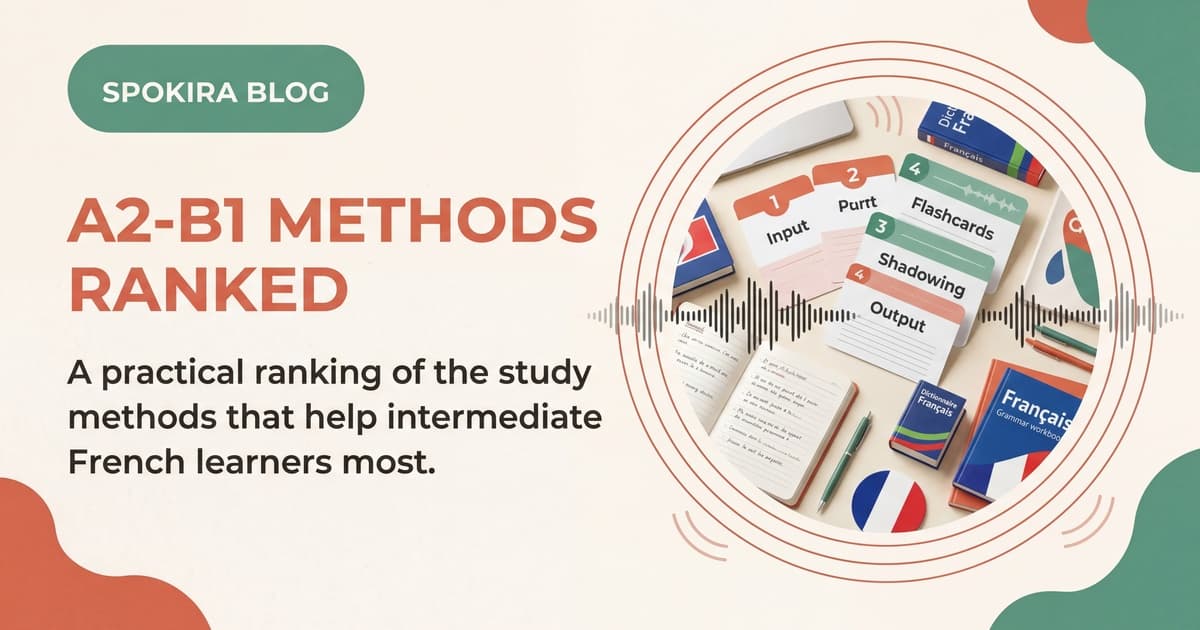
For A2-B1 learners, I would rank them like this:
- comprehensible input
- shadowing
- retrieval practice
- task-based conversation practice
- SRS flashcards
Why this order?
- Input still matters because it keeps expanding your internal model of French (Krashen, 2020).
- Shadowing and pronunciation work matter because A2-B1 learners are starting to produce more, and production quality does not fully self-correct through exposure alone (Yao et al., 2025).
- Retrieval and spacing research support active recall plus repeated review over passive rereading (Roediger & Karpicke, 2006; Cepeda et al., 2006).
- CEFR speaking descriptors for this band focus on familiar, functional communication, which is why task-based practice belongs here too (Council of Europe, 2020).
What this ranking is actually measuring
This is not a ranking of academic prestige. It is a ranking of practical usefulness for the A2-B1 stage.
The core question is:
Which methods help the most if you want to understand more French and also speak it more reliably?
Best French learning methods A2-B1 ranking: 1) Comprehensible input
Best for: listening growth, phrase familiarity, and general acquisition.
At A2-B1, comprehensible input is still the base layer. You need enough understandable French in your system that common patterns stop feeling new every time.
This includes:
- learner podcasts
- subtitled short-form video
- easy native content
- graded reading
Why it ranks first:
- it feeds every other method
- it expands vocabulary in context
- it keeps your ear improving
Why it does not solve everything:
- it does not automatically train fast spoken recall
- it does not directly repair pronunciation
If you lean too hard on this method alone, you get the exact problem covered in Can you learn French with videos alone?.
2) Shadowing
Best for: pronunciation, rhythm, and the bridge from input to output.
Shadowing ranks second because it starts turning passive knowledge into physical speech. At A2-B1, that matters a lot.
It is especially strong for:
- smoothing delivery
- reducing English-style stress patterns
- copying native rhythm
- moving from "I know this" to "I can say this"
It does not rank first only because shadowing works best when it is built on understandable input. Without that base, you are just imitating noise.
Go deeper here with Why shadowing works for French.
3) Retrieval practice
Best for: recall speed, anti-freeze speaking, and real access.
This is where many A2-B1 learners get their biggest surprise.
They realize their real problem is not lack of exposure. It is lack of access under pressure.
Retrieval practice means producing the phrase without support. It tells you whether the French is available or only recognizable.
It ranks above conversation for one reason: it is a cleaner training bridge. It is easier to control, repeat, and measure than free conversation.
Use the French output retrieval drill if this is your bottleneck.
4) Task-based conversation practice
Best for: transfer into real-life interactions.
Conversation matters at A2-B1, but task-based conversation matters more than random chat.
Good examples:
- cafe ordering
- introducing yourself at work
- asking for directions
- clarifying a reservation
- explaining a simple problem
This method ranks fourth because it is valuable, but it works better after you already have:
- enough input to recognize common patterns
- enough shadowing to produce them more clearly
- enough retrieval work to say them without a script
If you add it too early, it turns into panic and circumlocution.
5) SRS flashcards
Best for: memory support.
SRS flashcards are still useful at A2-B1. They just should not dominate your study week.
For most learners, this means Anki. Anki is a spaced-repetition flashcard tool that shows you cards on a schedule based on how well you remember them. If a phrase is easy, it appears less often. If you keep missing it, it comes back sooner.
That is why Anki can be helpful for French:
- it keeps common phrases available
- it reduces random forgetting
- it gives structure to vocabulary review
But it also has a clear ceiling. Anki can help you remember French. It cannot, by itself, make your pronunciation clearer or your speaking more automatic.
Why they rank fifth:
- they help retention
- they are easy to overuse
- they do less for pronunciation, flow, and speaking transfer than the four methods above
They are strongest when tied to the rest of your system:
- phrases you heard in input
- lines you shadowed
- expressions you failed in retrieval
That is when flashcards stop being a separate hobby and start supporting your French.
What this ranking changes if your bottleneck is unusual
The order above fits a typical A2-B1 learner, not every learner.
You might move shadowing to number one if:
- people often do not understand your pronunciation
- your rhythm is the main problem
You might move task-based conversation higher if:
- you already sound fairly clear
- your main problem is live performance
You might move SRS higher temporarily if:
- you are missing basic high-frequency vocabulary constantly
But for most learners, the general order stays close to this one.
A good weekly split for A2-B1
If you want a practical mix, try:
| Method | Share of study time |
|---|---|
| Comprehensible input | 35-40% |
| Shadowing | 20-25% |
| Retrieval practice | 15-20% |
| Task-based conversation | 10-15% |
| SRS flashcards | 10-15% |
That is not a law. It is just a useful baseline.
The pattern is clear, though: methods that build understanding and speaking transfer deserve more time than memory support alone.
The biggest A2-B1 mistake
The biggest mistake at this stage is treating all study methods as interchangeable.
They are not.
- input builds the model
- shadowing builds the sound pattern
- retrieval builds access
- task practice builds transfer
- SRS preserves useful material
Once you see those jobs clearly, study planning gets much easier.
Build the Right Method Mix for A2-B1 French
Use input, shadowing, and retrieval in the right order so your French study time turns into clearer speaking and faster recall.
Final ranking for A2-B1 French learners
If your goal is to understand more French and speak it more reliably, keep this order in mind:
- input
- shadowing
- retrieval
- task-based conversation
- SRS
That is not the only way to learn French. But for many A2-B1 learners, it is the most practical way to stop floating between methods and start getting compounding returns from them.