You listen to French. You understand most of it. Then someone asks you a simple question and your answer comes out slow, broken, or not at all.
That is the listening-to-speaking gap, and it is exactly where focused french conversation practice helps. You do not need ten new lessons. You need one short clip and a repeatable system that moves you from recognition to fast spoken retrieval.
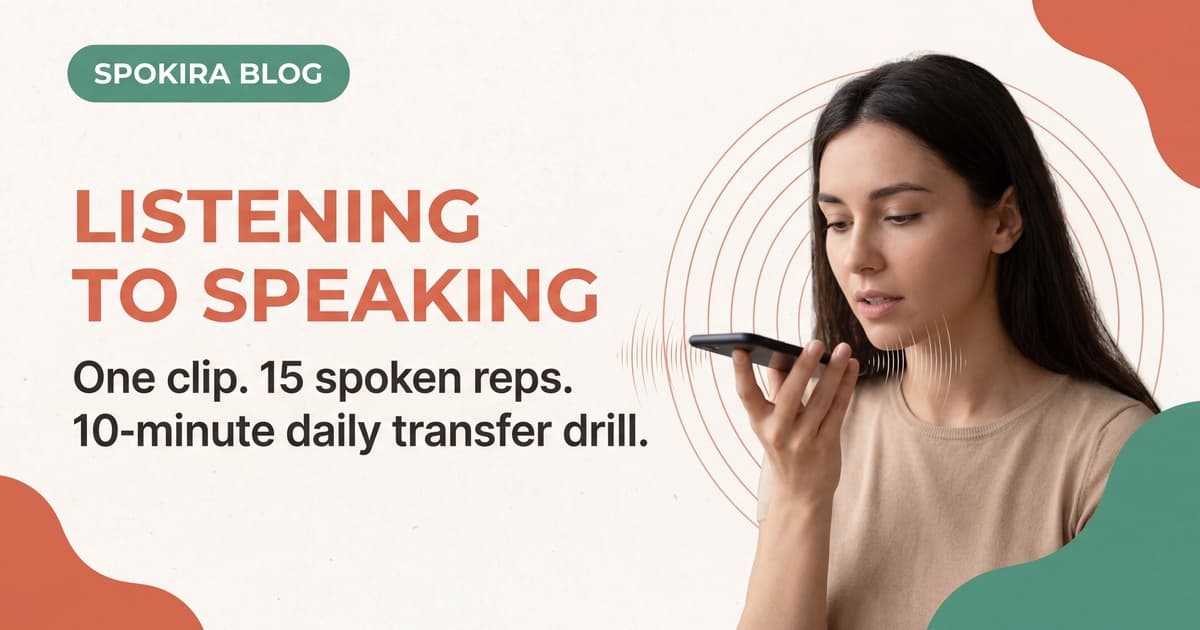
In this guide, you will learn a 10-minute routine that turns one audio clip into 15 spoken reps. You will train rhythm, word retrieval, and recovery lines under light pressure. This is built for A2-B1 learners who want usable speech in real conversations.
If you want the big-picture framework first, start with French Speaking Practice: The Complete Guide. This post gives you one narrow skill: converting input into output quickly.
Quick plan: french conversation practice in 10 minutes
Use one short clip (10-25 seconds) and run this sequence:
- Listen twice for meaning.
- Chunk the clip into 3-5 speakable units.
- Shadow each chunk 3 times.
- Recall each chunk without audio.
- Link chunks into one full run.
- Do 3 pressure rounds (faster pace, variation, interruption).
- Record one final run and score it.
Why this works: retrieval practice beats passive review for long-term recall. In a controlled study, Roediger and Karpicke (2006) found repeated testing produced better delayed retention than repeated study (PubMed).
Why does listening not automatically become speaking?
Most learners spend more time on input than output. That is normal. It is also why speech can feel fragile.
Listening gives you recognition cues. Speaking removes those cues and demands rapid retrieval, sequencing, and motor execution in real time. CEFR descriptors also reflect this gap: many learners can understand familiar topics before they can produce smooth, sustained speech under interaction pressure (CEFR Companion Volume, Council of Europe, 2020).
Your brain is handling three jobs at once:
- lexical retrieval: finding the right word now
- sentence assembly: organizing words into a usable structure
- mouth timing: producing French rhythm and sounds clearly enough
If one job slows down, your sentence collapses. You pause, restart, or switch to English.
The fix is not more random listening. The fix is deliberate transfer practice: short input, immediate output, and repeated recall.
French conversation practice method: the 1-to-15 transfer loop
Here is the core idea: one audio clip should produce at least 15 spoken reps in the same session.
That gives you enough repetition to train access speed, not just familiarity.
The rep structure
- Reps 1-3: shadow chunk A
- Reps 4-6: shadow chunk B
- Reps 7-9: shadow chunk C
- Reps 10-12: recall chunks without audio
- Reps 13-15: full sentence or dialogue run under pressure
You can adjust to four or five chunks, but keep the total at 15 spoken reps.
Why 15 reps and not 3
Three reps feel good because they are easy. But easy performance during practice does not always mean strong memory later. Karpicke and Roediger (2008) showed repeated retrieval mattered for long-term retention even after items were produced correctly once (PubMed).
For speaking, that means one correct run is not enough. You want multiple successful retrievals across changing conditions.
Why daily short sessions beat occasional marathons
You can do 45 minutes once a week, but your transfer speed usually improves faster with brief daily reps. Cepeda et al. (2006) reviewed spacing studies and found distributed practice generally improved long-term recall across many conditions (PubMed).
For this skill, consistency wins:
- one clip per day
- 10 minutes
- same transfer loop
If you already use our 5-minute French output routine, this method plugs in directly as your speaking block.
The 10-minute french conversation practice drill (step by step)
Minute 0-1: pick the right clip
Choose a clip that is:
- short: 10-25 seconds
- clear: one speaker or very clean audio
- practical: language you might actually say
Good sources include beginner news, travel dialogues, and situation phrases. Keep difficulty slightly above comfortable, not impossible.
If you need a base script first, use French for Travel and convert one mini-dialogue into audio reps.
Minute 1-2: listen for meaning, not perfection
Play the clip twice without speaking.
Your goal is simple:
- What is the speaker doing?
- What is the intent of each line?
- Which words carry the core meaning?
Do not stop to translate every word. You are preparing for production, not vocabulary research.
Minute 2-3: chunk the clip
Break the clip into 3-5 speakable chunks. Example:
- Bonjour, je cherche la station la plus proche.
- Est-ce que c'est loin d'ici?
- D'accord, merci beaucoup.
Chunking reduces overload. You are creating units your mouth can retrieve quickly.
Minute 3-5: shadow each chunk (9 reps)
Run three reps per chunk.
Rules:
- speak with the audio, not after it
- keep pace even if one word is messy
- match rhythm first, then fine-tune sounds
A classroom study on Japanese learners reported that both oral reading and shadowing supported gains in prosodic reading, with shadowing especially useful for training timing and phrasing in connected speech (J-Stage).
If your French sounds flat or too English, combine this with French pronunciation for English speakers.
Minute 5-7: recall without audio (3 reps)
Now remove the clip.
For each chunk:
- Speak from memory.
- Pause one second.
- Repeat with cleaner rhythm.
Do not restart the whole line after one miss. Repair and continue. Real conversations reward recovery, not perfection.
Minute 7-9: merge chunks into one full run (3 reps)
Do three full runs of the complete text:
- Run 1: normal pace
- Run 2: 10 percent faster
- Run 3: add one variation (change place, time, or noun)
This is where transfer happens. You are no longer echoing audio. You are producing under constraint.
Minute 9-10: record, score, and log
Record one final run.
Score 0-2 on each metric:
- Flow: Did you keep moving?
- Retrieval: Did target words arrive on time?
- Rhythm: Did phrases sound grouped, not word-by-word?
- Recovery: Did you bridge mistakes without freezing?
Total score out of 8. Track it daily for one week.
Simple Rule
If your score is under 5, keep the same clip tomorrow. If your score is 6 or higher for two days, move to a new clip.
Example: from listening to speaking in french with one cafe clip
Let us apply the method to a practical travel moment.
Source line
"Bonjour, je voudrais un cafe creme, et l'addition s'il vous plait."
Chunk map
| Chunk | Focus | Common issue | Quick fix |
|---|---|---|---|
| Bonjour, je voudrais | polite opening + rhythm | too much stress on every word | group as one musical unit |
| un cafe creme | vowel clarity | English "a" drift | shorter, cleaner vowels |
| et l'addition s'il vous plait | liaison and flow | long pauses between words | connect function words smoothly |
15 reps in practice
- Reps 1-3: first chunk
- Reps 4-6: second chunk
- Reps 7-9: third chunk
- Reps 10-12: no-audio chunk recall
- Reps 13-15: full line with speed and one variation
Variations you can test on reps 14 and 15:
- change drink: "un the"
- add quantity: "deux cafes"
- add correction: "en fait"
This keeps the line alive so you do not memorize a dead script.
French conversation practice for pressure moments
The hardest part is not your first clean run. It is your second run when someone interrupts.
Train that explicitly.
Pressure drill A: interruption bridge
During your full run, force one interruption after chunk two.
Use a bridge line and continue:
- "Attendez, je reformule."
- "Je veux dire..."
- "Comment dire..."
This teaches recovery speed.
Pressure drill B: one-question response
After your full line, answer one follow-up question out loud.
Examples:
- "Sur place ou a emporter?"
- "Vous payez comment?"
- "Avec ou sans sucre?"
Prepare two short answers and rotate them.
Pressure drill C: timed response
Set a 2-second response rule:
- hear prompt
- start speaking within two seconds
- no silent planning longer than two seconds
This is the closest simulation of real conversation pressure.
If freeze points are still frequent, review common French pronunciation mistakes to remove sound bottlenecks that slow your output.
Need Structured French Conversation Practice?
Spokira gives you short native clips, built-in rep loops, and record-and-compare feedback so listening turns into speaking every day.
A 7-day transfer plan (one clip per day)
Do not chase novelty this week. Chase transfer quality.
| Day | Focus | Target reps | Success check |
|---|---|---|---|
| 1 | Learn the loop | 15 | complete all steps once |
| 2 | Cleaner chunk rhythm | 15 | fewer mid-chunk pauses |
| 3 | Faster retrieval | 15 | start each chunk in under 2 seconds |
| 4 | Variation control | 15 | 2 correct variations without restart |
| 5 | Interruption recovery | 15 | use one bridge line smoothly |
| 6 | Q and A extension | 15+3 | answer 3 follow-up prompts |
| 7 | Full simulation | 15 | three stable no-restart runs |
At the end of Day 7, review your scores:
- average flow score
- longest pause length
- number of restarts
- number of successful recoveries
You are looking for trend improvement, not perfect speech.
When should you switch to a new clip in french conversation practice?
Do not switch clips just because you are bored. Switch when the current clip no longer creates retrieval stress. A practical rule is to keep the same clip until you can complete three no-restart runs, answer one follow-up prompt quickly, and keep your longest pause under two seconds.
If one of those signals drops, keep the clip for one more day and tighten the weak step. This protects transfer quality and prevents fake progress where you feel busy but still freeze in real conversation.
Use this checkpoint:
- two consecutive days with score 6+ out of 8
- three stable full runs without restart
- one variation delivered clearly
- one interruption bridge completed smoothly
Mistakes that break listening-to-speaking transfer
Mistake 1: using clips that are too long
Long clips feel advanced but create cognitive overload. Keep clips short until your no-restart runs are stable.
Mistake 2: chasing new vocabulary mid-drill
When you stop every 20 seconds to look things up, you kill speaking momentum. Park unknown words and finish the rep loop first.
Mistake 3: restarting from zero after one miss
Restarting trains hesitation. Repair in motion instead. Conversation does not give you a reset button.
Mistake 4: skipping recording
If you do not record, you guess. If you record, you can measure. That is the difference between practice and training.
Mistake 5: changing topics too early
Keep one context long enough for automaticity. Then expand. If you rotate topics daily, you collect fragments, not fluency.
For broader strategy on consistency and session design, revisit French shadowing: complete guide.
How this fits your full speaking stack
Use this article as your transfer block inside a weekly routine:
- Foundation and scripts: French speaking practice guide
- Daily habit: 5-minute French output routine
- Sound cleanup: Pronunciation for English speakers
- Scenario confidence: French for travel
If you are comparing tools, see how workflow and speaking depth differ in Spokira vs FluentU, Spokira vs Talkpal, Spokira vs Mondly, Spokira vs Busuu, Spokira vs Speak.com, Spokira vs Pimsleur, and Spokira vs Shadowing App. Look for one key feature: do you get enough guided spoken reps per clip, not just passive exposure.
Conclusion: one clip, many reps, real transfer
Most A2-B1 learners do not need more random content. They need a tighter loop that converts listening into speaking fast.
Run this french conversation practice method for seven days:
- one short clip
- 15 spoken reps
- pressure rounds
- recorded score
That is enough to feel measurable change in retrieval speed and confidence under light pressure.
Start small, keep it daily, and train your mouth to move when your brain hesitates. That is the bridge from "I understand" to "I can say it."
When this loop feels easy, keep the same structure and raise the challenge with slightly faster clips, tighter response timing, and cleaner recovery under interruption.
Turn Input Into Real French Speech
Use Spokira to practice native clips, record your responses, and get clear next-step feedback in 5-10 minute sessions.