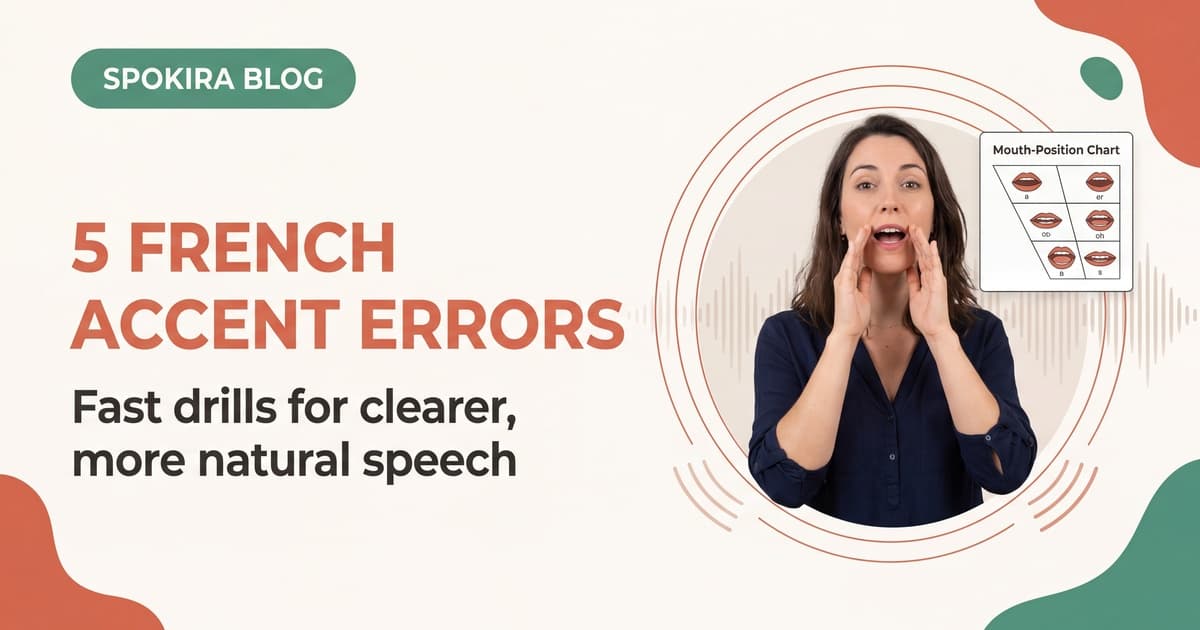
These top 5 french accent errors are why many English speakers feel stuck between understanding French and actually speaking it. You may know the words and grammar, but your mouth still follows English habits under pressure.
The good news is simple: French accent errors are highly predictable. If you train the right sound patterns in short, focused sessions, your clarity improves fast. This is a targeted correction guide for the mistakes that hurt intelligibility most.
If you want a complete sound-by-sound reference, start with our full French pronunciation guide for English speakers. In this article, we stay practical: fix what blocks understanding first.
Why short drill blocks matter: a 2025 meta-analysis of pronunciation training studies (65 studies; 2,793 learners) reported a large overall improvement effect for trained groups versus control conditions (JSLHR meta-analysis). You do not need marathon sessions, but you do need repeated, targeted reps.
French Accent Errors: Quick Answer
If you want the short version, these are the five French accent errors that matter most:
- You pronounce silent final letters that should disappear.
- You use an English "r" instead of the French uvular
r. - You add a hard
normafter nasal vowels. - You merge French
uandouinto one sound. - You separate words instead of linking them through liaison and enchainement.
Here is the fastest correction strategy:
- Choose one mistake for the week.
- Shadow one short native clip daily.
- Record 20 to 30 seconds.
- Compare and fix one target sound only.
- Repeat for 7 days before switching focus.
| French accent error | What listeners usually hear | First drill to run |
|---|---|---|
| Silent letters pronounced | Speech sounds over-articulated or choppy | Read 10 high-frequency words, mark silent endings, shadow one sentence |
English r in French words | Strong foreign accent on common words | 4-minute soft-friction r loop with minimal pairs |
Extra n after nasal vowels | bon, pain, un sound non-native | Nasal airflow drill with finger-under-nose check |
u and ou merged | Meaning confusion (tu vs tout) | ee-tongue + rounded-lips contrast drill |
| Missing liaison/enchainement | Correct words but broken rhythm | Chunk reading and connected-speech shadowing |
Train your mouth, not your streak
Short, daily pronunciation reps beat occasional long sessions. Five focused minutes every day is enough to reduce French accent errors when the drill is specific.
Why Do French Accent Errors Keep Coming Back?
Bottom line: most French accent errors persist because your speech system is automated for English, not because you are bad at learning languages. Under time pressure, your mouth returns to familiar sound habits. If you want faster improvement, you need short, repeated correction loops that retrain perception, tongue placement, and rhythm in real speaking contexts.
Three forces create repeated French accent errors:
- Spelling interference. You read letters and apply English sound rules.
- Perception gaps. You cannot always hear a subtle French contrast yet.
- Production habits. Your tongue, lips, and airflow still follow English timing.
This is why pronunciation improves through repetition with feedback, not through theory alone. A rule helps, but a drill changes your output.
When useful, we reference IPA symbols in this guide. If you want the official symbol standard, use the International Phonetic Alphabet chart.
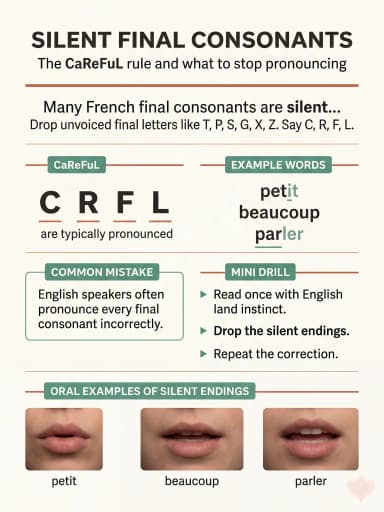
French Accent Errors #1: Pronouncing Silent Letters
Bottom line: pronouncing silent endings is one of the fastest mistakes to fix and one of the easiest ways to sound more natural immediately. French spelling can look familiar, but spoken French removes many final consonants in common words and verb forms. Correcting this single pattern improves rhythm, intelligibility, and listener comfort in everyday conversation.
Why this mistake happens
English often pronounces final consonants, so learners transfer that reflex to French.
Common examples:
petitbecomes "petit-t"beaucoupends with a hardpparlezends with a strongz
These choices are understandable, but they reduce natural rhythm and can make your speech sound rigid.
What to remember
In many contexts, final consonants are silent in French. A useful beginner rule is CaReFuL: final c, r, f, l are more likely to be pronounced than other final consonants.
This is not a perfect rule, but it removes a large portion of beginner French accent errors quickly.
3-minute drill
- Make two columns: written and spoken.
- Add 10 frequent words from your current lessons.
- Mark final letters that disappear in speech.
- Read each word twice: slow version, then natural version.
- Shadow a native sentence that includes those words.
Practice set
petit,grand,froid,beaucoup,parlentvous parlez,ils parlent,un grand ami
If this mistake appears in your recordings, spend one full week only on silent endings. Fixing this single category removes many French accent errors at once. For a fuller clarity-first sequence that combines silent endings with liaison, vowel contrasts, and prosody, use French pronunciation rules that matter for speaking clarity.
French Accent Errors #2: Using an English R
Bottom line: the French r is a high-impact fix because it appears constantly in basic vocabulary and strongly affects perceived accent. If you keep the English r habit, your speech remains understandable but less stable in connected phrases. Training a softer, back-of-mouth friction sound gives clearer and more consistent pronunciation in daily conversation.
Why this mistake happens
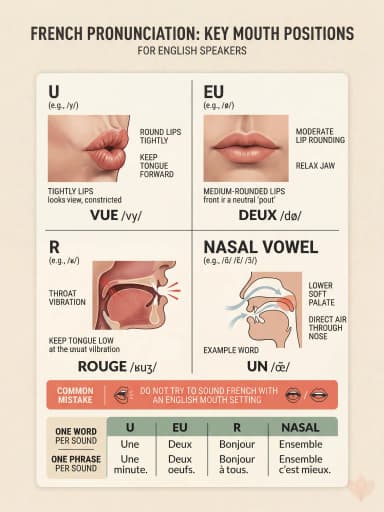
English r is produced near the front of the mouth. Standard French r is generally uvular and produced farther back with friction. If you keep the English position, many words still work, but your accent becomes much stronger and less stable in connected speech.
For a reference explanation and audio examples, see the University of Texas resource on la consonne /R/.
What to feel physically
- Tongue tip relaxed, low, and forward.
- Friction at the back of the oral cavity.
- Airflow stays steady, not explosive.
Think "soft friction" rather than a hard throat clear.
4-step drill (4 minutes)
- Make a gentle gargle sound without water.
- Reduce intensity until the sound is soft and continuous.
- Alternate pairs:
rue/roue,rat/roi,Paris/péri. - Record one sentence with 5 to 7
rwords and compare.
Sentence loop
Je regarde la rue de Paris.Trois roses rouges.Le train arrive tard.
Repeat one sentence 10 times. Do not chase perfection. Chase consistency. Stable reps reduce French accent errors faster than constantly changing material.
Get Feedback on Your Exact Sounds
Spokira gives phoneme-level feedback so you can see which sounds still create French accent errors and what to train next.
French Accent Errors #3: Nasal Vowels with Extra N or M
Bottom line: nasal vowels are hard because English expects a vowel plus a full consonant, while French often keeps the consonant silent and nasalizes the vowel itself. If you add a hard n or m, words can sound off even when your grammar is correct. Nasal airflow drills reduce this quickly with focused repetition.
For a complete progression with minimal pairs and timed transfer, use Nasal Vowels French Practice: AN/EN/ON/IN drills.
Why this mistake happens
In words like bon, pain, or un, English speakers often add a full n sound. In standard French pronunciation, the vowel carries nasality and the final n or m is not pronounced as a separate consonant in these contexts.
Target contrast
The key contrast is oral versus nasal vowels, not spelling.
beauvsbonpainvspaixbrunvsbruit
3-minute airflow drill
- Sustain a vowel for one second.
- Let part of the airflow pass through your nose.
- Keep the sound continuous.
- Stop cleanly, without adding a hard final
n.
Place a finger under your nose to check airflow. If you feel only a burst at the end, you are still adding a consonant.
Minimal pair block
Practice each pair in two modes:
- Isolated words (slow)
- Short phrase (natural speed)
Examples:
un pain,bon vin,sans son,dans Paris
Consistent contrast work is one of the fastest ways to remove stubborn French accent errors in beginners and intermediates.
French Accent Errors #4: Mixing Up U and OU
Bottom line: fixing u versus ou early prevents real meaning confusion in high-frequency phrases. When both collapse into one English-like sound, listeners may still infer context but your clarity drops. This contrast becomes reliable when you train one physical rule: keep the ee tongue position and change only lip rounding.
Why this mistake happens
English has no direct equivalent of French u ([y]), so learners map both sounds to an "oo"-like vowel.
Mouth-position formula
Use this physical sequence:
- Say
eeand freeze the tongue. - Keep that tongue position.
- Round lips forward as if whistling.
That combined posture creates French u. Then compare with ou.
2-minute contrast drill
Alternate these pairs slowly, then faster:
tu/toutrue/rouesur/sousvu/vous
Then place them in short phrases:
Tu veux tout.Je suis sur la route.Vous avez vu?
Track one pair for a full week. Repeated contrast prevents this category of French accent errors from reappearing in spontaneous speech. For articulation reference on close vowels and rounded-front vowels, see the UT guide for voyelles orales /i y u/.
French Accent Errors #5: Ignoring Liaison and Enchainement
Bottom line: you can pronounce words correctly and still sound unnatural if you do not link them in connected speech. Liaison and enchainement shape French rhythm, so missing links create segmented delivery that feels less native and harder to follow. Training phrase chunks instead of isolated words produces faster gains in conversational fluency.
Why this mistake happens
English rhythm often tolerates clear word boundaries. French rhythm favors smoother sound chains, especially in common grammatical patterns.
Liaison can be obligatory, optional, or forbidden depending on context. For a structured overview with examples, see la liaison (Français interactif).
High-value patterns to train first
Start with obligatory contexts you hear every day:
- determiner + noun:
les amis - pronoun + verb:
ils ont - adjective + noun:
petits enfants
4-minute linking drill
- Write 5 short chunks with obligatory liaison.
- Mark the linking consonant.
- Read each chunk slowly with smooth transition.
- Shadow one native clip and mimic rhythm, not just consonants.
Practice chunks:
les amis arriventils ont une idéeun petit appartementnous avons un problème
Most intermediate French accent errors in rhythm come from under-linking, not vocabulary gaps.
How Can You Fix French Accent Errors in 7 Days?
Bottom line: the best short plan is to keep one sound focus per day, then verify progress with before/after recordings at the end of the week. This 7-day cycle is intentionally narrow, repeatable, and realistic for busy learners. It works because it prioritizes consistency, focused correction, and measurable feedback over random practice.
Day 1: Baseline recording (10 minutes)
- Record 45 to 60 seconds introducing yourself in French.
- Mark your top two error categories from this guide.
- Pick one primary sound target for the week.
Day 2: Silent letters block (8 minutes)
- 3 minutes rule review + word list.
- 3 minutes shadowing one short clip.
- 2 minutes self-record and compare.
Day 3: French R block (8 minutes)
- 2 minutes soft-friction warm-up.
- 4 minutes minimal pairs + sentence loops.
- 2 minutes recording with deliberate
rdensity.
Day 4: Nasal vowels block (8 minutes)
- 2 minutes airflow awareness.
- 4 minutes oral/nasal minimal pairs.
- 2 minutes phrase reading and playback.
Day 5: U vs OU block (8 minutes)
- 2 minutes posture setup (
eetongue + rounded lips). - 4 minutes pair alternation.
- 2 minutes phrase loop at natural speed.
Day 6: Liaison and rhythm block (10 minutes)
- 3 minutes read chunk list with marks.
- 5 minutes shadow connected speech clip.
- 2 minutes record one paragraph with linking focus.
Day 7: Compare and consolidate (10 minutes)
- Re-record the same baseline text from Day 1.
- Compare old and new versions.
- Keep one unresolved issue for next week.
This cycle works because it is constrained. Most learners fail by changing targets too often. Stable focus removes French accent errors faster than random drills.
Self-Check Scorecard for French Accent Errors
Use this weekly checklist after your Day 7 recording:
- I no longer pronounce most silent final letters.
- My French
rstays stable in short sentences. - I avoid adding a hard
nafter nasal vowels. - I can clearly contrast
uandou. - I produce liaison in basic obligatory contexts.
- My rhythm sounds less segmented than last week.
If you can check four or more boxes, progress is on track.
Which French Accent Errors Hurt Clarity Most in Real Conversations?
Some contexts expose pronunciation errors more than others. Train these first if your goal is confidence in real conversations.
1. Ordering food and coffee
Fast service interactions punish unclear vowels and dropped links.
Useful phrase loops:
Je voudrais un café, s'il vous plaît.Vous avez une table pour deux?Je prends un croissant.
2. Directions and transport
Street names and numbers reveal u/ou errors and weak linking.
Useful phrase loops:
Où est la rue de Rivoli?Vous pouvez répéter, s'il vous plaît?Je dois prendre quel bus?
3. Introductions at work
This exposes r, nasal vowels, and rhythm under mild stress.
Useful phrase loops:
Je travaille dans le marketing.Je viens de Boston.Nous avons un projet en cours.
Scenario drills reduce French accent errors faster than isolated word lists because they match real speaking pressure.
French Accent Errors FAQ
How long does it take to reduce French accent errors?
You can hear measurable improvements in 2 to 4 weeks if you practice daily in short focused blocks. Deep accent change takes longer, but clarity improves quickly when drills are specific.
Should I fix all French accent errors at the same time?
No. Choose one category each week. Trying to fix every issue at once usually lowers quality and motivation.
Are French accent errors a problem if people still understand me?
Not always. The target is intelligibility and confidence, not a perfect native accent. But reducing high-impact French accent errors helps you speak with less effort and fewer repetitions.
What is better: shadowing or reading aloud?
Shadowing is better for rhythm and connected speech because it gives you a native timing model. Reading aloud is useful, but it can reinforce your current habits if not paired with comparison. Use this guide with our deep dive on why shadowing works for French.
Build a Longer Practice System
Once these French accent errors are improving, extend your routine:
- Follow a daily script from 5-minute French speaking routine.
- Add scenario practice from French speaking practice guide.
- Train practical travel dialogs with French for travel.
- Use French accent training app for a focused correction loop.
- Use French pronunciation app for broader sound and rhythm coaching.
- Use app to practice speaking French if response speed is your main blocker.
If you only do one thing this month, keep the 7-day cycle running for four rounds. That alone can remove a large share of your repeat French accent errors.
Compare Pronunciation Tools Before You Choose
If you want to evaluate alternatives before committing, review:
- Spokira vs Speechling for pronunciation feedback depth
- Spokira vs Parle for pronunciation-coach workflows
- Spokira vs Duolingo for pronunciation-first speaking practice
Final Takeaway
French accent errors are normal, predictable, and fixable. You do not need a perfect accent. You need a system that trains your ears, mouth, and rhythm with deliberate repetition.
Pick one sound target. Practice 5 to 10 minutes daily. Record and compare every week. Keep going until the correction feels automatic.
Ready to Fix French Accent Errors?
Use guided shadowing and AI feedback to track your exact sound errors, fix them step by step, and speak French more clearly in real conversations.