French E Acute vs E Grave Pronunciation
A clean contrast card for French e acute and e grave.
Share this visual
Share the page URL so the visual earns links, saves, and citations.
Embed snippet links back to the canonical visual page.
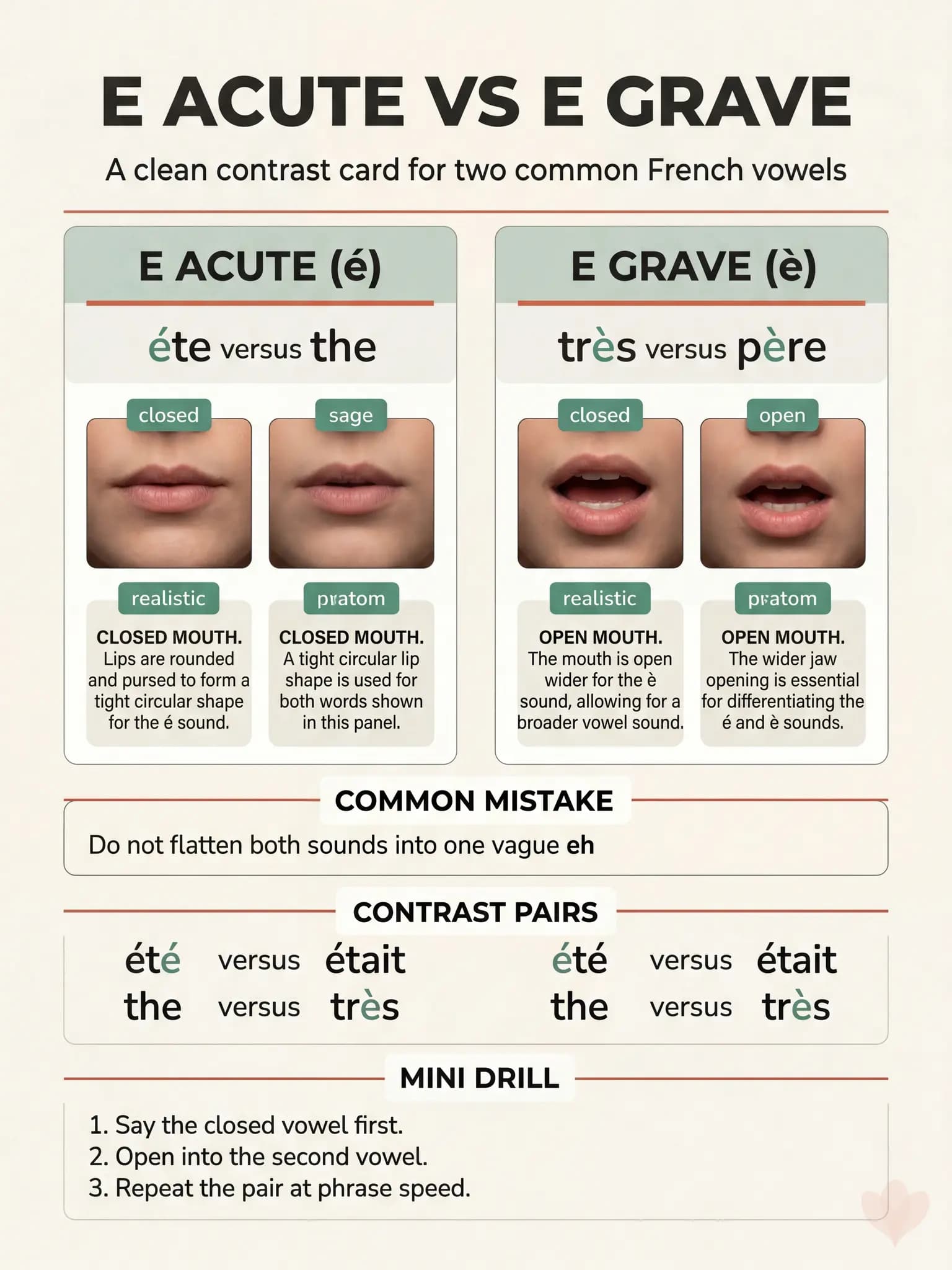
French é and è are close enough to blur together if you are moving too fast, but they do not land the same way in the mouth. É stays more closed. È opens more. That small shift matters more than it seems when you start listening for it, because French listeners use it to separate common word families.
What to listen for
éas inété,théèas intrès,père
Why English speakers miss it
English speakers often flatten both vowels into a single middle eh, which makes the contrast disappear.
Contrast pairs
été/étaitthé/trèsmes/mère
Quick comparison table
| Sound | Mouth cue | Example words | English-speaker drift |
|---|---|---|---|
é | Keep the vowel higher and more closed | été, thé, clé | Flattening it into a generic eh |
è | Let the jaw open a little more | très, père, mère | Keeping it too tight, so it sounds like é |
Quick practice
- Say the closed vowel first.
- Open into the second vowel.
- Repeat the pair at phrase speed.
Self-check tip
If both accents still sound identical, slow down and exaggerate the mouth opening on è. You do not need a dramatic dip. You just need enough space that été no longer sounds like était, and thé no longer sits in the same vowel slot as très.
Why this works
The accents are not just spelling decoration here. Lawless French on the acute accent notes that é is pronounced [e], while Lawless French on the grave accent explains that è marks [ɛ]. Keeping that closed-versus-open contrast is what stops both vowels from collapsing into one vague English-style eh.
Where to go next
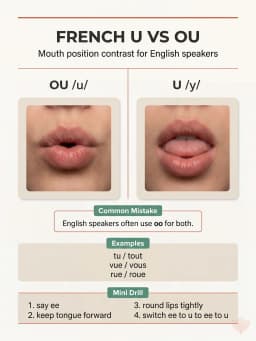
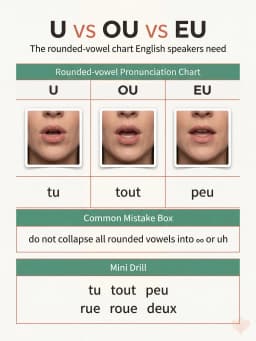
If rounded vowels are also giving you trouble, compare this with the French U, OU, and EU pronunciation chart. For the broader pattern set, read French accent errors: fast fix drills.
Practice Inside Spokira
Check vowel contrast accuracy inside Spokira.