French U vs OU Mouth Position
A quick mouth-position guide for hearing and pronouncing French u and ou correctly.
Share this visual
Share the page URL so the visual earns links, saves, and citations.
Embed snippet links back to the canonical visual page.
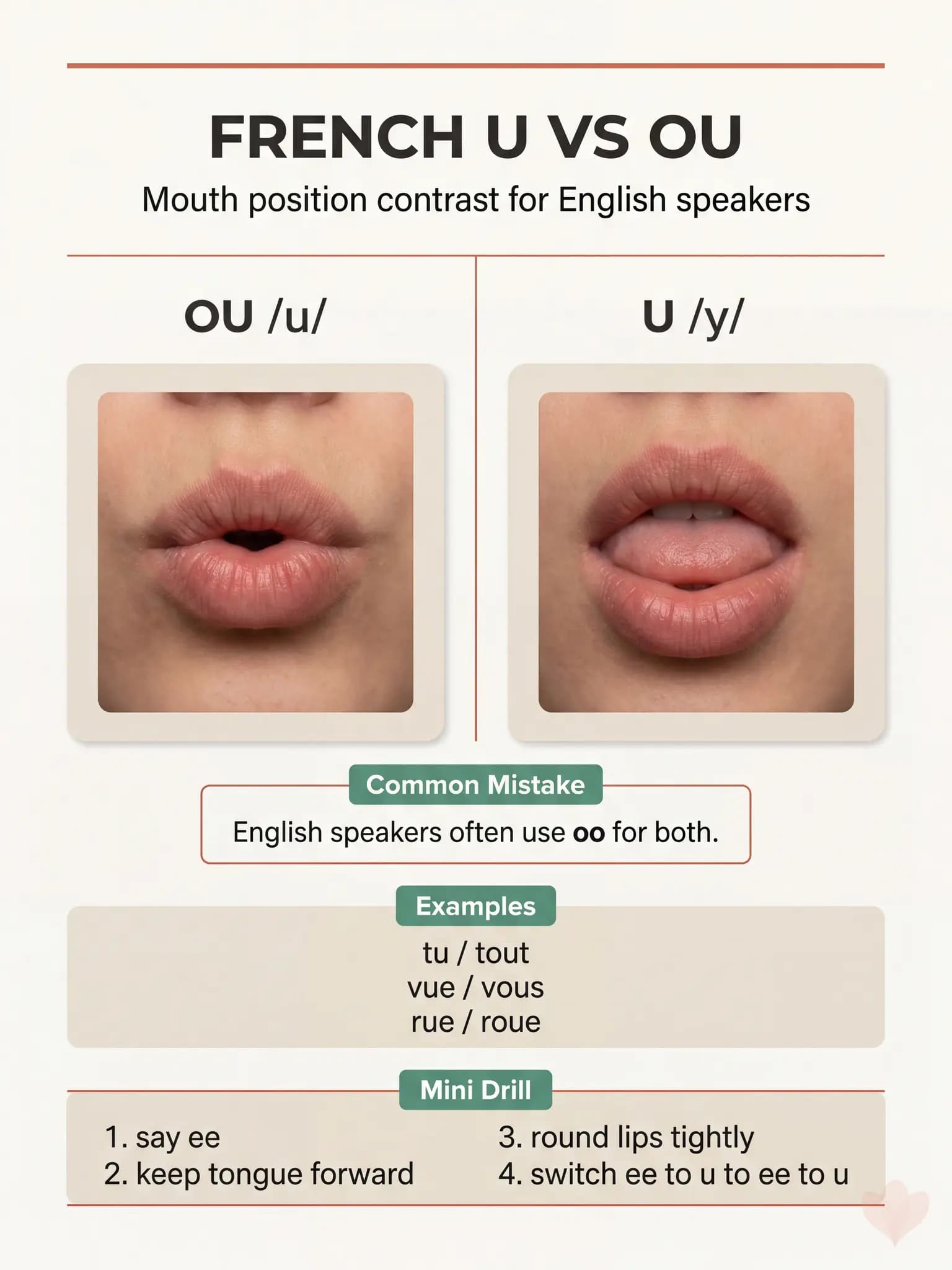
French u and ou feel close to English speakers because both use rounded lips, but they are not the same vowel. The useful shortcut is this: ou keeps the classic "oo" shape, while u keeps the tongue forward as if you were saying "ee" and rounds the lips around that position. This page is the narrowest fix in the rounded-vowel cluster: just one contrast, just one mouth-position decision.
What changes in the mouth?
- OU /u/: round lips, relaxed tongue
- U /y/: tight rounded lips plus 'ee' tongue
Side-by-side check
| Sound | Tongue position | Lip shape | Good test word |
|---|---|---|---|
u | Forward, like ee | Tight and rounded | tu, rue |
ou | Backer, like oo | Rounded but less tense | tout, roue |
Why English speakers miss it
English usually lets "oo" do too much work. In French, that shortcut makes tu sound closer to tout, which is exactly the contrast you want to avoid.
Example pairs worth drilling
- tu / tout
- vue / vous
- rue / roue
Quick practice
- Say 'ee'.
- Keep the tongue forward.
- Round the lips tightly.
- Switch: ee -> u -> ee -> u.
Self-check tip
If tu still sounds like too, do not start by pushing the lips harder. Reset the tongue first. Say ee, freeze the tongue where it is, then round the lips around that same position. That sequence usually separates u from ou faster than trying to guess the sound directly.
Why this works
Standard French keeps a real contrast between the close front rounded vowel /y/ and the back rounded /u/, which is why pairs like tu and tout stay distinct in careful speech. The overview in French phonology on Wikipedia lays out that rounded-vowel system, and Lawless French's pronunciation pages explain the practical learner version: u keeps the tongue farther forward than English-style oo.
Where to go next
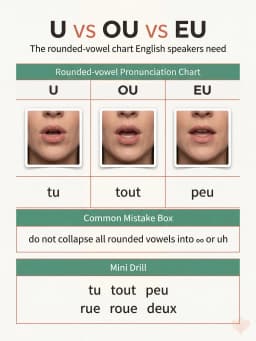
If u still collapses, compare it against the full French U, OU, and EU pronunciation chart. If you want a wider walkthrough of the sounds English speakers usually blur together, read French pronunciation for English speakers.
Practice Inside Spokira
Practice this sound inside Spokira with phoneme-level feedback.