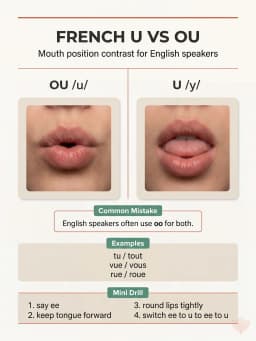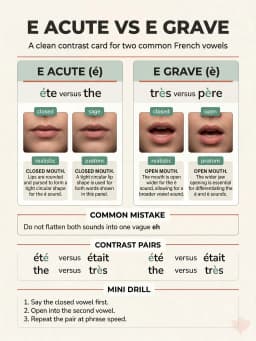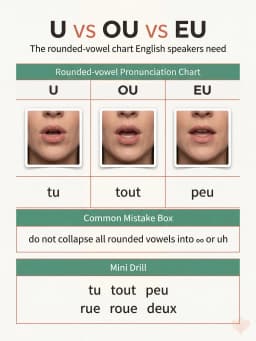
French Nasal Vowels Pronunciation Chart
A simple chart for French nasal vowels with examples and airflow tips.
Share this visual
Share the page URL so the visual earns links, saves, and citations.
Embed snippet links back to the canonical visual page.
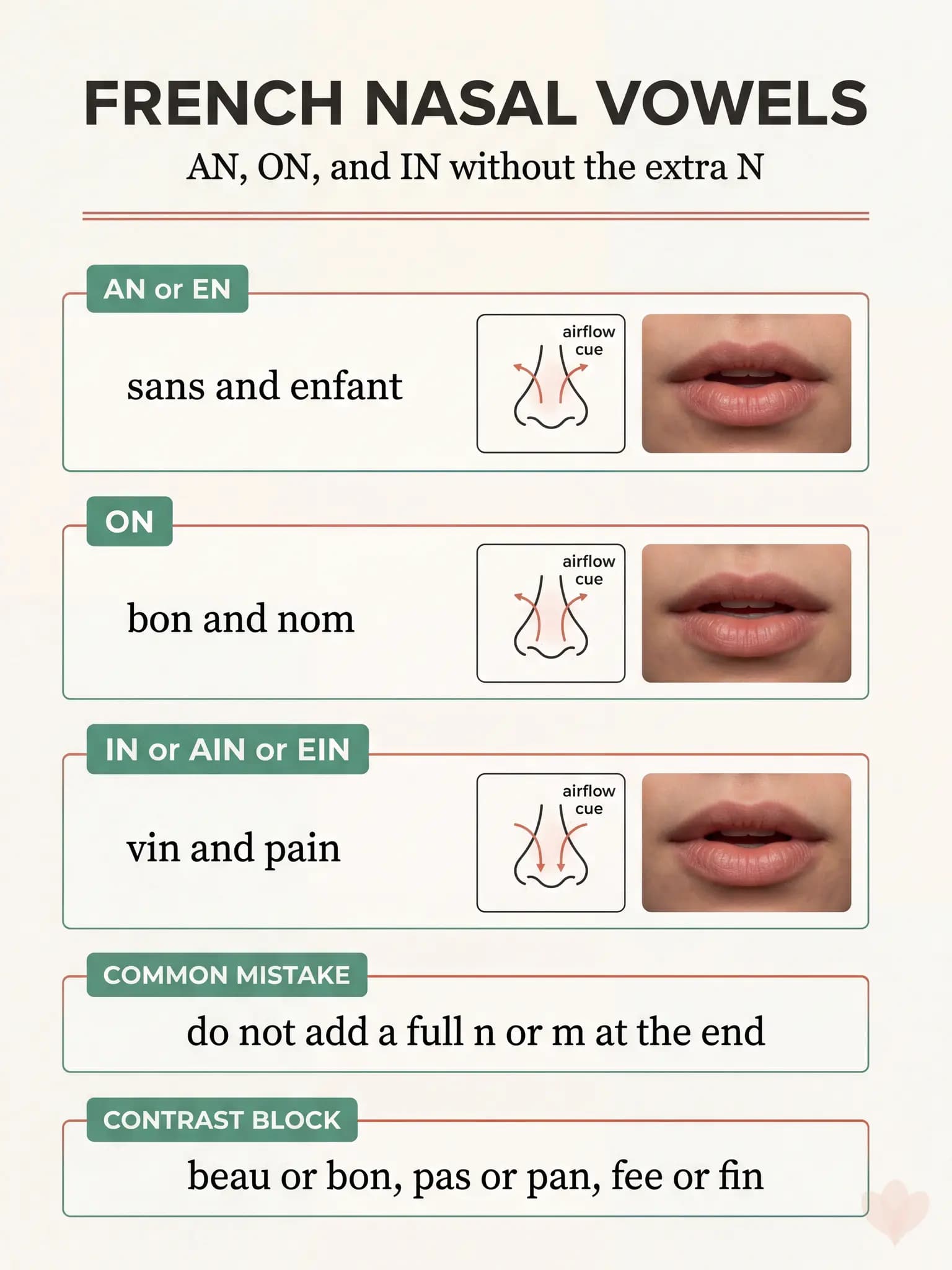
French nasal vowels sound strange at first because English usually wants to finish them with a clean n or m. French does not. The vowel stays in place while some of the airflow moves through the nose.
The three nasal targets
- AN / EN: sans, enfant
- ON: bon, nom
- IN / AIN / EIN: vin, pain
Why English speakers miss them
The usual mistake is closing the word too hard, as if the final consonant has to be fully pronounced. That turns a nasal vowel into a different sound.
Contrast pairs
- beau / bon
- pas / pan
- fee / fin
Quick practice
- Hold the vowel.
- Let air pass through the nose.
- Keep the final consonant out of the sound.
Why this works
French keeps nasal vowels as part of the vowel system itself, not as a vowel plus a fully pronounced final n or m. French phonology on Wikipedia summarizes the standard nasal inventory, and Michael Dow's 2020 study in the Journal of French Language Studies shows how nasality is carried in the vowel rather than treated like a separate final consonant closure.
Where to go next
If you need the bigger pronunciation picture, open the French pronunciation mouth position guide. If you want more pairs and drills, go to nasal vowels French practice: AN, EN, ON, IN minimal pairs.
Practice Inside Spokira
Train nasal vowels in Spokira and check which one breaks down first.