If you can read French but still sound "English" when you speak, nasal vowels are usually one of the biggest bottlenecks. Most learners pronounce an, en, on, and in as a vowel plus a clear n sound. In French, that final consonant is usually not released. The vowel itself becomes nasal.
That is why nasal vowels french practice should be treated as daily mouth training, not a one-time pronunciation tip. You need contrast drills, not just explanations.
This guide gives you a practical routine for A2-B1 learners: minimal pairs, timed reps, recording checks, and transfer prompts for real conversation. Sources and product references were verified on March 8, 2026.
If you want the full accent framework first, start with French Pronunciation for English Speakers. Then return here for focused execution on nasal vowels.
Quick answer: what works best for nasal vowels French practice?
Run short daily contrast drills in this order:
- Oral vs nasal pairs (
beauvsbon,maisvsmain) - Nasal-vs-nasal pairs (
sansvsson,painvspont) - Three-word chunks (
un bon vin,dans mon sac) - Timed sentence retrieval without reading
- Record and compare two takes
Why this structure works:
- French phonetics training materials from the University of Texas French Interactive Phonetics guide model the nasal-vowel categories and articulatory targets learners need to distinguish (
an/en,on,in, andun) (UT Austin). - CEFR speaking descriptors emphasize intelligibility and interaction outcomes, not perfect imitation. For A2-B1, the target is being understood consistently in everyday exchanges (Council of Europe CEFR Companion Volume, 2020).
- A 2025 meta-analysis found explicit pronunciation instruction has a strong positive effect on L2 pronunciation outcomes, supporting targeted drills over passive exposure alone (Saito et al., 2025, PubMed).
- Spaced and retrieval practice findings remain robust, which is why short daily repetitions plus no-script recall outperform occasional long sessions (Cepeda et al., 2006, PubMed; Roediger & Karpicke, 2006, PubMed).
What AN/EN/ON/IN really are in spoken French
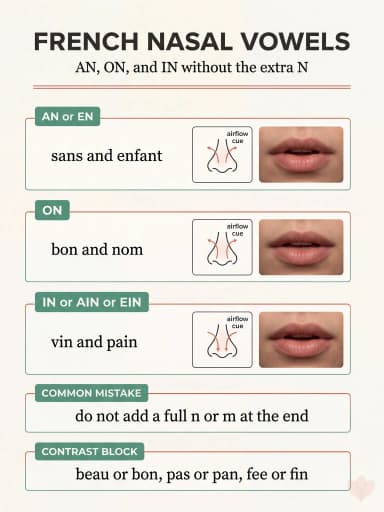
For learners, spelling causes most confusion. You see two letters and expect two sounds. In many French words, n or m marks vowel nasalization instead of a fully pronounced consonant.
Practical map for training:
an/en-> broad low nasal target (example family:sans,dans,enfant)on-> rounded back nasal target (bon,nom,long)in/ain/ein-> front nasal target (vin,pain,plein)un-> often distinct in careful speech, but commonly merges towardinin many modern accents
Two execution rules matter most:
- Keep airflow continuous through the vowel.
- Do not "pop" a hard
nat the end.
If you are unsure, use the finger-under-nose test while speaking. Air should be present during the vowel, not only at the end.
One Correction That Fixes Most Errors
If your mouth closes at the end of bon, pain, or un, you are likely adding an English-style consonant. Keep the vowel open and let the sound fade, not stop.
Why nasal vowels French practice often stalls
Most learners plateau for predictable reasons:
- They drill only single words and never move to chunks.
- They memorize spellings instead of training contrasts.
- They switch between ten different YouTube cues each day.
- They avoid recording because they do not like hearing themselves.
That combination produces fragile progress. You can pronounce bon correctly alone, then lose it immediately in "un bon vin blanc".
The fix is progression, not more random repetition.
Use a ladder, not a list
A stable session should move across levels:
- Sound target
- Word contrast
- Three-word chunk
- Sentence with timing
- Short free response
This preserves pronunciation quality while increasing cognitive load. If you jump directly to free conversation, your old habits return.
The 12-minute nasal vowels French practice routine
Run this once per day for 14 days before changing targets.
Minute 1-2: setup and airflow
- Say oral
a, then nasalanslowly. - Say oral
o, then nasalonslowly. - Keep jaw and throat relaxed.
- Aim for steady, quiet airflow.
Goal: feel the difference between oral and nasal resonance without adding final consonants.
Minute 3-5: oral-vs-nasal minimal pairs
Start with contrasts that are easy to hear.
| Oral | Nasal | Drill cue |
|---|---|---|
beau | bon | Round lips less on bon, keep the vowel open |
a | an | Keep an longer, no hard release |
mais | main | Hold the nasal vowel, skip final n |
peau | pont | Keep pont compact; avoid English n |
Do 6 reps per pair:
- slow clear rep
- normal-speed rep
- no-look rep (eyes off text)
Minute 6-8: nasal-vs-nasal minimal pairs
Now contrast nasal vowels against each other.
| Pair | What to notice |
|---|---|
sans vs son | on is rounder and more back |
pain vs pont | in is more front, on more rounded |
brin vs brun | In careful speech, un can be lower/rounder; many accents merge |
dans vs dons | Keep the vowel target stable as consonants stay similar |
Use 4 clean reps per pair, then one fast alternating set.
Minute 9-10: chunk transfer
Say each chunk 5 times, then once from memory:
un bon vindans mon saccinq bons planson prend le trainun parfum intense
Keep rhythm natural. Do not isolate each word too much.
Minute 11: timed sentence round
Set a 60-second timer. Produce as many clean sentences as possible from prompts:
- "Describe what you ordered at a cafe."
- "Describe what you did this morning."
- "Describe one thing in your bag."
Constraint: include at least one an/en, one on, and one in word in each sentence.
Minute 12: record and score
Record two short takes (20-30 seconds each):
- Take 1 before drill
- Take 2 after drill
Score from 1-5:
- nasal clarity
- no extra final
n - rhythm and flow
- stability under speed
Track one "next fix" for tomorrow.
Minimal pairs you can keep for 30 days
You do not need 200 pairs. You need a core bank you can repeat until automatic.
Core set A: oral vs nasal
beau/bona/anmais/mainpeau/pontdu/d'un
Core set B: nasal vs nasal
sans/sonpain/pontvin/ventdans/donsbrin/brun
Core set C: high-frequency phrase frames
C'est un bon plan.On prend le train demain.J'ai besoin d'un pain complet.Dans mon sac, j'ai un livre.Ce vin blanc est bon.
If you freeze at phrase level, reduce to 3-word chunks first.
Want instant feedback on nasal vowels?
Practice French minimal pairs and get AI coaching on clarity, rhythm, and sound-by-sound errors in short daily sessions.
How to keep progress when spelling tricks you
French spelling will tempt you back into English pronunciation habits. Use these guardrails:
- Read less, repeat more: hear-first reps reduce spelling interference.
- Mark nasal targets in your notes (
AN,ON,IN) instead of full IPA if IPA slows you down. - Keep one cue per sound. Example:
ON = round + back;IN = forward resonance. - Use fewer words more often. Consistency beats novelty.
If you want broader pronunciation triage around this work, use 5 Common French Pronunciation Mistakes (And How to Fix Them).
14-day progression plan (A2-B1)
Use this schedule to avoid random practice.
Days 1-4: build the contrast
- 12-minute routine daily
- focus on oral-vs-nasal pairs
- one 30-second recording per day
Success marker: you no longer add strong final n in controlled words.
Days 5-9: stabilize under speed
- same routine
- increase chunk speed slightly
- add one 60-second no-text speaking round
Success marker: nasal targets stay clear at near-conversation pace.
Days 10-14: conversation transfer
- keep minimal pairs as warm-up
- spend 3-4 minutes on scenario prompts
- review recordings every third day
Success marker: nasal vowels remain stable during spontaneous answers.
If your general fluency still lags, combine this with French Speaking Practice: The Complete Guide for A2-B1 Learners and Record Yourself in French Without Cringing.
Troubleshooting: fast fixes for common nasal vowel errors
"I still pronounce a full N at the end"
Slow down and fade the vowel instead of stopping it. Think "open ending," not consonant ending.
"AN and ON sound the same when I speed up"
Over-contrast for 2-3 days. Exaggerate lip rounding on on, then reduce once stable.
"IN and UN always blur"
That can happen even in native accents, but keep training both targets in careful speech so your listening and production stay flexible.
"I sound fine in drills, bad in conversation"
Your load is too high too early. Return to chunk drills, then add timed prompts gradually.
"I can hear my errors but cannot fix them"
Use immediate repetition loops: correct rep within 5 seconds after each error. Delayed correction is weaker for motor learning.
How this connects to app-based speaking practice
Nasal-vowel progress is faster when your app workflow includes:
- short daily speaking loops
- immediate correction cycles
- phrase-level practice, not only single words
- retrieval rounds without transcript
If you are choosing tools for this, compare French Pronunciation App and Practice-Speaking French App based on feedback quality and drill speed, not just lesson quantity.
Weekly self-test: measure if your nasal vowels are actually improving
Use this test once per week. Keep the same script so your recordings are comparable.
Test part 1: controlled list (45 seconds)
Read this list once slowly, once at normal pace:
bon, banc, pain, pont, un, dans, son, vin, vent, brun
Checklist:
- Did any word end with a strong
nrelease? - Could you keep
onandindistinct at normal speed? - Did
uncollapse intoinevery time, or only sometimes?
Test part 2: phrase chain (45 seconds)
Speak these without pausing between each phrase:
un bon paindans mon salonon prend le trainc'est un parfum fince vin blanc est bon
Goal: keep vowel quality stable while rhythm increases.
Test part 3: free response (60 seconds)
Answer one prompt out loud:
- "What did you eat today?"
- "What are your plans this weekend?"
- "Describe your neighborhood in French."
Constraint: include at least five nasal-vowel words naturally.
Score all three parts from 1-5 on:
- clarity
- consistency
- speed stability
If your score drops from part 1 to part 3, that is normal. It means your next week should focus on transfer, not more theory.
20 high-frequency nasal-vowel words worth overlearning
Build automaticity by repeating useful words that appear in everyday French speech.
AN/EN family
dans, sans, enfant, pendant, important, franc
ON family
bon, nom, maison, non, monde, long
IN family
vin, pain, matin, plein, faim, rien
UN family
un, parfum
You can rotate these inside one frame sentence:
Aujourd'hui, j'ai ___ dans mon ___.
This keeps grammar simple while targeting pronunciation.
For stronger retention, revisit the same word bank three times per week rather than replacing it daily. That approach matches spaced-practice evidence better than novelty-heavy practice blocks.
7-day nasal vowels French practice schedule you can repeat
If you do not want to guess what to practice each day, use this loop. The goal is predictable repetition, not constant variation.
Day 1: oral-vs-nasal reset
- 12-minute ladder from this guide
- extra focus on
beau/bon,mais/main,a/an - one 30-second recording
Day 2: ON vs IN contrast
- 4 minutes minimal pairs (
son/sans,pont/pain) - 4 minutes phrase chains
- 2 minutes timed response
- 2 minutes recording and notes
Day 3: AN/EN in sentence rhythm
- 3 minutes word-level warmup
- 5 minutes sentence reps with metronome-style pacing
- 4 minutes spontaneous answers with constraints
Day 4: UN awareness day
In many accents, un and in move closer. For training, keep both targets in careful speech so your listening remains flexible.
- 4 minutes
brin/brunandparfum/painstyle contrasts - 4 minutes chunk transfer
- 4 minutes free production
Day 5: speed stability
- 5 minutes mixed minimal pairs
- 5 minutes fast chunk drills
- 2 minutes recording
Aim for clean vowels at normal speed, not dramatic speed.
Day 6: conversation transfer
- 3 minutes warmup pairs
- 3 minutes phrase chain
- 6 minutes scenario speaking
Scenarios:
- ordering at a bakery
- describing weekend plans
- giving directions
Day 7: review + retest
- run weekly self-test
- compare with last week
- pick one target for next week
When this loop is done, restart it with the same core bank. Repeating a stable structure is one of the simplest ways to keep nasal vowels French practice effective over a full month.
FAQ: practical questions learners ask about nasal vowels French practice
Do I need IPA to improve nasal vowels?
No. IPA helps, but you can improve fast with consistent contrast labels (AN, ON, IN, UN) and frequent audio feedback. The core requirement is repeated speaking with correction.
Should I train all four nasal vowels every day?
Train all four briefly, then spend most time on your two weakest contrasts. For many English speakers, ON vs IN and final-consonant suppression are the highest-value targets.
How long before people hear a difference?
Many learners hear better stability within 7-14 days of daily, structured practice. The bigger jump happens when you add conversation transfer and recording review, not when you add more theory.
What if my accent still sounds non-native?
That is expected. CEFR speaking outcomes prioritize intelligibility and interaction success. Focus on clarity, consistency, and response speed first. Accent refinement can continue later.
Conclusion: train contrast daily, then transfer under pressure
Nasal vowels are not a talent test. They are a contrast-and-repetition problem.
For most A2-B1 learners, the fastest path is simple:
- daily oral-vs-nasal drills
- nasal-vs-nasal minimal pairs
- phrase and sentence transfer
- recording and self-scoring
Keep sessions short, focused, and repeatable. Five clean days in a row will beat one perfect weekend session.
When you are ready, combine this drill with French R Pronunciation Drill and the 5-minute French speaking routine so clarity holds in real conversations.