If your French sounds clear in your head but rough when you speak out loud, the French R is often one of the biggest bottlenecks. You are not imagining it. For many English speakers, this sound feels unstable, inconsistent, and hard to repeat under pressure.
That is exactly why french r sound practice should be a daily motor drill, not a random pronunciation tip you try once. The goal is not to force one perfect classroom sound. The goal is to produce a stable French R that is clear, repeatable, and easy to keep while speaking full sentences.
This guide gives you a practical 12-minute routine, mouth-position cues that you can feel, and a 14-day progression plan. You will also get self-checks so you can improve without waiting for a teacher in every session. If you want a general speaking habit (not just the French R), use this 5-minute French output routine.
If you want the full pronunciation system around this drill, start with French pronunciation for English speakers, then come back here for focused execution.
Quick answer: what works best for french r sound practice?
Use short, structured daily reps with clear progression:
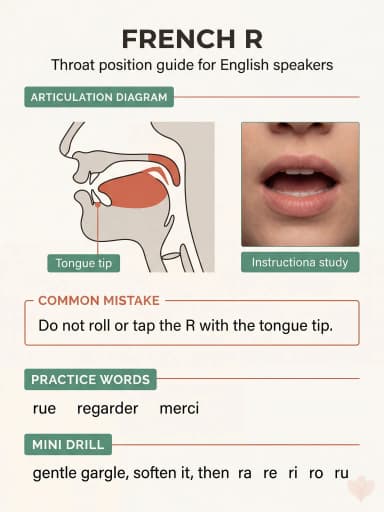
- Set tongue and airflow for a soft uvular friction sound.
- Train isolated syllables first (
ra,ri,ru). - Move immediately to short words and 3-word chunks.
- Add retrieval pressure with timed sentence reps.
- Record one before-and-after take each session.
Why this works:
- In the International Phonetic Association's French illustration (Journal of the International Phonetic Association), standard French /R/ is described as uvular, not the English alveolar
r, so learners need a different articulatory target from day one (Fougeron and Smith, 1999, Cambridge). - Retrieval-practice evidence shows active recall beats restudy for durable performance, which is why no-audio reps belong inside pronunciation sessions (Karpicke and Blunt, 2011, PubMed).
- Spaced practice outperforms massed practice across large evidence sets, so short daily sessions are better than occasional long ones (Cepeda et al., 2006, PubMed).
- A 2025 meta-analysis found explicit pronunciation instruction has a strong positive effect on L2 pronunciation outcomes, supporting deliberate drill design over passive exposure alone (Saito et al., 2025, PubMed).
What is the French R, exactly, and why does it feel unnatural?
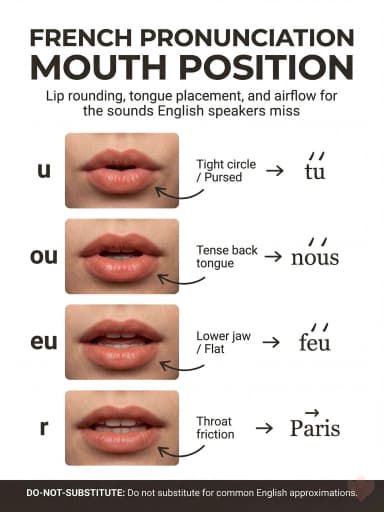
For English speakers, the key shift is location. English r is often produced near the front or central oral cavity with very different tongue shaping. French R is typically uvular, with constriction farther back in the vocal tract.
That shift creates three problems:
- You cannot rely on your English motor habit.
- You may over-tighten the throat and create harsh friction.
- You lose stability when speech speed increases.
So the target is not "growl from the throat." The target is controlled airflow at a back-of-mouth constriction with low tension.
If your overall rhythm still breaks even when the sound is correct in isolation, pair this with French speaking speed drills. Clear sound plus better pacing is what transfers to real conversation.
Why many french r sound practice attempts fail
Most learners do one of these:
- They only repeat isolated
rsounds and never move to real speech. - They switch mouth cues every day and never stabilize one method.
- They chase "native perfection" instead of intelligible consistency.
- They wait until full conversation to test the sound.
That approach creates fragile progress. You can do five good reps alone, then lose the sound immediately in a normal sentence.
A better structure is staircase training:
- Setup and feel
- Syllables
- Words
- Chunks
- Timed sentences
- Conversation transfer
That sequence keeps quality while gradually increasing cognitive load.
The 12-minute daily french r sound practice drill
Run this routine once a day for 14 days before changing targets.
Minute 0-2: Setup your mouth and airflow
Stand or sit upright. Relax jaw and neck.
Do this sequence:
- Exhale slowly through the mouth for 4 seconds.
- Keep lips lightly rounded, then say a soft gargle-like friction without voice for 2 seconds.
- Add voice gently for another 2 seconds.
- Stop if your throat tightens.
You are testing placement, not volume.
Cues that usually help:
- "Fog a cold window, but with smaller airflow."
- "Back of tongue rises slightly, throat stays relaxed."
- "Low-friction buzz, not a cough."
Tension Check
If your neck muscles are visibly tight, you are forcing it. Reduce pressure and shorten the rep.
Minute 2-4: Syllable ladder (slow and controlled)
Run each syllable 5 times:
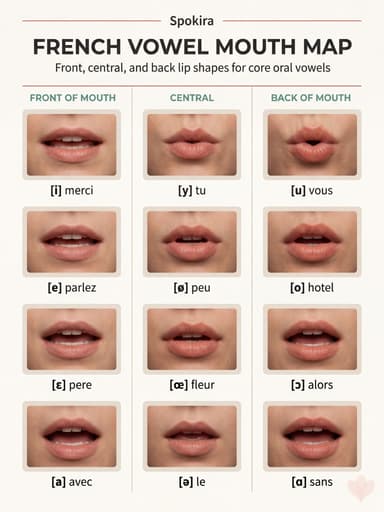
ra,re,ri,ro,ruar,er,ir,or,ur
Rules:
- Keep pace slow.
- Keep volume medium.
- If one vowel breaks the sound, mark it and repeat that pair 3 extra times.
This is where you anchor consistency.
Minute 4-6: Word reps (high-frequency, useful words)
Use practical words you will actually say:
rueregardermercitrainprendrerestaurantbonjourParis
Do 3 rounds:
- Slow pronunciation round
- Natural speech round
- Slightly faster round
If you drop the sound under speed, return to round 2. Do not keep accelerating through bad reps.
For broader pronunciation cleanup around these same words, use fast-fix accent drills.
Minute 6-8: Three-word chunk reps
Now attach the sound to short spoken rhythm.
Practice chunks like:
je regarde icimerci pour rienje prends le trainau restaurant ce soir
Do each chunk 4 times with a metronome or timer beat.
Target:
- No full restart
- Stable R in every repetition
- Smooth chunk rhythm
If chunk rhythm is unstable, review French shadowing technique and use one short native clip before this block.
Minute 8-10: Timed sentence transfer
Set a timer for 2 minutes. Alternate between two sentence prompts:
- "Je prends le train pour Paris vendredi."
- "Au restaurant, je regarde la carte et je commande."
Protocol:
- Hear prompt (read it once).
- Wait 2 seconds.
- Say sentence from memory.
- Repeat with one small variation.
This is the transfer block that turns pronunciation into usable speaking skill.
If you freeze mid-sentence, apply one rescue line from the French conversation freeze drill and continue.
Minute 10-12: Record, compare, score
Record one sentence at minute 10 and one at minute 12.
Score each take 0-2 on:
- R stability
- Clarity
- Rhythm
- Recovery after small errors
Total out of 8. Track in a simple note.
You are looking for trend, not perfection.
Mouth-position cues that actually help English speakers
Different learners need different anchors. Test these cues for 3 sessions each and keep the one that gives most stability.
Cue set A: "Small back friction"
- Tongue back rises slightly toward uvular area.
- Airflow is continuous, not explosive.
- Voice is light.
Best for learners who over-force the sound.
Cue set B: "Soft gargle to speech"
- Start from a tiny gargle sensation.
- Reduce intensity by half.
- Blend immediately into vowel.
Best for learners who cannot find the placement at all.
Cue set C: "R in motion, not in isolation"
- Say
ra-ra-rain rhythm. - Move to
je regardewithout pause. - Keep same mouth feeling through the phrase.
Best for learners who can do isolated R but lose it in words.
Use one cue set per week. Switching every day slows progress.
A 14-day progression plan for french r sound practice
Use this table exactly before you redesign your routine.
| Day | Focus | Constraint | Success metric |
|---|---|---|---|
| 1 | Placement discovery | Slow only | Find one cue that works |
| 2 | Syllable consistency | No speed increase | 80% stable reps |
| 3 | Word set A | Medium pace | Fewer harsh/throaty reps |
| 4 | Word set B | Add timer beat | Keep clarity |
| 5 | Chunk rhythm | No restart rule | Complete full set |
| 6 | Sentence transfer | 2-second response | Stable first rep |
| 7 | Review day | Same material | Score baseline +1 |
| 8 | New word set | Keep cue fixed | No placement drift |
| 9 | Hard vowels | ri and ru focus | Better vowel transitions |
| 10 | Faster chunks | +10% pace | Maintain intelligibility |
| 11 | Prompt variation | Swap one noun/verb | R stays stable |
| 12 | Mini roleplay | 4 turns | No full freeze |
| 13 | Recording check | Compare day 1 vs 13 | Clearer and steadier output |
| 14 | Live transfer | Real conversation prompt | 6/8 score or higher |
If score stagnates for 4 sessions, reduce complexity, not effort. Go back one step and rebuild.
Common French R mistakes and fast corrections
Mistake 1: Overly harsh throat sound
What you hear: rough, strained, fatigued voice.
Fix:
- Lower airflow pressure.
- Shorten reps to 2-3 seconds.
- Alternate voiced and voiceless friction.
Mistake 2: English R sneaks back in
What you hear: front-of-mouth r in words like rue or regarder.
Fix:
- Start from a back-friction cue before each word.
- Use
a-r-aandu-r-ubridges. - Record and compare 5 tokens in a row.
Mistake 3: Good R alone, bad R in sentence
What you hear: clean isolated sound, collapse during connected speech.
Fix:
- Prioritize chunk drills over isolated drills.
- Add metronome pacing.
- Keep no-restart rule in sentence block.
Mistake 4: Tension climbs as speed climbs
What you hear: tighter jaw, lower clarity, more pauses.
Fix:
- Keep same speed for 3 sessions.
- Increase only when score is 6/8 or better.
- Pair with full speaking-practice structure so speed work stays controlled.
How do you know your French R is improving?
Use measurable checkpoints every 3 days.
Checkpoint 1: Stability rate
Count stable R productions in 20 attempts.
- 0-9: placement still unstable
- 10-15: functional but inconsistent
- 16-20: strong daily control
Checkpoint 2: Transfer quality
Can you keep R stable in 3 full sentences at natural pace?
- If no: keep chunk stage longer.
- If yes: move to conversation prompts.
Checkpoint 3: Listener clarity
Ask one partner or tutor to rate clarity from 1-5 in a 30-second clip.
Target: climb by at least 1 point over two weeks.
The CEFR Companion Volume (Council of Europe, 2020) frames spoken control around intelligibility, fluency, and interaction management, not perfect native imitation (CEFR Companion Volume). Use that standard when judging your own progress.
Can an app help with french r sound practice?
Yes, if the app gives high rep volume, recording loops, and targeted correction instead of passive recognition tasks.
When evaluating a pronunciation app for this specific sound, prioritize:
- quick repeat cycles on short phrases
- audio model + immediate self-recording
- practical speaking prompts with multiple
Rwords - feedback that identifies one next fix
For a broader app buyer decision page, use app to practice speaking french. For sound-specific evaluation criteria, use French pronunciation app and AI French pronunciation feedback.
Extra french r sound practice drills for busy days
If you only have five minutes, you can still do productive french r sound practice. Keep one tiny sequence and repeat it daily.
Drill 1: 60-second reset
Run this cycle three times:
- One relaxed exhale.
- Two soft back-friction reps.
- One voiced
ra-re-ri-ro-rupass.
This mini french r sound practice block prevents tension carryover from long workdays.
Drill 2: Commuter whisper reps
When you cannot speak loudly, do low-volume repetitions:
rue,regarder,merci,prendre- then one short chunk:
je regarde la rue
Quiet reps still support french r sound practice because placement and airflow can be trained without high volume.
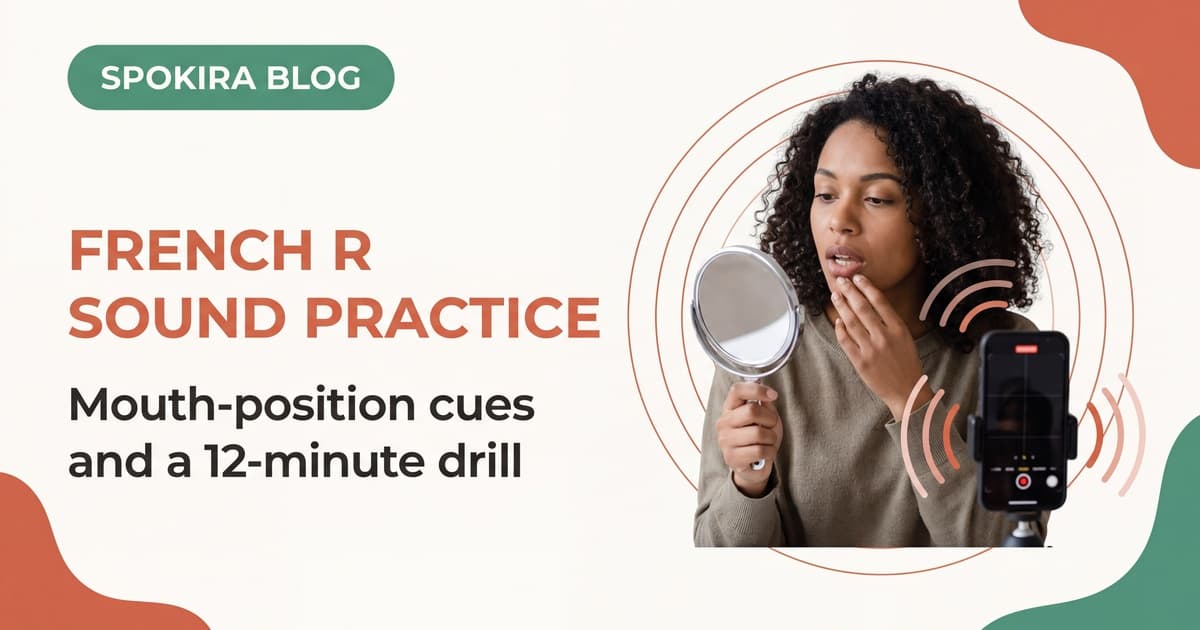
Drill 3: Mirror checkpoint
Use a mirror for 90 seconds and verify:
- jaw is not clamped
- lips are neutral or lightly rounded
- neck is relaxed
This visual check keeps french r sound practice honest. Many learners think the sound failed because of tongue position when the real issue is neck tension.
Drill 4: One-line transfer
Say one practical sentence five times:
Je prends le train demain matin.
Run it at normal pace, then slightly faster pace. If quality drops, return to normal pace and end there. That is still good french r sound practice because you are reinforcing stable production, not forcing speed.
Daily template you can copy
Use this exact script in your notes app:
- Cue used today:
- Hardest syllable today:
- Hardest word today:
- Best sentence today:
- Score (out of 8):
- One fix for tomorrow:
Consistency beats novelty here. Five clean sessions in a row is better than one intense weekend block.
Train French R In Real Speech, Not Isolation
Use Spokira to run short pronunciation loops with native audio, record-and-compare reps, and focused AI feedback on the exact sound that needs fixing.
Final takeaway
French R does not improve because you "know" where it should be. It improves when your mouth can reproduce the sound under normal speaking pressure.
So keep your french r sound practice simple:
- one cue set
- one daily routine
- one measurable score
- one small upgrade at a time
In two weeks, you should hear a clear shift: less tension, more consistency, and better transfer into real phrases. That is the point. Not perfect accent theater. Real French speech you can keep using.