If your words come out one by one in French, your grammar is not always the main issue. The bottleneck is often french speaking speed: retrieving chunks fast enough while your mouth keeps rhythm.
That is why timed shadowing works. You are not only learning what to say. You are training when and how quickly to say it under light pressure.
This guide gives you a 12-minute routine you can run daily. It is built for A2-B1 learners who understand a lot but still sound slow in real conversations.
If you want the full system first, start with French Speaking Practice: The Complete Guide. Then use this page as your speed block. If you want a broader habit before this pace protocol, start with the 5-minute French output routine.
Quick plan to improve french speaking speed
Run one short audio clip (10 to 20 seconds) through this sequence:
- Baseline run at normal pace (no pausing to fix mistakes).
- Timed shadowing ladder: 3 rounds with stricter pacing.
- No-audio retrieval relay: produce the same line from memory.
- Speed transfer: answer one related question inside 3 seconds.
- Record one final take and score flow, clarity, and recovery.
You can finish this in 12 minutes. Keep the same clip for 5 to 7 days before switching.
Why this structure is evidence-aligned:
- Roediger and Karpicke (Psychological Science, March 2006) found that active retrieval outperformed additional restudy on delayed tests (PubMed).
- Cepeda and colleagues (Psychological Bulletin, May 2006) reviewed 317 experiments and showed distributed practice improves long-term verbal recall (PubMed).
- Takeuchi et al. (published July 23, 2020; Brain Imaging and Behavior, 2021) reported that speaking-based shadowing and reading-aloud training improved working-memory-related reaction-time outcomes versus non-speaking controls (PubMed).
Why french speaking speed stalls even when vocabulary is good
Most learners who feel slow are stuck between recognition and real-time production.
You recognize phrases in reading and listening. But conversation removes those cues and adds time pressure. Now you need quick retrieval, sentence assembly, and motor timing at the same moment.
The CEFR Companion Volume (Council of Europe, 2020) describes this gap clearly: around B1, speakers can often sustain interaction, but pauses for lexical and grammatical planning are still visible in spontaneous speech (Council of Europe CEFR Companion Volume).
So, "I sound slow" is usually not a motivation problem. It is a training design problem.
You need drills that do three things together:
- force fast chunk retrieval
- keep rhythm under controlled pace
- teach recovery instead of restart
Timed shadowing gives you that mix.
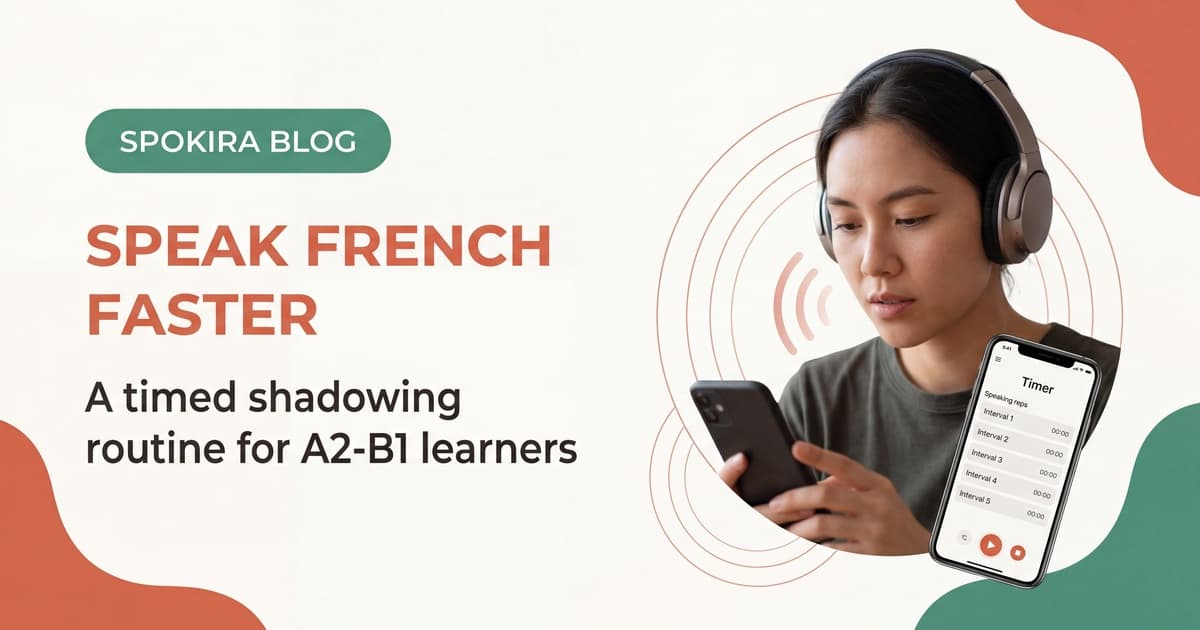
The 12-minute timed shadowing routine for french speaking speed
Use one clip from beginner dialogues, travel scenarios, or short interview answers. Keep it practical enough that you might say it yourself.
Minute 0-2: Baseline run
- Listen once for meaning.
- Read transcript once (if available).
- Say the full line once with no stop rule.
Track three numbers immediately:
- Time-to-first-word (seconds before you start speaking)
- Longest pause (seconds)
- Restart count (how many full restarts)
Do not judge accent here. This is baseline only.
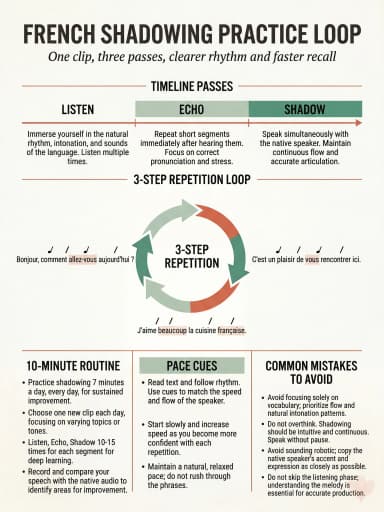
Minute 2-6: Timed shadowing ladder
Run three rounds with a timer.
| Round | Audio pace | Target | Rule |
|---|---|---|---|
| 1 | 100% speed | Keep up through whole line | No pause longer than 1 second |
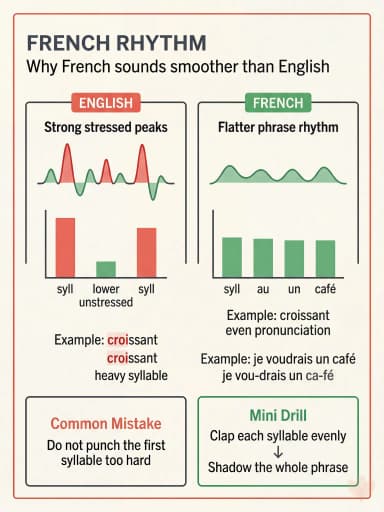
| 2 | 100% speed | Cleaner chunk linking | Mark one rhythm fix |
| 3 | 105 to 110% speed | Stay intelligible while faster | Do not restart |
If round 3 collapses completely, drop back to 100% and repeat round 2.
Your goal is not "maximum speed." Your goal is stable speed with understandable rhythm.
If your rhythm still feels choppy, review French Shadowing: The Complete Guide to Actually Speaking French before the next session.
Minute 6-10: Retrieval relay (no audio)
Now remove the audio and speak from memory.
Do three relay passes:
- Pass A: full line at normal pace.
- Pass B: same line, 10% faster.
- Pass C: same line plus one variation (time, place, or noun change).
This is the highest-value block for french speaking speed because it trains retrieval without external support.
If you blank, use one rescue phrase and continue:
- "Attendez, je reformule."
- "Je veux dire..."
- "Comment dire..."
Do not rewind to the beginning. Recovery beats perfect restarts in real conversation.
This retrieval emphasis is exactly what testing-effect research supports: successful later recall depends on repeated retrieval attempts, not only repeated exposure.
Minute 10-12: Speed transfer to live response
You now convert practice speed into conversational speed.
Ask one related question and answer within 3 seconds.
Example for cafe script:
- Prompt: "Sur place ou a emporter?"
- Response: "Sur place, merci."
Example for directions script:
- Prompt: "C'est loin d'ici?"
- Response: "Non, a cinq minutes a pied."
Do 3 prompt-response reps. Then record one final take and compare to baseline.
Score 0 to 2 on each metric:
- Flow
- Clarity
- Retrieval speed
- Recovery
Total out of 8.
Speed Rule
If your score is under 5 for two sessions, keep the same clip. If you score 6+ in three sessions, move to a new clip.
A 7-day progression plan (same clip, smarter pressure)
Use this exact progression before changing content.
| Day | Main focus | Pressure setting | Success checkpoint |
|---|---|---|---|
| 1 | Baseline and chunking | 100% pace | Complete routine once |
| 2 | Rhythm linking | 100% pace | Fewer long pauses |
| 3 | Faster response starts | 105% pace in round 3 | Lower time-to-first-word |
| 4 | Retrieval under variation | 1 variable change per pass | Fewer restarts |
| 5 | Interruption tolerance | Add one surprise prompt | Recover without freezing |
| 6 | Clarity under speed | Keep pace, protect vowels | Clearer final recording |
| 7 | Simulation day | Full timed run + Q&A | Stable score 6/8 or higher |
This is how you build french speaking speed without turning speech into rushed noise.
Need a companion drill for output volume? Pair this with French Output Retrieval Drill: 1 Clip, 15 Timed Reps.
Common reasons timed shadowing fails and how to fix each one
1. You pick clips that are too hard
If you understand under 70% of the clip, you will spend the whole session decoding instead of speaking.
Fix:
- choose shorter clips
- reduce unknown words
- keep one communicative intent per line
For controlled beginner-friendly sentence design, use patterns from French Speaking Practice Guide.
2. You treat speed as shouting
Many learners push volume and tension when they try to speak faster.
Result: less clarity, more fatigue.
Fix:
- keep jaw and lips relaxed
- shorten pauses, not vowels
- maintain phrase grouping
For pronunciation-specific cleanup, review French Pronunciation for English Speakers.
3. You restart every time you miss one word
Restart loops feel "careful," but they train stop-and-go habits.
Fix:
- use bridge phrases
- finish the line anyway
- patch one word after completion
If this is your main pattern, run French Conversation Freeze Drill for one week in parallel.
4. You change clips too often
Novelty feels motivating but weakens automation.
Fix:
- keep one clip for 5 to 7 days
- only increase challenge after consistent 6+/8 scoring
5. You ignore recording comparisons
Without before/after audio, speed gains are hard to detect objectively.
Fix:
- keep Day 1 and Day 7 recordings
- compare pause length and response latency
- note one repeated win and one repeated weak point
If recording discomfort blocks you, use Record Yourself in French Without Cringing as your companion method.
Weekly benchmark: measure french speaking speed without guessing
If you never measure speed, you usually overestimate good days and forget bad ones. Keep a weekly benchmark every 7 sessions.
Record one 30-second response on the same prompt and track:
- average pause length
- longest pause
- time-to-first-word
- words delivered in 30 seconds
- restart count
You do not need perfect transcription. You need directional trend.
Use this practical target pattern across 4 weeks:
- Week 1: baseline and setup
- Week 2: fewer restarts, slightly shorter pauses
- Week 3: faster starts plus cleaner chunk links
- Week 4: stable pace in short live exchanges
If words-per-30-seconds rises but clarity drops, slow down 5 to 10% and protect vowels plus phrase boundaries. Speed that listeners cannot follow is not usable progress.
If pace stays flat for 10 days, apply one change only:
- shorten clip length
- reduce unknown vocabulary
- keep same clip two extra days
- add one extra retrieval pass
Avoid changing all variables at once. One variable per mini-cycle gives cleaner feedback.
Keep speed and clarity together
Fast but muddy speech creates new problems. The goal is quicker delivery that remains understandable.
Use this balance rule during round 3:
- if clarity score falls below 1/2, lower pace
- if clarity stays 2/2 for three sessions, raise pace slightly
For high-friction sounds that break clarity under speed, run one focused fix from 5 French Accent Errors That Block Clarity (Fast Fix Drills) before timed shadowing. Then return to the same speed clip.
Timed shadowing templates you can use tonight
Template A: Cafe order speed loop
Core line:
"Bonjour, je voudrais un cafe creme, s'il vous plait."
Variation prompts:
- Change drink
- Change quantity
- Add payment method
Speed transfer question:
"Vous payez comment?"
Template B: Direction request loop
Core line:
"Excusez-moi, ou est la station la plus proche?"
Variation prompts:
- Add distance question
- Add transport mode
- Confirm turns
Speed transfer question:
"Vous y allez a pied ou en bus?"
Template C: Social intro loop
Core line:
"Bonjour, je m'appelle Alex, je suis ici pour le travail."
Variation prompts:
- Add city
- Add duration of stay
- Ask reciprocal question
Speed transfer question:
"Et vous, vous venez d'ou?"
Want Guided Speed Drills?
Spokira gives you short shadowing packs, timed speaking rounds, and targeted AI feedback so you can increase speed without losing clarity.
FAQ: french speaking speed and timed shadowing
Is speaking faster always better?
No. Useful speed means you respond with less delay while staying understandable. If clarity drops sharply, you are above your productive pace.
How many minutes per day are enough?
For most A2-B1 learners, 10 to 15 focused minutes daily beats one long weekly session. This aligns with spacing findings in verbal learning research.
Should I use subtitles during shadowing?
Use subtitles only in the first pass when needed for decoding. Then remove them for retrieval rounds.
How long until I notice change?
Most learners notice shorter response delays in 5 to 7 sessions when they keep the same clip and track metrics consistently.
Can this replace conversation practice?
No. Timed shadowing prepares your response speed. Live conversation applies that speed under unpredictable turns. Use both.
30-second warm-up when your mouth feels slow
Some days your first attempts feel heavy. Do this before the routine:
- One relaxed exhale.
- Say one memorized opener twice.
- Shadow one short chunk at easy pace.
- Start round 1 immediately.
This warm-up is not separate training. It just removes the first-minute friction so your timed reps are cleaner. Keep it short. If warm-up becomes five minutes, it turns into avoidance.
French speaking speed checklist before each session
Use this one-minute checklist before you start. It keeps french speaking speed training focused and prevents random practice drift.
- Choose one line you could actually say today.
- Confirm you understand the line at least 70%.
- Decide one speed target and one clarity target.
- Commit to no-restart recovery for the full round.
- Write your score before changing the clip.
If french speaking speed is flat after a week, do not change everything at once. Keep the same line and increase only one variable: pace, variation, or response time.
This simple checklist makes french speaking speed measurable. You stop guessing and start comparing real sessions.
Final takeaway
If you keep saying, "I speak French too slowly," stop searching for more theory and run a tighter routine.
One short clip. Twelve focused minutes. Daily repetition. Clear scoring.
That is enough to change your french speaking speed profile in a measurable way.
Train your mouth, not your streak. Keep the pressure small, keep the reps consistent, and carry that new pace into real conversations.