French Rhythm vs English Stress
Why French sounds smoother than English, and how to copy that rhythm.
Share this visual
Share the page URL so the visual earns links, saves, and citations.
Embed snippet links back to the canonical visual page.
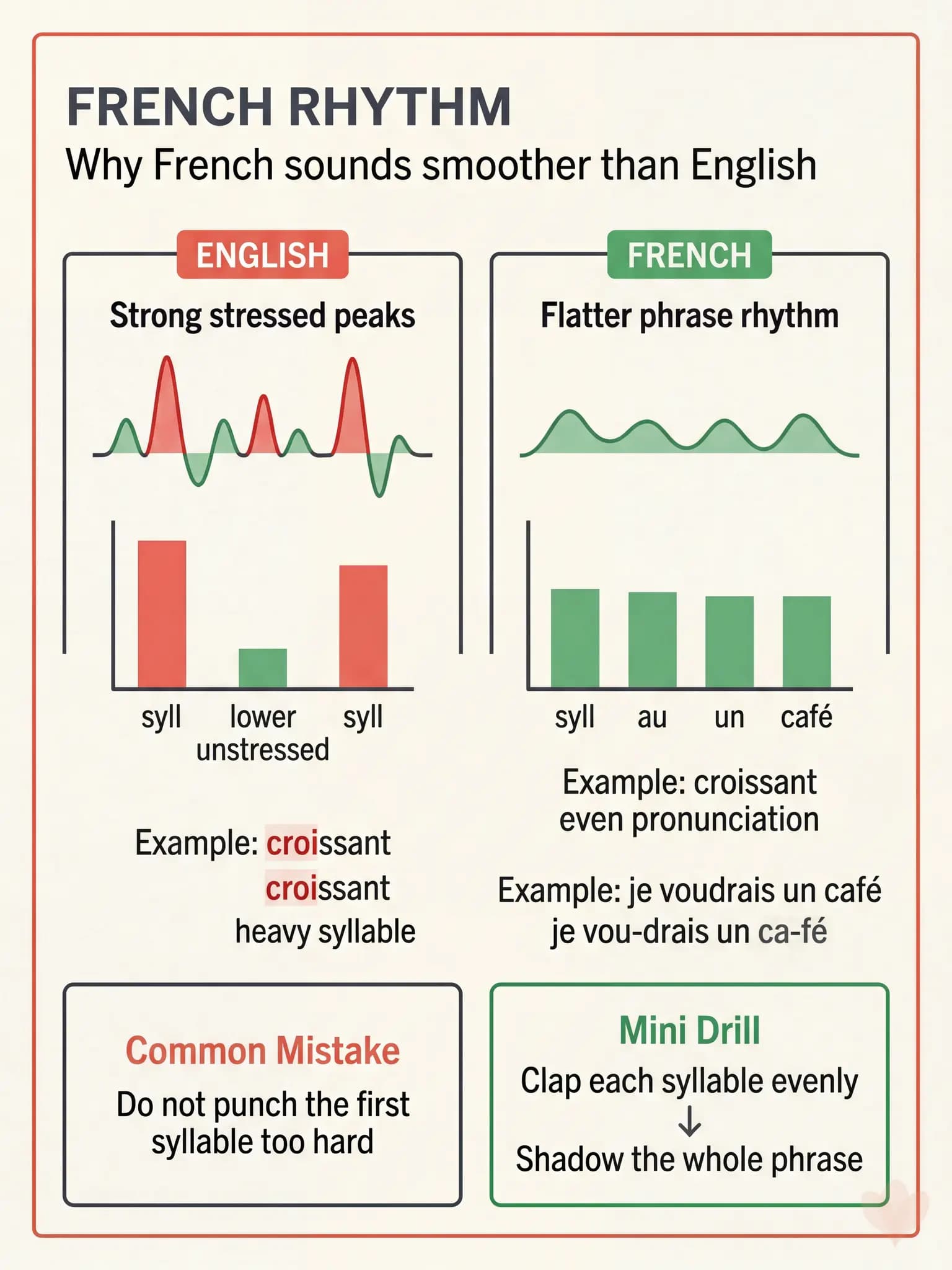
French rhythm usually sounds smoother because the phrase carries forward more evenly. English, by contrast, leans harder on stressed syllables. If your French still sounds abrupt, rhythm is often the missing piece rather than the individual consonants or vowels.
What to listen for
- English: stressed syllables and strong peaks
- French: flatter phrase rhythm with lighter stress shifts
Practice phrases
- croissant
- je voudrais un cafe
Why English speakers miss it
The first instinct is to punch one syllable too hard and let the rest fall away. That works in English more often than it does in French.
Quick practice
- Clap each syllable evenly.
- Shadow the full phrase.
- Repeat at native pace without adding English stress.
Why this works
French is commonly described as more syllable-timed than English, which helps explain why English-style stress peaks sound heavy when they are copied straight across. The background page on Isochrony on Wikipedia covers the stress-timed versus syllable-timed distinction, and French phonology on Wikipedia notes that stress in French is organized differently from English word stress.
Where to go next
Pair this with the French liaison rules quick guide if your phrases still sound segmented. For a routine built around this idea, read French speaking speed shadowing routine.
Practice Inside Spokira
Use timed shadowing in Spokira to lock in French rhythm.