French Liaison Rules Quick Guide
A quick visual guide to when French words connect in speech.
Share this visual
Share the page URL so the visual earns links, saves, and citations.
Embed snippet links back to the canonical visual page.
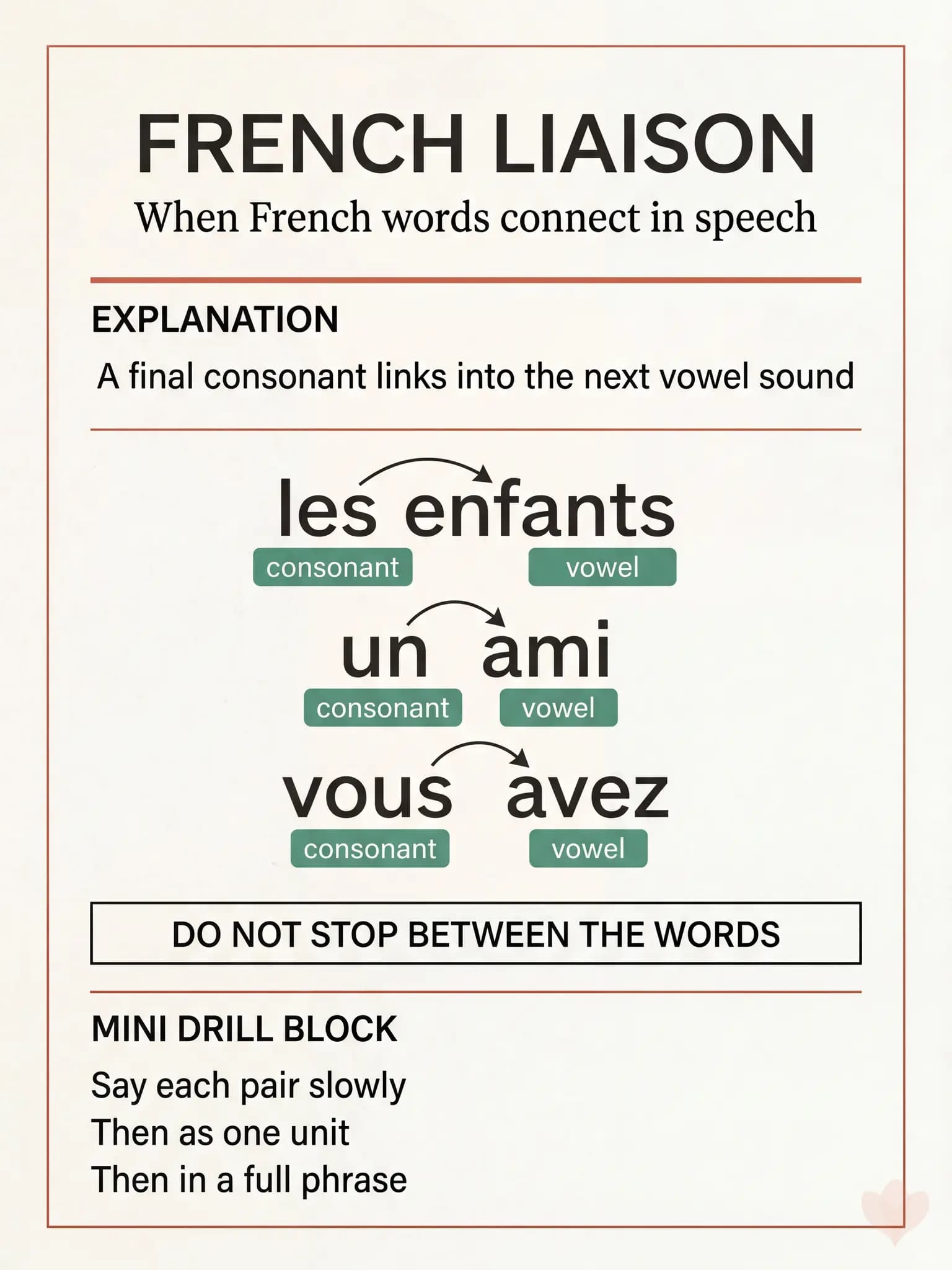
French liaison is one reason fast French sounds smoother than the written words suggest. When a word ends in a consonant that is usually silent and the next word begins with a vowel, the consonant links forward instead of staying silent.
What liaison is
- A final consonant links to the next vowel sound
- The two words are pronounced as one connected unit
Common examples
- les enfants
- un ami
- vous avez
Why English speakers miss it
English speakers often pause between words because the spelling looks separate. In connected French, that pause makes the phrase sound chopped up.
Quick practice
- Say each pair slowly.
- Link them as one unit.
- Repeat them inside a full phrase.
Why this works
Liaison is not random decoration. As Lawless French explains, a normally silent final consonant can surface before a following vowel or h muet, and some of those links are required while others are optional or forbidden. The standard overview in French phonology on Wikipedia also treats liaison as one of the core processes affecting word-final sounds in French.
Where to go next
For the full liaison deep dive with drills and self-checks, read French liaison rules: when to link words. This works well alongside the French rhythm vs English stress card because liaison and phrase rhythm reinforce each other. For the complete connected speech system, see French connected speech rules.
Practice Inside Spokira
Practice liaison inside real phrases in Spokira.