Liaison is the single most important connected speech rule in French. It is also the one English speakers struggle with most, because English has nothing like it.
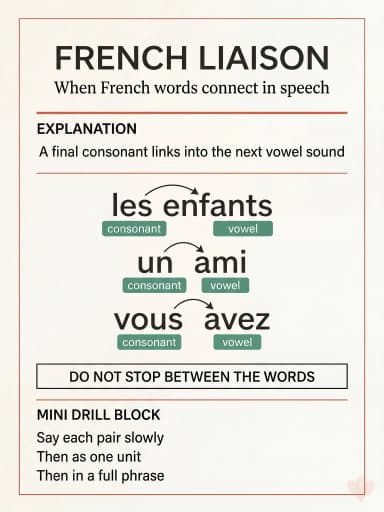
In French, a consonant that is normally silent at the end of a word "wakes up" and links to the vowel at the start of the next word. The two words are then pronounced as one connected unit. This is liaison.
Get it right, and your French flows naturally. Get it wrong, either by missing required liaisons or by adding forbidden ones, and you sound either choppy or bizarre.
This guide gives you the complete system: when liaison is required, when it is optional, when it is forbidden, and how to drill it until it becomes automatic. This is part of the French connected speech rules system.
What liaison is
Liaison happens when three conditions are met at the same time:
- A word ends in a consonant that is normally silent
- The next word begins with a vowel sound (including silent h, called h muet)
- The two words are in a close grammatical relationship
When all three conditions apply, the silent final consonant sounds and attaches to the beginning of the next word.
Example: les amis (the friends)
- Written: two separate words
- Without liaison: /le/ + /a.mi/, sounds chopped
- With liaison: /le.za.mi/, sounds native
The s in les is normally silent. But before the vowel in amis, it surfaces as /z/ and links forward.
Liaison vs enchaînement
Liaison involves a consonant that is normally silent coming to life. Enchaînement involves a consonant that is always pronounced sliding forward. Both create linking, but they are different processes. See French enchaînement for the distinction.
The three categories of liaison
Both the Académie française and standard French phonetics curricula split liaison into three groups (Académie française, Liaisons; UT Austin, la liaison):
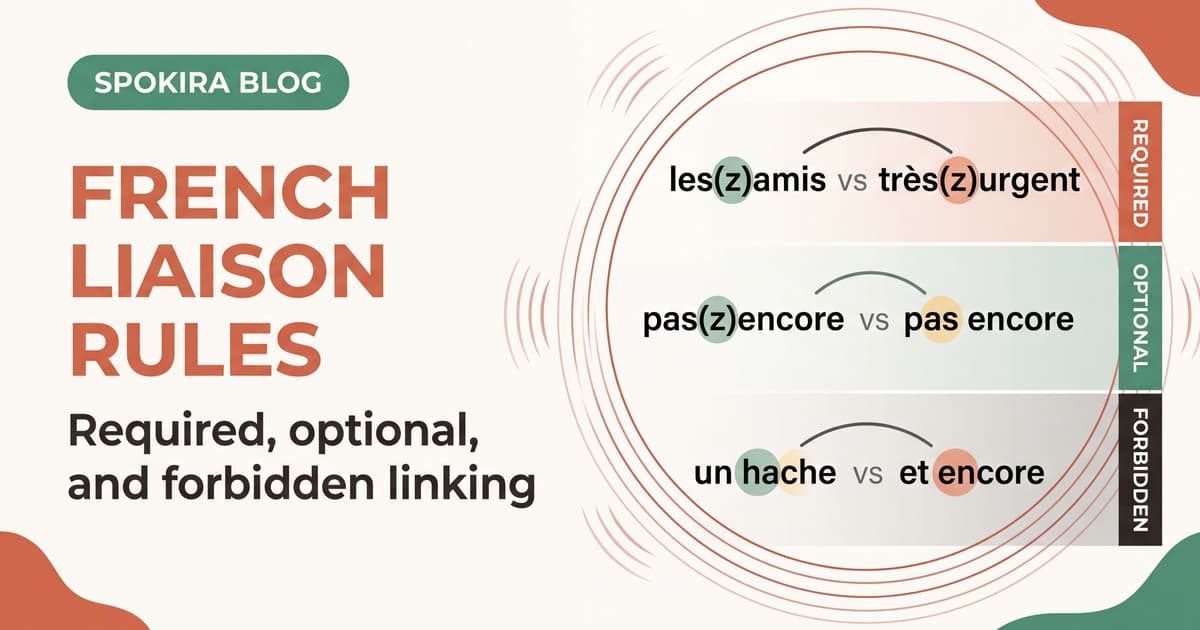
1. Liaison obligatoire (required)
You must make these liaisons. Skipping them sounds wrong to any French speaker.
| Context | Example | Pronunciation |
|---|---|---|
| Determiner + noun | les‿amis | /le.za.mi/ |
| Determiner + adjective | un‿ancien | /œ̃.nɑ̃.sjɛ̃/ |
| Adjective + noun (before noun) | petit‿enfant | /pə.ti.tɑ̃.fɑ̃/ |
| Subject pronoun + verb | ils‿ont | /il.zɔ̃/ |
| Verb + subject pronoun (inversion) | ont‿ils | /ɔ̃.til/ |
| After est (c'est, il est) | c'est‿important | /sɛ.tɛ̃.pɔʁ.tɑ̃/ |
| Preposition + complement | dans‿une | /dɑ̃.zyn/ |
| After très, bien, trop | très‿utile | /tʁɛ.zy.til/ |
| Fixed expressions | les‿États-Unis | /le.ze.ta.zy.ni/ |
2. Liaison facultative (optional)
These liaisons are style-dependent. Formal speech uses more of them. Casual speech drops most of them.
| Context | Example | Formal | Casual |
|---|---|---|---|
| Plural noun + adjective | enfants‿adorables | /ɑ̃.fɑ̃.za.dɔ.ʁabl/ | /ɑ̃.fɑ̃.a.dɔ.ʁabl/ |
| After pas | pas‿encore | /pa.zɑ̃.kɔʁ/ | /pa.ɑ̃.kɔʁ/ |
| Verb + complement | je vais‿à | /ʒə.vɛ.za/ | /ʒə.vɛ.a/ |
A2-B1 learners: do not worry about optional liaisons yet. Master the required ones first. Optional liaisons are a register tool you will develop naturally with more exposure.
3. Liaison interdite (forbidden)
Never make these liaisons. Adding them sounds wrong.
| Context | Example | Why forbidden |
|---|---|---|
| After et (and) | et // il | Historical rule; et never links |
| Before h aspiré | les // haricots | Aspirated h blocks liaison |
| Singular noun + verb | l'enfant // arrive | The noun-verb boundary blocks it |
| After a proper name | Jean // est | Names create a boundary |
| Before onze, oui, un (some contexts) | les // onze | Specific lexical exceptions |
The most common forbidden-liaison mistake
English speakers often link et to the next word: et‿il → /e.til/. This is always wrong. Et never makes liaison. Say /e.il/ with a tiny breath between.
Which consonant sounds appear in liaison?
The written consonant does not always produce the sound you expect:
| Written letter | Liaison sound | Example |
|---|---|---|
| s, x | /z/ | les‿amis /le.za.mi/, deux‿ans /dø.zɑ̃/ |
| t, d | /t/ | petit‿ami /pə.ti.ta.mi/, grand‿ami /gʁɑ̃.ta.mi/ |
| n | /n/ | un‿ami /œ̃.na.mi/, bon‿appétit /bɔ.na.pe.ti/ |
| r | /ʁ/ | premier‿étage /pʁə.mjɛ.ʁe.taʒ/ |
| p | /p/ | trop‿aimable /tʁo.pɛ.mabl/ (rare) |
Notice that d in liaison sounds as /t/, not /d/. This surprises many learners: grand‿ami is /gʁɑ̃.ta.mi/, not /gʁɑ̃.da.mi/.
10 high-frequency liaison phrases to memorize
These appear in everyday French constantly. Make them automatic:
- les‿amis /le.za.mi/, the friends
- ils‿ont /il.zɔ̃/, they have
- nous‿avons /nu.za.vɔ̃/, we have
- c'est‿un /sɛ.tœ̃/, it's a
- vous‿êtes /vu.zɛt/, you are
- dans‿un /dɑ̃.zœ̃/, in a
- très‿important /tʁɛ.zɛ̃.pɔʁ.tɑ̃/, very important
- petit‿à petit /pə.ti.ta.pə.ti/, little by little
- en‿avant /ɑ̃.na.vɑ̃/, forward
- tout‿à fait /tu.ta.fɛ/, exactly
Say each one 5 times right now. Speed up each round.
The common English-speaker mistake
English speakers make two opposite errors with liaison:
Mistake 1: skipping required liaisons
This is the most common beginner error. You treat each French word as an island, the way you do in English:
- ❌ /le/ /a.mi/ (word-by-word)
- ✅ /le.za.mi/ (linked)
The result: your French sounds like you are reading a dictionary, not speaking.
Mistake 2: adding liaisons everywhere
Once you learn about liaison, you overcorrect and start linking everything:
- ❌ et‿il /e.til/ (forbidden liaison after et)
- ❌ les // haricots spoken as /le.za.ʁi.ko/ (forbidden: h aspiré)
- ✅ et il /e.il/ with brief separation
- ✅ les haricots /le.a.ʁi.ko/ with no linking
The fix: learn the forbidden list first. It is shorter than the required list, and breaking a forbidden liaison sounds worse than missing an optional one.
Mistake 3: wrong liaison consonant sound
Pronouncing the liaison consonant with its spelling value instead of its liaison value:
- ❌ grand‿ami /gʁɑ̃.da.mi/ (using /d/)
- ✅ grand‿ami /gʁɑ̃.ta.mi/ (liaison d → /t/)
Shadowing drill: 5-minute liaison workout
This drill builds automatic liaison production. Do it daily for 7 days.
Round 1: Slow linking (2 minutes)
Read each phrase slowly. Exaggerate the liaison consonant. Feel the link:
- Les‿enfants sont‿arrivés.
- Vous‿avez un‿ami?
- C'est‿un‿excellent‿endroit.
- Nous‿allons‿en‿Italie.
- Il est‿impossible de partir.
Round 2: Natural speed (2 minutes)
Now say each phrase at conversation speed. The liaison should still be there, just faster:
- Les‿enfants sont‿arrivés.
- Vous‿avez un‿ami?
- C'est‿un‿excellent‿endroit.
- Nous‿allons‿en‿Italie.
- Il est‿impossible de partir.
Round 3: No-text recall (1 minute)
Close your eyes. Say as many of the five phrases as you can from memory. The liaisons should survive without visual support.
If a liaison drops when you go from memory, that phrase needs more reps tomorrow.
Self-check: are your liaisons working?
Record yourself reading this passage:
Les‿anciens‿amis de mon frère sont‿arrivés dans‿un petit‿hôtel. C'est‿un‿endroit très‿agréable. Ils‿ont deux‿enfants, et ils sont‿en vacances.
Now check each liaison point:
| Liaison point | Expected sound | Did you link? |
|---|---|---|
| les‿anciens | /z/ | ☐ |
| anciens‿amis | /z/ | ☐ |
| sont‿arrivés | /t/ | ☐ |
| dans‿un | /z/ | ☐ |
| petit‿hôtel | /t/ | ☐ |
| c'est‿un | /t/ | ☐ |
| un‿endroit | /n/ | ☐ |
| très‿agréable | /z/ | ☐ |
| ils‿ont | /z/ | ☐ |
| deux‿enfants | /z/ | ☐ |
| sont‿en | /t/ | ☐ |
Also check: did you correctly avoid liaison after et? (et ils should NOT link.)
Score:
- 9-11 linked: excellent, focus on speed
- 6-8 linked: good foundation, drill the misses
- Under 6: spend one more week on required liaisons before moving on
When liaison does not happen (summary)
Quick reference of the most important forbidden contexts:
- After et, never, in any context
- Before h aspiré words, les héros, les haricots, les hiboux
- After a singular noun before a verb, l'enfant arrive (no liaison)
- After a proper name, Jean est là (no liaison)
- Before onze, les onze (no liaison)
- After comment in inversion, comment allez-vous (no liaison after comment)
When in doubt, skip the liaison. A missing optional liaison is barely noticeable. A wrong forbidden liaison stands out.
How liaison connects to the rest of the system
Liaison does not work alone. It is part of the French connected speech system:
- Liaison + enchaînement often work together in the same phrase. Elle est arrivée: elle est uses enchaînement (the /l/ is always pronounced), then est arrivée uses liaison (the /t/ wakes up). See enchaînement guide.
- Liaison depends on silent finals: you need to know which consonants are normally silent before you can identify which ones "wake up." See silent final consonants.
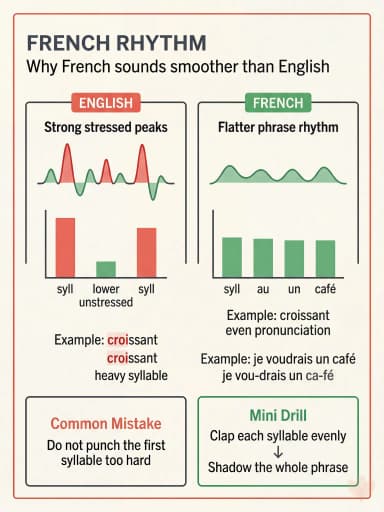
- Liaison serves French rhythm: the point is not just to link sounds but to maintain the smooth CV syllable flow that French phrase groups require. See French rhythm and intonation practice.
Practice Liaison in Real French Phrases
Shadow native clips, get instant feedback on your linking, and build automatic liaison habits with short daily drills.
What to do next
If you scored well on the self-check, move to French Enchaînement, it is the next connected speech process to master.
If you need more liaison practice, keep doing the shadowing drill daily for 7 days, then re-test.
For the full connected speech system and learning roadmap, return to French Connected Speech Rules.