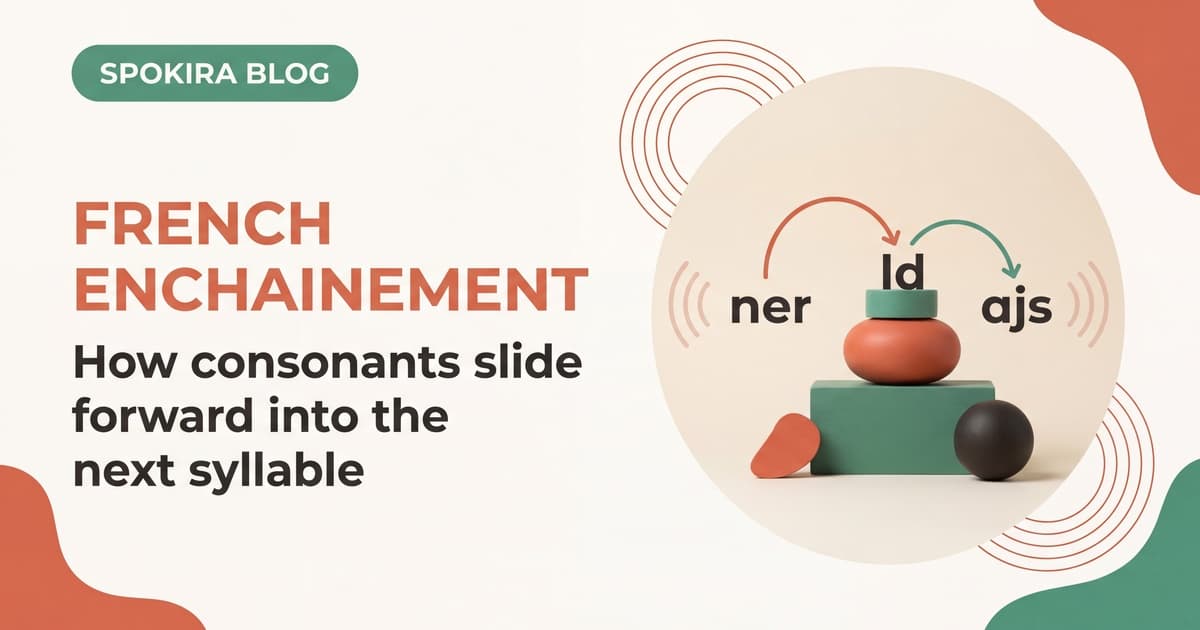
French enchainement is the rule that makes an already-pronounced final consonant slide into the next syllable when a vowel follows. If your French sounds choppy even when the individual sounds are correct, French enchainement is usually part of the problem.
If liaison is French connected speech's headline act, enchaînement is the rhythm section. It is less dramatic but arguably more constant. It happens in almost every phrase you speak.
Enchaînement is what makes French sound smooth where English sounds choppy. When a word ends in a consonant that is always pronounced and the next word starts with a vowel, the consonant slides forward and becomes the start of the next syllable. No pause. No gap. Just flow.
English speakers almost never do this. That is why their French has tiny micro-pauses between words that native speakers do not produce. Those micro-pauses are what make you sound "foreign" even when your sounds are correct.
This guide is part of the French connected speech rules system. It also fits directly into the broader French pronunciation guide for English speakers and the shorter French pronunciation rules for speaking clarity roadmap.
French enchainement in one sentence
French enchainement means a consonant you already pronounce at the end of one word slides forward to begin the next syllable when the next word starts with a vowel.
What is French enchainement?
Enchaînement means "chaining." It is the simplest connected speech rule in French:
When a word ends in a pronounced consonant and the next word begins with a vowel, the consonant links forward to start the next syllable.
Example: elle est (she is)
- The /l/ at the end of elle is always pronounced
- est starts with a vowel sound /ɛ/
- Enchaînement: the /l/ slides forward → /ɛ.lɛ/
- Not: /ɛl/ + /ɛ/ with a gap between
The syllable boundary shifts. Instead of ending elle with /l/ and starting est with /ɛ/, French treats the /l/ as the beginning of the second syllable: /ɛ-lɛ/.
This is the same principle UT Austin's phonetics curriculum describes: French prefers consonant-vowel (CV) syllable patterns, so final consonants naturally migrate forward to create that pattern (UT Austin, les syllabes). The CEFR Companion Volume also treats intelligibility and prosody in connected speech as core parts of pronunciation progress, not optional polish (Council of Europe, 2020).
Enchaînement vs liaison: the key difference
These two processes look similar but work differently:
| Feature | Enchaînement | Liaison |
|---|---|---|
| Final consonant | Always pronounced | Normally silent |
| When it happens | Any time a pronounced consonant meets a vowel | Only in specific grammatical contexts |
| Creates a new sound? | No, the sound was already there | Yes, a silent consonant "wakes up" |
| Can be forbidden? | No, it is automatic | Yes, some contexts block it |
Enchaînement example: elle‿arrive, the /l/ is always pronounced, it just shifts forward → /ɛ.la.ʁiv/
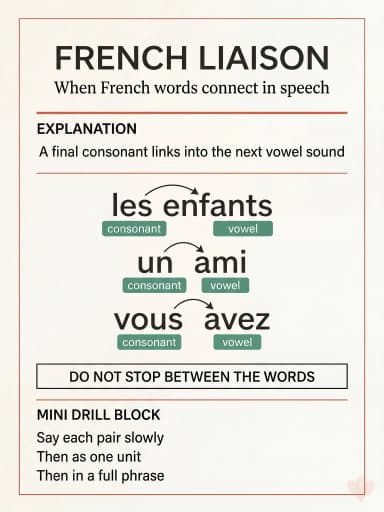
Liaison example: les‿amis, the /z/ is normally silent, it wakes up before the vowel → /le.za.mi/
Simple test
Ask: "Would this consonant be pronounced if the next word started with a consonant?" If yes → enchaînement. If no → liaison. Example: elle parle, the /l/ is still there. So elle arrive is enchaînement. But les garçons, the /s/ is silent. So les amis is liaison.
When enchaînement happens
Enchaînement is automatic and unrestricted. Unlike liaison, there is no "forbidden" category. Whenever these two conditions are met, enchaînement occurs:
- The word ends in a pronounced consonant (l, r, t in some words, k, v, f, n, etc.)
- The next word starts with a vowel sound
That's it. No grammatical restrictions. No style variation. It just happens.
Common consonants involved in enchaînement:
| Consonant | Example | Pronunciation |
|---|---|---|
| /l/ | elle‿est | /ɛ.lɛ/ |
| /ʁ/ | pour‿elle | /pu.ʁɛl/ |
| /k/ | avec‿elle | /a.vɛ.kɛl/ |
| /v/ | neuve‿idée | /nœ.vi.de/ |
| /t/ | sept‿heures | /sɛ.tœʁ/ |
| /s/ | une place‿assise | /yn.pla.sa.siz/ |
| /n/ | une‿amie | /y.na.mi/ |
French enchainement examples you hear every day
French enchainement shows up most clearly in short, ordinary phrases. That is useful because you do not need exotic vocabulary to train it. You need common phrases that come up all the time.
Here are five high-frequency examples with the exact movement to notice:
| Phrase | What moves | Result |
|---|---|---|
| elle arrive | final /l/ of elle shifts forward | /ɛ.la.ʁiv/ |
| avec elle | final /k/ of avec shifts forward | /a.vɛ.kɛl/ |
| pour un | final /ʁ/ of pour shifts forward | /pu.ʁœ̃/ |
| sur une | final /ʁ/ of sur shifts forward | /sy.ʁyn/ |
| notre ami | final /ʁ/ of notre shifts forward | /nɔ.tʁa.mi/ |
The practical test is simple: if the consonant is already pronounced when the next word starts with a consonant, keep it and push it into the next vowel when a vowel follows. If the consonant normally disappears and only wakes up before a vowel, you are in liaison, not enchaînement.
When enchaînement does not happen
Enchaînement only fails in these situations:
-
The next word starts with a consonant: no vowel to link to, so no enchaînement. Elle parle, the /l/ stays at the end of elle.
-
The final consonant is not pronounced: then it is either a liaison context (if the consonant surfaces) or nothing happens. Petit garçon, the /t/ in petit is silent before a consonant.
-
A deliberate pause for emphasis: speakers can break enchaînement for dramatic effect, but this is rare in normal speech. It sounds marked and intentional.
There is no "forbidden enchaînement" category. This is one of the reasons it is easier than liaison, you simply link every time the conditions are met.
10 high-frequency enchaînement phrases
These word combinations appear constantly in everyday French. Make the linking automatic:
- elle‿est /ɛ.lɛ/, she is
- il‿a /i.la/, he has
- pour‿un /pu.ʁœ̃/, for a
- avec‿elle /a.vɛ.kɛl/, with her
- une‿autre /y.notʁ/, another
- sur‿une /sy.ʁyn/, on a
- par‿exemple /pa.ʁɛg.zɑ̃pl/, for example
- quatre‿heures /ka.tʁœʁ/, four o'clock
- notre‿ami /nɔ.tʁa.mi/, our friend
- faire‿attention /fɛ.ʁa.tɑ̃.sjɔ̃/, to pay attention
Say each one 5 times. On the first pass, slow down at the link point and feel the consonant slide forward. On the last pass, say it at natural speed.
The common English-speaker mistake
English speakers instinctively close each word before starting the next. This creates micro-pauses that do not exist in French.
What it sounds like
English approach to elle est ici (she is here):
/ɛl/ · /ɛ/ · /i.si/, three separate islands with tiny gaps
French approach:
/ɛ.lɛ.ti.si/, one continuous flow (enchaînement + liaison: the /t/ from est links via liaison to ici)
The micro-pauses are often shorter than 50 milliseconds, you might not even hear them in your own speech. But French listeners do. Those gaps are what make your French sound "word-by-word" instead of flowing.
Why English speakers do this
English uses word-final consonant closure as a boundary signal. We release the consonant, create a tiny gap, then start the next word. French does not work this way. French consonants at word boundaries are transitional, not terminal.
How to fix it
The fix is physical, not intellectual. You need to retrain your mouth to keep moving through the consonant instead of stopping on it.
Exercise: say elle est ici as if it were one word: "elestiici." Remove all internal pauses. Then gradually restore natural rhythm without adding the pauses back.
This feels wrong at first. It is correct.
French enchainement practice routine for A2-B1 learners
If you want French enchainement to survive outside drills, train it in three layers:
1. Word pair layer
Use nothing but two-word chains for two or three days:
- elle est
- avec elle
- sur une
- pour un
- notre ami
Your job is not speed yet. Your job is zero gap.
2. Phrase layer
Once the pair feels stable, insert each chain into a longer phrase:
- Elle est ici depuis une heure.
- Je viens avec elle demain.
- On reste sur une idée simple.
- C'est pour un ami.
- Notre ami arrive ce soir.
This is where many learners relapse. They can link in isolation but add the gap back once the sentence gets longer.
3. Conversation layer
Finally, use the same chains in answers you would actually say:
- Elle est en retard.
- Je suis avec elle.
- C'est pour un collègue.
- On part sur une autre option.
The 2025 meta-analysis of pronunciation training studies found large gains from targeted phonetic work, which lines up with this kind of repeated, focused practice rather than vague "speak more" advice (Yao et al., 2025).
The best self-check
Record one version at slow speed and one at normal speed. If the link disappears when you speed up, you do not own the pattern yet. Keep the same phrase set for another two or three days.
Shadowing drill: 5-minute enchaînement workout
Round 1: Two-word chains (2 minutes)
Link each pair smoothly. No gap between words:
- elle‿est → /ɛ.lɛ/
- il‿arrive → /i.la.ʁiv/
- pour‿elle → /pu.ʁɛl/
- avec‿un → /a.vɛ.kœ̃/
- sur‿une → /sy.ʁyn/
Round 2: Full phrases (2 minutes)
Now chain multiple enchaînements together:
- Elle‿est‿ici avec‿une‿amie. → continuous flow
- Il‿arrive pour‿une‿heure. → no internal pauses
- Notre‿ami habite sur‿une‿île. → smooth linking throughout
Round 3: No-text recall (1 minute)
Close your eyes. Say as many phrases as you can from memory. Check: did the linking survive without visual support?
If you added micro-pauses when going from memory, that phrase needs more reps.
Self-check: is your enchaînement working?
Record yourself reading this passage:
Elle est arrivée avec une amie. Notre ami habite sur une île, et il a quatre enfants. Pour elle, c'est une autre aventure.
Check each link point:
| Link point | Expected flow | Did you link? |
|---|---|---|
| elle‿est | /ɛ.lɛ/ | ☐ |
| est‿arrivée | liaison /t/ + flow | ☐ |
| avec‿une | /a.vɛ.kyn/ | ☐ |
| une‿amie | /y.na.mi/ | ☐ |
| notre‿ami | /nɔ.tʁa.mi/ | ☐ |
| sur‿une | /sy.ʁyn/ | ☐ |
| une‿île | /y.nil/ | ☐ |
| il‿a | /i.la/ | ☐ |
| quatre‿enfants | /ka.tʁɑ̃.fɑ̃/ | ☐ |
| pour‿elle | /pu.ʁɛl/ | ☐ |
| une‿autre | /y.notʁ/ | ☐ |
Score:
- 9-11 linked: your enchaînement is strong, focus on speed
- 6-8: good awareness, drill the missed links
- Under 6: spend one more week on two-word chains before moving to full phrases
French enchainement vs liaison vs silent finals
Learners usually confuse these three because they all affect word boundaries:
| Rule | What happens | Example | Main question |
|---|---|---|---|
| French enchainement | A pronounced consonant shifts forward | avec elle | Was the consonant already pronounced? |
| Liaison | A usually silent consonant appears | les amis | Does the consonant wake up only before a vowel? |
| Silent finals | The consonant disappears at word end | petit | Should that consonant be heard at all? |
If you are not sure which category you are hearing, start with French silent final consonants. That article tells you whether the consonant exists in speech in the first place. Then use the liaison guide for the normally-silent cases that reactivate before vowels.
How enchaînement connects to the rest of the system
Enchaînement works alongside the other French connected speech rules:
- Enchaînement + liaison happen in the same phrase. Elle est arrivée: elle est is enchaînement (the /l/ is always pronounced), est arrivée is liaison (the /t/ is normally silent). Both create smooth flow.
- Enchaînement depends on silent finals: if the final consonant is silent, enchaînement cannot happen, it might be a liaison context instead. See silent final consonants.
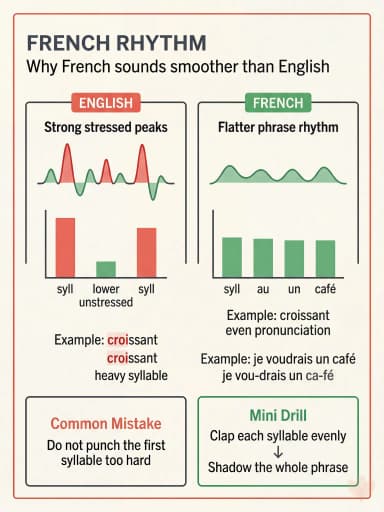
- Enchaînement creates French rhythm: the forward-linking of consonants is what produces the smooth CV syllable flow that makes French sound different from English. See French rhythm and intonation practice.
Train Smooth French Linking
Shadow native clips and get instant feedback on your word linking. Short drills that build the smooth flow English speakers miss.
What to do next
If your enchaînement self-check went well, move to French Silent Final Consonants, knowing which consonants are pronounced is the foundation for both liaison and enchaînement.
For the full learning roadmap, return to French Connected Speech Rules.