You know the words. You know the grammar. But when you speak French, people still look confused or switch to English.
The problem is almost never vocabulary. It is how you connect words. French has a system of connected speech rules that determines how sounds flow from one word to the next. English speakers who ignore this system sound choppy, robotic, and hard to follow, even when every individual word is technically correct.
This guide is the map. It covers every major connected speech process in French, explains how they interact, and gives you a clear learning order. Each section links to a deep-dive guide with drills, examples, and self-checks.
If you want the full sound system first, start with French Pronunciation for English Speakers. If you only need the top clarity rules, use French Pronunciation Rules for Speaking Clarity. This page focuses specifically on the connected speech layer, the system that sits on top of individual sounds and makes French actually sound like French.
Why connected speech matters more than perfect sounds
You can pronounce every French vowel and consonant perfectly in isolation, and still sound foreign. Why?
Because French does not work word-by-word.
French speech is organized into rhythmic groups, chunks of 3 to 7 syllables that flow as a single unit. Inside those groups, word boundaries blur. Consonants jump to the next word. Vowels merge. Sounds appear that the spelling does not show, and sounds disappear that the spelling does show.
UT Austin's French phonetics curriculum explains how French syllable organization favors consonant-vowel (CV) chains, where final consonants naturally link forward to following vowels rather than closing off a word the way English does (UT Austin, les syllabes).
The CEFR Companion Volume (2020) frames pronunciation progress around intelligibility and prosody in connected speech, not perfection of isolated sounds (Council of Europe, 2020).
The 2025 meta-analysis of 65 pronunciation training studies (2,793 learners) confirmed that targeted phonetic training produces large gains, but the training needs to match how speech actually works (Yao et al., 2025).
The core idea
French connected speech is not decoration. It is the operating system. Individual sounds are the apps. You need both, but the operating system comes first if you want to be understood in real conversation.
The five connected speech processes in French
French has five main processes that change how words sound when they meet other words. Here is the complete system:
| Process | What happens | Example | Effect |
|---|---|---|---|
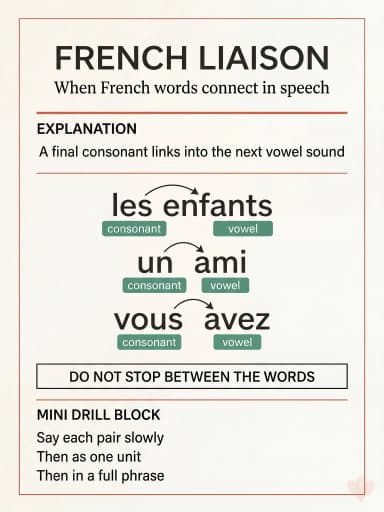
| Liaison | A normally silent final consonant sounds before a vowel | les‿amis → /le.za.mi/ | New sound appears |
| Enchaînement | A pronounced final consonant links to the next vowel | elle‿est → /ɛ.lɛ/ | Syllable boundary shifts |
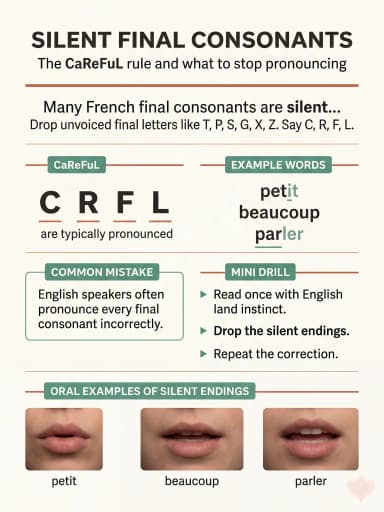
| Silent final consonants | Written consonants stay silent at word end | petit → /pə.ti/ | Sound disappears |
| Glides / semi-vowels | Two vowels compress into a single syllable | bien → /bjɛ̃/ | Syllable count changes |
| Elision | A vowel drops and is replaced by an apostrophe | le + ami → l'ami | Vowel disappears |
These five processes interact constantly. In the phrase les petits enfants (the little children):
- Silent finals: the s in petits and the t stay silent before a consonant
- Liaison: les does not make liaison here because petits starts with a consonant, but petits‿enfants does link with /z/
- Enchaînement: the /t/ ending of enfants would link forward if a vowel followed
All in one three-word phrase. This is why connected speech is a system, not a list of tricks.
The learning order that works
Not all five processes are equally important for your speaking clarity. Here is the order that produces the fastest gains for English speakers:
1. Liaison (learn first)
Liaison is the highest-impact connected speech rule because it is the most noticeable when you get it wrong. Missing a required liaison makes you sound like a textbook. Adding a forbidden liaison makes you sound bizarre.
What it is: A normally silent final consonant "wakes up" and links to the vowel sound at the start of the next word.
Why it matters most: Liaison is the core of French connected speech. It is where the language sounds most different from its spelling, and where English speakers make the most audible mistakes.
Deep dive: French Liaison Rules: When to Link Words in Connected Speech
2. Enchaînement (learn second)
Enchaînement is liaison's quieter partner. While liaison creates a new sound, enchaînement simply shifts where an already-pronounced consonant lands.
What it is: A consonant that is always pronounced at the end of one word slides forward to begin the next syllable when a vowel follows.
Why it matters: Without enchaînement, your French has tiny micro-pauses between every word. Those pauses are what make English speakers sound "choppy" in French.
Deep dive: French Enchaînement: How Consonants Link to Vowels in Speech
3. Silent final consonants (learn third)
Before you can master liaison and enchaînement, you need to know which consonants are there to begin with. French spelling shows many final consonants that vanish in speech.
What it is: Most final consonants in French are not pronounced. The familiar CaReFuL rule (C, R, F, L are often pronounced) is a useful starting filter, not a complete law.
Why it matters: If you pronounce too many finals, your French sounds over-articulated and foreign. If you silence too many, you lose important contrasts.
Deep dive: French Silent Final Consonants: Which Endings to Drop and Keep
4. Glides and semi-vowels (learn fourth)
Glides compress two vowel sounds into a single syllable. They affect syllable count and rhythm more than individual sound quality.
What it is: When certain vowel combinations appear inside a word, one vowel becomes a rapid glide (semi-vowel) instead of a full syllable.
Why it matters: Getting glides wrong adds extra syllables to words, which breaks the rhythmic pattern of French phrase groups.
Deep dive: French Glides and Semi-Vowels: How to Pronounce /j/, /w/, and /ɥ/
5. Elision (learn last)
Elision is the simplest connected speech process because the spelling shows you exactly where it happens. The apostrophe is the signal.
What it is: A short vowel at the end of a function word drops when the next word starts with a vowel or silent h. The apostrophe marks the deletion.
Why it matters: Elision keeps French vowels from colliding. Without it, your speech has awkward hiccups. But since the spelling already shows you where elision occurs, the main challenge is pronunciation, not knowledge.
Deep dive: French Elision Rules: When Vowels Drop in Speech
How the five processes interact in real speech
Here is a single sentence that uses all five processes:
Written: L'enfant est un petit ami de l'école.
What happens:
- Elision: le + enfant → l'enfant (vowel drops)
- Enchaînement: l'enfant links the /t/ forward to est → /lɑ̃.fɑ̃.tɛ/
- Liaison: est + un → the /t/ links → /ɛ.tœ̃/
- Silent finals: the t in petit is usually silent, but before ami liaison activates: petit‿ami → /pə.ti.ta.mi/
- Glide: not present in this sentence, but in bien /bjɛ̃/ the /i/ becomes the glide /j/
The key insight: these rules do not operate in isolation. They overlap and interact inside every phrase group. That is why learning them as a system matters more than memorizing each one independently.
The English-speaker mistake that ties everything together
English speakers separate words. French speakers separate phrase groups.
In English, you can pause after almost any word and still sound natural. In French, pausing inside a phrase group sounds broken. The connected speech rules exist to keep phrase groups flowing as single units.
The single biggest shift you can make: stop thinking in words and start thinking in phrase groups.
Instead of:
je / vais / prendre / un / café
Think and speak:
je vais prendre / un café
Two breath groups. Smooth internal flow. Liaison and enchaînement handle the connections automatically.
Quick diagnostic: where is your connected speech breaking?
Read this passage aloud and record yourself:
Les enfants ont un ami qui est arrivé avec elle à l'école.
Now check:
| Checkpoint | What to listen for | Your score |
|---|---|---|
| Liaison: les‿enfants | Do you hear /le.zɑ̃.fɑ̃/? | ☐ Yes ☐ No |
| Liaison: ont‿un | Do you hear /ɔ̃.tœ̃/? | ☐ Yes ☐ No |
| Liaison: est‿arrivé | Do you hear /ɛ.ta.ʁi.ve/? | ☐ Yes ☐ No |
| Enchaînement: avec‿elle | Do you hear /a.vɛ.kɛl/? | ☐ Yes ☐ No |
| Elision: l'école | Do you say /le.kɔl/ not /lə.e.kɔl/? | ☐ Yes ☐ No |
| Silent finals: ami | Is the final i clean with no added consonant? | ☐ Yes ☐ No |
| Flow: overall | Do phrase groups sound connected, not word-by-word? | ☐ Yes ☐ No |
Score 5+ yes: you have a solid foundation. Focus on speed and automaticity. Score 3-4 yes: target the specific weak areas using the deep-dive guides below. Score 0-2 yes: start with the liaison guide and work through the system in order.
10-minute connected speech warm-up
Use this routine daily before any speaking practice:
Phase 1: Liaison chains (3 minutes)
Say each phrase three times, increasing speed:
- les‿amis → les‿anciens‿amis
- nous‿avons → nous‿en‿avons
- c'est‿important → c'est‿un‿événement‿important
Phase 2: Enchaînement flow (3 minutes)
Link each final consonant smoothly forward:
- elle‿est → elle‿est‿ici
- une‿autre → une‿autre‿idée
- il‿arrive → il‿arrive‿avec‿elle
Phase 3: Mixed passage (4 minutes)
Read once slowly with marked connections. Read again at natural speed. Record and compare:
Les‿amis de Paul sont‿arrivés avec‿elle à l'hôtel. C'est‿un‿endroit‿agréable pour‿un dîner.
Mark every liaison with ‿ and every enchaînement with ‿ before you speak. Then remove the marks and try from memory.
Your learning roadmap
| Week | Focus | Guide |
|---|---|---|
| Week 1 | Liaison, mandatory contexts, forbidden contexts, high-frequency phrases | Liaison deep dive |
| Week 2 | Enchaînement + Silent finals, how they interact with liaison | Enchaînement guide + Silent finals guide |
| Week 3 | Glides, syllable compression in common words | Glides guide |
| Week 4 | Elision, clean vowel drops + full system integration | Elision guide |
Each week, spend 10 minutes daily on the warm-up above plus the specific drills in each guide. By Week 4, run the full diagnostic again and compare scores.
How connected speech connects to Spokira
Connected speech is where the hear → repeat → diagnose → repair loop matters most. You cannot fix liaison errors by reading about them. You need to:
- Hear the correct connected form in native speech
- Repeat it with the same flow and linking
- Diagnose where your version breaks, which liaisons you miss, which enchaînements you chop
- Repair the specific break point with targeted reps
That is exactly how Spokira's shadowing and pronunciation feedback works. You shadow a native clip, the system shows you where your connected speech deviates, and you re-record until the flow matches.
Train Connected Speech with Real Feedback
Shadow native French clips and get instant feedback on liaison, linking, and flow. Short drills built for A2-B1 learners who want to stop sounding word-by-word.
Where to go next
Start with French Liaison Rules, it is the highest-impact connected speech rule and the foundation for everything else.
If you want supporting context:
- French Pronunciation for English Speakers, the full sound system
- French Pronunciation Rules for Speaking Clarity, the top 5 clarity rules with a 14-day plan
- French Accent Errors: Fast Fix Drills, the five biggest English-speaker mistakes
- Why Shadowing Works for French, the method behind the drills
- Sound More Natural: French Rhythm and Intonation Practice, the prosody layer that sits on top of connected speech