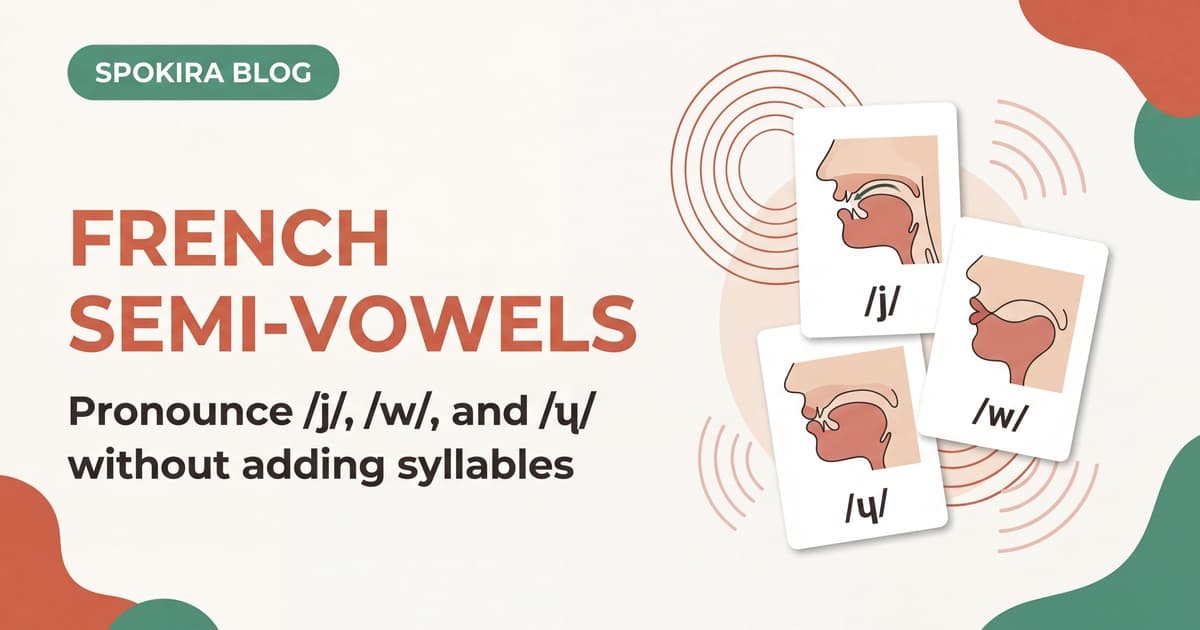
French semi-vowels are the compressed glide sounds /j/, /w/, and /ɥ/ that turn two-vowel sequences into one smooth syllable. If french semi-vowels still feel abstract, think of them as the reason bien, oui, and lui stay compact instead of splitting into two beats. If you keep pronouncing both vowels fully, your French picks up extra syllables and your rhythm falls apart.
French has three sounds that sit between consonants and vowels. They are called semi-vowels (or glides), and they affect something English speakers rarely think about: how many syllables a word has.
When certain vowel combinations appear in French, one of the vowels compresses into a rapid glide instead of getting its own syllable. The result is a shorter, faster word. If you do not glide where French does, you add extra syllables that break the rhythm of the phrase.
This guide covers all three French semi-vowels, explains when gliding happens and when it does not, and gives you drills to make the correct syllable count automatic. This is part of the French connected speech rules system, pairs well with the broader French pronunciation guide for English speakers, and supports the shorter French pronunciation rules for speaking clarity sequence.
French semi-vowels in one sentence
French semi-vowels are compressed glide sounds that turn written vowel sequences like bi-en, ou-i, and lu-i into one syllable instead of two.
What are French semi-vowels?
A semi-vowel is a vowel that has been compressed so short that it no longer forms its own syllable. Instead, it glides rapidly into the following vowel within the same syllable.
French has three semi-vowels, each derived from a full vowel:
| Semi-vowel | IPA | Derived from | Example word | Syllables |
|---|---|---|---|---|
| Yod | /j/ | /i/ | bien | 1 (not 2) |
| Wa | /w/ | /u/ | oui | 1 (not 2) |
| Ué | /ɥ/ | /y/ | lui | 1 (not 2) |
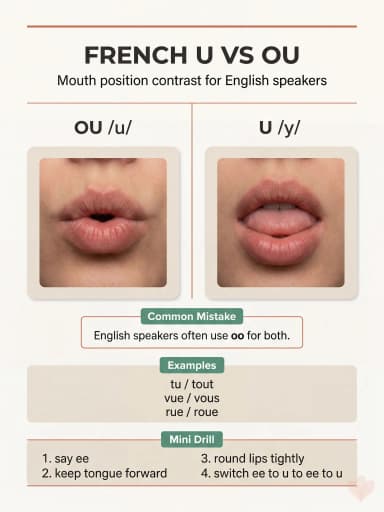
The third one, /ɥ/, does not exist in English. It is the semi-vowel version of the French u /y/, the same rounded front vowel that English speakers already find challenging.
UT Austin's phonetics curriculum explains these as the rapid, non-syllabic versions of French vowels that appear when a high vowel precedes another vowel (UT Austin, phonétique). The CEFR Companion Volume also treats prosody and connected speech control as part of pronunciation development, which is why syllable compression matters for real speaking, not just phonetics exercises (Council of Europe, 2020).
When do French semi-vowels glide?
French semi-vowels in real speech
French semi-vowels matter because they change the beat count of a phrase. Compare these:
- bien joué is not four neat English-style syllables. The first word starts with /bj/, not /bi/.
- oui, lui aussi sounds compact because oui is /wi/ and lui is /lɥi/.
- hier soir keeps moving because hier starts with /j/ and soir is one syllable /swaʁ/.
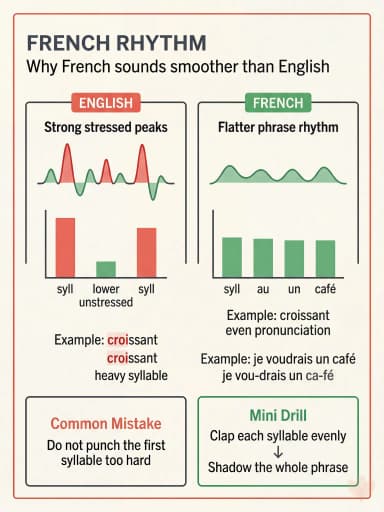
If you miss the glide, French rhythm slows down immediately. That is why these sounds connect directly to French rhythm and intonation practice, not just isolated mouth-position work.
Gliding occurs when a high vowel (/i/, /u/, or /y/) appears before another vowel within the same word or tight grammatical unit:
/j/, the yod (from /i/)
When /i/ appears before another vowel, it compresses to the glide /j/:
| Written | Full vowels | With glide | Syllables |
|---|---|---|---|
| bien | /bi.ɛ̃/ | /bjɛ̃/ | 1 |
| pied | /pi.e/ | /pje/ | 1 |
| hier | /i.ɛʁ/ | /jɛʁ/ | 1 |
| lion | /li.ɔ̃/ | /ljɔ̃/ | 1 |
| vieux | /vi.ø/ | /vjø/ | 1 |
/j/ also appears after consonants in many words: fille /fij/, travail /tʁa.vaj/, soleil /sɔ.lɛj/.
/w/, the wa (from /u/)
When /u/ (written ou) appears before another vowel, it compresses to /w/:
| Written | Full vowels | With glide | Syllables |
|---|---|---|---|
| oui | /u.i/ | /wi/ | 1 |
| jouer | /ʒu.e/ | /ʒwe/ | 1 |
| moi | n/a | /mwa/ | 1 |
| soir | n/a | /swaʁ/ | 1 |
| louer | /lu.e/ | /lwe/ | 1 |
The combination oi is always pronounced /wa/. This is one of French's most recognizable sounds.
/ɥ/, the ué (from /y/)
When /y/ (written u after a consonant) appears before another vowel, it compresses to /ɥ/:
| Written | Full vowels | With glide | Syllables |
|---|---|---|---|
| lui | /ly.i/ | /lɥi/ | 1 |
| nuit | /ny.i/ | /nɥi/ | 1 |
| suis | /sy.i/ | /sɥi/ | 1 |
| pluie | /ply.i/ | /plɥi/ | 1 |
| fruit | /fʁy.i/ | /fʁɥi/ | 1 |
The /ɥ/ challenge
/ɥ/ is the hardest semi-vowel for English speakers because it requires the rounded front position of French u /y/, a sound that does not exist in English, compressed into a rapid glide. If you cannot produce a clear /y/ vowel yet, work on that first with French U vs OU practice before drilling /ɥ/.
French semi-vowels examples that fix common timing errors
Use these as a fast reference when your syllable count keeps drifting:
| Word | Target sound | Common error | Fix |
|---|---|---|---|
| bien | /bjɛ̃/ | saying /bi.ɛ̃/ | merge the /i/ into /j/ |
| oui | /wi/ | saying /u.i/ | make one quick syllable |
| lui | /lɥi/ | saying /lwi/ or /ly.i/ | start from French /y/ and glide |
| nuit | /nɥi/ | saying /nu.i/ | keep lips rounded through the glide |
| jouer | /ʒwe/ | saying /ʒu.e/ | shorten the vowel sequence |
| pied | /pje/ | saying /pi.e/ | move straight into the next vowel |
These are small changes, but they affect whole phrases. Once a learner starts hearing bien and oui as one beat instead of two, the rest of French connected speech gets easier to parse.
When gliding does not happen
Not every vowel sequence creates a glide. Gliding is blocked in several contexts:
1. When the high vowel carries stress or is in a separate morpheme
Some words keep two full syllables where you might expect a glide:
- pays, /pe.i/ (2 syllables, not /pɛj/)
- créer, /kʁe.e/ (2 syllables)
- scier, can be /sje/ (1) or /si.e/ (2) depending on speaker
2. After two consonants in the same syllable
When two consonants precede the high vowel, the glide is often blocked to keep the consonant cluster manageable:
- plier, /pli.e/ (2 syllables, the cluster /pl/ blocks the glide for many speakers)
- prier, /pʁi.e/ (2 syllables) vs premier, /pʁə.mje/ (glide possible)
This varies by dialect and speaking speed. In fast casual speech, more gliding occurs. In careful speech, fewer glides.
3. When the vowels are in different morphological parts
Compound forms and some derived words resist gliding:
- il a eu, /i.la.y/ (no glide between a and eu)
The practical rule
For A2-B1 learners: if the word is common and short, glide. If it feels awkward to compress, keep two syllables. Most pronunciation errors come from the opposite problem, adding too many syllables, not too few.
10 high-frequency semi-vowel words to drill
These appear in everyday French. Get the syllable count right:
- bien /bjɛ̃/, 1 syllable (not bi-en)
- oui /wi/, 1 syllable (not ou-i)
- lui /lɥi/, 1 syllable (not lu-i)
- nuit /nɥi/, 1 syllable (not nu-it)
- pied /pje/, 1 syllable (not pi-ed)
- soir /swaʁ/, 1 syllable
- moi /mwa/, 1 syllable
- jouer /ʒwe/, 1 syllable (not jou-er)
- vieux /vjø/, 1 syllable (not vi-eux)
- fruit /fʁɥi/, 1 syllable (not fru-it)
Say each one five times. On each rep, check: are you producing one syllable, or does a second syllable sneak in?
The common English-speaker mistake
Adding extra syllables
The #1 mistake English speakers make with French semi-vowels is treating them as full vowels. This adds syllables that do not exist in native French:
-
❌ bien as "bee-en" (2 syllables)
-
✅ bien as "byɛ̃" (1 syllable)
-
❌ nuit as "noo-ee" (2 syllables)
-
✅ nuit as "nɥi" (1 syllable)
-
❌ oui as "oo-ee" (2 syllables)
-
✅ oui as "wi" (1 syllable)
This matters because extra syllables break French rhythm. French phrase groups have predictable syllable counts, and adding syllables to common words like bien, nuit, and oui throws off the timing of every phrase they appear in.
Substituting /w/ for /ɥ/
English speakers often produce /w/ (which they know from English) instead of /ɥ/ (which they don't):
-
❌ lui as /lwi/ (using /w/)
-
✅ lui as /lɥi/ (using /ɥ/)
-
❌ nuit as /nwi/ (using /w/)
-
✅ nuit as /nɥi/ (using /ɥ/)
The fix: start from the French u /y/ position (lips rounded, tongue forward) and glide from there. If your starting position is English "oo" (lips rounded, tongue back), you will get /w/ instead of /ɥ/.
Flattening every glide in careful speech
Some learners can produce the correct glide in a single word, then lose it as soon as they slow down and "speak carefully." The result sounds neat but artificial:
- Oui, je suis ici becomes /u.i ʒə sɥi i.si/ with too many beats
- Hier, lui et moi becomes /i.ɛʁ ly.i e mwa/ instead of a compact sequence
Careful speech in French is still connected speech. Slower does not mean syllable-by-syllable.
Shadowing drill: 5-minute semi-vowel workout
Round 1: Single words (2 minutes)
Say each word, focusing on keeping it to one syllable:
Yod /j/: bien, pied, vieux, hier, lion Wa /w/: oui, moi, soir, jouer, noir Ué /ɥ/: lui, nuit, suis, pluie, fruit
Round 2: In phrases (2 minutes)
Now use them in short sentences. Keep the semi-vowel words compressed:
- C'est bien, oui. (two semi-vowels in one phrase)
- Il fait nuit, je suis chez lui. (three /ɥ/ words)
- Hier soir, j'ai joué avec un vieux piano. (/j/ and /w/ mix)
- La pluie tombe sur le fruit.
- Moi, je vais à pied.
Round 3: Speed challenge (1 minute)
Say this sentence at natural speed. Every underlined word contains a semi-vowel. None should get an extra syllable:
Hier soir, lui et moi, on a joué sous la pluie. C'était bien.
Count your syllables. The target is approximately: /jɛʁ.swaʁ.lɥi.e.mwa.ɔ̃.na.ʒwe.su.la.plɥi.se.tɛ.bjɛ̃/, 14 syllables. If you get 17+, you are adding extra syllables to the semi-vowel words.
French semi-vowels practice routine for one week
If you want these sounds to stick, train them by sound family instead of mixing everything at random.
Days 1-2: /j/ family
Use bien, pied, hier, vieux, lion. Read them, then say them inside short phrases:
- C'est bien.
- Mon pied va mieux.
- Hier soir, il est venu.
Days 3-4: /w/ family
Use oui, moi, soir, jouer, noir. Your only goal is one syllable per target word:
- Oui, moi aussi.
- Ce soir, on joue.
- Le noir lui va bien.
Days 5-7: /ɥ/ family
This is the hard one. Keep the lips rounded and the tongue forward:
- lui
- nuit
- pluie
- fruit
- je suis
The 2025 meta-analysis of pronunciation training studies supports this kind of narrow, repeated practice: targeted phonetic work creates the biggest gains when learners rehearse the exact contrast that breaks intelligibility (Yao et al., 2025).
Record one sentence three times
Say the same sentence once slowly, once naturally, and once fast. If the glide disappears in the slow version, you are over-articulating. If it disappears in the fast version, you do not own it yet.
Self-check: are your semi-vowels working?
Record yourself reading these six sentences:
- Oui, c'est bien.
- Il est chez lui ce soir.
- J'ai mis le pied dans l'eau.
- La nuit est belle.
- Je suis vieux mais actif.
- On va jouer dans la pluie.
Listen back and check:
| Word | Expected syllables | Extra syllable? |
|---|---|---|
| oui | 1 | ☐ No ☐ Yes |
| bien | 1 | ☐ No ☐ Yes |
| lui | 1 | ☐ No ☐ Yes |
| soir | 1 | ☐ No ☐ Yes |
| pied | 1 | ☐ No ☐ Yes |
| nuit | 1 | ☐ No ☐ Yes |
| suis | 1 | ☐ No ☐ Yes |
| vieux | 1 | ☐ No ☐ Yes |
| jouer | 1 | ☐ No ☐ Yes |
| pluie | 1 | ☐ No ☐ Yes |
Score:
- All 10 correct: your glides are solid, move to elision
- 7-9 correct: good, drill the missed words specifically
- Under 7: spend more time on single-word reps before using phrases
French semi-vowels and the rest of connected speech
French semi-vowels are an inside-the-word process, but they affect the same flow problems as liaison, enchaînement, and elision:
- They reduce syllable count, which makes phrase timing more French.
- They stop learners from pronouncing every written vowel separately.
- They make common chunks easier to shadow at normal speed.
If your glides are weak, your rhythm will still sound stiff even if your elision and linking are decent. That is why semi-vowel work belongs in the same training block as French rhythm and intonation practice.
Get Your French Syllable Count Right
Shadow native clips and get feedback on rhythm, timing, and syllable compression. AI-powered drills for smoother French.
What to do next
If your semi-vowels are clean, move to French Elision Rules, the last connected speech process in the system.
If /ɥ/ is your main problem, work on the underlying /y/ vowel first with French U vs OU practice.
For the full connected speech system, return to French Connected Speech Rules.