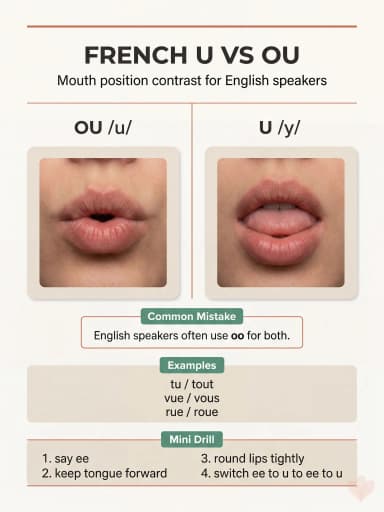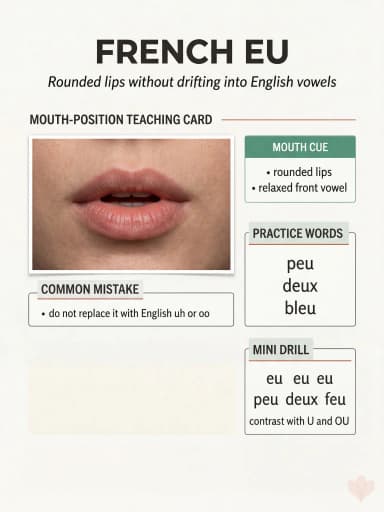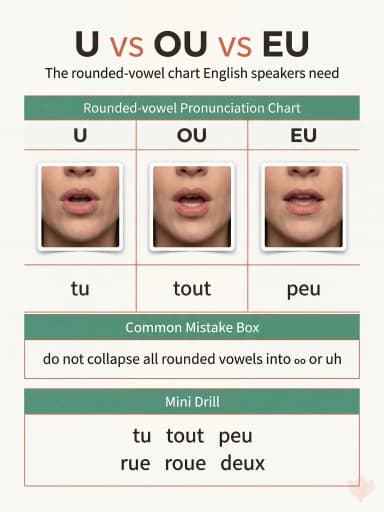
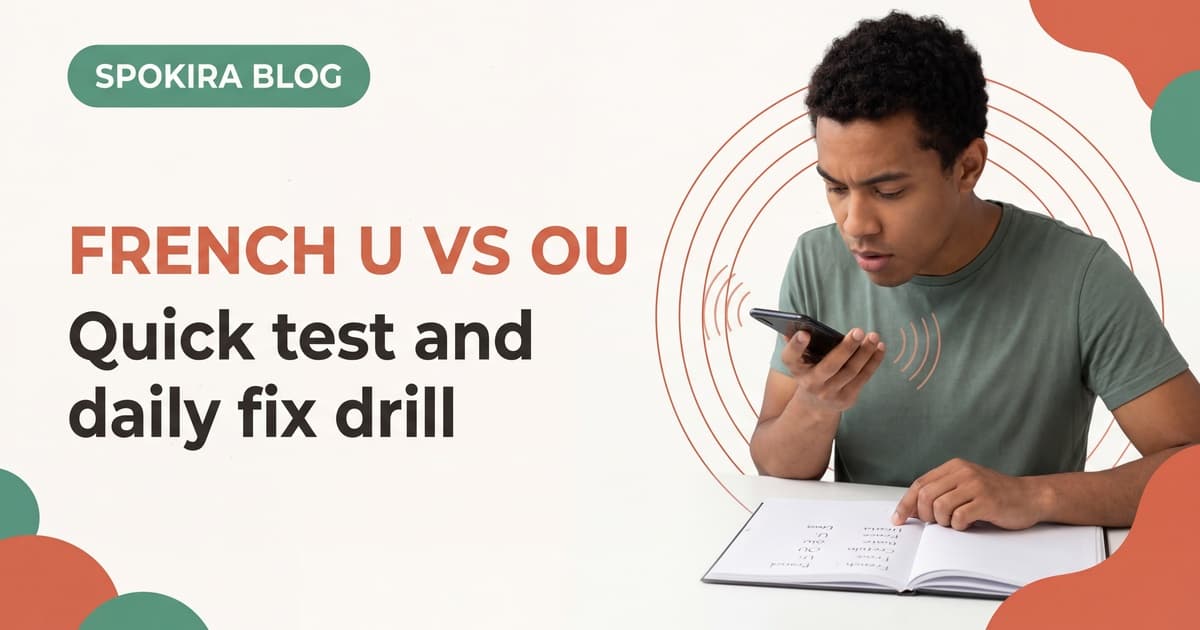
If your French sounds clear in drills but collapses in conversation, one likely bottleneck is the u vs ou contrast. English speakers often pull both sounds toward English "oo," so words like tu and tout become too similar.
That is exactly why french u vs ou pronunciation practice works best as a daily contrast routine, not an occasional pronunciation check. You need a stable mouth pattern, fast retrieval, and transfer into real phrases.
This guide gives you a practical A2-B1 plan: a quick diagnostic, minimal pairs, a 12-minute ladder, and recording checks you can repeat for 14 days. Sources and claims were verified on March 9, 2026.
If you want a full sound-system overview first, start with French Pronunciation for English Speakers. Then come back for focused execution on u vs ou.
Quick answer: what fixes French U vs OU fastest?
Use a short daily progression in this order:
- Hear and produce
uandouin isolation - Drill minimal pairs (
tuvstout,survssous) - Move to three-word chunks
- Run 60-second timed sentence prompts
- Record before/after and score
Why this sequence is effective:
- The University of Texas French Interactive Phonetics module for
/i/ /y/ /u/explains that French vowels should stay pure (no English-style glide), and it explicitly contrasts front rounded/y/(Frenchu) with back rounded/u/(Frenchou) (UT Austin, lesson 06). - CEFR Companion Volume descriptors (2020 edition) prioritize intelligibility and interaction outcomes for speaking proficiency, which supports consistent, high-frequency pronunciation practice over perfectionism (Council of Europe CEFR Companion Volume, 2020).
- A 2025 meta-analysis reports a strong positive overall effect for second-language phonetic training, reinforcing that targeted training can produce measurable gains (Yao et al., 2025).
- Research on non-native French front-rounded vowel learning found that discrimination training on difficult contrasts can improve processing outcomes, especially with repeated sessions and delayed retention checks (Diaz et al., 2022).
What French U and OU actually are
Most English-speaking learners map both sounds to one familiar category. In French, they are distinct vowel targets.
- French
uis IPA/y/: lips rounded, tongue relatively forward. - French
ouis IPA/u/: lips rounded, tongue farther back.
If you are hearing "both are oo," that is normal at first. The solution is not more theory. The solution is repeatable contrast practice with tight feedback.
Two rules that matter every day:
- Keep the vowel stable. Do not turn it into an English diphthong.
- Keep the consonants light while you focus on the vowel target.
Fast Physical Cue
For French u (/y/), imagine saying English "ee" with rounded lips. For French ou (/u/), keep lip rounding but pull the tongue farther back.
Run this 60-second self-test first
Before starting the full drill, run a short diagnostic to set your baseline.
Listening check (20 seconds)
Play or say these pairs and decide if they are same or different:
tu/toutsur/sousdu/douxlune/loune(nonsense form for contrast)
If you miss more than 1 in 4, start with slower listening and fewer pairs.
Production check (20 seconds)
Say each pair three times:
tu/toutrue/rouedessus/dessous
Record on your phone. If the two items in a pair sound nearly identical to you, that is your current training target.
Sentence check (20 seconds)
Read these lines once each:
Tu as tout vu.Je suis sur le pont.Dessus ou dessous?
If rhythm pressure collapses the contrast, prioritize chunk and sentence drills, not isolated sound drills only.
Why learners plateau on U vs OU
Most plateaus come from predictable mistakes:
- Drilling words without contrasting pairs
- Switching cues every day
- Reading too much and listening too little
- Skipping recording because self-review feels uncomfortable
There is also a language-transfer effect. In one study on American English learners producing French vowels, front rounded vowels remained difficult even with substantial experience, and production quality varied by consonantal context (Levy & Law, 2010).
So if your u is unstable in connected speech, that is expected. It is not a talent problem. It is a training-sequence problem.
The 12-minute French U vs OU pronunciation practice routine
Use this routine daily for 14 days before changing focus.
Minute 1-2: isolate and set posture
- Alternate
uthenouslowly. - Hold each vowel for 1-2 seconds.
- Keep jaw movement minimal.
- Keep lip rounding consistent.
Goal: establish distinct motor targets before adding consonants.
Minute 3-5: minimal pairs (slow to normal)
Use these pairs first:
| Pair | Focus cue |
|---|---|
tu / tout | u forward tongue; ou back tongue |
sur / sous | keep lip rounding in both; move tongue target |
du / doux | avoid collapsing both to "doo" |
rue / roue | preserve contrast at normal speed |
dessus / dessous | maintain contrast across two syllables |
Do 6 reps per pair:
- slow clear rep
- normal-speed rep
- no-look rep (eyes off text)
Minute 6-8: chunk transfer
Now train short chunks:
tu as toutsur la routedessus, dessousune rue doucetu joues où?
Say each chunk 4-5 times, then once from memory.
Minute 9-10: sentence ladder
Move from controlled to less controlled output:
- read sentence
- repeat sentence without looking
- paraphrase sentence with same target vowels
Starter lines:
Tu as tout prepare pour lundi.Je suis sur le toit, pas sous la table.La roue tourne dans la rue.
Minute 11: timed retrieval
Set a 60-second timer and answer one prompt aloud:
- Describe your morning routine.
- Explain directions in your neighborhood.
- Compare two things you used today.
Constraint: include at least 3 words with u and 3 words with ou.
Minute 12: record + score
Record two takes:
- Take 1 before drilling
- Take 2 after drilling
Score each take 1-5 on:
- contrast clarity (
uvsou) - stability at normal speed
- rhythm and flow
- confidence under light time pressure
Write one next-step note for tomorrow.
Minimal-pair bank for 30 days
You do not need huge lists. You need repeatable pairs that stay in rotation.
Set A: core contrasts
tu/toutsur/sousdu/douxrue/rouedessus/dessous
Set B: phrase-level contrasts
Tu as tout compris.Je suis sur de moi.Il est sous la pluie.La roue bouge vite.Passe par la rue.
Set C: scenario prompts
- Explain where something is:
survssous - Give short instructions using
tuandtout - Describe objects in a room with
dessusanddessous
If quality drops, go back one level (word -> chunk -> sentence).
Want instant feedback on French vowels?
Train U vs OU and get AI feedback on clarity, rhythm, and recurring sound errors in short daily speaking sessions.
14-day progression plan
Use this schedule so practice stays focused.
Days 1-4: contrast foundation
- 12-minute routine daily
- prioritize Set A minimal pairs
- keep speed moderate
Success target:
- you can clearly hear and produce at least 4 of 5 core pairs
Days 5-9: speed and stability
- keep full 12-minute routine
- increase no-look reps
- expand chunk and sentence work
Success target:
- contrast survives normal speaking speed in prepared sentences
Days 10-14: conversation transfer
- keep minimal pair warm-up
- spend more time on timed retrieval prompts
- include personal topics (work, errands, plans)
Success target:
- contrast remains audible while you think about meaning
Common mistakes and exact corrections
Mistake 1: both vowels sound like English "oo"
Correction:
- exaggerate front tongue position on
u - keep lip shape similar between both vowels
- alternate
u-ou-u-oufor 30 seconds before words
Mistake 2: good in single words, weak in phrases
Correction:
- reduce phrase length to 2-3 words
- run 3 clean reps before longer sentences
- reintroduce full sentence only when contrast remains stable
Mistake 3: over-focusing on spelling
Correction:
- do listening-first rounds (no text visible)
- use audio + repeat cycles
- read only during final stage of session
Mistake 4: practice feels random
Correction:
- keep same pair bank for 2 weeks
- track a daily 1-5 score
- change only one variable at a time (speed or complexity)
Weekly scorecard for French U vs OU pronunciation practice
Use this simple tracker so your french u vs ou pronunciation practice stays objective.
Track 5 metrics daily:
- Listening accuracy on 10 pair tokens
- Minimal pair production clarity
- Chunk stability at normal speed
- Timed retrieval success (60 seconds)
- Confidence rating
You can use a 1-5 scale for each metric. Keep it simple:
1= contrast is mostly unclear3= mixed but improving5= clear and stable in short spontaneous speech
Example weekly log:
| Day | Listening | Pair clarity | Chunk stability | Timed retrieval | Confidence | Main note |
|---|---|---|---|---|---|---|
| Mon | 2 | 2 | 2 | 1 | 2 | u and ou collapse in tu/tout |
| Tue | 3 | 2 | 2 | 2 | 2 | better isolation, weak in phrases |
| Wed | 3 | 3 | 2 | 2 | 3 | rue/roue clearer at slow speed |
| Thu | 4 | 3 | 3 | 2 | 3 | chunk work improves sur/sous |
| Fri | 4 | 4 | 3 | 3 | 3 | contrast survives one full minute |
| Sat | 4 | 4 | 4 | 3 | 4 | fewer collapses under pressure |
| Sun | 5 | 4 | 4 | 4 | 4 | consistent on core pair bank |
This table helps you avoid the common trap of "I think I improved." For french u vs ou pronunciation practice, audible contrast in recordings is the real benchmark.
Advanced drills when basics feel easy
Once your core pairs are stable, increase difficulty while preserving contrast.
Drill 1: speed ladder without blur
Use one sentence and three tempos:
- slow clear tempo
- normal conversation tempo
- slightly faster tempo
Sentence example: Tu trouves tout tout de suite.
Rule: if contrast blurs at faster speed, step back one tempo and rebuild.
Drill 2: stress-shift repetitions
French rhythm is phrase-timed, so your vowel contrast should survive different emphasis patterns.
Try:
TU as tout vu.Tu as TOUT vu.Tu as tout VU.
Goal: keep u and ou stable while shifting prominence.
Drill 3: dual-task speaking
To simulate real conversation load, run french u vs ou pronunciation practice while adding a second task:
- count backward by twos while describing a photo
- list groceries while giving directions
- summarize your day while watching a 30-second timer
If accuracy drops, reduce complexity but keep the contrast target.
Drill 4: contrast chains
Build short chains where the contrast alternates rapidly:
tu -> tout -> tu -> toutsur -> sous -> sur -> sousrue -> roue -> rue -> roue
Then place each chain into a sentence:
Tu as tout vu sur la roue.Je suis sur, pas sous, la roue.
This is one of the fastest ways to automate mouth-position switching.
Drill 5: conversation rescue strategy
Even with good training, mistakes still happen in live conversation. Use this recovery move:
- repeat the word once, slower
- keep the sentence moving
- do not apologize repeatedly
Example:
- First try:
Je suis sou... - Quick repair:
Je suis SUR le pont. - Continue:
On se retrouve devant le cafe.
That keeps interaction smooth while reinforcing the contrast in real time.
How this fits your full French speaking plan
U vs OU is one piece of a bigger intelligibility system. Combine it with:
- French Accent Errors: Fast Fix Drills for error triage
- French R Sound Practice for consonant control
- Nasal Vowels French Practice for vowel contrast depth
- Record Yourself in French Without Cringing for self-review method
- French Speaking Practice Guide for full weekly structure
If you prefer guided feedback loops, Spokira's French pronunciation app and speaking practice app flow let you run the same contrast and transfer sequence with score tracking.
FAQ: French U vs OU pronunciation practice
How long until I hear a real difference?
Most learners notice a clearer contrast within 7-14 days of daily focused practice. The key variable is consistency, not session length.
Should I learn IPA first?
No. IPA helps, but daily execution matters more. One reliable mouth cue for each vowel is enough to start.
Is 12 minutes enough?
Yes, if it is structured and daily. A short focused routine with recording feedback often beats occasional long sessions.
Can I practice without a teacher?
Yes. You can make strong progress with a repeatable pair bank, timed prompts, and recordings. A coach or app can speed up error detection, but self-monitoring still works.
After day 14: maintain gains without losing contrast
Once your initial french u vs ou pronunciation practice block is done, move to maintenance mode so the contrast stays automatic.
Use this weekly structure:
- 3 short maintenance sessions (8-10 minutes each)
- 1 transfer session focused on free speaking (10-15 minutes)
- 1 recording review session (5 minutes)
Maintenance session template:
- 2 minutes isolated alternation (
u/ou) - 3 minutes core pair bank (
tu/tout,sur/sous,rue/roue) - 3 minutes phrase and sentence transfer
Transfer session template:
- choose one real topic (work update, travel plan, grocery list)
- speak for 90 seconds without notes
- repeat once with a focus on clearer
uvsou
Recording review template:
- listen back once for meaning only
- listen back once for sound contrast only
- note one recurring error and one clear improvement
If you skip maintenance completely for several weeks, contrast drift is normal. Restart with three days of core pair work, then return to conversation prompts.
Conclusion: train contrast, then train transfer
If u and ou still blur in your speech, do not add more random materials. Keep one repeatable system for two weeks: minimal pairs, chunks, timed prompts, and recordings.
Your next step is simple:
- Run the 60-second baseline test today.
- Do the 12-minute drill daily for 14 days.
- Track scores and focus on one correction at a time.
That is how French vowel work becomes automatic speech behavior, not just a pronunciation note in your notebook.