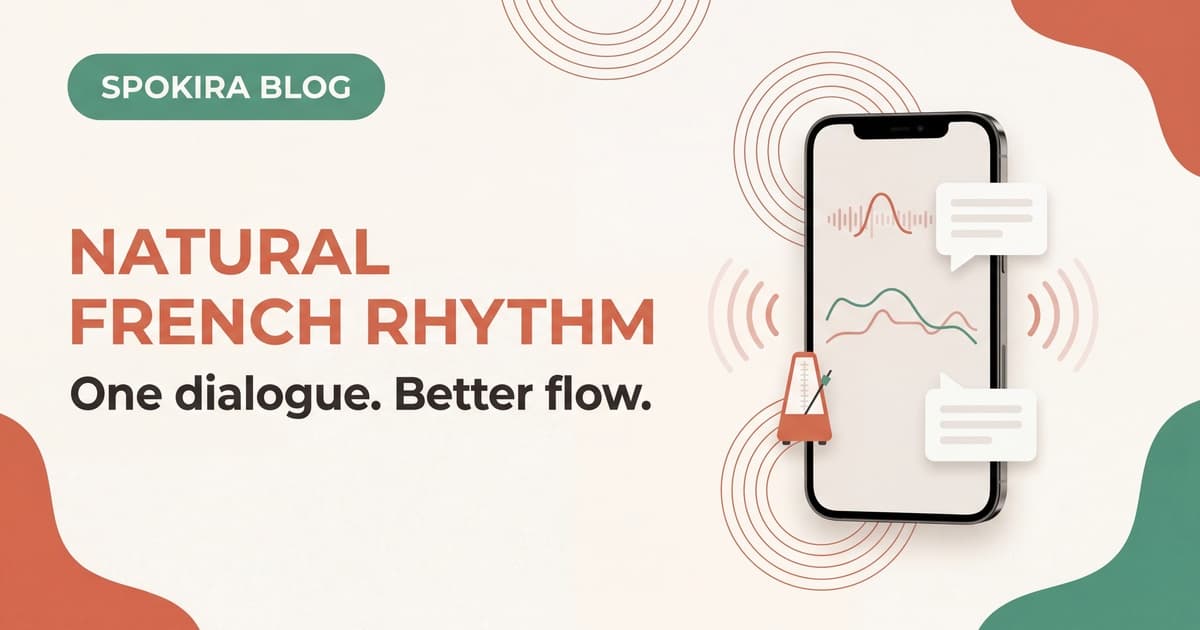
If people understand your French but still reply in English, the issue is often not vocabulary. It is delivery. Your words may be correct, but your rhythm and pitch still sound English.
That is exactly where french rhythm and intonation practice helps. You do not need ten random dialogues. You need one short dialogue trained the right way, every day, until the melody feels automatic.
In this guide, you will get a repeatable 12-minute routine for A2-B1 learners. You will mark rhythm groups, practice intonation moves, record two takes, and track progress for 14 days. Claims and references were verified on March 9, 2026.
If you want full pronunciation foundations first, start with French Pronunciation for English Speakers. Then return here to make your speech flow sound more natural.
Quick answer: what improves French rhythm and intonation fastest?
Use one short dialogue and train it in this order:
- Mark rhythm groups and pauses
- Practice pitch direction (fall, rise, continuation)
- Repeat each turn in slow then natural speed
- Do a 60-second no-text recall round
- Record before and after, then score
Why this works:
- UT Austin's French Interactive Phonetics lesson on rhythmic groups explains that French rhythm is organized around stress on the final syllable of a sense group, not English-style stress timing. It also links phrasing to intonation shape (UT Austin, rhythmic groups).
- The CEFR Companion Volume (2020) frames pronunciation and prosody around intelligibility and interaction quality, which supports practical repetition and communication outcomes over perfectionism (Council of Europe CEFR Companion Volume, 2020).
- A 2025 meta-analysis reports strong positive effects of L2 phonetic training, which supports focused, repeated pronunciation work (Yao et al., 2025).
- Spacing and retrieval evidence supports short repeated sessions plus recall pressure instead of one long weekly block (Cepeda et al., 2006; Roediger and Karpicke, 2006).
What "natural" French rhythm actually means
Many English speakers try to sound natural by speaking faster. That usually makes things worse. French naturalness is less about speed and more about grouping and melody.
Three practical rules:
- Group words into short meaning chunks.
- Let stress land near the end of each chunk.
- Keep pitch movement intentional: statements usually settle, yes/no questions usually rise.
If you ignore grouping, your speech sounds chopped. If you ignore pitch, it sounds flat or uncertain. If you force speed too early, both collapse.
Coach Cue
Train your mouth, not your streak. Keep one dialogue for 14 days and improve one rhythm pattern at a time.
The one-dialogue method (A2-B1)
Choose a short everyday scenario with two speakers. Your dialogue should be 6-8 turns total and around 60-90 words.
Use this model script:
Dialogue: at a cafe
A: Bonjour, je voudrais un cafe, s'il vous plait.
B: Bien sur. Vous le prenez sur place ou a emporter?
A: Sur place, merci. Et vous avez une tarte aux pommes?
B: Oui, il nous en reste deux. Je vous en mets une?
A: Oui, parfait. Je peux payer par carte?
B: Oui, pas de probleme.
This works well because it includes:
- polite formulas
- short question/answer turns
- contrast between falling and rising contours
- reusable daily vocabulary
If cafe language is not useful for you, replace the script with a metro, office, or hotel variant. Keep the same length.
Step 1: mark rhythm groups in 3 minutes
Before speaking, mark chunk boundaries with /.
Example (first two turns):
Bonjour / je voudrais un cafe / s'il vous plait.Bien sur / vous le prenez / sur place / ou a emporter?
Then underline the last pronounced syllable in each chunk. That is your rhythm anchor.
Common mistake: marking pauses after every word. French rhythm usually feels smoother when groups are chunked by meaning, not by spelling.
Use this checklist:
- Can you say each chunk in one breath?
- Does each chunk carry one clear idea?
- Are you avoiding tiny unnatural stops?
If a line is long, split into more chunks. If it feels robotic, you probably split too much.
Step 2: mark intonation direction in 2 minutes
Add arrows to each chunk:
->continuationdownfinal statementupyes/no question
Example:
Bonjour -> je voudrais un cafe downVous le prenez sur place ou a emporter upJe peux payer par carte upOui, pas de probleme down
You do not need perfect pitch labeling. You need consistency. If your question melody sounds like a statement, fix that first.
Step 3: run the 12-minute daily ladder
This is the core training sequence.
Minute 1-2: listen and echo
- Listen to a native or near-native model once.
- Echo each turn with no pause after the model.
- Focus on chunk timing, not individual words.
Minute 3-5: slow chunk reps
For each turn:
- Speak chunk by chunk slowly.
- Keep final stress clear.
- Repeat the full turn once at normal speed.
Do 3 rounds across all turns.
Minute 6-8: turn exchange at natural speed
Read turns A and B aloud like a mini roleplay.
- Round 1: read with text.
- Round 2: glance only at first word each turn.
- Round 3: no text, from memory.
Target: keep the same melody from round 1 to round 3.
Minute 9-10: rhythm pressure test
Set a 60-second timer.
- Produce the full dialogue once from memory.
- If you blank, restart from the last completed turn, not from the beginning.
- Keep flow over perfection.
This is where many learners discover their real bottleneck. If rhythm breaks under pressure, return to chunk reps tomorrow.
Minute 11: free transfer prompt
Use one short prompt linked to the dialogue theme:
- "What do you usually order at a cafe?"
- "How do you ask politely for one more minute?"
- "What do you do if a place has no card payment?"
Speak for 30-45 seconds while preserving the same chunk length and pitch style.
Minute 12: record and score
Take two recordings:
- Take 1 before practice
- Take 2 after the ladder
Score each from 1-5:
- chunk smoothness
- question melody clarity
- statement landing
- overall flow
Write one note: "Tomorrow I will fix ___."
French rhythm and intonation practice: 14-day progression plan
Do not change the dialogue too early. Keep the same script long enough for automaticity.
| Days | Focus | Success marker |
|---|---|---|
| 1-3 | Chunk boundaries + final stress | Fewer unnatural stops |
| 4-6 | Question vs statement melody | Clear rise/fall contrast |
| 7-10 | Natural-speed roleplay | Stable flow without text |
| 11-14 | Free transfer answers | Melody holds in personal answers |
On day 15, either:
- keep the same dialogue and increase speed 10%, or
- switch scenario but keep the same routine structure.
Common rhythm and intonation mistakes (and fixes)
Mistake 1: "Word-by-word" delivery
Symptoms:
- pauses after function words
- robotic timing
- over-articulated every syllable equally
Fix:
- mark 2-4 word chunks
- practice saying chunks in one breath
- reduce micro-pauses
Mistake 2: flat pitch on all turns
Symptoms:
- questions sound like statements
- polite formulas sound cold
- listeners ask for repetition
Fix:
- mark arrows before speaking
- exaggerate rise/fall for 3 days
- normalize gradually after contrast is clear
Mistake 3: speed before control
Symptoms:
- dropped words
- melody collapse
- rising stress and tension in the jaw
Fix:
- use 80% speed for 3 rounds
- add one natural-speed round at the end
- only increase speed when score is 4/5 for two days
Mistake 4: no recording loop
Symptoms:
- you "feel" better but cannot verify progress
- same errors repeat for weeks
Fix:
- 20-30 second clips only
- compare take 1 and take 2 daily
- track one correction target per session
Want guided rhythm and intonation feedback?
Practice short dialogues with native-paced audio, get targeted pronunciation feedback, and track your speaking clarity in minutes a day.
Where this fits in your bigger speaking plan
Use this dialogue routine 4-6 days per week as your prosody block.
Pair it with:
- one sound-contrast drill from French U vs OU Pronunciation Practice
- one nasal-vowel contrast from Nasal Vowels French Practice
- one confidence check from Record Yourself in French Without Cringing
If your overall speech still feels stiff, add a weekly review using French Speaking Practice: The Complete Guide for A2-B1 Learners and 5 Common French Pronunciation Mistakes.
For a broader method view, pair this routine with French Shadowing: The Complete Guide to Actually Speaking French so rhythm work and speaking stamina improve together.
For tool support, use /french-pronunciation-app when you want feedback by sound and /practice-speaking-french-app when you want scenario-based speaking reps.
French rhythm and intonation practice: weekly scorecard
If you want this method to stick, use a simple tracker instead of relying on memory. The goal is not to track everything. The goal is to notice one pattern and fix it fast.
Use this format after each session:
| Session date | Dialogue score (1-5) | Main issue | One fix for tomorrow |
|---|---|---|---|
| Mon | 3 | Flat yes/no questions | Mark rises on all questions |
| Tue | 3 | Pauses in the middle of chunks | Rehearse chunk breathing |
| Wed | 4 | Better melody, unstable speed | Keep 80% speed for 2 rounds |
| Thu | 4 | Good rhythm, weak ending falls | Add final-landing reps |
| Fri | 4 | Stable with text, weak without text | Do no-text round twice |
A score of 4/5 means intelligible and reasonably natural for everyday situations. Do not wait for 5/5 to move forward.
Two useful thresholds:
- If your score is 2 or below for two days, shorten the dialogue and reduce speed.
- If your score is 4 for three days in a row, add one harder transfer prompt.
This is where french rhythm and intonation practice becomes measurable instead of subjective.
French rhythm and intonation practice by level (A2 to B1)
Keep the same routine, but adjust complexity so you do not overload working memory.
A2 profile
Use shorter turns and fewer tense changes.
- 6 turns max
- mostly present tense
- one question type per session
- 30-second free transfer
Example transfer prompt:
- "What do you order and why?"
High A2 to B1 profile
Increase variation while preserving rhythm control.
- 8 turns max
- one past event line plus present response
- yes/no and open question in one dialogue
- 45-60 second free transfer
Example transfer prompt:
- "What happened yesterday, and what will you do differently today?"
At B1, your rhythm target is not "native accent." Your target is smooth grouping, clear pitch contrasts, and stable flow under light pressure.
5-minute fallback when your day is packed
If you cannot run the full 12-minute routine, do this minimum session so french rhythm and intonation practice stays consistent:
- Read the dialogue once with rhythm marks.
- Speak turns 1-3 from memory.
- Record one 20-second take.
- Write one correction note.
That is enough to protect momentum. Five focused minutes today beats zero and keeps tomorrow easier.
FAQ
How long until my French sounds more natural?
Most learners hear a clear change within 10-14 consistent sessions, especially in chunk smoothness and question melody. Full automaticity takes longer, but daily short reps compound quickly.
Should I use more than one dialogue at once?
For this goal, no. One dialogue gives enough repetition to stabilize prosody. Add a second only after your score is consistently 4/5 on the first.
Do I need perfect pronunciation first?
No. You can improve rhythm and intonation while still refining individual sounds. In fact, prosody work often makes your existing pronunciation easier to understand.
What if I freeze during no-text rounds?
That is normal. Restart from the last successful turn, not from turn one. This keeps retrieval pressure useful without turning practice into frustration.
How do I choose my next dialogue after 14 days?
Choose a scenario you actually use each week. Keep the same dialogue length, keep two question turns, and keep one polite clarification line. Good upgrades are hotel check-in, asking for directions, or office scheduling. Your goal is to reuse the same rhythm and melody patterns in new vocabulary, not to start from zero with a completely different speaking style.
Conclusion: make natural French a trainable skill
If you want to sound more natural fast, focus less on collecting new phrases and more on delivering familiar ones with better rhythm and intonation.
Use one short dialogue. Mark chunks. Mark pitch direction. Run the 12-minute ladder. Record two takes. Fix one thing tomorrow.
This is how you move from "I know the words" to "I can actually say them" in real situations.
When you want guided feedback and a structured daily routine, Spokira can help you practice this process with native-paced shadowing and clear next-step corrections.