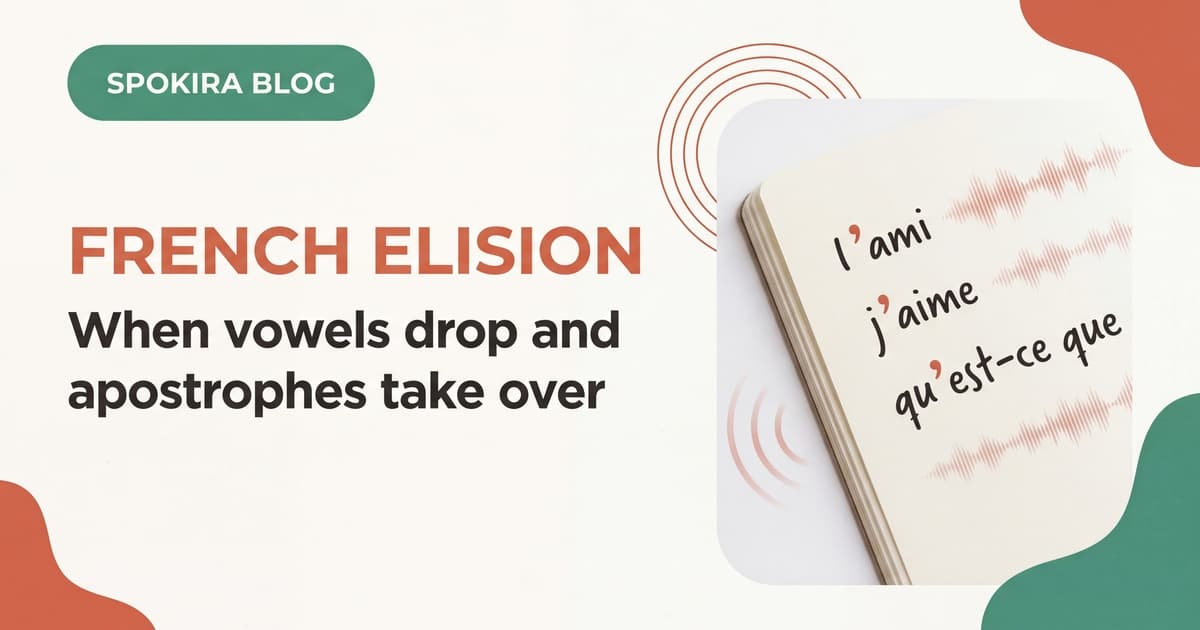
Elision is the most spelling-friendly connected speech rule in French. The apostrophe tells you exactly where it happens. But knowing where elision occurs and pronouncing it correctly in flowing speech are two different skills.
French elision drops a final vowel from certain short words when the next word begins with a vowel sound. The result is smoother flow and no awkward vowel collision. This is part of the French connected speech rules system, and while it is the simplest rule to learn, it still trips up English speakers who reinsert the dropped vowel under pressure.
What elision is
Elision occurs when a short function word ending in a vowel meets another word starting with a vowel sound. The final vowel of the first word drops and is replaced by an apostrophe in writing:
- le + ami → l'ami (the friend)
- je + ai → j'ai (I have)
- ce + est → c'est (it is)
- de + eau → d'eau (of water)
Without elision, you would have two vowels colliding: le ami → /lə.a.mi/. That collision creates an awkward hiccup in French. Elision prevents it by removing one of the vowels entirely.
UT Austin's phonetics curriculum explains elision as one of the mechanisms French uses to maintain smooth consonant-vowel alternation in connected speech (UT Austin, les syllabes).
Elision vs liaison
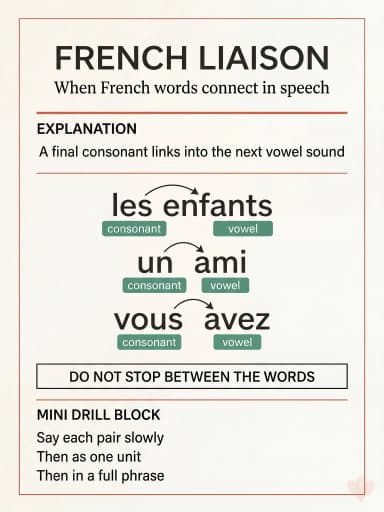
Both elision and liaison solve the same problem by smoothing word boundaries before vowels. But they work differently. Elision removes a vowel. Liaison adds a consonant. They never compete: a given word boundary uses one or the other, never both.
The complete list of words that elide
Only specific short function words undergo elision. Here is the complete list:
Always elide before a vowel or silent h
| Word | Elided form | Example |
|---|---|---|
| le | l' | l'ami, l'hôtel |
| la | l' | l'amie, l'école |
| je | j' | j'ai, j'aime |
| me | m' | il m'aime, il m'a dit |
| te | t' | il t'attend, je t'aime |
| se | s' | il s'appelle, elle s'est levée |
| ce | c' | c'est, c'était |
| de | d' | d'accord, beaucoup d'eau |
| ne | n' | je n'ai pas, il n'est pas |
| que | qu' | qu'est-ce que, parce qu'il |
| si | s' | s'il (only before il and ils) |
| jusque | jusqu' | jusqu'à, jusqu'ici |
| lorsque | lorsqu' | lorsqu'il |
| puisque | puisqu' | puisqu'elle |
| quoique | quoiqu' | quoiqu'il |
Important: si only elides before il/ils
Si is the only word with a restricted elision:
- ✅ s'il vous plaît (before il)
- ✅ s'ils arrivent (before ils)
- ❌ s'elle; wrong, must be si elle
- ❌ s'on; wrong, must be si on
When elision happens
Elision is triggered by two conditions:
- One of the words above is followed by a word starting with a vowel sound
- That vowel sound includes words starting with h muet (silent h)
H muet vs h aspiré
This is where elision gets tricky. French has two kinds of h:
-
H muet (silent h): treats the word as if it starts with a vowel. Elision and liaison happen normally.
-
l'homme, l'hôtel, l'heure
-
H aspiré (aspirated h): blocks elision and liaison. The word behaves as if it starts with a consonant.
-
le héros (not l'héros)
-
la honte (not l'honte)
-
les // haricots (no liaison)
There is no reliable spelling rule to distinguish the two. You need to learn h aspiré words individually. The most common ones:
le haricot, le héros, la honte, le hasard, la haine, le hamster, la Hollande, le hockey, la hausse, le handicap
The h aspiré trap
H aspiré does not involve any actual aspiration, the h is still silent. The term is misleading. What it really means is: "this word blocks elision and liaison." Think of it as an invisible wall before the vowel.
When elision does not happen
Elision is blocked in these situations:
1. Before h aspiré words
As noted above:
- ❌ l'haricot → ✅ le haricot
- ❌ l'héros → ✅ le héros
2. Before certain numbers and letters
- le onze (not l'onze), onze blocks elision
- le un (when referring to the number/letter), context-dependent
3. Before oui
- le oui (not l'oui), oui typically blocks elision in standard use
4. Words not in the elision list
Only the specific function words listed above undergo elision. Other words ending in vowels do not elide:
- ma amie, this is wrong for a different reason (use mon amie instead), but ma does not elide
- tu as, tu does not elide (say /ty.a/ with a slight link)
10 high-frequency elision phrases
These appear in almost every French conversation. Make them automatic:
- l'ami /la.mi/, the friend
- j'ai /ʒɛ/, I have
- c'est /sɛ/, it is
- d'accord /da.kɔʁ/, agreed / OK
- l'école /le.kɔl/, the school
- j'aime /ʒɛm/, I like/love
- s'il vous plaît /sil.vu.plɛ/, please
- n'est-ce pas /nɛs.pa/, isn't it
- qu'est-ce que /kɛs.kə/, what is
- jusqu'à /ʒys.ka/, until
Say each one five times. On each rep, check: is the elided form clean, or are you reinserting a ghost vowel?
The common English-speaker mistake
Mistake 1: reinserting the dropped vowel
The most common error is knowing that elision exists but still producing the full vowel under speed pressure:
-
❌ je ai /ʒə.ɛ/ (reinserting the /ə/)
-
✅ j'ai /ʒɛ/ (clean elision)
-
❌ le ami /lə.a.mi/ (reinserting the /ə/)
-
✅ l'ami /la.mi/ (clean elision)
This happens because English speakers are not used to vowel deletion. In English, every written vowel gets some sound. In French, the deleted vowel truly disappears.
Mistake 2: eliding before h aspiré
- ❌ l'héros /le.ʁo/
- ✅ le héros /lə.e.ʁo/
The fix: learn the common h aspiré words as a short list rather than trying to derive a rule.
Mistake 3: over-eliding words not in the list
Some learners start dropping vowels from words that do not undergo elision:
- ❌ tu'as or t'as in writing (although t'as appears in very casual spoken French, it is not standard elision)
- ❌ ma'amie, the solution here is mon amie, not elision
Mistake 4: treating elision as optional
Elision in the standard list is mandatory, not stylistic. You must say l'ami, never le ami. This is different from liaison, which has optional categories. Elision has no optional category, if the conditions are met with a word from the list, you elide.
Shadowing drill: 5-minute elision workout
Round 1: Clean elision pairs (2 minutes)
Say each pair, first the un-elided form (slowly, to hear the collision), then the correct elided form:
- le ami → l'ami, feel the vowel drop
- je ai → j'ai, clean transition
- ce est → c'est, one syllable
- de eau → d'eau, smooth
- ne est pas → n'est pas, no ghost vowel
Round 2: In phrases (2 minutes)
Now use elided forms in full sentences. Keep the flow smooth:
- J'ai un ami à l'école., three elisions
- C'est l'heure de partir, s'il vous plaît., four elisions
- Il n'a pas d'argent jusqu'à lundi., three elisions
- Qu'est-ce qu'il a dit?, two elisions
- Je m'appelle Marc, et j'aime l'art., three elisions
Round 3: Speed recall (1 minute)
Close your eyes. Say these from memory at natural speed:
- C'est l'ami de l'école.
- J'ai beaucoup d'eau.
- S'il vous plaît, qu'est-ce que c'est?
Check: did any ghost vowels creep back in?
Self-check: is your elision clean?
Record yourself reading this passage:
J'ai une amie qui s'appelle Marie. Elle habite à l'hôtel jusqu'à samedi. C'est l'endroit qu'elle préfère. S'il fait beau, on ira à l'école ensemble. Je n'ai pas d'argent, mais ce n'est pas un problème.
Check each elision point:
| Elision | Expected | Clean? |
|---|---|---|
| j'ai | /ʒɛ/ | ☐ |
| s'appelle | /sa.pɛl/ | ☐ |
| l'hôtel | /lo.tɛl/ | ☐ |
| jusqu'à | /ʒys.ka/ | ☐ |
| c'est | /sɛ/ | ☐ |
| l'endroit | /lɑ̃.dʁwa/ | ☐ |
| qu'elle | /kɛl/ | ☐ |
| s'il | /sil/ | ☐ |
| l'école | /le.kɔl/ | ☐ |
| n'ai | /nɛ/ | ☐ |
| d'argent | /daʁ.ʒɑ̃/ | ☐ |
| n'est | /nɛ/ | ☐ |
Score:
- 10-12 clean: excellent, your elision is solid
- 7-9 clean: good foundation, drill the missed forms
- Under 7: practice Round 1 daily for a week before re-testing
How elision connects to the rest of the system
Elision works with the other French connected speech rules:
- Elision prevents the vowel collisions that would otherwise require other solutions. Without elision, French would need different strategies to keep speech flowing before vowel-initial words.
- Elision and liaison solve the same boundary problem differently. Elision removes a vowel; liaison adds a consonant. Both maintain smooth CV alternation.
- Elision interacts with h aspiré/h muet, which also affects liaison and enchaînement.
Clean Up Your French Flow
Shadow native speakers and get feedback on elision, liaison, and connected speech. Short drills that build automatic linking.
What to do next
You have now covered all five connected speech processes. Return to French Connected Speech Rules to review the full system and run the integrated diagnostic.
For continued practice:
- French Pronunciation Rules for Speaking Clarity, the top 5 rules with a 14-day plan
- French Accent Errors: Fast Fix Drills, the five biggest English-speaker mistakes
- French Pronunciation for English Speakers, the complete sound system