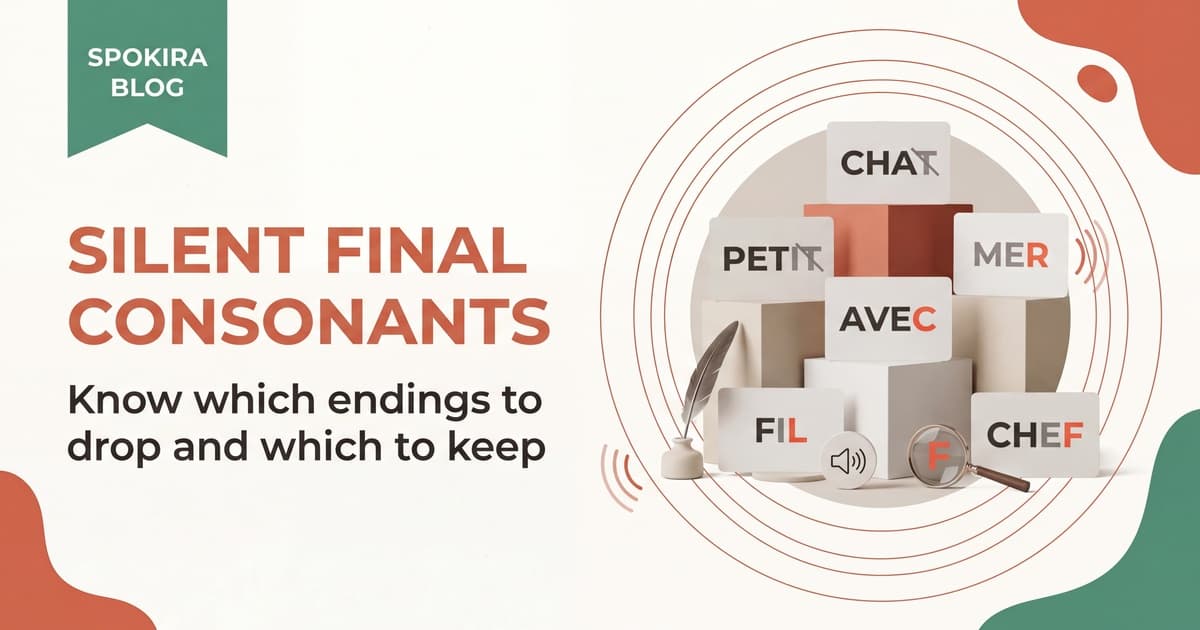
The fastest way to sound less English in French is to stop pronouncing every letter you see.
French spelling preserves consonants that disappeared from speech centuries ago. Most final consonants are silent. But some are pronounced, and the pattern is not random.
This guide gives you a reliable system for deciding which endings to drop and which to keep. You will get the core rule, the main exceptions, high-frequency practice words, and a self-check drill. This is part of the French connected speech rules system.
What the rule is
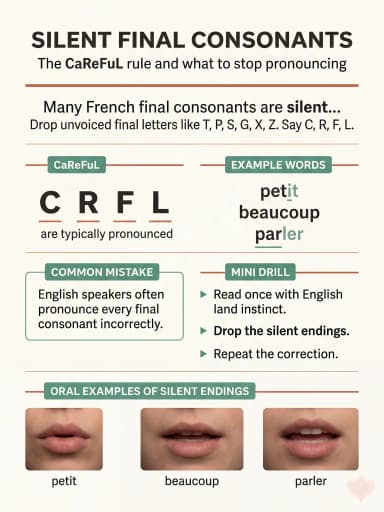
The default in French: most final consonants are silent.
This includes: -s, -t, -d, -x, -z, -p, -g, -b, -n, -m (when part of a nasal), and most doubled endings.
If you are unsure whether to pronounce a final consonant, the safer bet in French is usually to stay silent. Over-pronouncing finals is a more noticeable error than occasionally dropping one that should be heard.
UT Austin's phonetics curriculum teaches this as the starting filter for learners: assume silence, then learn the exceptions (UT Austin, les syllabes).
Start from silence
English habits push you to pronounce everything you see. In French, start from silence and add sound only when you have a reason. This reversal is the single biggest shift English speakers need to make with final consonants.
The CaReFuL rule: a useful but imperfect filter
The classroom mnemonic CaReFuL helps you remember which final consonants are often pronounced:
- C, avec /a.vɛk/, sac /sak/, parc /paʁk/
- R, pour /puʁ/, bonjour /bɔ̃.ʒuʁ/, finir /fi.niʁ/
- F, neuf /nœf/, actif /ak.tif/, bref /bʁɛf/
- L, mal /mal/, hotel /o.tɛl/, avril /a.vʁil/
This mnemonic is a starting point. It works for many common words but has important exceptions:
CaReFuL exceptions (consonant is silent despite the rule)
| Letter | Silent example | Why |
|---|---|---|
| C | estomac /ɛs.tɔ.ma/ | Some -ac words are silent |
| C | blanc /blɑ̃/ | -nc is often silent |
| R | parler /paʁ.le/ | -er infinitives: the -r is silent |
| R | premier /pʁə.mje/ | -ier endings: the -r is silent |
| R | boucher /bu.ʃe/ | -er noun/adjective endings: often silent |
| L | gentil /ʒɑ̃.ti/ | Some -il words drop the /l/ |
The key insight from Lawless French's silent letters guide: CaReFuL is a classroom-level heuristic, not a law. Use it as your starting filter, then learn the specific exceptions for words you actually use.
When final consonants are silent
Here are the most common silent-final patterns:
Always silent (in isolation)
| Pattern | Examples | Pronunciation |
|---|---|---|
| Final -s | paris, trois, mauvais | /pa.ʁi/, /tʁwa/, /mo.vɛ/ |
| Final -t | petit, fait, nuit | /pə.ti/, /fɛ/, /nɥi/ |
| Final -d | grand, froid, chaud | /gʁɑ̃/, /fʁwa/, /ʃo/ |
| Final -x | deux, voix, noix | /dø/, /vwa/, /nwa/ |
| Final -z | chez, nez, riz | /ʃe/, /ne/, /ʁi/ |
| Final -p | beaucoup, trop, coup | /bo.ku/, /tʁo/, /ku/ |
| Final -g | long, sang | /lɔ̃/, /sɑ̃/ |
| Final -ent (verb) | ils parlent, elles mangent | /il.paʁl/, /ɛl.mɑ̃ʒ/ |
The -ent trap
The third-person plural ending -ent is silent on verbs: ils parlent → /il.paʁl/.
But -ent on nouns and adverbs is pronounced: moment → /mɔ.mɑ̃/, souvent → /su.vɑ̃/ (as a nasal vowel, not a full consonant).
This catches many learners. The fix: if the word is a verb conjugation, silence the -ent. If it is a noun or adverb, pronounce it.
When final consonants are pronounced
Beyond the CaReFuL consonants, these patterns reliably produce a final sound:
| Pattern | Examples | Pronunciation |
|---|---|---|
| Final -l | mal, hotel, sol | /mal/, /o.tɛl/, /sɔl/ |
| Final -r (non -er) | pour, amour, fleur | /puʁ/, /a.muʁ/, /flœʁ/ |
| Final -f | neuf, bref, actif | /nœf/, /bʁɛf/, /ak.tif/ |
| Final -c | avec, sac, sec | /a.vɛk/, /sak/, /sɛk/ |
| Final -q | cinq | /sɛ̃k/ |
| Foreign words | bus, film, tennis | /bys/, /film/, /te.nis/ |
10 high-frequency words to get right
These appear constantly. Drill the correct pronunciation:
- petit /pə.ti/, silent -t
- beaucoup /bo.ku/, silent -p
- avec /a.vɛk/, pronounced -c (CaReFuL)
- parler /paʁ.le/, silent -r (CaReFuL exception: -er infinitives)
- pour /puʁ/, pronounced -r (CaReFuL)
- grand /gʁɑ̃/, silent -d
- ils sont /il.sɔ̃/, silent -t on sont
- neuf /nœf/, pronounced -f (CaReFuL)
- trop /tʁo/, silent -p
- gentil /ʒɑ̃.ti/, silent -l (CaReFuL exception)
Say each one five times. On the final rep, use the word in a short phrase.
The common English-speaker mistake
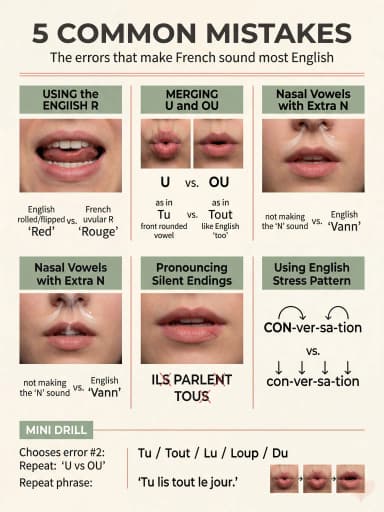
English speakers make two opposite errors with final consonants:
Mistake 1: pronouncing everything (most common)
English spelling-to-sound rules are relatively consistent: if you see a letter, you usually say it. French does not work this way.
- ❌ petit → /pə.tit/ (pronouncing the -t)
- ❌ beaucoup → /bo.kup/ (pronouncing the -p)
- ✅ petit → /pə.ti/
- ✅ beaucoup → /bo.ku/
Over-pronouncing finals is the fastest way to sound like a textbook reader instead of a speaker.
Mistake 2: silencing CaReFuL consonants
Once learners discover that French finals are often silent, some overcorrect and silence everything, including the consonants that should be heard:
- ❌ avec → /a.vɛ/ (dropping the -c)
- ❌ pour → /pu/ (dropping the -r)
- ✅ avec → /a.vɛk/
- ✅ pour → /puʁ/
Mistake 3: inconsistency under speed
Many learners can handle finals correctly in slow, careful speech but revert to English habits when speaking faster. The 2025 meta-analysis found that structured phonetic training produces lasting gains, which supports repeated practice under speed pressure rather than just knowing the rule (Yao et al., 2025).
How silent finals connect to liaison and enchaînement
Silent final consonants are the foundation of the connected speech system:
- Liaison: when a normally silent final consonant "wakes up" before a vowel. Petit has a silent -t, but in petit‿ami, the /t/ surfaces. See French liaison rules.
- Enchaînement: when an always-pronounced final consonant links forward. Avec always has its /k/, so in avec‿elle, the /k/ slides forward to begin the next syllable. See French enchaînement.
You need to know which finals are silent and which are pronounced before you can apply either rule correctly. This is why silent finals are the supporting layer underneath liaison and enchaînement.
Shadowing drill: 5-minute silent finals workout
Round 1: Drop drill (2 minutes)
Read each word twice, once with the English instinct (pronouncing the ending), then with the correct French pronunciation. Feel the difference:
- petit: /pə.tit/ → /pə.ti/
- beaucoup: /bo.kup/ → /bo.ku/
- grand: /gʁɑ̃d/ → /gʁɑ̃/
- ils parlent: /il.paʁl.ɑ̃t/ → /il.paʁl/
- fait: /fɛt/ → /fɛ/
Round 2: Keep drill (2 minutes)
Now practice words where the final IS pronounced:
- avec, feel the /k/ at the end
- pour, feel the /ʁ/
- neuf, feel the /f/
- mal, feel the /l/
- actif, feel the /f/
Round 3: Mixed practice (1 minute)
Read this sentence and decide each ending in real time:
Il est petit mais actif, et il fait beaucoup de mal avec un sac.
- petit: silent -t ✓
- actif: pronounced -f ✓
- fait: silent -t ✓
- beaucoup: silent -p ✓
- mal: pronounced -l ✓
- avec: pronounced -c ✓
- sac: pronounced -c ✓
Self-check: are your finals correct?
Record yourself reading this passage:
Mon ami est grand et gentil. Il habite dans un petit appartement avec un chat. Il parle beaucoup, surtout le soir. Hier, il a fait un long discours pour elle.
Check each final consonant decision:
| Word | Final letter | Should be | Your pronunciation |
|---|---|---|---|
| ami | -i | pronounced (vowel) | ☐ Correct |
| grand | -d | silent | ☐ Correct |
| gentil | -l | silent (exception) | ☐ Correct |
| petit | -t | silent | ☐ Correct |
| avec | -c | pronounced | ☐ Correct |
| chat | -t | silent | ☐ Correct |
| beaucoup | -p | silent | ☐ Correct |
| surtout | -t | silent | ☐ Correct |
| soir | -r | pronounced | ☐ Correct |
| fait | -t | silent | ☐ Correct |
| long | -g | silent | ☐ Correct |
| discours | -s | silent | ☐ Correct |
| pour | -r | pronounced | ☐ Correct |
Score:
- 11-13 correct: strong control, move to speed practice
- 8-10 correct: good foundation, drill the misses
- Under 8: focus on CaReFuL rule + the verb -ent pattern for one more week
Stop Guessing French Endings
Get instant AI feedback on which endings you over-pronounce or incorrectly silence. Short drills built for English speakers.
What to do next
If your finals are solid, move to French Glides and Semi-Vowels, they affect syllable count and rhythm.
If you need more practice on finals, pair this guide with 5 French Accent Errors: Fast Fix Drills, silent finals are error #1 in that guide.
For the full connected speech system, return to French Connected Speech Rules.