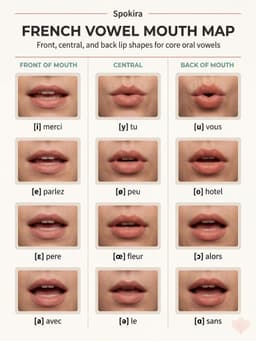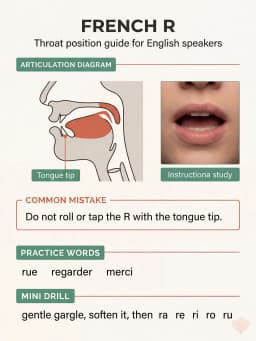
French Pronunciation Mouth Position Cues
Lip shape and tongue placement cues for the French sounds English speakers blur most often.
Share this visual
Share the page URL so the visual earns links, saves, and citations.
Embed snippet links back to the canonical visual page.
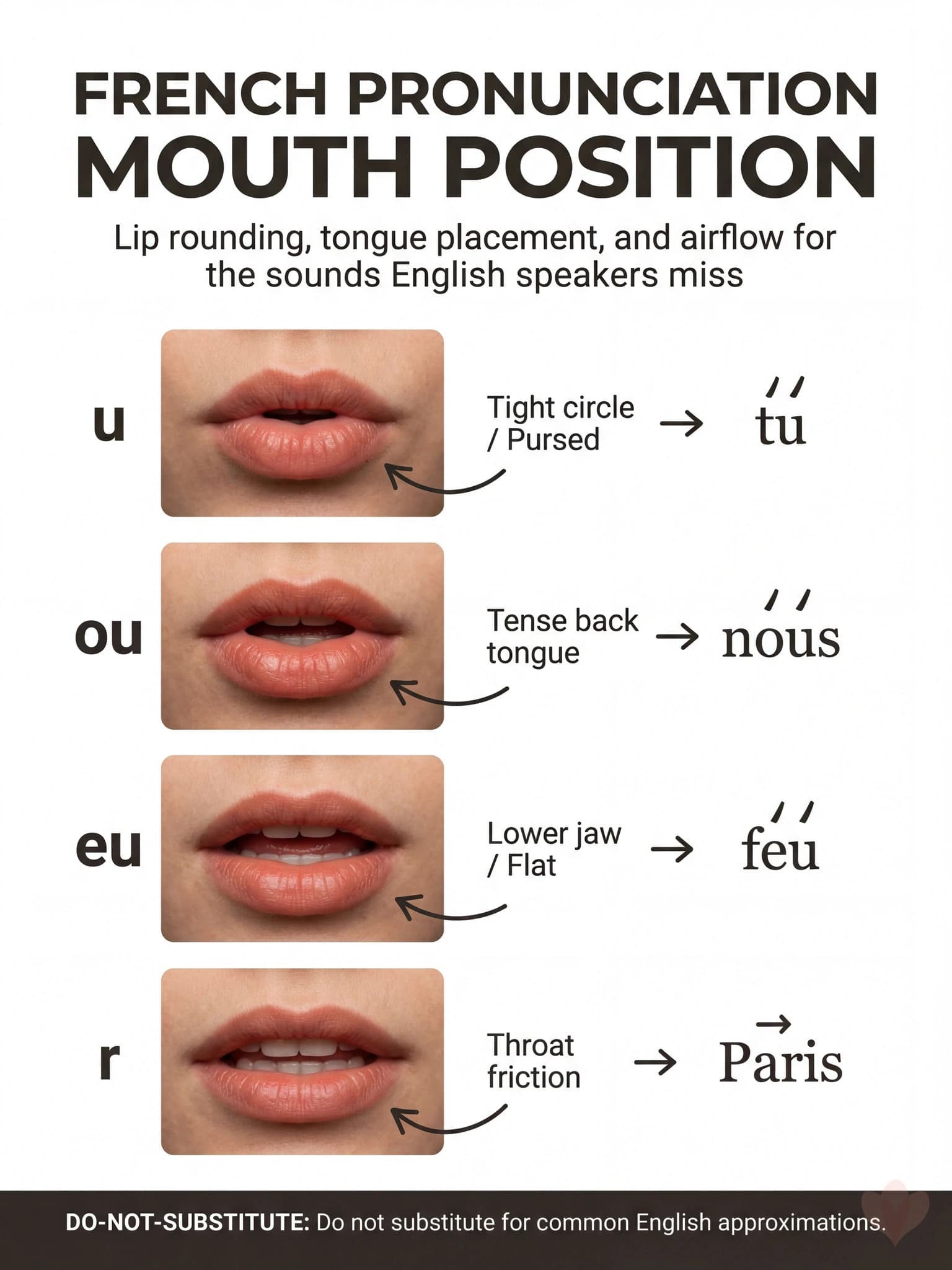
When learners search for french pronunciation mouth position, they usually want one thing: a visible cue they can trust before they try another repetition. This card covers four high-value trouble spots, because the mouth posture for u, ou, eu, and French r is where English approximations usually sneak in.
The four cues
u: keep the tongue forward, then round tightlyou: keep the lips rounded with a backer voweleu: relax the jaw more than forur: feel friction farther back in the throat
The main mistake
Trying to get a French sound with an English mouth setting. That is why tu turns into too, eu gets flattened, and the French r comes out as an English r.
Quick practice
- Hold the mouth position silently for a second.
- Say one word only.
- Repeat the word inside a short phrase.
Why this helps
Visible articulation cues matter because French keeps contrasts English does not always preserve, especially among rounded vowels and the uvular r. The sound inventory summarized in French phonology on Wikipedia shows why these distinctions are real and not just accent fine-tuning.
Where to go next
For more detail on the rounded vowels, open French U vs OU mouth position and French EU pronunciation mouth position. For the wider diagnosis, read French pronunciation for English speakers.
Practice Inside Spokira
Practice these sounds in Spokira and check which mouth-shape cue still breaks down in full phrases.