French Pronunciation Diagram for English Speakers
A one-page pronunciation diagram showing the French sound families English speakers usually need first.
Share this visual
Share the page URL so the visual earns links, saves, and citations.
Embed snippet links back to the canonical visual page.
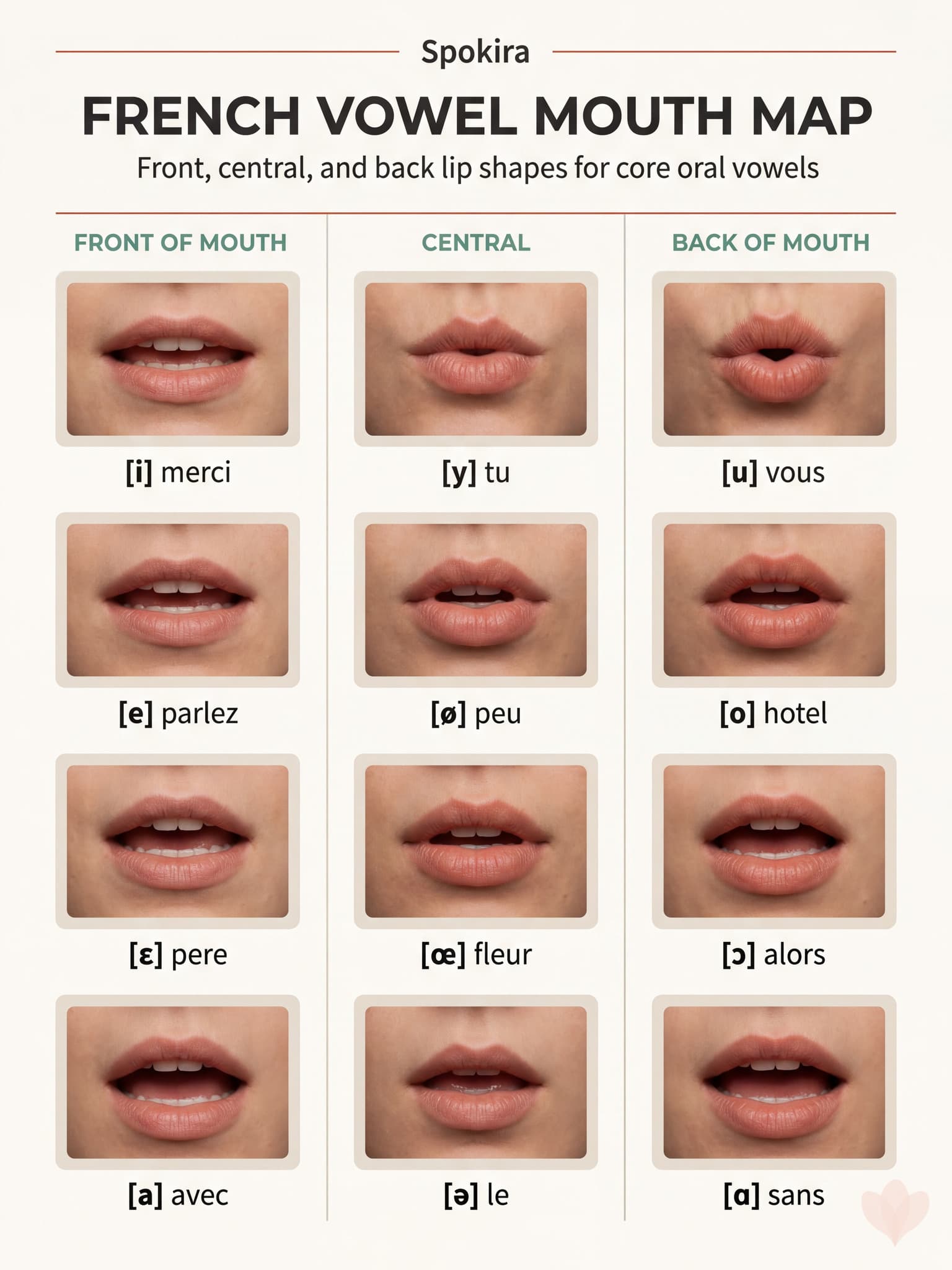
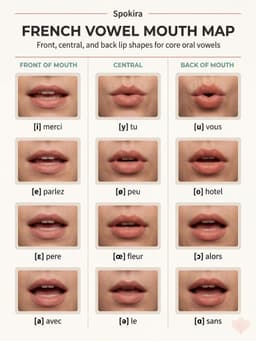
This visual is the short version of the bigger pronunciation problem. Most English speakers do not need fifty French sound rules on day one. They need the four sound families that keep showing up in the same mistakes: u, eu, French r, and nasal vowels.
The four high-value sound panels
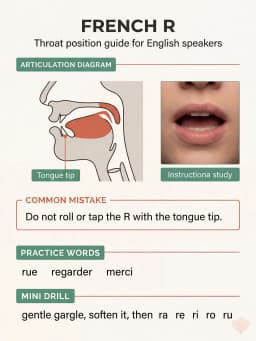
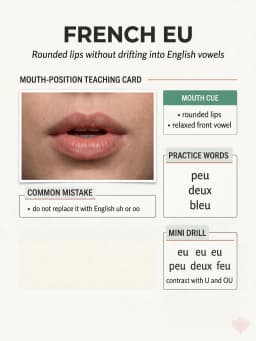
u: tongue forward, lips tightly roundedeu: rounded, but with a looser jaw thanur: friction farther back in the mouth- Nasal vowels: keep the vowel and let some air pass through the nose
The common problem
Trying to make a French sound while keeping an English mouth setting. That is why learners flatten eu, replace u with oo, and turn the French r into an English r.
Quick practice
- Pick one panel only.
- Say one example word.
- Repeat the same sound inside a short phrase.
Why this helps
French keeps contrasts English does not train by default, especially among rounded front vowels, nasal vowels, and the uvular r. French phonology on Wikipedia is a solid learner-facing reference for that sound inventory.
Where to go next
Open the detailed cards for French U vs OU mouth position, French EU pronunciation mouth position, French R mouth position diagram, and French nasal vowels pronunciation chart. The companion article French pronunciation for English speakers gives the longer explanation.
Practice Inside Spokira
Use Spokira to test these sound families in full phrases instead of isolated words.