If you can follow French podcasts better than before, understand a teacher, or read simple French without much trouble, but still freeze when it is your turn to answer, you are dealing with a very specific problem. Your comprehension is ahead of your speaking.
That gap is normal. It is also fixable. The method that actually helps is not "just talk more" and it is not "keep watching input until speaking appears on its own." For most A2-B1 learners, the fix is a stack: shadowing for sound and rhythm, retrieval for access speed, scenario loops for usable phrases, and one repair target at a time.
This article shows how that method works, why passive exposure alone usually stalls, and how to turn the French you already recognize into French you can actually say under pressure. If you are still unsure whether you have simply stayed input-only for too long, use When to Stop Only Doing Input and Start Speaking French as the diagnostic companion piece.
Quick answer: what actually fixes the understand-but-can't-speak gap?
If you understand French but can't speak it easily, the method that usually works best is:
- copy short native audio until the line feels speakable,
- remove the support and retrieve it from a cue,
- repeat the same scenario enough times that the language becomes available faster,
- fix one recurring bottleneck such as pauses, rhythm, or one pronunciation problem,
- transfer the same material into a short live or recorded response.
That fits what the Council of Europe's CEFR Companion Volume describes for A2-B1 speakers: they can often manage familiar topics, but hesitation, repair, and searching are still part of performance. It also fits what retrieval-practice research found. Karpicke and Blunt reported in 2011 that retrieval practice improved learning more than concept mapping in their experiment (PubMed), while Cepeda and colleagues' 2006 review found spaced practice more durable than massed review (PubMed).
So the question is not whether you know enough French to begin speaking. The question is whether your practice trains retrieval and production, not just recognition.
Why you understand French but can't speak it smoothly yet
Recognition and production are related, but they are not the same skill.
When you listen or read, you get extra support:
- context tells you what is probably coming,
- subtitles or text reduce pressure,
- you can recognize meaning without assembling the sentence yourself,
- you do not need to pronounce anything in real time.
Speaking strips those supports away. Now you have to:
- retrieve the right words,
- organize them fast enough,
- produce French sounds and rhythm,
- continue even if one piece goes wrong.
That is why many learners say things like:
- "I know this when I hear it."
- "I can read it, but I cannot answer fast."
- "I understand the question, then my mind goes blank."
If that sounds familiar, your problem is not zero knowledge. It is fragile access.
The methods that help a little, but usually do not solve the problem alone
Before looking at what works, it helps to be clear about what usually stalls.
More passive input only
Input still matters. You should not stop listening or reading. But once your comprehension is clearly ahead of speaking, more passive exposure alone often gives smaller returns on output.
You may keep improving your ear while still answering slowly. That is why this stage feels frustrating: progress is real, but it is happening in the wrong channel.
Random conversation practice
Jumping into full conversation can help eventually, but it is not always the best first fix for this gap. If you have weak retrieval, broad conversation creates too many moving parts at once:
- topic choice,
- vocabulary search,
- pronunciation,
- listening pressure,
- turn-taking pressure.
That usually leads to survival mode, not useful repetition.
Bigger vocabulary decks
More words can help only if those words become usable in speech. If your main issue is retrieval speed, adding more isolated vocabulary often expands passive knowledge faster than active output.
Grammar polishing as the default answer
Sometimes grammar really is the bottleneck. But a lot of A2-B1 learners already know enough grammar to produce short answers. Their real issue is that the sentence does not arrive quickly or smoothly enough to use.
Which method actually works? A four-part method stack
The strongest answer for this stage is not one magic trick. It is a stack of four practices that solve different parts of the same problem.
| Part | What it fixes | What you do |
|---|---|---|
| Shadowing | mouth feel, rhythm, sound pattern | copy one short native clip several times |
| Retrieval | slow access | answer from cues, not full text |
| Scenario loops | random practice | repeat one familiar situation for several days |
| Repair work | vague effort | fix one recurring weakness at a time |
If you want the full system around this stack, use How to Practice Spoken French: A Complete A2-B1 System. You can also use the broader French speaking practice hub if you want the cluster map before choosing drills. This article is narrower: it explains which method actually closes the passive-to-active gap.
If you understand French but can't speak, start with shadowing
Many learners think their speaking problem is only lexical. Often it is partly physical. The line still feels unfamiliar in the mouth.
That is why shadowing works well as the first bridge. Instead of inventing a sentence from scratch, you follow a native model and copy:
- timing,
- linking,
- phrasing,
- melody,
- overall flow.
This lowers decision load and gives your mouth a version of the line that feels more natural. A 2025 meta-analysis of pronunciation training found a large positive overall effect across 65 studies and 2,793 learners, which supports direct pronunciation work rather than assuming better speech will emerge automatically from exposure alone (PubMed).
Use one short clip, not a whole lesson. Five to seven minutes is enough if you stay on one useful line or mini-dialogue. If you need a ready-made routine, use French shadowing practice: use one clip for 15-30 spoken reps.
Why shadowing helps this specific gap
If you already understand the line, shadowing converts that comprehension into a speakable motor pattern. It turns "I know what this means" into "I can say something shaped like this."
That matters because a lot of hesitation is not deep confusion. It is shallow instability.
Part 2: switch quickly to retrieval, or the phrase still is not really yours
This is the step many learners skip.
If the line only works while the audio or text is present, it is not fully available yet. You are still leaning on recognition.
So after a few supported reps, remove the support and retrieve from a cue:
| Cue | French response |
|---|---|
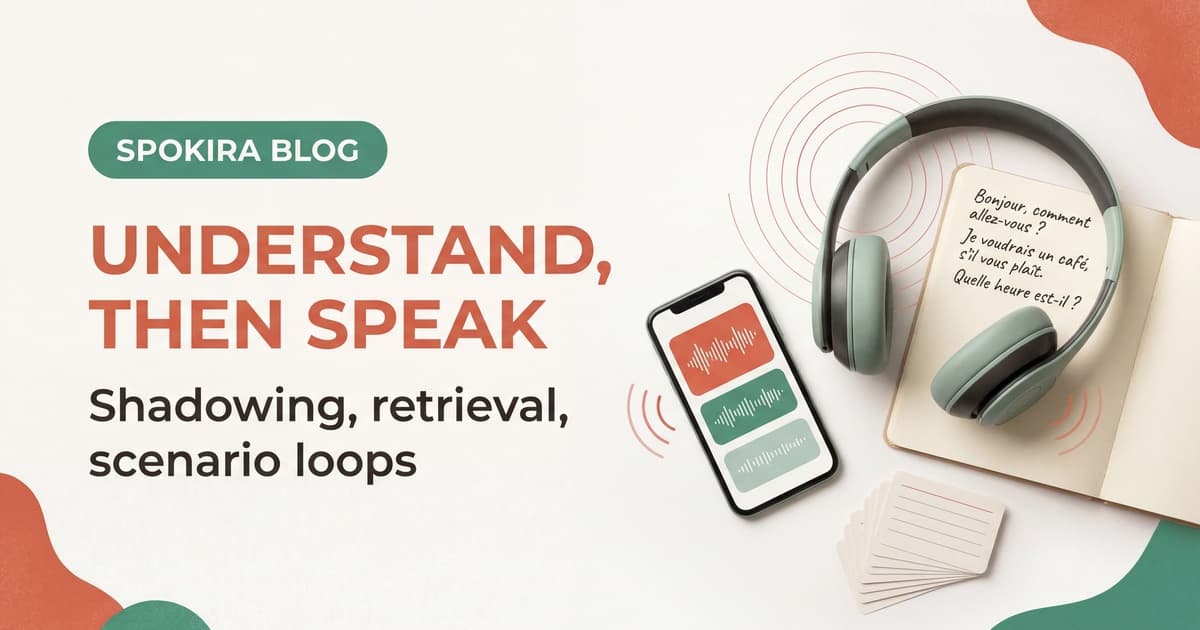
| order politely | Bonjour, je voudrais un cafe, s'il vous plait. |
| ask to repeat | Pardon, vous pouvez repeter ? |
| correct yourself | En fait, je voulais dire... |
| buy time | Attendez, je reformule. |
The cue should trigger function, not an English sentence you mentally translate.
This is where speaking starts to change. Retrieval practice is useful because it forces access under slight pressure. It exposes the exact place where you do not yet own the phrase. If you want a focused version of this block, use the French output retrieval drill.
Swain's output-hypothesis work is relevant here too. Producing language helps learners notice the gap between what they meant to say and what they could actually say (Cambridge). That gap is often invisible during passive review.
If you understand French but can't speak, use scenario loops
If you switch topics constantly, nothing gets enough repetitions to become fast.
That is why scenario loops work better than random speaking prompts for this stage. Pick one familiar situation for the week:
- ordering at a cafe,
- introducing yourself,
- asking someone to repeat,
- small talk with simple follow-ups,
- correcting yourself politely.
Now train 5-8 lines inside that one situation.
For example, a cafe loop might include:
- Bonjour, je voudrais un cafe, s'il vous plait.
- Sur place, merci.
- Je peux payer par carte ?
- Pardon, vous pouvez repeter ?
- En fait, je voulais dire un cafe creme.
This works because the content stays stable while your speaking improves. You are not wasting energy deciding what to talk about. You are using that energy on:
- recall speed,
- rhythm,
- pronunciation,
- repair language,
- smoother linking.
If you want a ready-made scenario example, use French cafe conversation practice.
Part 4: repair one bottleneck at a time
Do not tell yourself to "get better at speaking French" in general. That is too vague.
Pick one bottleneck for the week:
- you pause too long before the first word,
- your French sounds word-by-word,
- you restart after one mistake,
- one sound such as French
rkeeps breaking flow, - you freeze when you need to ask for repetition.
Repair work matters because speaking becomes much easier when one recurring friction point gets cleaned up. If your answers are slow mostly because your pacing collapses, that is the target. If you understand fine but keep freezing when audio is fast, the target may be recovery language. If you overthink every line in English first, continue with How to Stop Translating in Your Head When Speaking French.
For pacing work specifically, pair this method with the French speaking speed routine.
What the full weekly method looks like in practice
You do not need an elaborate schedule. You need a repeatable loop.
Day 1: choose one scenario and one short clip
Pick the situation. Pick one native model. Shadow the clip several times until the rhythm feels less awkward.
Day 2: retrieve from cues
Hide the full sentence. Use prompts such as "ask to repeat" or "order politely." Speak from the cue.
Day 3: add one small variation
Change one noun, place, or time expression. Keep the same sentence frame. This matters because it pushes the phrase from memorized imitation toward flexible use.
Day 4: repair one weak point
Choose one issue only: long pause, French r, overcareful rhythm, restarting, or weak repair phrases.
Day 5: record one short take
Say the same mini-scenario without text. Then listen back. If recording makes you tense, use Record Yourself in French Without Cringing.
Day 6: transfer into low-pressure speech
Use the same material in a short self-talk, AI conversation, or brief exchange. The point is not novelty. The point is using trained language without the original support. If you want a guided version of that practice, compare this routine with the practice speaking French app page.
Day 7: repeat the baseline
Run the same scenario again and compare:
- Are starts faster?
- Are pauses shorter?
- Are fewer restarts happening?
- Does the line sound less translated and more grouped?
That is the measurement that matters.
How to know if this is really your bottleneck
Use this quick test:
- Listen to one short French line.
- Repeat it successfully with support.
- Wait five seconds.
- Say it again without audio or text.
- Change one detail and say the new version.
If step 2 feels fine but steps 4 and 5 collapse, your main problem is probably not comprehension. It is output access.
That is useful news, because output-access problems respond well to the method stack above.
What not to do when you understand French but can't speak
Avoid these traps:
- calling more passive listening "speaking practice,"
- switching to a new topic every day,
- waiting for spontaneous fluency before doing retrieval,
- trying to correct every weakness at once,
- using long open conversation as the only speaking format.
The goal is not to prove that you can survive chaos. The goal is to build usable French that survives pressure better than before.
Turn Passive French Into Usable Speech
Practice with shadowing, retrieval, and AI feedback built for learners who understand more than they can say.
The method that actually fixes it
If you understand French but cannot speak it well yet, the fix is usually not more passive exposure alone and not one giant leap into free conversation.
What works better is narrower and more repeatable:
- shadow short useful audio,
- retrieve it without support,
- repeat one scenario for several days,
- repair one bottleneck at a time,
- transfer the same material into a live answer.
That is how passive French starts becoming active French. Not all at once, and not by magic. By making the language you already recognize easier to retrieve, easier to pronounce, and easier to reuse when it is finally your turn to speak. If you want to test that workflow with guided feedback, start a 7-day trial.