Most learners do too many French clips and too few spoken repetitions.
If your output feels slow, hesitant, or "classroom-like," the fastest fix is usually not more vocabulary. It is tighter retrieval practice on a small audio unit.
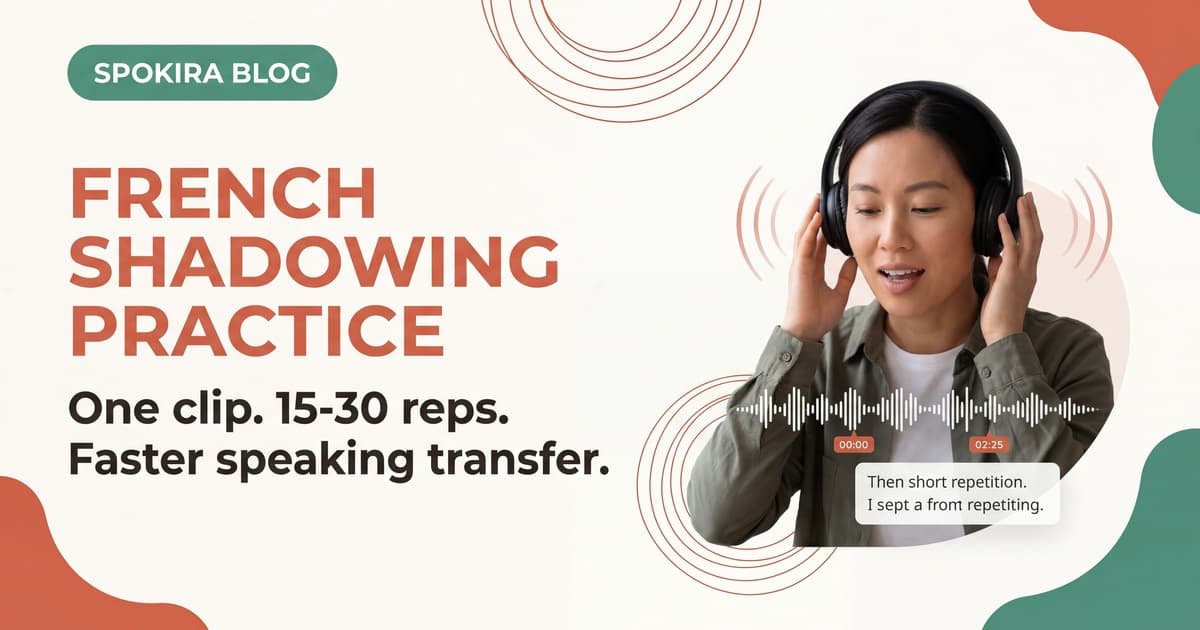
That is why french shadowing practice works best when you stay with one short clip long enough to automate timing, linking, and response speed.
This guide gives you a practical method: take one 20-40 second clip and run 15-30 reps in a structured sequence. You will train pronunciation, pace, and recall at the same time.
In this article, you will get:
- A clear one-clip shadowing framework for A2-B1 learners
- A 15-30 rep ladder you can run in 10-20 minutes
- A scoring system so you know when to move on
- A 14-day progression that prevents random practice
For evidence, this guide references web-verified sources checked on March 11, 2026: the CEFR Companion Volume from the Council of Europe (2020), retrieval-practice findings from Karpicke and Roediger in PNAS (2008), spacing findings from Cepeda et al. in Psychological Bulletin (2006), and open-access shadowing training findings in Brain Imaging and Behavior (published July 23, 2020; volume issue 2021).
If you are new to this method, read Why shadowing works for French, then return here for the exact rep system.
Quick answer: what is the best french shadowing practice routine?
Use one short clip and run these six rounds in order:
- Slow echo shadowing (text visible)
- Natural-speed echo shadowing
- Delayed shadowing (half-second lag)
- Chunk shadowing by breath groups
- Cue-only recall without full text
- One recorded no-text take
Do 15 reps if you are short on time, 30 reps if you want speed gains. Keep the same clip for 3-4 sessions before replacing it.
This structure is consistent with what learning science shows about retrieval and spacing. Repeated retrieval improves longer-term retention versus repeated restudy (PNAS, 2008), and distributed practice improves retention compared with massed practice (Psychological Bulletin, 2006).
One-Clip Rule
Do not rotate clips too early. Keep one clip until your no-text take is clear at near-native pace.
Why one-clip french shadowing practice beats random clip hopping
Most people fail at french shadowing practice because they confuse exposure with skill transfer.
Listening to ten clips can feel productive, but speaking improvement usually comes from repeated attempts on the same motor-linguistic pattern. You need enough reps for your mouth, ear, and timing system to align.
The CEFR Companion Volume emphasizes interaction and functional speaking behavior rather than isolated form knowledge (Council of Europe, 2020). In practical terms, you should train speech chunks you can retrieve under pressure, not just lines you recognize when reading.
A focused one-clip routine gives you:
- stable phoneme targets,
- stable rhythm targets,
- repeated retrieval pressure,
- controlled variation.
That combination is exactly what random, one-and-done clip practice lacks.
How to choose the right clip for french shadowing practice
Clip selection matters more than people think. Choose badly and you train panic. Choose well and you train control.
Use these filters.
1. Length: 20-40 seconds
Short clips let you accumulate true repetitions. A 2-minute clip usually lowers quality after a few runs.
2. Difficulty: 80-90% understandable with transcript
If every line feels opaque, your reps become decoding only. If it is too easy, you do not push pace or articulation.
3. Audio quality: clean, single speaker first
Crowded audio is useful later, but early reps should target stability.
4. Useful scenario content
Prioritize lines you will actually say: ordering, clarifying, agreeing, asking follow-up questions.
5. Transcript availability
You need clean text for first passes and targeted correction.
If you need scenario material, pair this with French cafe conversation practice.
The 15-30 rep ladder (core method)
This is the main french shadowing practice sequence. Keep the clip constant and move from assisted repetition to retrieval.
Round A (Reps 1-5): echo shadowing with text
Goal: lock pronunciation and segmentation.
- Rep 1-2: slow pace, high clarity.
- Rep 3-4: normal pace, maintain vowel quality and liaisons.
- Rep 5: normal pace, no pausing between chunks.
Do not optimize for speed yet. Optimize for stable articulation.
Round B (Reps 6-10): delayed shadowing
Goal: strengthen online processing and memory buffering.
Speak with a small lag after the model voice. This forces you to keep sound in working memory while speaking.
A 2020 open-access study in Brain Imaging and Behavior found that training with shadowing/reading-aloud conditions was associated with better working-memory-related performance patterns than non-speaking control conditions (Akira et al., published July 23, 2020).
You do not need to over-interpret one study, but it supports the practical idea that speaking-in-time tasks can train the memory-and-timing system that fluent output needs.
Round C (Reps 11-14): chunk shadowing with stress targets
Goal: fix rhythm and prosody.
Split the clip into 3-6 breath groups and repeat each group three times before running the full clip again. Mark where your voice should rise, flatten, or link.
Use Sound more natural fast: rhythm and intonation practice as your prosody reference.
Round D (Rep 15): first no-text take
Goal: test retrieval transfer.
Hide the transcript and run one full take. If you can deliver a clear version at reasonable pace, you have completed the base session.
Optional extension to 30 reps
If you want stronger gains, continue:
- Reps 16-22: cue-only prompts (not full text)
- Reps 23-27: variable substitutions (time/place/person/detail)
- Reps 28-30: two no-text recorded takes + one correction take
Use this full 30-rep block 3 times per week. Use the 15-rep block on other days.
What to score after each session (so you stop guessing)
Most learners cannot tell whether a session "worked." Use a simple 0-2 score in five areas.
- Segment clarity (vowels/consonants understandable)
- Rhythm (chunk timing, no robotic word-by-word pacing)
- Linking/flow (few unnatural breaks)
- Retrieval speed (can continue without long stalls)
- Repair control (recovers quickly after a miss)
Maximum is 10 points.
- 0-5: keep same clip, keep transcript visible longer.
- 6-7: keep same clip, start more cue-only reps.
- 8-10: graduate clip and carry pattern forward.
For confidence and self-review mechanics, use Record yourself in French without cringing.
The 14-day french shadowing practice progression
Here is a practical calendar you can follow.
Days 1-3: stabilization phase
- 15 reps per session
- transcript visible for most reps
- one recorded take at end
Days 4-7: retrieval phase
- 20-25 reps per session
- delayed shadowing + cue-only reps
- two recorded takes
Days 8-11: variation phase
- 25-30 reps per session
- substitute key details in each run
- keep prosody stable despite substitutions
Days 12-14: transfer phase
- 15-20 reps on original clip
- add one new clip and run 10 starter reps
- compare no-text takes between old and new clip
Spacing matters here: daily short sessions outperform occasional long sessions for retention in verbal learning tasks (Cepeda et al., 2006).
Want guided shadowing feedback, not guesswork?
Practice with short French clips, get immediate pronunciation feedback, and track your speaking clarity over time.
Common mistakes in french shadowing practice
Mistake 1: copying speed before copying structure
If timing is fast but sounds are unstable, you automate errors.
Fix: first lock vowels/consonants and chunk boundaries, then raise pace.
Mistake 2: always reading full text
Text dependence feels safe but weakens recall.
Fix: move to cue cards by rep 10-12.
Mistake 3: switching clips every day
Novelty kills repetition depth.
Fix: keep one clip for multiple sessions and score progress.
Mistake 4: no recording loop
Without recording, self-perception is unreliable.
Fix: always keep one recorded no-text take.
Mistake 5: ignoring retrieval drills
Shadowing alone is good, but shadowing plus retrieval is better for conversation carryover. Retrieval-practice evidence supports this training logic (PNAS, 2008).
If you freeze during free speech, combine this with Stop freezing mid-sentence in French.
How to transfer shadowing gains into real conversation
A lot of learners improve in drills but not in dialogue. Transfer requires one extra step: turn clip chunks into response templates.
Example transformation:
- Clip line: "Je voudrais..., s'il vous plait."
- Template: "Je voudrais [X], s'il vous plait."
- Live use: "Je voudrais un cafe allonge, s'il vous plait."
Build 8-12 templates from your clip and drill them with variable substitution. This is where shadowing becomes usable conversation behavior.
To support this transition:
- run one 60-second roleplay after each shadowing block,
- force at least 3 substitutions,
- include one repair phrase ("Je veux dire...").
For broader routine design, use French speaking speed shadowing routine and French output retrieval drill.
15 reps vs 30 reps: which french shadowing practice target should you use?
Use this quick decision table when planning your french shadowing practice block.
| Situation | Use 15 reps | Use 30 reps |
|---|---|---|
| Busy weekday | Yes | No |
| New clip, still unstable | Yes | No |
| You want speed gains this week | Optional | Yes |
| You keep freezing in free response | Optional | Yes |
| You need maintenance only | Yes | No |
In plain terms:
- choose 15 reps when consistency is the bottleneck,
- choose 30 reps when transfer and speed are the bottlenecks.
The key is not choosing one forever. The best french shadowing practice rotates both targets across the week: shorter sessions to protect habit, longer sessions to force adaptation.
Example 12-minute french shadowing practice session
If you need a concrete template, run this timer-based block.
- Minute 0-2: listen once, read transcript once, mark 3 hard chunks.
- Minute 2-5: five echo reps with text.
- Minute 5-8: five delayed reps with half-second lag.
- Minute 8-10: three cue-only reps.
- Minute 10-12: one no-text recording + quick score.
This short block still gives you 14-15 speaking exposures, which is enough to make french shadowing practice productive even on crowded days.
If you have 20 minutes, run the same block twice and add one variation-only round between blocks.
Troubleshooting plateaus in french shadowing practice
If your french shadowing practice feels stuck after one week, diagnose the bottleneck before changing your method.
Use this quick triage:
-
You can keep pace but sound unclear. Cause: articulation stability is weak. Fix: return to slower reps and exaggerate vowel contrasts for two sessions.
-
You sound clear but freeze without text. Cause: retrieval pressure is too low. Fix: add cue-only reps earlier, around rep 8 instead of rep 12.
-
You improve in drills but collapse in conversation. Cause: transfer step is missing. Fix: force a 60-90 second roleplay at the end of every session with substitutions.
-
You feel progress one day and regression the next. Cause: spacing and load are inconsistent. Fix: keep a stable cadence (for example, 5 days weekly) and avoid marathon catch-up sessions.
When in doubt, keep the routine simple: fewer clips, more clean repetitions, and one recorded no-text take each day. That pattern gives french shadowing practice enough structure to produce measurable gains.
Should you do french shadowing practice every day?
For most A2-B1 learners: yes, but short.
A practical weekly split:
- 4 days: 15-20 rep sessions,
- 2 days: 25-30 rep deep sessions,
- 1 day: light review and recording only.
Session length can stay between 10 and 20 minutes. Consistency matters more than long blocks.
If your goal is acquisition speed, track three numbers weekly:
- no-text clarity score,
- words-per-minute at stable clarity,
- number of successful variable substitutions.
Those metrics tell you whether your french shadowing practice is converting into spontaneous output.
Final takeaway
The best french shadowing practice is not complicated. It is disciplined.
Pick one short clip. Run 15-30 structured reps. Record one no-text take. Keep the clip long enough to build automatic control. Then transfer the same pattern to a new clip.
If you do this for 14 days, your speech usually changes in exactly the areas learners care about: fewer stalls, better rhythm, cleaner pronunciation, and faster retrieval.
Start simple today:
- Choose a 20-40 second clip.
- Run the 15-rep ladder once.
- Record one no-text take and score it out of 10.
Then repeat tomorrow with the same clip.
If you want a guided system that combines shadowing with real-time pronunciation and fluency feedback, explore Spokira's speaking practice tools and use the method above as your daily baseline.