If you can read or understand French but still build every answer in English first, you are not missing motivation. You are missing speaking conditions that force French to come out earlier.
That is why the fix for stop translating in your head when speaking French is usually not "think harder" or "memorize more words." It is building faster access to short French chunks you can retrieve under pressure.
This guide gives you that system. You will learn why mental translation keeps happening, what to practice instead, and how to build a 7-day loop that moves you toward direct French recall.
The evidence in this article was web-verified on March 13, 2026. It draws on the Council of Europe's CEFR Companion Volume (2020), retrieval-practice findings from Roediger and Karpicke in PNAS (2008), spacing findings from Cepeda and colleagues in Psychological Bulletin (2006), and Swain's output-hypothesis testing in Studies in Second Language Acquisition.
Quick answer: how do you stop translating in your head when speaking French?
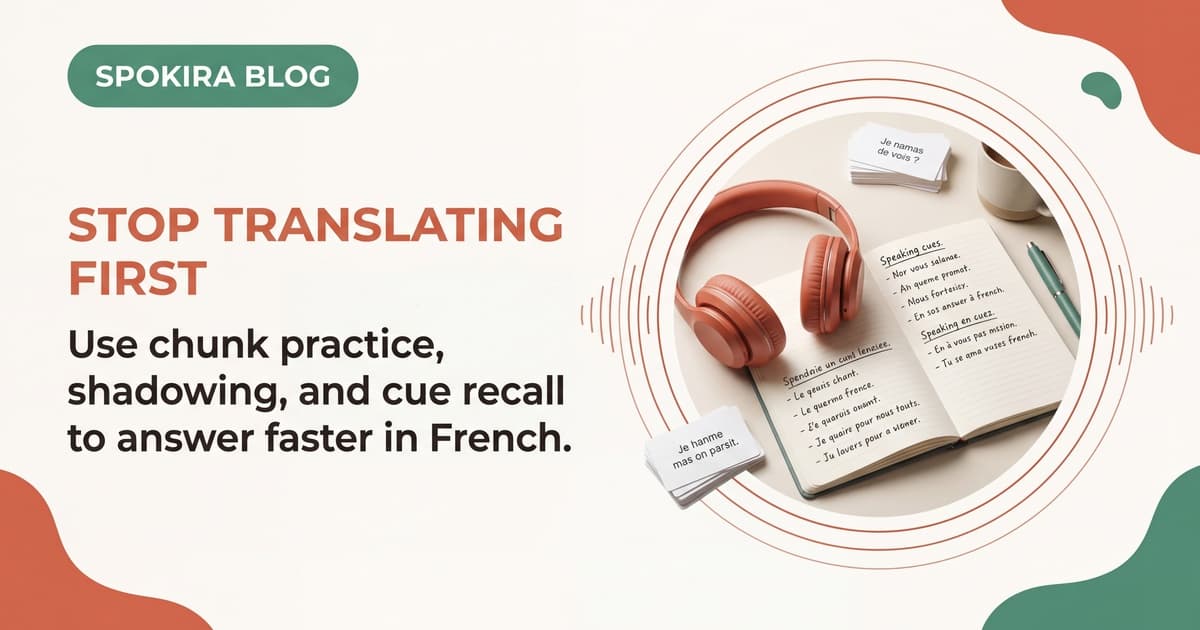
You stop translating in your head when you:
- practice short French chunks instead of isolated words,
- shadow native audio until the rhythm feels familiar,
- switch from full text to cue-based recall,
- repeat the same scenario long enough for faster retrieval,
- add small variations without restarting from English.
The key idea is simple: thinking in French is usually not a mystical switch. It is faster access to familiar forms.
That matches what the CEFR Companion Volume describes for A2-B1 speakers. At that stage, learners often have enough language for familiar situations but still pause, repair, and search while speaking. It also matches what retrieval research found in the 2008 PNAS paper by Roediger and Karpicke: pulling information out strengthens later access better than more review alone (PNAS).
So the goal is not "never think of English again." The goal is to make French retrieval fast enough that English stops leading every sentence.
Why you keep translating in your head
Most learners translate in their head for three practical reasons.
1. You learned recognition before production
Reading, listening, flashcards, and subtitles all help you recognize meaning. They do not automatically train you to produce the line fast enough for conversation.
That is why you may understand:
- Je voudrais un cafe
- Tu peux repeter ?
- J'arrive dans cinq minutes
but still feel a pause before saying them yourself.
If this is your main bottleneck, start with Understand French but can't speak?. This article goes narrower: what to do when English still sits in front of your French.
2. You are building sentences word by word
If you start with an English idea and convert each piece, your brain has to do too much work:
- choose the meaning,
- find the French words,
- assemble the order,
- pronounce the result,
- keep the conversation moving.
That is too slow for most real interactions.
3. Your practice is too broad
Random topics create random retrieval. You need repeated reps on one small set of useful lines before your brain starts reaching for French directly.
Swain's output-hypothesis work matters here because speaking forces learners to notice exactly where their knowledge breaks down (Cambridge). If you only consume input, you can stay comfortable in recognition for a long time.
What to do instead of translating line by line
The replacement is not "think in pure French all day." That advice is too vague to help.
Use this progression instead:
- learn one short phrase family,
- copy it out loud with rhythm,
- retrieve it from a cue,
- change one detail,
- reuse it in one scenario.
That turns speaking into a motor-and-retrieval skill, not a live translation exercise.
Better Goal
Do not aim for zero English in your head tomorrow. Aim for faster French retrieval on 5-10 phrases you actually need this week.
Step 1: stop memorizing single words for speaking
Single words help comprehension, but they are weak building blocks for live speech.
When you speak, your brain moves faster with chunks such as:
- je voudrais...
- est-ce que je peux...?
- je veux dire...
- en fait...
- ça depend...
These chunks reduce decision-making because the sentence already has a shape.
That is one reason many A2-B1 learners improve faster when they move from vocabulary lists to scenario lines. If you need a broader method overview, use the French speaking practice hub. If you want a full weekly calendar, use the French speaking practice guide.
Build a chunk bank, not a giant phrasebook
For one week, choose one scenario only:
- cafe ordering,
- introductions,
- directions,
- small talk,
- asking someone to repeat.
Then write 5-8 French chunks you would realistically say in that situation.
Bad goal:
- memorize 40 disconnected words
Better goal:
- train 6 reusable line starters until they come quickly
Step 2: shadow one native model before free speaking
Many people try to stop translating by pushing themselves into spontaneous output too early. That often makes translation worse.
Shadowing is the better bridge because it gives you a French model to copy before you have to invent anything.
Use one short clip. Repeat it until you can match:
- timing,
- linking,
- mouth movement,
- overall melody.
This matters because translating in your head is not only a vocabulary problem. It is often a timing problem. Your brain is slow because the line does not yet feel speakable.
If you need the deeper method, read Why shadowing works for French. If speed is the real issue, pair this with the French speaking speed routine.
Step 3: switch from full text to cue-based recall
This is the step most learners skip.
If the whole French sentence stays visible, you can still lean on recognition. That means English may disappear temporarily during practice, but it returns the second the text is gone.
Instead, use cue cards like these:
| Cue | What you produce |
|---|---|
| order politely | Bonjour, je voudrais un cafe, s'il vous plait. |
| ask to repeat | Pardon, vous pouvez repeter ? |
| buy time | Attendez, je reformule. |
| soften answer | En fait, je voulais dire... |
The cue should trigger French directly. Not a hidden English sentence. Just the function.
If you want a tighter spoken system for that specific cue, see How to Buy Time in French Without Sounding Stuck. It is the practical follow-up for learners who still freeze in the half-second between the cue and the sentence.
This is exactly why retrieval practice is useful. Roediger and Karpicke's 2008 study showed stronger long-term retention when learners repeatedly retrieved information instead of only restudying it (PNAS).
If you want a tighter version of this step, use the French output retrieval drill.
Step 4: train one scenario long enough to feel automatic
If you switch from travel French to restaurant French to work French in the same session, translation stays active because nothing gets enough reps.
For seven days, keep one scenario and one small script.
Example for a cafe:
- Bonjour, je voudrais un cafe, s'il vous plait.
- Sur place, merci.
- Je peux payer par carte ?
- Pardon, vous pouvez repeter ?
- En fait, je voulais dire un cafe creme.
That is enough. You do not need variety yet. You need retrieval speed.
If you want a ready-made scenario pack, use French cafe conversation practice.
Step 5: add small variations without restarting from English
Once the base line feels stable, change one detail at a time:
- cafe -> the
- sur place -> a emporter
- par carte -> en especes
The rule is important: keep the sentence frame and change only one element.
That teaches your brain to stay inside French while adjusting meaning.
Bad habit:
- stop,
- rebuild the whole sentence in English,
- translate again.
Better habit:
- hold the French frame,
- swap one piece,
- keep going.
A 10-minute drill to stop translating in your head when speaking French
Run this once a day for one week.
Minutes 1-2: pick one scenario and 5-8 chunks
Choose a narrow situation and keep it the same all week.
Minutes 2-5: shadow one short clip
Repeat the same lines with native audio. Stay focused on rhythm, not theory.
Minutes 5-7: cue-only recall
Hide the full text. Use function cues and say the line from memory.
Minutes 7-9: variation reps
Change one detail per repetition while keeping the same frame.
Minutes 9-10: one no-text recording
Record one final run and check:
- Where did you pause?
- Where did English sneak in first?
- Which chunk came out fastest?
For a calmer feedback loop, pair this with Record yourself in French without cringing.
Train Faster French Recall
Spokira gives you native shadowing, cue-based speaking reps, and focused feedback so you spend less time translating and more time responding.
A 7-day stop translating in your head when speaking French plan
This is the simplest weekly structure for A2-B1 learners.
| Day | Main focus | Goal |
|---|---|---|
| 1 | Build your chunk set | Choose one scenario and 5-8 core lines |
| 2 | Shadowing reps | Make the lines feel speakable |
| 3 | Cue recall | Produce from prompts, not full text |
| 4 | Variation practice | Change one noun, verb, or detail |
| 5 | Anti-freeze repair | Use rescue lines when you blank |
| 6 | Scenario transfer | Do one no-text roleplay |
| 7 | Record and review | Compare to day 1 and keep the best chunks |
Why a weekly loop works:
- The spacing review by Cepeda and colleagues found that distributed practice is generally better for retention than massed study (PubMed).
- The CEFR Companion Volume makes it clear that hesitations and repair are normal at A2-B1, so improvement should be measured by smoother familiar-task performance, not instant spontaneity across every topic.
What thinking in French actually looks like
Many learners imagine "thinking in French" as a constant internal monologue. That is not necessary.
In real practice, it usually looks like this:
- you reach for a French chunk before an English sentence,
- your response starts faster,
- you make smaller repairs inside French,
- you stay in the conversation after one mistake.
That is enough.
You are not aiming to become a philosopher in French by next Tuesday. You are aiming to answer familiar questions without composing everything through English first.
Common mistakes that keep translation alive
Practicing only with text visible
This can help at the start, but it is not enough for speaking transfer.
Choosing phrases you would never actually say
If the line is too formal or irrelevant, retrieval stays weak because it never matters to you.
Restarting after every mistake
That teaches perfectionism, not conversation flow. If freezing is a pattern, add the French anti-freeze drill.
Switching topics too early
Keep one scenario until the French frame starts arriving without help.
Treating translation as a moral failure
It is just a stage. The point is to reduce dependence on it through better practice design.
When translation is still fine
You do not need to ban translation from your whole learning life.
Translation is still useful for:
- checking meaning,
- learning a new expression,
- comparing nuance,
- writing notes after practice.
It becomes a problem only when it sits inside every live speaking attempt.
What should you say when you blank instead of translating?
When you blank, the worst move is usually silent panic followed by a full English rebuild.
Use a rescue line that keeps you inside French:
- Attendez, je reformule.
- Je veux dire...
- Pardon, vous pouvez repeter ?
- En fait...
These lines buy time without ejecting you from the interaction.
The important part is how you practice them. Do not learn them as emergency wallpaper. Insert them into your drills on purpose.
For example:
- say your main line,
- interrupt yourself once,
- use one rescue phrase,
- finish the thought in simpler French.
That teaches your brain a better habit than translation. Instead of stopping to build a perfect sentence, you stay in motion and repair inside the language you are speaking.
This is also why anti-freeze practice matters so much for learners who translate in their head. A rescue phrase gives you a French bridge while retrieval catches up. If this is your main problem, spend one extra day each week on the French anti-freeze drill before returning to normal chunk practice.
Final takeaway
If you want to stop translating in your head when speaking French, do not chase a vague "think in French" mindset. Build faster retrieval of real chunks.
Choose one scenario. Shadow one model. Switch to cues. Add one variation at a time. Record one no-text take. Repeat for a week.
That is how English stops leading every sentence. Not because you forced it out, but because French started arriving faster.
If you want guided reps instead of building every drill yourself, compare the speaking-practice app workflow with your current routine and keep the same chunk-first structure inside the app.