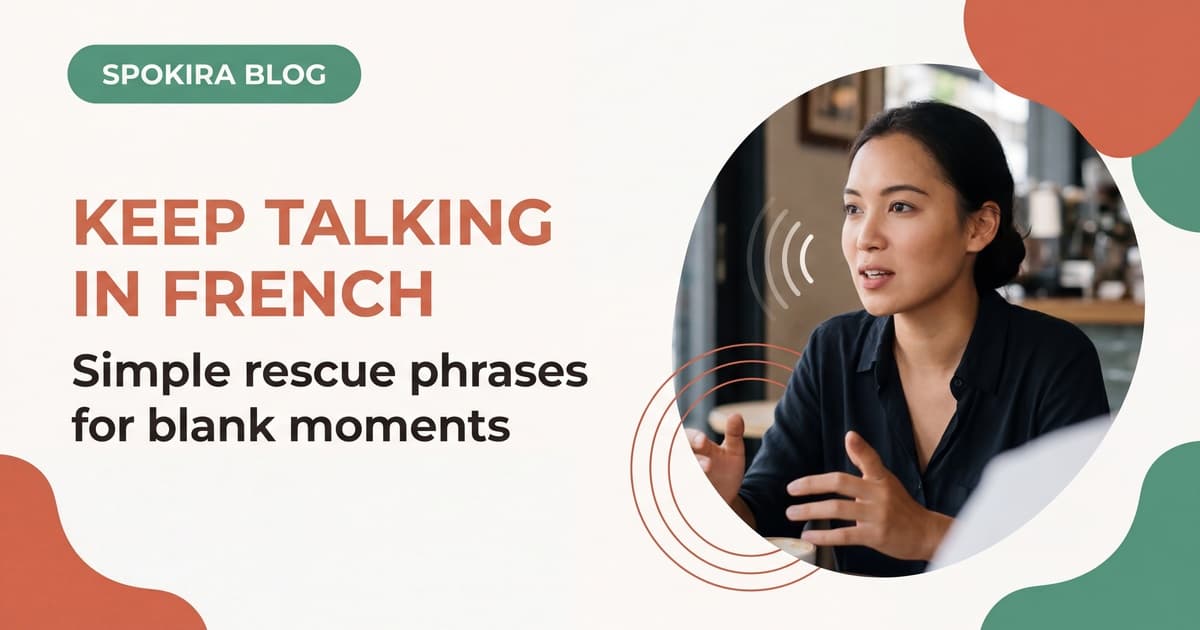
If your mind goes blank in the middle of a French conversation, that does not automatically mean your level is too low. More often, it means the interaction got faster than your current retrieval speed.
That is why the fix for keep a French conversation going is not "learn hundreds more words first." The better fix is learning how to stay in the exchange while your brain catches up.
This guide shows you what to do in that exact moment. You will get a simple rescue system, practical French phrases, and a 10-minute drill that makes blank moments feel less catastrophic.
Quick answer: how do you keep a French conversation going when your mind goes blank?
When your mind goes blank in French:
- signal that you are still engaged,
- buy one or two seconds with a simple chunk,
- switch from the missing word to easier meaning,
- ask a small follow-up or clarification question,
- keep speaking instead of apologizing and shutting down.
This matters because spoken interaction is not only about correct sentences. The Council of Europe's CEFR Companion Volume, updated in 2020, treats turn-taking, clarification, and repair as core parts of real interaction, especially for familiar situations at lower and middle levels (Council of Europe, 2020).
In practice, that means a "good" answer is not always a perfect answer. A good answer often just keeps the conversation alive.
Why your mind goes blank in French even when you know the words
Most learners think blank moments mean, "I don't know enough French." Sometimes that is true. Often it is not the full story.
Usually, three things are happening at once.
1. Recognition is ahead of production
You can recognize far more than you can produce on demand.
That is why you may understand a question like Tu fais quoi ce week-end ? but still stall when it is your turn to answer. Recognition gets help from context. Speaking does not.
If this is your bigger pattern, start with Understand French but can't speak?. That article explains the larger gap. This one focuses on what to do inside the blank moment itself.
2. You are trying to build the whole answer from scratch
When your brain searches word by word, conversation speed wins.
You are trying to:
- choose the idea,
- find the French words,
- build the sentence,
- pronounce it clearly,
- stay socially present.
That is too much to do in two seconds.
Research on formulaic sequences points in the opposite direction. A 2022 review in Frontiers in Psychology notes that ready-made multiword sequences can support oral fluency by increasing speed and reducing pausing when learners retrieve them holistically instead of word by word (Yu, 2022).
3. Pressure exposes weak retrieval
Blank moments often feel emotional, but the mechanism is usually practical: the phrase is not accessible fast enough yet.
That is where retrieval practice matters. Roediger and Butler's 2011 review explains that pulling information out is a strong memory enhancer and improves later access more than passive restudy alone (Roediger and Butler, 2011).
So the goal is not to become fearless first. The goal is to make key French lines easier to retrieve under light pressure.
The rescue system to keep a French conversation going
Think of this as your anti-freeze loop. You do not need every move every time. You just need one move fast enough to avoid silence collapse.
Move 1: show that you are still with the conversation
Your first job is social, not grammatical.
Give a signal that says, "I heard you. I am still here."
Useful lines:
- Attends une seconde...
- Alors...
- Voyons...
- Bonne question...
These are not magic filler words. They are conversation bridges. They stop the other person from assuming you are lost or finished.
If this exact first move is where you struggle, read How to Buy Time in French Without Sounding Stuck. It goes deeper on which short filler phrases help, which ones make you sound more frozen, and how to train them until they feel automatic.
If your bigger issue is not silence but sounding disengaged between turns, How to Show You're Listening in French gives you the short listener cues and follow-up questions that keep the interaction socially alive.
Move 2: switch to a chunk you already own
Do not chase the perfect sentence. Use the simplest frame you can already say smoothly.
Examples:
- Je pense que...
- En général...
- En fait...
- Le problème, c'est que...
- Je veux dire...
This matters because producing something partial is usually better than producing nothing. Output also helps you notice the exact gap. That is one reason Izumi and colleagues' 1999 work on the output hypothesis still matters: production can push learners to notice what they cannot yet say precisely (Izumi et al., 1999).
If you still translate every sentence before you speak, pair this article with How to stop translating in your head when speaking French.
Move 3: paraphrase the missing word instead of hunting for it
This is where most conversations are saved.
You do not need the exact word. You need enough meaning to keep moving.
Instead of freezing on one noun or verb, describe it with easier French:
- function: C'est un truc pour...
- category: C'est une sorte de...
- appearance: C'est quelque chose de petit / grand / rond...
- situation: Tu sais, quand...
Paraphrasing is not cheating. It is real communication.
If you want deeper practice on this skill, French conversation freeze retrieval drill is the best companion page.
Move 4: hand back a small question
When the pressure spikes, you do not have to carry the whole turn alone.
Ask a small related question:
- Et toi ?
- Tu vois ce que je veux dire ?
- Comment tu dirais ça ?
- Tu préfères quoi, toi ?
This does two things at once:
- it keeps the interaction alive,
- it gives you a few more seconds to reorganize your answer.
This move is especially useful in low-stakes conversations like cafe chat, introductions, or everyday small talk. For one concrete scenario, see French cafe conversation practice: a speaking script for automatic recall.
Move 5: repair and continue instead of restarting
Many learners make blank moments worse because they restart the whole sentence.
Try this instead:
- say a short version,
- correct one piece,
- keep going.
For example:
Je vais... enfin, non... je voudrais plutôt dire que je pars demain.
That is much better than stopping, apologizing, and beginning from zero.
Better Goal
Do not aim for elegant French during a blank moment. Aim for continuity. If the conversation stays alive, you already won that turn.
French phrases that keep the conversation moving
Use these as a small emergency set. Learn them as full chunks.
| Situation | French phrase | What it does |
|---|---|---|
| You need one second | Attends une seconde... | Buys a beat without sounding panicked |
| You are thinking | Bonne question... | Signals engagement |
| You want to soften a restart | Je veux dire... | Lets you repair naturally |
| You forgot the exact word | C'est une sorte de... | Opens a paraphrase |
| You need clarification | Tu peux répéter un peu plus lentement ? | Keeps the exchange active |
| You want help without quitting | Comment tu dirais ça ? | Requests support and keeps the topic alive |
| You want to pass the turn briefly | Et toi ? | Shares the load and buys time |
| You missed part of the sentence | Si j'ai bien compris... | Lets you confirm meaning before continuing |
Train these until they feel ordinary in your mouth, not special emergency language.
That is where Why shadowing works for French becomes useful. Shadowing helps these chunks sound smooth enough that you can actually use them under pressure.
How do you keep a French conversation going if you forget a word?
Use this simple sequence:
- say a holding phrase,
- switch to an easier chunk,
- describe the missing idea,
- ask one small question if needed,
- continue with a shorter answer than you planned.
For example, imagine you want to say "kettle" but the word disappears.
Do not stop and hunt for the exact noun. Say:
- C'est le truc pour faire chauffer l'eau.
- Tu sais, la chose dans la cuisine...
- Comment tu dirais ça ?
That is still real communication. In fact, this is one of the fastest ways to keep a French conversation going when vocabulary access lags behind your ideas.
The mistake is waiting for the perfect word before you speak again. The better move is to keep the exchange moving with simpler French.
Train your anti-freeze phrases out loud
Use guided shadowing and AI feedback to turn rescue lines into automatic spoken French.
A 10-minute practice loop to keep a French conversation going
You do not fix blank moments by reading about them once. You fix them by making a few rescue moves automatic.
Use this 10-minute session three or four times a week.
Minute 1-2: pick one conversation theme
Choose one familiar topic only:
- weekend plans,
- work or study,
- cafe ordering,
- travel,
- family or hobbies.
Do not mix five topics. Keep the reps narrow.
Minute 3-4: shadow four rescue chunks
Choose four phrases from the table above and repeat them with audio or your own model until they sound stable.
Good set:
- Bonne question...
- Je veux dire...
- C'est une sorte de...
- Tu peux répéter un peu plus lentement ?
What a good recovery sounds like in real French
Here is the mindset shift: a successful recovery is usually short, imperfect, and socially smooth.
Example:
Other person: Et toi, tu fais quoi comme sport en ce moment ?
You: Bonne question... en ce moment, pas beaucoup. Je fais surtout... enfin, comment dire... des exercices à la maison. Et toi ?
That answer is not fancy. It works because you:
- stayed engaged,
- used a holding phrase,
- repaired mid-answer,
- handed the turn back naturally.
That is the standard to train for. Not perfect French. Usable French that keeps the exchange moving.
Minute 5-7: run cue-based recall
Now hide the French and speak from function cues:
- thinking
- restart
- paraphrase
- clarify
- pass back question
This is the key shift. The cue should trigger French directly, not a full English sentence you then translate.
Minute 8-9: do one short roleplay with one forced blank
Pretend you forgot a word on purpose.
For example:
- answer a simple question,
- stop where the missing word would be,
- use a rescue move,
- continue the answer anyway.
That is how you train recovery, not just clean performance.
Minute 10: record one no-text take
End by recording one short answer. Listen back once. Do not grade everything.
Only ask:
- Did I stay in the conversation?
- Did I use one rescue move quickly?
- Did I continue after the gap?
For a calmer review method, use Record yourself in French without cringing.
If you want to keep a French conversation going more reliably, repeat the same loop for one topic three days in a row before changing the scenario.
Mistakes that make blank moments worse
Apologizing too much
One quick désolé is fine. Three apologies kill momentum.
After one apology, do the next thing. Clarify, paraphrase, or keep talking.
Chasing one exact word
This is the classic trap.
If the word does not come in two seconds, move sideways. Describe it. Simplify it. Ask a related question. Keep the turn alive.
Practicing only perfect answers
Real conversations include interruption, repair, hesitation, and quick decisions.
If your practice never includes those conditions, freezing will keep surprising you.
That is why the broader system in How to practice spoken French matters. You need output, retrieval, and scenario practice together.
What to focus on this week
If your main problem is that your mind goes blank, do not try to fix all of spoken French at once.
Focus on these three wins:
- learn four repair chunks as full phrases,
- practice one conversation theme for several days in a row,
- finish every practice rep by continuing after a small mistake.
That is enough to change how blank moments feel. They stop feeling like total failure and start feeling like a short recovery step.
The real shift is simple: train your rescue language before you need it. Then the next time your brain stalls, you will still have something to say.
If you want guided reps instead of improvising your own drills, try Spokira's speaking practice flow or start a free trial and train these recovery phrases out loud.