Many French learners think the problem is only what they say.
Often, the bigger problem is what happens while the other person is talking.
If your only response is silence, a flat oui, or a long pause before your next full sentence, your French can sound correct but oddly distant. You may understand everything and still sound like you are not really in the conversation.
That is why learning how to show you're listening in French matters so much. This post is the first entry in a new Spokira series, React Naturally in French, and the promise is simple: help you sound more present, more social, and less textbook with short, trainable spoken moves.
Quick answer: how do you show you're listening in French?
To show you're listening in French, use short listener cues, react quickly to the meaning, echo one useful detail, and add a small follow-up when the moment needs it.
That is not just "nice conversation style." It is part of spoken interaction itself. The Council of Europe’s CEFR Companion Volume treats co-operating and turn-taking as part of communicative ability, and a 2022 Frontiers paper describes backchannels as the brief feedback listeners give while another speaker still has the floor, signaling how the message is being received (Council of Europe, 2024 edition; Blomsma, Skantze, and Swerts, 2022).
So if you want to sound more natural in French, do not train only answers. Train your listening reactions too.
Why this matters more than most learners realize
Real conversation is not a sequence of perfectly separated speeches.
It is full of small signals:
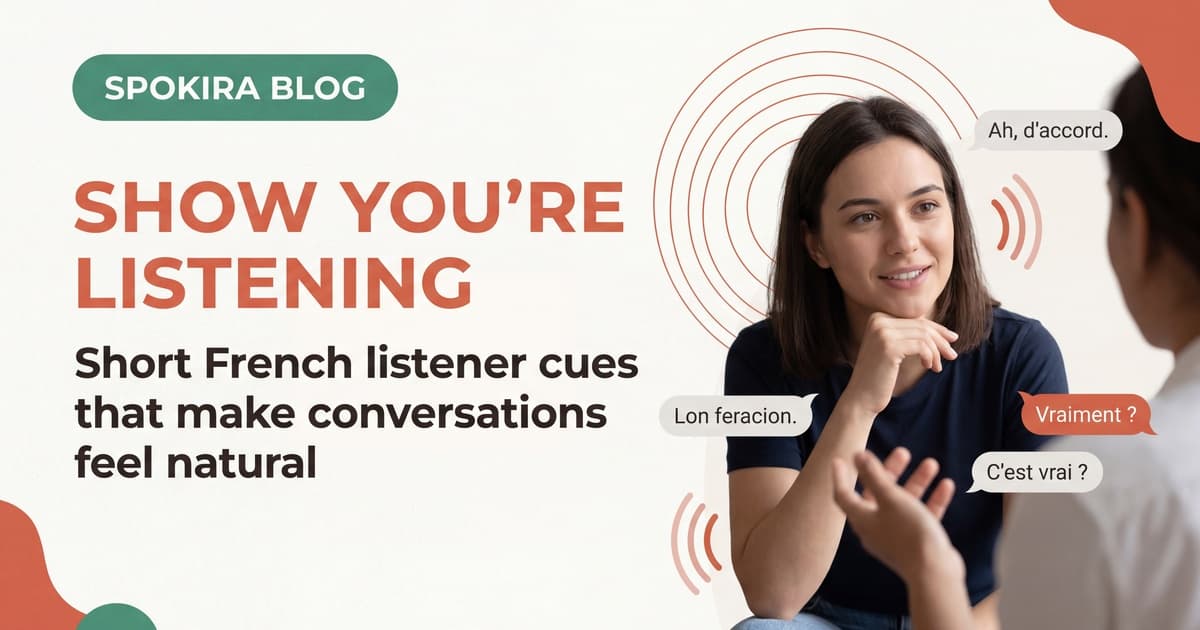
- ah oui ?
- je vois
- d'accord
- ah bon ?
- oui, exactement
These signals do at least three useful jobs:
- they show the other person you are still with them,
- they help the conversation keep its rhythm,
- they buy you a fraction of a second before your next longer sentence.
Second-language research frames this as part of communication strategies. In Cambridge’s 2016 research timeline, Kennedy and Trofimovich note that L2 speakers may repeat part of an interlocutor’s utterance to show they are listening and engaged, not only to repair a vocabulary gap (Cambridge, published online September 23, 2016).
There is also a fluency reason to practice listener cues as chunks. A 2022 Frontiers in Psychology paper argues that formulaic sequences can support oral fluency because speakers retrieve them as ready-made units instead of building every response word by word (Yu, published September 9, 2022).
Inference: if you have no automatic listener cues in French, your conversation timing will feel heavier than it needs to.
If you freeze more broadly, read How to Buy Time in French Without Sounding Stuck. If your issue is that the conversation dies after short replies, also pair this with How to Keep a French Conversation Going When Your Mind Goes Blank.
How to show you're listening in French with short listener cues
The fastest way to show you're listening in French is to stop aiming for a complete response every time.
Very often, a short cue is enough:
| Situation | Useful French cue | What it signals |
|---|---|---|
| You have just understood | je vois | I follow what you mean |
| You agree with the point | d'accord / exactement | I am with you |
| You are surprised | ah bon ? / ah oui ? | really? tell me more |
| A plan sounds fine | ça marche | that works |
| Something feels obvious or relatable | c'est clair | yes, clearly |
What matters is speed and timing. These phrases work best when they arrive quickly, not after a long silent build-up.
Examples:
- Je vais peut-être quitter Paris l'année prochaine.
Ah bon ? Pourquoi ? - Le plus dur, c'est de parler sans traduire.
Oui, exactement. - On peut se retrouver devant la gare à huit heures.
Ça marche.
If you tend to overthink here, your first goal is not variety. Your first goal is availability. Pick three or four cues you can say smoothly.
Step 2: Echo one useful detail so your reaction sounds connected
A lot of learners use listener cues, but they still sound generic because the cue is not attached to what the other person actually said.
That is where echoing helps.
You do not need to repeat the whole sentence. Just repeat one useful word or idea:
- Je commence un nouveau travail lundi.
Lundi ? Ah oui, ça arrive vite. - J'ai enfin trouvé un appartement.
Un appartement ? Ah, super. - Je vais passer trois semaines à Montréal.
Trois semaines ? Pas mal.
This is one of the cleanest ways to sound engaged without speaking a lot. It shows the other person that you heard the detail and are reacting to it, not to a vague theme.
It is also beginner-safe. You do not need advanced grammar to do it well.
If you want a simple pattern, use:
- echoed word or detail,
- short cue,
- one extra line if needed.
That is enough.
Step 3: Add a tiny follow-up question
Sometimes a cue alone is fine. Sometimes it sounds incomplete.
The easiest fix is a tiny follow-up:
- Ah bon ? Pourquoi ?
- Je vois. Et après ?
- D'accord. Depuis quand ?
- Ah oui ? Comment ça ?
These are not heavy conversation questions. They are light continuation moves.
That distinction matters. Many learners think they need interesting, original questions to sound engaged. Usually they just need to keep the door open.
Here are three easy models:
Surprise + follow-up
- Ah bon ? Pourquoi ?
- Ah oui ? Sérieux ?
Understanding + continuation
- Je vois. Et du coup ?
- D'accord. Et après ?
Agreement + extension
- Exactement. C'est ça.
- C'est clair. Surtout à l'oral.
If you already know 7 French Filler Phrases That Help You Keep Talking, combine the two systems. Filler phrases help you hold your turn. Listener cues help you stay socially present while the other person has theirs.
Step 4: Match your tone to the moment
This part is easy to miss because the phrases themselves are short.
But with short phrases, tone carries a lot of meaning.
Compare:
- ah bon ? said with real surprise,
- ah bon ? said flatly,
- ah bon ? said too theatrically.
Same words. Three different effects.
To show you're listening in French, you do not need dramatic acting. You need believable tone:
- warm for agreement,
- light surprise for new information,
- calm for understanding,
- relaxed for practical yes.
This is one reason shadowing matters. Naturalness is not just lexical. It is rhythm, timing, and mouth feel. That is why Sound More Natural Fast: French Rhythm and Intonation Practice connects directly to this topic.
Do Less, Faster
One fast, believable cue is better than a perfect sentence that arrives too late.
How to show you're listening in French in real mini-scenarios
Do not practice them as isolated vocabulary only.
Practice them inside situations where you would actually need them.
Scenario 1: café chat
Friend: Le serveur ici est toujours sympa.
You: Oui, c'est clair.
Friend: Ils ont changé la carte cette semaine.
You: Ah bon ? Je n'avais pas vu.
Scenario 2: making plans
Friend: On peut y aller samedi matin.
You: Ça marche.
Friend: Mais il faut réserver aujourd'hui.
You: Ah oui ? D'accord, je le fais.
Scenario 3: personal update
Friend: Je commence des cours du soir le mois prochain.
You: Ah bon ? Dans quel domaine ?
Friend: Je veux surtout améliorer mon anglais.
You: Je vois. C'est une bonne idée.
If you want a fuller scripted setting, plug these cues into French cafe conversation practice: a speaking script for automatic recall. That gives you a clean place to practice them with realistic timing.
Practice Listening Reactions Until They Feel Automatic
Spokira helps you shadow short spoken French chunks, repeat them in context, and build reactions that arrive on time in real conversations.
What should you say instead of only oui?
If you are trying to show you're listening in French, plain oui is not useless. It is just low-information.
Use this simple upgrade ladder:
| If you usually say... | Try this instead | Why it works |
|---|---|---|
oui | je vois | shows understanding, not only agreement |
oui | ah bon ? | signals surprise and invites more detail |
oui | exactement | shows strong agreement |
oui | ça marche | fits plans and practical decisions |
oui | c'est clair | sounds more conversational and engaged |
Here is what that looks like in practice:
- Flat version: Oui.
Better version: Je vois. - Flat version: Oui.
Better version: Ah bon ? Et après ? - Flat version: Oui, oui.
Better version: Exactement. C'est ça.
This is a small change, but it makes a big difference. The other person gets a clearer sense of how you received their message, and your French starts sounding more socially responsive.
What if you understand, but you still react too late?
That usually means the issue is retrieval speed, not understanding.
You heard the sentence. You even know what you want to communicate. But instead of using a short listener cue, you start building a neat response from scratch. By the time it arrives, the moment has already gone flat.
Use this repair sequence:
- short cue first,
- one-second pause,
- fuller sentence second.
Examples:
- Ah bon ? ... Je ne savais pas.
- Je vois ... c'est pour ça que tu hésites.
- D'accord ... on peut faire ça.
This matters especially for shy learners. You do not need to become highly expressive overnight. You just need one small spoken move that tells the other person, "I'm still here, I got that, keep going."
If your late reactions come from fear of sounding awkward, combine this article with Record Yourself in French Without Cringing. Recording makes the timing problem obvious in a useful way: you can hear exactly where a short cue would have made the exchange feel more natural.
The three habits that make you sound less engaged
If you want to show you're listening in French, avoid these traps.
1. Waiting too long before reacting
If you understand the message but react only after a long silence, the conversation starts to feel heavy.
Often this is not a comprehension problem. It is a retrieval problem. You are still trying to build a polished response instead of using a small cue first.
2. Saying only oui for everything
Oui is not wrong. It is just thin.
Try replacing some plain oui responses with:
- je vois
- exactement
- c'est clair
- ça marche
- ah bon ?
Each one gives the listener slightly more information about how you received what they said.
3. Asking big questions too early
Some learners jump straight from silence to an oversized question because they feel pressure to "keep the conversation going."
Usually that is too much.
A tiny continuation move is enough:
- Pourquoi ?
- Et après ?
- Comment ça ?
- Depuis quand ?
Small moves are easier to use on time. That is why they work.
A 10-minute drill to sound more engaged in French
Here is a short practice routine that actually transfers into conversation.
Minute 1-2: choose four listener cues
Start with:
- je vois
- ah bon ?
- exactement
- ça marche
Minute 3-4: shadow each one with different tones
Say each cue five times:
- neutral,
- warm,
- lightly surprised,
- calm,
- more emphatic.
This helps you stop saying everything in the same flat learner rhythm.
Minute 5-7: add one continuation line
Practice pairs like:
- Ah bon ? Pourquoi ?
- Je vois. Et après ?
- Exactement. C'est ça.
- Ça marche. On fait comme ça.
The goal is not to memorize abstractly. The goal is to make the cue lead somewhere.
Minute 8-9: run thirty-second dialogues
Make three tiny dialogues about:
- plans,
- work or study,
- a personal update.
Use at least one listener cue in each.
Minute 10: record and check timing
Record one minute of mini-dialogues, then listen back.
Ask:
- did the cue arrive fast enough?
- did it match the meaning?
- did it sound calm and believable?
If recording still makes you tense, use Record Yourself in French Without Cringing as the support method beside this drill.
Final takeaway
If your French feels a little cold or flat, the fix is not always more vocabulary or longer sentences.
Sometimes the fix is learning how to show you're listening in French with short, well-timed cues that make the other person feel heard.
Start small. Use je vois, ah bon ?, exactement, and ça marche. Echo one useful detail. Add a tiny follow-up. Practice the rhythm until it feels automatic.
That is how your French starts sounding less like a classroom answer and more like a real conversation.