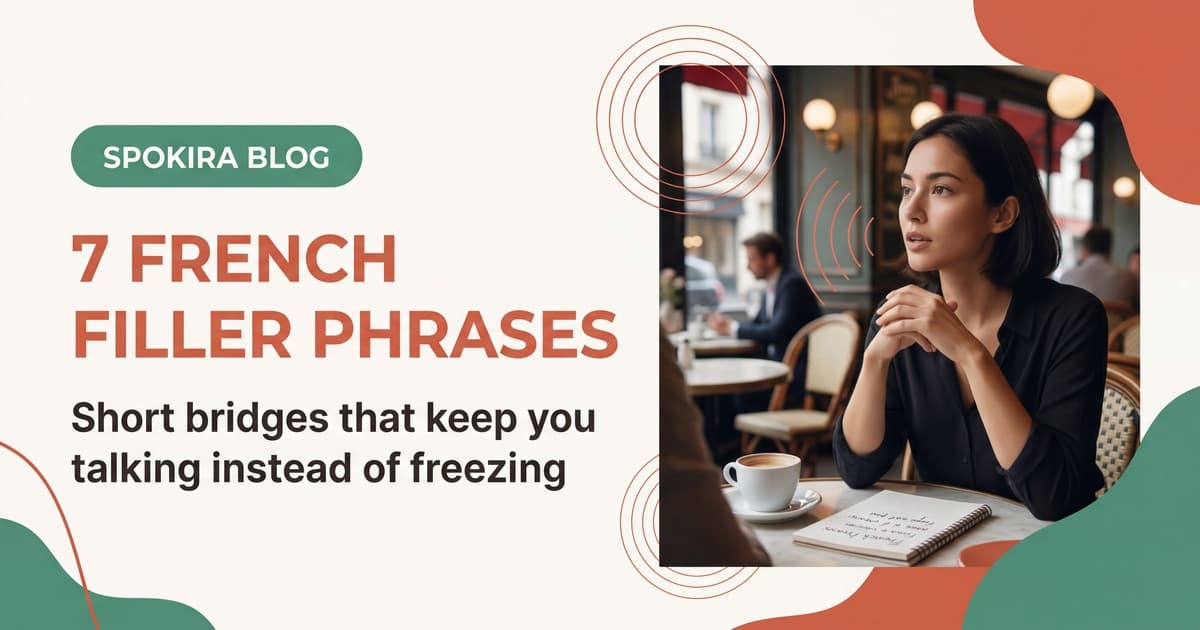
If you freeze in French, you usually do not need a perfect sentence. You need one second, one calm bridge, and one sentence frame you can actually say.
That is where French filler phrases help. Used well, they give you just enough space to stay in the conversation without dropping into silence or apologizing for every pause.
This article is deliberately narrow. It is not a giant list of slangy French hesitation words. It is a practical set of seven filler phrases that help you keep talking at A2-B1, with clear examples, register notes, and a short drill to make them usable under pressure.
Quick answer: which French filler phrases actually help?
The most useful French filler phrases for learners are short, flexible, and easy to continue from. A small set like alors, bon, en fait, je veux dire, enfin, eh bien, and voyons is usually enough.
What matters is not collecting dozens of fillers. It is learning a few phrases you can say smoothly, then moving into a real sentence right away.
That fits the CEFR Companion Volume’s 2020 strategy descriptors. In its compensating scale, the Council of Europe treats keeping communication going, qualifying meaning, and paraphrasing around missing language as part of real speaking ability, not as failure (Council of Europe, 2020).
So the goal with French filler phrases is simple: use a short phrase, keep your turn, then continue.
Why filler phrases help when your French stalls
Many learners think French filler phrases are bad habits. The better distinction is this:
- a useful filler phrase buys one beat and leads somewhere,
- a useless filler habit stretches the pause without helping you continue.
That matters because speech is rarely perfectly smooth, even in a first language. A 2018 open-access paper in Applied Psycholinguistics notes that everyday speech is full of disfluencies, including short pauses, repairs, and filler words, especially when speakers are still figuring out how to formulate an utterance (Fleker, Klockmann, and De Jong, published online November 6, 2018).
There is also a listening reason to care. In a Cambridge study from 1995, learners understood a lecture better when discourse markers such as so, right, well, and OK were present than when they were removed (Flowerdew and Tauroza, Studies in Second Language Acquisition). That does not mean every filler is automatically good. It does mean small markers can help conversation feel more navigable.
For speaking, the same principle applies. A 2022 Frontiers in Psychology review argues that formulaic sequences can support oral fluency because speakers retrieve them as chunks instead of building every line word by word (Yu, published September 9, 2022). Inference: for A2-B1 French learners, a few memorized bridge phrases are often more useful than trying to improvise from zero.
If you want the broader anti-freeze system, read How to Buy Time in French Without Sounding Stuck. This article is the smaller phrase kit inside that system.
The 7 French filler phrases worth learning first
Here is the short version before we go phrase by phrase:
| Phrase | Best use | Register feel | Main risk |
|---|---|---|---|
| Alors... | opening your answer | neutral, flexible | overusing it before every sentence |
| Bon... | resetting or transitioning | casual but common | sounding abrupt if your tone is sharp |
| En fait... | reframing or correcting | very common | using it so often that it loses meaning |
| Je veux dire... | repairing what you just said | neutral spoken French | repeating it too many times in one turn |
| Enfin... | softening a correction or nuance | common, slightly careful | confusing it with a dramatic "finally" tone |
| Eh bien... | thoughtful pause before an answer | slightly more deliberate | sounding too formal if forced |
| Voyons... | visible thinking moment | deliberate, occasional | sounding theatrical if overdone |
1. Alors...
If you learn only one French filler phrase, start with alors.
It works because it does not trap you. It opens space, but it also points forward. In real speech, that makes it easier to move into a sentence like:
- Alors, je pense que oui.
- Alors, ce week-end, je vais voir des amis.
- Alors, en général, je prends le train.
For A2-B1 learners, alors is safer than a long euhhhh. It sounds like the conversation is still moving.
Use it when:
- you need one second to start,
- you are answering a question,
- you want to reconnect after a pause.
Do not use it before every sentence in the same conversation. Once or twice is natural. Eight times sounds like a verbal tic.
2. Bon...
Bon is useful when you need to reset calmly and continue.
It often works after a small false start, when you want to simplify what you were trying to say:
- Bon, je vais expliquer autrement.
- Bon, pour moi, le plus difficile, c'est la prononciation.
- Bon, on peut dire que c'est un peu compliqué.
This one is practical because it helps you stop chasing the perfect version. You signal a reset, then move on.
That makes bon a good partner for How to Keep a French Conversation Going When Your Mind Goes Blank. When the blank moment hits, you do not need elegance. You need a clean restart.
The caution is tone. If you say bon too sharply, it can sound impatient. Keep it light.
3. En fait...
En fait is one of the best filler phrases for correcting or refining what you just said.
It is useful when your first answer was too simple, slightly wrong, or incomplete:
- En fait, pas exactement.
- En fait, je voulais dire samedi, pas dimanche.
- En fait, je comprends, mais je ne parle pas encore facilement.
This phrase helps because it gives your correction a natural entry point. You are not stopping the conversation. You are adjusting it.
That is also why it belongs in an anti-freeze toolkit. If you are still translating in your head, you often say version one and then need version two. How to Stop Translating in Your Head When Speaking French covers the bigger habit. En fait helps you survive the moment while that habit improves.
The main risk is using en fait as an automatic throat-clearing sound. Keep it attached to a real correction or reframing move.
4. Je veux dire...
This is the phrase to use when you are already mid-sentence and need to repair the line without giving up.
Examples:
- C'est difficile, je veux dire, c'est surtout fatigant mentalement.
- Je prends le bus, je veux dire, le tram, quand je vais au centre-ville.
- Il est sympa, je veux dire, très patient.
Je veux dire is especially useful for learners because it buys time and explains why you are restarting. You are telling the listener, "I am still talking; I am just adjusting."
If your bigger issue is missing vocabulary, link this phrase with How to Paraphrase in French When You Forget a Word. The pattern is:
- Je veux dire...
- easier description,
- clearer sentence.
That sequence is often enough to save the turn.
5. Enfin...
Enfin is powerful, but learners need a narrower use for it.
Do not treat it as a universal filler. Treat it as a soft correction or nuance marker:
- Enfin, pas toujours.
- Enfin, ça dépend de la situation.
- Enfin, je ne suis pas encore très à l'aise à l'oral.
Used this way, enfin sounds thoughtful rather than random. It is a useful bridge when you want to soften what came just before.
It also helps you sound less rigid, because conversation is full of partial corrections and small adjustments. You are often not replacing one sentence with a totally different one. You are shading it.
The caution: some learners hear enfin and start dropping it everywhere. If you are not correcting, qualifying, or softening, choose something simpler.
6. Eh bien...
Eh bien works when you want to sound measured and slightly more deliberate.
Examples:
- Eh bien, je dirais que ça dépend.
- Eh bien, au début, c'était très difficile.
- Eh bien, pour être honnête, je comprends plus que je ne parle.
This phrase is helpful in interviews, class discussions, and longer answers because it signals, "I am thinking about this."
For many learners, eh bien is easier to use in practice drills than in fast casual conversation. That is fine. You do not need every phrase to fit every setting.
If you record yourself answering slow prompts, this is a good one to test. Pair it with Record Yourself in French Without Cringing, because filler phrases are much easier to judge when you can hear whether they sound calm or forced.
7. Voyons...
Voyons is the most limited phrase in this list, but it can still be useful.
Use it for a brief, visible thinking moment:
- Voyons... je crois que c'était en mai.
- Voyons... comment expliquer ça simplement ?
- Voyons... le mot exact, je ne l'ai pas, mais c'est comme...
This phrase has more personality than alors or bon, so use it sparingly. In a light, natural tone, it can sound thoughtful. In an exaggerated tone, it can sound theatrical.
That is why it ranks seventh. It is not the most universal filler phrase. It is just a good extra option once the first six feel comfortable.
Use Them as Bridges
The phrase is not the goal. The goal is what comes right after it. If the filler phrase does not lead into a real sentence, it is not helping enough.
Which filler phrases should beginners avoid overusing?
Two habits usually cause more trouble than the lack of filler phrases itself.
Long strings of euh
One quick euh is normal. A long string of euh... euh... euh... keeps you suspended in hesitation instead of moving you forward.
Replace that with a bridge phrase plus a sentence frame:
- Alors, je pense que...
- Bon, pour moi...
- En fait, le problème, c'est que...
Over-colloquial fillers you cannot control yet
Learners often hear native speakers use fillers like ben, du coup, or highly compressed casual speech and try to copy everything at once.
That is usually a mistake. The phrase is not "advanced" just because it sounds native. It is useful only if:
- you know when people actually use it,
- you can pronounce it smoothly,
- you can continue naturally after it.
For most A2-B1 learners, these French filler phrases are a better foundation. They are flexible, easier to control, and less likely to make you sound like you are acting out internet French.
How do you practice filler phrases so they come out under pressure?
Memorizing the list is not enough. You need retrieval.
Use this 10-minute drill:
- Pick three phrases from this article.
- Write one answer pattern for each:
- Alors, je pense que...
- En fait, je voulais dire...
- Bon, pour moi...
- Shadow each line 10 times.
- Hide the script and answer five simple questions out loud.
- Record yourself and listen for one thing: did the filler phrase help you continue, or did it just delay the silence?
If you need practice material, use short everyday prompts from French Cafe Conversation Practice: A Speaking Script for Automatic Recall, then bring the same three filler phrases into each answer.
The point is not sounding fancy. The point is making your first two seconds easier.
Train Your Mouth, Not Your Streak
Practice short French speaking reps with shadowing, feedback, and realistic prompts that help your next sentence come out faster.
A simple rule for sounding natural with French filler phrases
If you want one rule to remember, use this:
short phrase, calm tone, immediate continuation.
That is what makes filler phrases sound useful instead of awkward.
Good:
- Alors, je pense que oui.
- En fait, ça dépend.
- Bon, je vais expliquer autrement.
Less good:
- Euhhhhh...
- Alors... alors... alors...
- filler phrase with no sentence after it
This is also where shadowing helps. If you train short spoken chunks with rhythm, your bridge phrases stop feeling bolted on. Why Shadowing Works for French explains why chunk-based repetition is one of the fastest ways to make spoken French easier to retrieve.
Final takeaway
You do not need twenty French filler words to keep talking. You need a few reliable bridge phrases that feel easy in your mouth and lead into real sentences.
Start with alors, bon, and en fait. Add je veux dire when you need repair. Then bring in enfin, eh bien, and voyons only if they fit your speaking style.
If you freeze often, do not treat filler phrases as a magic trick. Treat them as conversation glue. They buy a beat, reduce panic, and give your next sentence somewhere to start.
Then practice them until they feel automatic.
If you want that practice to happen in short daily reps with speaking feedback, Spokira’s French speaking practice app is built for exactly that kind of retrieval work.