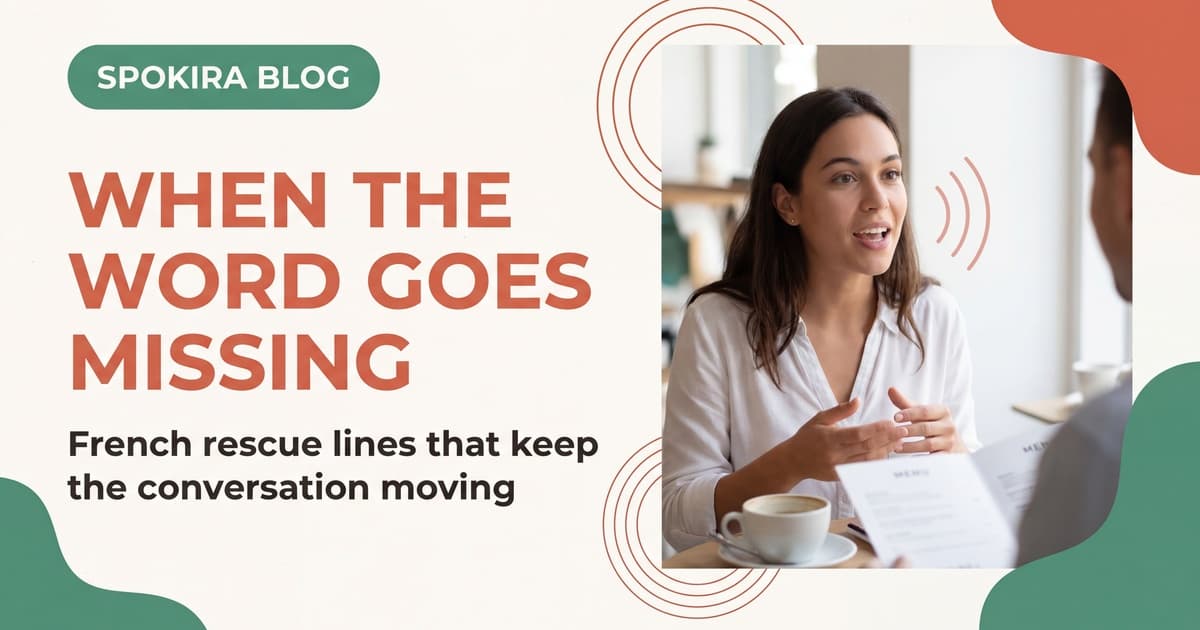
If you stop every time one French word goes missing, the real problem is not vocabulary. The real problem is that the whole conversation stalls while you search.
That is why what to say in French when you don't know the exact word matters so much for A2-B1 learners. You do not need a perfect sentence in that moment. You need a short rescue line that keeps your turn alive long enough to explain the idea another way.
This guide gives you those rescue lines. You will learn what to say first, how to keep speaking without sounding stuck, and how to train this skill until it feels automatic instead of panicky.
Quick answer: what should you say when the exact word is missing?
When the exact French word disappears:
- use a short phrase to hold your turn,
- say the category or situation,
- add one clue about what it does, looks like, or where it is,
- ask for confirmation if you need the exact word.
This is not a "fake" way to speak. The Council of Europe's CEFR descriptors treat compensating for missing language as part of real speaking ability. In the CEFR search tool, B1 speakers can define the features of something concrete when the exact word is missing, and B2 speakers can use circumlocution to cover gaps in vocabulary (Council of Europe).
So your target is not "never forget a word." Your target is "stay understandable when you do."
Why this works better than going silent
Many learners think they should pause until the right word appears. In real conversation, that usually makes you feel more blocked, not less.
Second-language research treats this kind of rescue move as a communication strategy. In their 2016 research timeline, Sara Kennedy and Pavel Trofimovich describe how speakers use the language they already have to get the message across, even when a precise word is unavailable (Cambridge, 2016).
That matters for spoken French because speed increases pressure. If you pause every time the exact noun is missing, you train a stop-start habit. If you keep describing, comparing, and confirming, you train recovery.
There is also a practice effect here. A study in Studies in Second Language Acquisition found that repeating oral tasks improved fluency-related measures such as breakdown and repair patterns, which supports short repeated drills around rescue language rather than one-off study sessions (Lambert, Kormos, and Minn, 2017).
Better goal
Do not ask, "How do I avoid ever forgetting a word?" Ask, "How do I keep speaking when one word is missing?"
What to say in French when you don't know the exact word at the start of a sentence
Your first sentence should do one job: keep the conversation moving.
These lines are useful because they sound normal, short, and recoverable:
| French phrase | What it does | Best use |
|---|---|---|
| Comment dire...? | Buys a second | Neutral, common |
| Je cherche le mot. | Signals a quick search | When you want to stay honest and natural |
| Je veux dire... | Lets you restart smoothly | Mid-sentence correction |
| C'est un truc... | Opens a paraphrase fast | Casual spoken French |
| Ce n'est pas exactement le mot, mais... | Gives you permission to approximate | When you are close, not exact |
| Tu vois ce que je veux dire ? | Checks understanding | After a description |
You do not need to memorize all of them. Pick three and overlearn them.
If your problem starts even earlier, where you mentally translate and then freeze, read How to Stop Translating in Your Head When Speaking French. Missing-word panic often arrives right after translation overload.
The 4-part rescue pattern that keeps you speaking
When you do not know the exact word, use this order.
1. Hold the turn
Start with a tiny buffer:
- Comment dire...?
- Je cherche le mot.
- Attends...
- Je veux dire...
The point is not elegance. The point is to avoid dead silence.
2. Give a category
Now say what kind of thing it is:
- C'est un truc pour...
- C'est une chose que tu utilises pour...
- C'est une sorte de...
- C'est un endroit où...
- C'est quelqu'un qui...
This works because categories are easier to retrieve than exact labels.
3. Add one strong clue
Use one of these clue types:
- function: ça sert à...
- location: on le trouve...
- appearance: c'est petit / long / rond...
- situation: tu l'utilises quand...
- comparison: c'est comme..., mais...
One clue is usually enough. Two clues are excellent. Five clues is too much.
4. Ask for confirmation
Finish cleanly:
- Comment ça s'appelle déjà ?
- On dit comment ?
- Le mot, c'est... ?
- Tu vois ?
That turns the exchange into collaboration instead of apology.
What to say in real situations
The best rescue phrases are not abstract. They are attached to situations you actually face.
At a cafe
You forget touillette or another small object on the counter.
You can say:
- Je cherche le mot... le petit truc pour mélanger le café.
- C'est un petit objet en bois ou en plastique, pour le café.
- Comment ça s'appelle ?
You do not need the exact noun to stay in the interaction. This pairs well with French Cafe Conversation Practice: A Speaking Script for Automatic Recall, where the goal is to keep functional speech moving in a real scenario.
In an apartment or daily-life conversation
You forget étagère.
Try:
- C'est un truc dans le salon.
- On met des livres dessus.
- C'est contre le mur.
- Le mot, c'est quoi déjà ?
That is much better than stopping after dans le salon il y a un... un...
During travel
You forget pharmacie or another place word.
You can say:
- Je cherche un endroit où on achète des médicaments.
- Ce n'est pas l'hôpital.
- Tu vois ?
Even if your sentence is simple, it works because it is precise enough.
In social conversation
You forget a word for a hobby item, a tool, or a job detail.
Use:
- C'est une sorte de machine pour...
- Tu l'utilises quand tu...
- C'est un peu comme..., mais en plus petit.
If you often lose momentum after the missing-word moment, How to Keep a French Conversation Going When Your Mind Goes Blank covers the next step: how to keep the turn alive after the first recovery line.
What to say in French when you don't know the exact word but want to sound natural
This is the part many learners miss. The goal is not only to survive. The goal is to survive without sounding like you have completely left the conversation.
That means choosing short, everyday lines instead of dramatic panic lines.
Use these habits:
- keep your rescue phrase brief,
- move to the clue quickly,
- avoid long apologies,
- end by checking understanding.
Here is the contrast.
Natural enough:
- Comment dire...? C'est un truc pour couper le papier.
- Je cherche le mot. Tu l'utilises dans la cuisine.
- Ce n'est pas exactement le mot, mais c'est comme un petit sac.
Less natural:
- Ah non, j'ai oublié, c'est horrible, mon français est nul...
- Je ne connais pas ce mot, je ne peux pas expliquer...
The first group keeps the focus on meaning. The second group puts the focus on your frustration. If your main goal is to sound less stiff overall, this article should eventually connect with the naturalness cluster, but right now it serves the immediate anti-freeze job: stay in the exchange.
French rescue phrases by job
Instead of learning giant lists, learn phrase families.
To buy one second
- Comment dire...?
- Je cherche le mot.
- Attends, je reformule.
- Je veux dire...
To define the thing
- C'est un truc pour...
- C'est quelque chose que tu utilises pour...
- C'est une sorte de...
- C'est un objet qui sert à...
To describe the situation
- Tu l'utilises quand...
- On le trouve souvent...
- C'est dans la cuisine / la rue / le bureau...
- C'est pour les gens qui...
To compare
- C'est comme..., mais...
- Ça ressemble à...
- C'est un peu la même idée que...
To check and recover
- Comment ça s'appelle déjà ?
- On dit comment ?
- Tu vois ce que je veux dire ?
- C'est bien ça ?
Practice rescue phrases out loud, not just in your head
Spokira helps you shadow real spoken French, record yourself, and get feedback so these recovery phrases come out faster under pressure.
Common mistakes when you do not know the exact word
Mistake 1: apologizing too much
Many learners say désolé, laugh nervously, and give up. One short apology is fine. Three apologies kill the rhythm.
Replace that with a move:
- not ideal: Désolé, désolé, je ne sais pas, c'est difficile...
- better: Je cherche le mot... c'est un truc pour ouvrir la bouteille.
Mistake 2: making the definition too long
When your explanation becomes a full paragraph, you create a second problem. Keep it short: category plus one clue.
Mistake 3: switching to English too fast
Sometimes English is practical. But if you switch immediately every time, you never train the French recovery pathway. Stay in French for five more seconds first.
Mistake 4: waiting for perfect grammar
In rescue moments, clarity beats polish. A simple sentence that lands is more useful than a perfect sentence you cannot finish.
Mistake 5: practicing rescue phrases only silently
This content is motor practice, not trivia. You are training your mouth to restart under pressure. Silent review helps recognition, but spoken repetition is what makes the line show up fast enough in conversation.
A 10-minute drill to train this until it feels automatic
This skill gets easier when you repeat it, not when you merely understand the idea.
Minute 1-2: choose 8 everyday nouns
Pick words from daily life:
- umbrella
- charger
- shelf
- receipt
- kettle
- pharmacy
- screwdriver
- napkin
Do not start with obscure vocabulary. Start with useful objects and places.
Minute 3-4: forbid yourself to say the exact word
For each item, explain it in French without naming it.
Example:
- C'est un objet qu'on utilise quand il pleut.
- Tu le prends dehors.
- Ça te protège de l'eau.
Minute 5-6: add one rescue opener every time
Now restart each answer with:
- Comment dire...?
- Je cherche le mot...
- Ce n'est pas exactement le mot, mais...
This makes the recovery line automatic, not theoretical.
Minute 7-8: record yourself
Use your phone. Keep the pace steady. If you hate hearing yourself, Record Yourself in French Without Cringing will help you review more usefully.
Minute 9-10: repeat the same items with one new clue
Do the same eight items again, but change one detail:
- add location instead of function,
- add comparison instead of location,
- ask for confirmation at the end.
That repetition matters. Repeated oral tasks improve how quickly your speaking system handles familiar communicative pressure, which is exactly what you want from rescue-language practice (Lambert, Kormos, and Minn, 2017).
A fast weekly plan if you keep forgetting what to say in French when you don't know the exact word
If you want this skill to become reliable, keep the practice tiny and frequent.
Day 1: learn three openers
Choose three lines only:
- Comment dire...?
- Je cherche le mot.
- Ce n'est pas exactement le mot, mais...
Day 2: define household objects
Pick ten objects around you and explain each one without naming it.
Day 3: define places in your town
Describe a pharmacy, bakery, station, and bank without using the exact noun.
Day 4: use the skill inside one short scenario
Take a cafe script or travel mini-dialogue and force yourself to recover twice on purpose.
Day 5: record and review
Listen for one thing only: did you restart quickly, or did you freeze before the rescue line?
This kind of short daily repetition fits the broader routine in How to Practice Spoken French: A Complete A2-B1 System. Keep it small. Keep it spoken. Keep it repeatable.
How this article fits your broader speaking practice
This is not a standalone trick. It works best as part of a larger spoken-French system.
Here is the simple stack:
- learn a few rescue lines,
- drill paraphrase with common everyday nouns,
- use it inside scenario practice,
- record and notice where you still freeze,
- repeat until the recovery feels boring.
That process connects directly with How to Paraphrase in French When You Forget a Word, which goes deeper into circumlocution patterns, and with How to Practice Spoken French: A Complete A2-B1 System, which shows where rescue drills sit inside a full speaking routine.
If you want guided practice, the fastest way is to use these phrases inside short repeated spoken reps, not isolated flashcards. That is also why a focused speaking tool like Spokira's French speaking practice app fits this problem well: you need repetition, pronunciation feedback, and enough structure to keep the drill going.
Conclusion: you do not need the perfect word to keep talking
When you do not know the exact French word, your job is simple. Hold the turn. Name the category. Add one clue. Ask for confirmation if needed.
That is real speaking, not failure. The CEFR descriptors explicitly treat this kind of compensation as part of communicative ability, and language-learning research treats it as a normal strategy, not a weakness (Council of Europe; Cambridge, 2016).
Train a small rescue bank until it comes out automatically. Five to ten minutes a day is enough if you do it out loud. The goal is not to sound perfect. The goal is to keep the conversation alive long enough for French to keep moving.