Forgetting one word in French does not have to kill the whole conversation. What usually breaks the flow is not the missing word itself. It is the silent panic that comes right after it.
That is why how to paraphrase in French when you forget a word is such an important speaking skill. If you can describe the thing, compare it, or explain what it does, you stay in the conversation long enough for French to keep moving.
This guide gives you a practical system for that moment. You will learn what to say first, how to build a simple paraphrase, which sentence frames work best at A2-B1, and how to train this until it feels automatic.
Quick answer: what do you say in French when you forget a word?
When you forget a word in French:
- buy yourself one second with a short rescue phrase,
- say what kind of thing it is,
- explain what it does or what it looks like,
- compare it to something similar,
- ask for confirmation if needed.
That is not cheating. It is a real communication strategy. The Council of Europe’s CEFR descriptors explicitly treat compensation as part of speaking ability: at B1, learners can define concrete things when the exact word is missing, and at B2 they can use circumlocution and paraphrase to cover gaps in vocabulary and structure (Council of Europe).
So the goal is not "always remember the perfect noun." The goal is "keep communicating well enough that the conversation survives."
Why paraphrasing is a speaking skill, not a failure
Many learners think paraphrasing means they are not good enough yet. That is the wrong frame.
In second-language research, this is usually discussed as a communication strategy: you use the language resources you do have so you can still get your meaning across. Sara Kennedy and Pavel Trofimovich’s 2016 research timeline gives a simple example of an L2 speaker saying "falling ice" when the word "hail" is missing. The point is not elegance. The point is successful communication (Cambridge).
That older idea also shows up in Cambridge’s overview of good language learners: effective learners use strategies such as circumlocution, paraphrase, and gestures to keep communication going (Cambridge).
For spoken French, that matters because real conversations do not pause while you search your memory. If you freeze every time a noun disappears, you train stopping. If you paraphrase, you train recovery.
Better Goal
Do not aim to know every word. Aim to stay understandable when one word is missing.
How to paraphrase in French when you forget a word: the 5-step method
Here is the method to use in real time.
1. Buy one second without giving up your turn
Your first job is not to find the perfect word. It is to keep the turn.
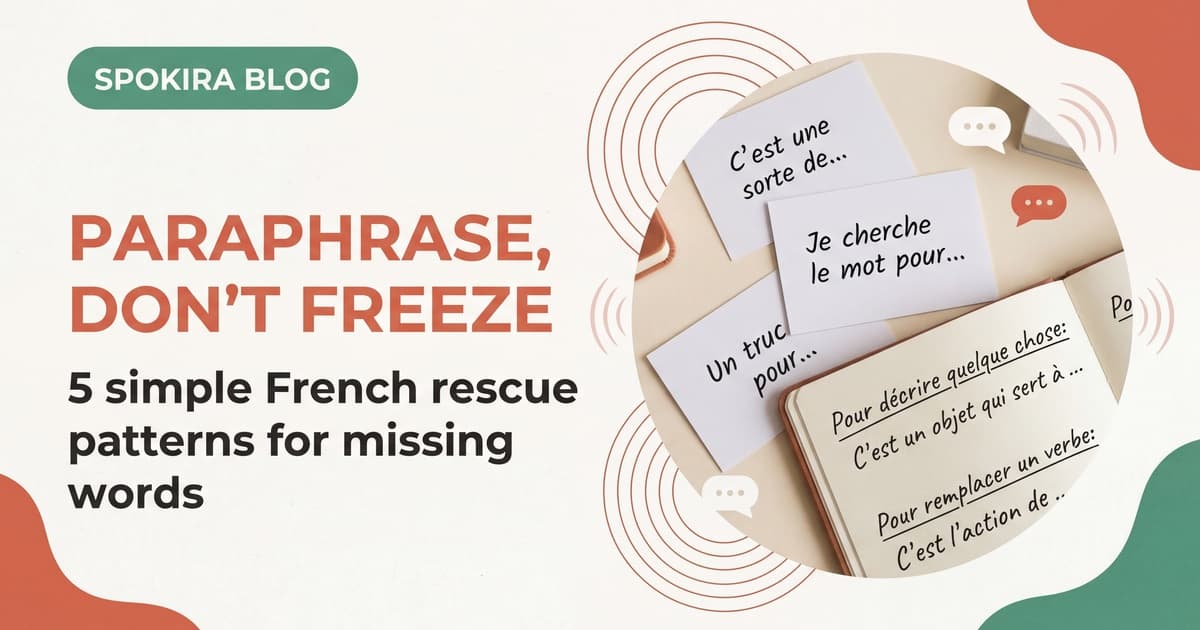
Use short phrases like:
- Attends...
- Comment dire...?
- Je cherche le mot...
- C'est le truc...
- Je veux dire...
These give you one or two seconds without dropping into silence.
If hesitation is a major problem for you, pair this article with How to Stop Translating in Your Head When Speaking French. Mental translation often makes the missing-word moment feel bigger than it is.
2. Name the category first
Once you have one second, say what kind of thing it is.
Useful frames:
- C'est un truc pour...
- C'est une chose que tu utilises pour...
- C'est un genre de...
- C'est un endroit ou...
- C'est quelqu'un qui...
This is the fastest way to restart motion because categories come earlier than exact labels.
Examples:
- C'est un truc pour couper le pain.
- C'est une chose qu'on utilise dans la cuisine.
- C'est un endroit ou on va pour acheter des medicaments.
You may not have the exact noun yet, but now the listener has a path.
3. Add function, shape, location, or material
If the category is not enough, add one more layer. In practice, four description types solve most gaps:
- function: what it does
- shape: what it looks like
- location: where you find or use it
- material: what it is made of
Useful frames:
- Ca sert a...
- C'est comme... mais...
- Tu le trouves souvent...
- C'est en...
- C'est petit / long / rond / en metal / en papier...
Example:
You forget ouvre-bouteille.
Instead of stopping, say:
- C'est un truc pour ouvrir une bouteille.
- C'est petit, souvent en metal.
- On l'utilise dans la cuisine.
At that point, many listeners already know what you mean.
4. Compare it to something familiar
Comparison is often easier than definition.
Useful frames:
- C'est comme un..., mais pour...
- Ca ressemble a...
- C'est un peu comme...
- C'est la meme idee que..., mais...
Examples:
- C'est comme un sac, mais plus petit, pour l'ecole.
- C'est un peu comme une veste legere pour la pluie.
- Ca ressemble a une soupe, mais plus epais.
This is one reason paraphrase works so well for intermediate speakers. You are not inventing a perfect dictionary definition. You are giving enough clues for shared meaning.
5. Ask for confirmation instead of apologizing too much
Once your listener has clues, close the loop.
Useful frames:
- Comment ca s'appelle deja ?
- On dit comment ?
- Le mot, c'est ... ?
- Tu vois ce que je veux dire ?
- C'est bien ca ?
This keeps the interaction collaborative instead of turning it into a breakdown.
If you often go blank halfway through, combine this with the rescue-line practice in French Conversation Freeze Drill. The skills overlap a lot.
French sentence frames that keep you moving
You do not need 50 rescue phrases. You need 10 to 12 that you can say quickly.
Core buy-time phrases
- Comment dire...?
- Je cherche le mot.
- Attends, je reformule.
- Je veux dire...
- Ce n'est pas exactement ca, mais...
If that first one or two seconds is the harder part for you, use How to Buy Time in French Without Sounding Stuck alongside this article. That page is narrower: it focuses on the short bridge phrases that keep you in the turn before the paraphrase itself begins.
Category frames
- C'est un truc pour...
- C'est une chose que tu utilises pour...
- C'est une personne qui...
- C'est un endroit ou...
- C'est une sorte de...
Description frames
- Ca sert a...
- C'est utilise pour...
- C'est petit / grand / rond / lourd...
- Ca ressemble a...
- Tu le trouves souvent...
Confirmation frames
- On dit comment ?
- Comment ca s'appelle ?
- Tu vois ce que je veux dire ?
- Le mot exact, c'est quoi ?
Keep It Simple
At A2-B1, simple French plus clear clues is better than a complicated sentence you cannot finish.
How to paraphrase in French when you forget a word in real conversations
The skill gets easier when you see it in real situations.
At a cafe
You forget cuillere.
Do not stop after:
- Je voudrais un cafe et... euh...
Keep going:
- Je voudrais un cafe et le petit truc pour le sucre.
- Le truc pour melanger.
- Une cuillere ?
You forget addition:
- Je voudrais payer.
- Le papier avec le prix...
- L'addition ?
For more scenario reps like this, use French cafe conversation practice after your paraphrase drill.
In an apartment or daily-life conversation
You forget etagere:
- C'est le meuble sur le mur pour mettre des livres.
You forget aspirateur:
- C'est la machine pour nettoyer le sol. Ca fait du bruit.
You forget oreiller:
- C'est la chose sur le lit, sous la tete.
None of these are elegant dictionary definitions. They do not need to be.
When you are out in the city
You forget pharmacie:
- C'est l'endroit ou on achete des medicaments.
You forget feu rouge:
- La lumiere pour les voitures, quand il faut s'arreter.
You forget trottoir:
- La partie de la rue pour marcher, pas pour les voitures.
This is especially useful for travelers, because the conversation often matters more than the exact label.
In social or work small talk
You forget collegue:
- La personne avec qui je travaille.
You forget rendez-vous:
- J'ai une rencontre avec quelqu'un a trois heures.
You forget presentation:
- Je dois parler de mon projet devant l'equipe.
Your French does not have to be perfect to be clear.
A 10-minute drill to train paraphrase until it feels automatic
The reason many learners still freeze is simple: they understand paraphrasing as an idea, but they have never practiced it under time pressure.
That is where repetition matters. In a 2016 Cambridge study, repeating oral tasks improved several fluency markers, including speech rate and pause behavior across repeated performances (Cambridge). The exact context was broader than French paraphrase, but the takeaway fits: repeated speaking tasks make retrieval smoother.
Use this drill:
Minute 1-2: choose 5 missing-word cards
Write five common nouns you often forget. Pick real-life words, not random textbook vocabulary.
Examples:
- chargeur
- serviette
- etagere
- aspirateur
- bouchon
Minute 3-4: hide the nouns
Now cover the target word. You are not allowed to say it.
Your job is to produce:
- one buy-time phrase,
- one category phrase,
- one function or description,
- one confirmation question.
Minute 5-7: do three rounds
Round 1: no timer
Round 2: 10 seconds per item
Round 3: 7 seconds per item
This is where you train speed, not just knowledge.
Minute 8-9: add one variation
Take the same missing word and describe it for a different context.
Example:
- bouchon for a wine bottle
- bouchon for traffic
Different context forces you to think in functions and situations, not memorized English translations.
Minute 10: record one clean run
Record yourself doing all five cards without restarting.
Then listen back and ask:
- Did I keep talking?
- Did I give useful clues?
- Did I ask for confirmation naturally?
- Did I switch to English too fast?
If recording still feels awkward, use Record Yourself in French Without Cringing. It makes this kind of self-review much easier to keep doing.
Train Recovery, Not Just Recall
Spokira helps you practice short spoken French loops with native audio, recording, and feedback so missing one word does not stop the whole sentence.
The mistake that makes paraphrasing harder
The biggest mistake is waiting until a live conversation to try paraphrasing for the first time.
If you only ever study French as exact word = exact translation, your brain expects one correct answer. Then the moment the word is missing, the whole sentence collapses.
A better model is:
- learn the exact word,
- learn one simpler synonym if possible,
- learn one category phrase,
- learn one function phrase,
- practice saying all three out loud.
That is how you move from "I forgot the word" to "I can still finish the thought."
This is also why paraphrase training fits naturally inside a larger speaking system. Use it with:
- How to Practice Spoken French: A Complete A2-B1 System
- How to Stop Translating in Your Head When Speaking French
- Why Shadowing Works for French
- Practice Speaking French App
FAQ: how to paraphrase in French when you forget a word
Is paraphrasing in French a bad habit?
No. Paraphrasing in French is only a bad habit if you use it to avoid learning common words forever. In real conversations, it is a strong recovery skill. The point is to stay in the interaction, then learn the exact word afterward.
Should I ask for the word right away?
Not always. First try to give two or three clues in French. That keeps your brain in French and gives the other person enough context to help you. If you ask for the word too early, you may switch back into translation mode.
What if my paraphrase is very simple?
Simple is fine. For spoken French, clear and fast usually beats elegant and slow. If you can say c'est un truc pour ouvrir une bouteille, you have already solved the communication problem.
How many paraphrase patterns should I train?
Start with a very small set:
- one buy-time phrase,
- three category frames,
- three description frames,
- two confirmation questions.
That is enough to handle many missing-word moments without sounding frozen.
Final takeaway
When you forget a word in French, you do not need a miracle. You need a recovery pattern.
Buy one second. Name the category. Add function or description. Compare it. Ask for confirmation. That is enough to keep many conversations alive.
Practice that pattern on a small set of high-frequency words, record yourself, and repeat until the response feels automatic. Train your mouth, not your streak.