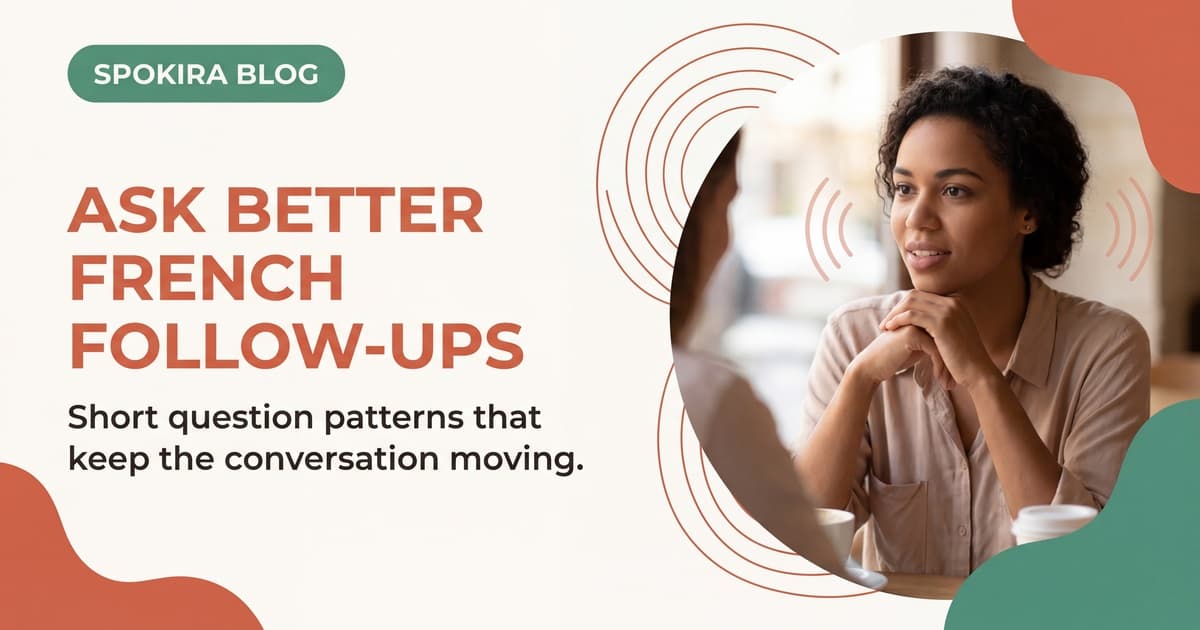
If you can answer in French but cannot keep the conversation moving, the missing skill is often not vocabulary. It is follow-up questions in French you can actually say in time.
For many learners, follow-up questions in French are the difference between a one-line answer and a real conversation.
That is why follow-up questions in French matter so much. They buy you time, show interest, and stop the whole interaction from depending on you producing one long perfect monologue.
This guide gives you a practical system for asking natural follow-up questions in French without sounding stiff, over-formal, or textbook. You will get useful question patterns, register tips, mini-dialogues, and a short drill you can run in 10 minutes.
Quick answer: how do you ask follow-up questions in French naturally?
To ask follow-up questions in French naturally:
- pick one detail from the other person's answer,
- use a short spoken question stem,
- prefer everyday question forms over heavy formal inversion,
- ask about reason, feeling, time, preference, or next step,
- keep the questions short enough that you can actually say them under pressure.
This is not just a nice extra. In the Council of Europe's CEFR Companion Volume (2020), asking for clarification and moving discussion forward with further details are part of real interactional ability, not bonus polish (Council of Europe, 2020).
And from a fluency point of view, short reusable question chunks help because they can be retrieved as ready-made units. A 2022 Frontiers in Psychology study on formulaic sequences and oral fluency found that well-learned chunks were linked to faster speech and less pausing when processed holistically (Yu, published September 9, 2022).
So the goal is simple: do not invent every question from zero. Train a small set of follow-up patterns until they feel automatic.
Why follow-up questions in French change your conversations fast
Many learners think a good conversation means giving interesting answers. In real life, conversations feel smooth when both people keep feeding each other material.
That is exactly what follow-up questions do. They help you:
- keep the turn moving,
- show that you understood,
- reduce pressure on your own long answers,
- sound more socially engaged,
- stay in French longer instead of escaping into silence.
This is especially useful if you freeze after your first sentence. Once your answer is finished, the conversation can die quickly unless you know how to open the next door.
If that freeze happens earlier, start with How to Keep a French Conversation Going When Your Mind Goes Blank. This article solves the narrower problem that comes right after: what to ask next so the exchange keeps breathing.
What sounds natural and what sounds too formal?
The biggest mistake learners make is trying to build elegant written-style questions in the middle of live speech.
In formal French, inversion is standard: Où allez-vous ?, Que faites-vous ensuite ? But the Académie française itself notes that oral French often drops inversion, even if formal written French prefers keeping it (Académie française, March 5, 2020).
For learners, the practical takeaway is this:
- formal written French: Où allez-vous ?
- neutral spoken French: Vous allez où ? or Où est-ce que vous allez ?
- casual spoken French: Tu vas où ?
That does not mean inversion is wrong. It means you do not need to force it every time if your goal is natural spoken interaction.
Here is the useful rule:
- if you need speed, use short spoken forms,
- if you need clarity, use
est-ce que, - if you are in a formal interview or writing exercise, inversion is safer.
For A2-B1 conversation practice, simple spoken forms are usually the best training target because they are easier to retrieve under pressure.
The easiest follow-up questions in French to learn first
You do not need fifty patterns. You need a small set that covers the most common conversation jobs.
| Conversation job | French pattern | What it does | Example |
|---|---|---|---|
| Ask for more detail | Comment ça ? | invites expansion | Tu vas changer de travail ? Comment ça ? |
| Ask why | Pourquoi ? / Pourquoi ça ? | asks for reason | Tu apprends le français pour le travail ? Pourquoi ? |
| Ask what happened next | Et après ? | moves the story forward | Tu es arrivé en retard... et après ? |
| Ask about feeling | Et toi, t'en penses quoi ? | asks for opinion | Ce resto est cher. Et toi, t'en penses quoi ? |
| Ask for a concrete example | Par exemple ? | makes the answer more specific | Tu trouves ça difficile ? Par exemple ? |
| Ask for frequency | Souvent ? / Ça t'arrive souvent ? | checks pattern or habit | Tu parles français avec tes collègues ? Ça t'arrive souvent ? |
| Ask for preference | Tu préfères quoi ? | opens comparison | Tu regardes des séries ou des vidéos ? Tu préfères quoi ? |
| Return the question | Et toi ? | keeps rhythm and balance | Moi, je cuisine rarement. Et toi ? |
These work because they are short. You can actually say them in time.
Start shorter than you think
If the conversation is moving fast, Et toi ?, Pourquoi ?, Et après ?, and Comment ça ? are often better than a long beautiful question you cannot finish.
The five follow-up question families that cover most real conversations
Once you know the small patterns, it helps to organize them by job.
1. Detail questions
Use these when the other person says something interesting but too broad.
- Comment ça ?
- Qu'est-ce que tu veux dire ?
- Dans quel sens ?
- Par exemple ?
These are excellent when you understood the topic but want one more layer.
Example
J'ai changé ma façon d'apprendre le français.
Ah oui ? Comment ça ?
If you often lose the thread while listening, pair this with How to Buy Time in French Without Sounding Stuck. A one-second bridge like ah oui ? makes the follow-up feel much smoother.
2. Reason questions
Use these when you want motive, cause, or explanation.
- Pourquoi ?
- Pourquoi ça ?
- Et pourquoi ?
- Qu'est-ce qui t'a donné envie de... ?
The advanced version can be longer, but the short version is usually enough.
Example
Je regarde moins de vidéos maintenant.
Pourquoi ?
That one word is often enough to keep the conversation moving.
3. Time and sequence questions
Use these when someone tells a story or explains a routine.
- Et après ?
- Et ensuite ?
- Depuis quand ?
- Tu fais ça quand, d'habitude ?
These are especially useful because they create structure. They help you sound engaged without needing fancy vocabulary.
If you want to practice these in a real script, use French cafe conversation practice and add one sequence question after every answer.
4. Opinion and feeling questions
Use these when you want the other person's reaction, not just facts.
- T'en penses quoi ?
- Et toi, tu trouves ça comment ?
- Ça te plaît ?
- Tu as aimé ?
- Ça t'a fait quoi ?
This family matters because good conversations are rarely just factual interviews. They become warmer when you ask how something felt or what someone thinks.
Example
J'ai enfin visité Lyon le mois dernier.
Ah oui ? T'en as pensé quoi ?
That is more natural than launching into a formal question every time.
5. Return questions
Use these to keep balance and avoid interrogation mode.
- Et toi ?
- Et toi, de ton côté ?
- Et pour toi ?
This is one of the highest-value moves in spoken French because it is easy, natural, and social.
If you only learn one follow-up pattern today, learn Et toi ?
Train Your Mouth, Not Your Script
Practice short French conversation turns with guided shadowing and AI feedback so follow-up questions come out under pressure.
A simple formula for building your own follow-up questions
When you stop memorizing isolated questions and start building them from a pattern, conversation gets easier.
Use this formula:
- react briefly,
- pick one detail,
- ask one small question.
Pattern 1: reaction + detail question
- Ah bon ? Comment ça ?
- Ah oui ? Par exemple ?
- D'accord... dans quel sens ?
Pattern 2: reaction + reason question
- Ah oui ? Pourquoi ?
- Ah bon ? Pourquoi ça ?
Pattern 3: reaction + sequence question
- Ah oui ? Et après ?
- D'accord, et ensuite ?
Pattern 4: short answer + return question
- Moi aussi, parfois. Et toi ?
- Pas vraiment. Et pour toi ?
This is much easier to retrieve than a long sentence like:
Pourriez-vous m'expliquer plus précisément quelles étaient les raisons de ce changement ?
That sentence is not wrong. It is just not where most A2-B1 learners should start if the goal is natural conversation.
Real mini-dialogues you can steal
Use these as speaking chunks, not just reading examples.
Situation 1: hobbies
Tu fais quoi le week-end, en général ?
Je vais souvent courir le dimanche matin.
Ah oui ? Depuis quand ?
Depuis l'année dernière, à peu près.
Et tu cours où, d'habitude ?
Situation 2: work
Je travaille plus souvent en télétravail maintenant.
Ah bon ? Pourquoi ?
Parce que je me concentre mieux chez moi.
D'accord. Et ça te plaît vraiment ?
Situation 3: French learning
En ce moment, j'essaie de parler français tous les jours.
Ah oui ? Comment tu fais ?
Je parle tout seul, je shadowe, et j'enregistre des réponses courtes.
Pas mal. Et qu'est-ce qui t'aide le plus ?
Notice what is happening in each dialogue:
- the questions are short,
- each one grows out of one detail,
- no one is trying to sound literary,
- the conversation keeps moving because the listener keeps opening one more door.
That same skill also reduces mental translation. If you want to stop building everything from English, read How to Stop Translating in Your Head When Speaking French. Follow-up patterns work best when they are stored as spoken chunks, not translated line by line.
The 10-minute drill for follow-up questions
This is the fastest way to make the patterns usable.
Minute 1-2: choose one topic
Pick one everyday topic:
- weekend plans
- food
- work
- travel
- learning French
Minute 3-4: write 8 short follow-up questions
Use only simple spoken patterns:
- Pourquoi ?
- Et après ?
- Comment ça ?
- Et toi ?
- Tu préfères quoi ?
- Depuis quand ?
- Par exemple ?
- T'en penses quoi ?
Minute 5-6: shadow them aloud
Say each question 5 to 10 times. Do not whisper. Train the rhythm.
If you need help making short spoken chunks feel automatic, use 7 French filler phrases that help you keep talking right before this drill as your warm-up.
Minute 7-8: answer, then ask
Record yourself doing both parts:
- give a one-line answer,
- ask one follow-up question,
- answer that follow-up,
- ask one more.
This is where the skill becomes conversational instead of theoretical.
Minute 9-10: replay and simplify
Listen back and cut anything too long or stiff.
If a question feels hard to say, shorten it.
- bad training target: Quelles sont exactement les raisons pour lesquelles... ?
- better training target: Pourquoi ?
For recording and replay, use the workflow in Record Yourself in French Without Cringing. Short question drills are ideal for that method because you can hear very quickly whether you sound natural or overloaded.
The three mistakes that make follow-up questions sound unnatural
1. Asking questions that are too long
When learners panic, they often build oversized questions because they think longer sounds smarter.
In conversation, longer usually just means harder to retrieve.
2. Using formal inversion for every question
Again, inversion is not wrong. But if every live follow-up sounds like an exam prompt, you will feel stiff and slow.
Train the spoken forms first. Add more formal control later.
3. Interrogating instead of conversing
If you ask five questions in a row with no reaction, no answer, and no warmth, it stops feeling like conversation.
Use little bridges:
- ah oui ?
- d'accord
- je vois
- pas mal
Then ask the next short question.
That balance keeps your French human.
The best first follow-up questions to memorize
If you want the minimum effective set, start here:
- Et toi ?
- Pourquoi ?
- Et après ?
- Comment ça ?
- Par exemple ?
- T'en penses quoi ?
That is enough to keep many A2-B1 conversations alive. For most learners, a small set of follow-up questions in French beats a long list of clever questions they never use.
The point is not to sound advanced. The point is to stop the blank moment that comes after the first answer.
Conclusion: keep it short enough to use
The best follow-up questions in French are not the most sophisticated ones. They are the ones you can say at the exact moment you need them.
Start with short spoken patterns. Use them on one topic. Repeat them until they feel like part of your mouth, not just part of your notes.
If you want the bigger system behind this, read How to Practice Spoken French: A Complete A2-B1 System. And if you want guided conversation reps with feedback, Spokira's speaking drills help you practice reactions, follow-ups, and natural spoken rhythm in short daily sessions.