You walk into a boulangerie. You've rehearsed this. You take a breath and say:
"Je voudrais un croissant, s'il vous plaît."
The baker hands you a croissant. It works. But you've also just used the most textbook-sounding phrase possible for a transaction that French people handle in about four words.
The lexical contrast matters here: vouloir carries plain desire, while prendre is the ordinary transactional verb behind everyday ordering. That is why je voudrais stays polite but can sound heavier than je vais prendre in routine service exchanges (CNRTL, vouloir, Larousse, vouloir, CNRTL, prendre).
Why Je Voudrais Sounds Textbook
Je voudrais (I would like) is grammatically impeccable. It uses the conditional tense. It's polite. It's the phrase every French course teaches for ordering, requesting, and being courteous.
The issue isn't correctness, it's frequency. In everyday French, je voudrais occupies a narrow band: it's more formal than what most casual situations require, but not formal enough for truly formal contexts (where je souhaiterais takes over).
It sits in an awkward middle ground. French speakers tend to go either more casual or more formal, depending on context.
What French People Actually Say
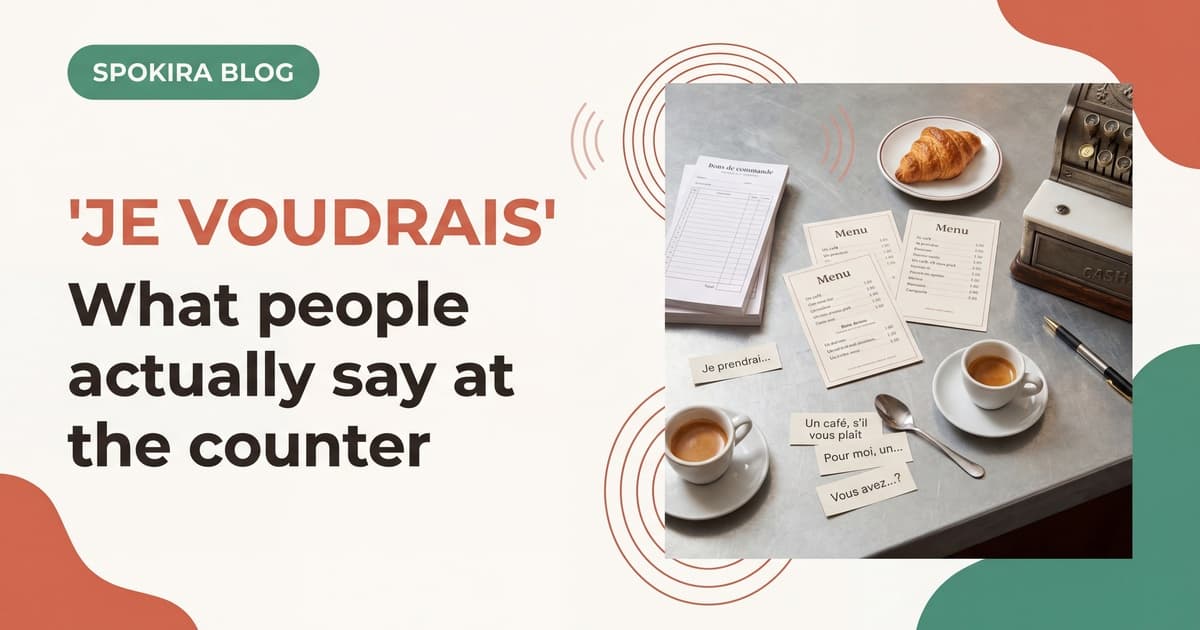
Here's what you'll hear at a café, a boulangerie, a restaurant, or any everyday transaction:
| Situation | What people say | Register |
|---|---|---|
| Ordering food/drinks | Je vais prendre... | Natural, standard |
| Quick order | Je prendrai... | Slightly more polished |
| Pointing at something | Ça, s'il vous plaît | Quick, common |
| At a bar | Un café, s'il vous plaît | Direct, no verb needed |
| Asking for the bill | L'addition, s'il vous plaît | Standard |
| Requesting something at a shop | Est-ce que vous avez... | Practical |
| Formal dining | Je voudrais... / Je souhaiterais... | Appropriate here |
Je vais prendre (I'll have / I'm going to take) is the workhorse. It's what French speakers default to in most ordering situations. It sounds natural, it's easy to conjugate, and it works everywhere.
Your New Default
"Je vais prendre un café, s'il vous plaît." This single phrase covers 90% of ordering situations. Natural, polite, zero awkwardness.
The Verb-Free Order
Here's something textbooks never teach: in quick transactions, French people often skip the verb entirely.
At a boulangerie:
"Une baguette, s'il vous plaît."
At a bar:
"Deux bières, s'il vous plaît."
At a market stall:
"Un kilo de tomates, s'il vous plaît."
No je voudrais. No je vais prendre. Just the thing + s'il vous plaît. The context makes it obvious you're ordering, so the verb is redundant. This is the most common pattern in quick retail transactions.
It's not rude. The s'il vous plaît does all the politeness work. French people do this a hundred times a week without thinking about it.
When Je Voudrais Is Right
Je voudrais isn't wrong, it's just situational. Here's when it fits:
- Formal dining: "Je voudrais le menu du jour", appropriate, expected
- Making a request (not ordering): "Je voudrais réserver une table", polite, clear
- With strangers in formal contexts: "Je voudrais un renseignement", asking for information at a desk
- Softening a request: "Je voudrais savoir si...", I'd like to know if...
The pattern: je voudrais works best when you're requesting something that requires effort from the other person, not when you're simply ordering off a menu. It adds a layer of deference that makes sense for requests but feels heavy for transactions.
The Register Ladder
From most casual to most formal, here's how ordering progresses:
- "Un café.", bare minimum, fine at a bar with a regular bartender
- "Un café, s'il vous plaît.", standard, polite, everyday
- "Je vais prendre un café.", natural, slightly more complete
- "Je prendrai un café, s'il vous plaît.", polished, restaurant-ready
- "Je voudrais un café, s'il vous plaît.", formal, textbook-polite
- "Je souhaiterais un café, s'il vous plaît.", very formal, rare
Most daily life happens at levels 2-4. Level 5 is where the classroom drops you, which is a bit high for a boulangerie and a bit low for a diplomatic dinner.
Other Useful Ordering Phrases
Beyond the main verb choice, here are phrases that make you sound like a regular:
"Qu'est-ce que vous me conseillez?" (What do you recommend?) Great at restaurants. Flatters the waiter and gets you a real suggestion.
"Pareil pour moi." (Same for me.) When your friend just ordered and you want the same thing. Quick, easy, natural.
"C'est quoi, le plat du jour?" (What's the special?) Casual way to ask. Note c'est quoi instead of qu'est-ce que c'est, spoken French shortcut.
"On peut avoir l'addition?" (Can we get the bill?) On peut + infinitive is the casual way to ask for things. Less formal than pourriez-vous.
"Je vais prendre pareil." (I'll have the same.) Variant of pareil pour moi. Both are common.
Practice These Scenarios
Imagine yourself at the counter. Say these out loud:
At a boulangerie:
"Bonjour! Deux pains au chocolat, s'il vous plaît."
At a café:
"Je vais prendre un allongé. Et un verre d'eau, s'il vous plaît."
At a restaurant, looking at the menu:
"Je vais prendre la salade en entrée, et le poulet."
When the waiter asks if you want dessert:
"Non merci, juste l'addition."
Notice the rhythm: greeting → order → s'il vous plaît. Fast, clear, polite. No conditional conjugation required.
For practicing real-world exchanges like ordering, asking for things, and handling everyday French transactions, Spokira's drills put you in the situation so you build reflexes, not just knowledge.