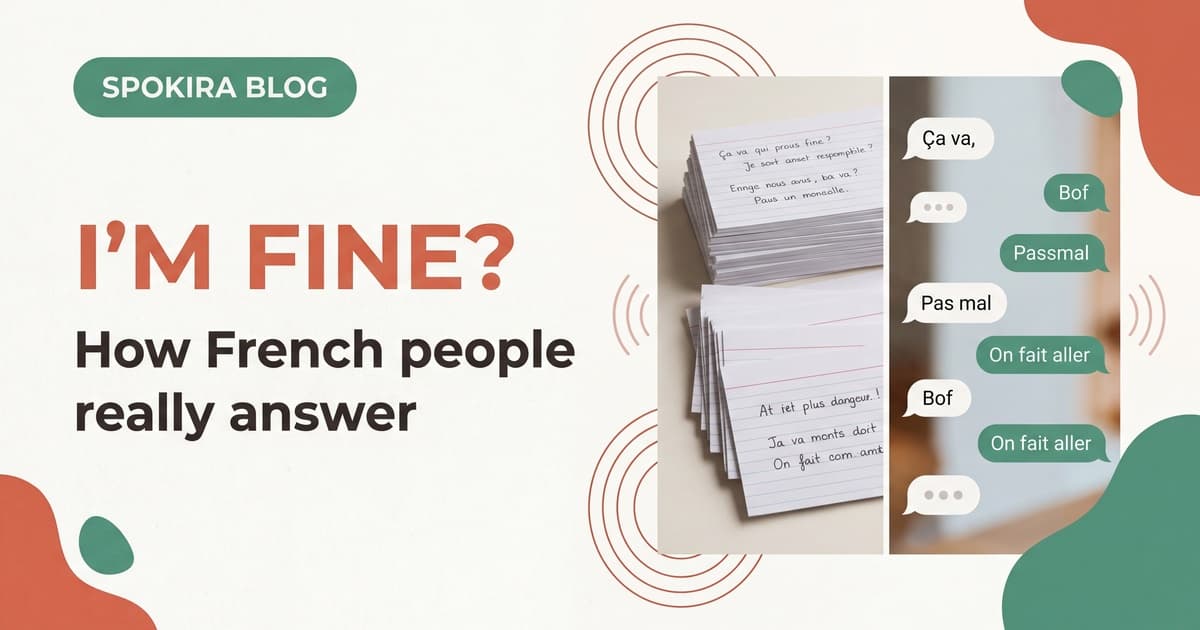
If you want the fastest natural answer first, "I am fine" in French is usually just ça va. Je vais bien, merci is correct, but it sounds more textbook and formal in casual conversation.
Lesson one of every French course on earth:
, Comment allez-vous? , Je vais bien, merci. Et vous?
It's clean. It's polite. It's grammatically correct. And it sounds like you're reciting from a textbook.
French people don't talk like this. The question is different. The answer is different. The whole exchange is faster and less formal than any classroom prepares you for.
The phrase ça va works because it comes straight from the very broad everyday verb aller, which dictionaries map to both movement and general state. That helps explain why it can function as both a greeting and an answer, while adding merci shifts the line back toward explicit politeness (CNRTL, aller, Larousse, aller, CNRTL, merci).
The Real Exchange
Here's what actually happens when two French people greet each other:
, Ça va? , Ça va, et toi?
That's it. Both the question and the answer are ça va. The first one rises in pitch (question). The second one stays flat (answer). The whole thing takes two seconds.
This is the baseline. Everything else is a variation.
The Full Range of "I'm Fine"
French speakers have a rich palette for answering ça va?, and the choice reveals exactly how they're feeling:
| Response | What it means | Mood |
|---|---|---|
| Ça va | I'm fine | Neutral, default |
| Ça va bien | I'm doing well | Genuinely good |
| Ça va, tranquille | All good, easy | Relaxed, chill |
| Ouais, ça roule | Yeah, it's rolling | Casual, upbeat |
| Nickel | Perfect | Great mood |
| La forme | In good shape | Energetic, positive |
| Bof | Meh | Not great, not terrible |
| Ça peut aller | It could go (be worse) | Surviving |
| Pas trop, non | Not really, no | Honest, inviting follow-up |
| On fait aller | We make it go | Getting by, stoic |
The Most Useful Answer
"Ça va, et toi?" covers 80% of greetings. Master this reflex first, then expand your range. The et toi is important, it immediately bounces the conversation forward.
What the Classroom Gets Wrong
The textbook answer "Je vais bien, merci, et vous?" has three problems in casual speech:
-
Je vais bien is complete and formal. In casual French, people don't construct full sentences for greetings. They use fragments: ça va, bien, tranquille.
-
Merci after "I'm fine" sounds slightly odd in casual contexts. It works formally, but among friends it creates unnecessary distance. You don't thank someone for asking how you are.
-
Et vous signals formal register. Unless you're speaking to a stranger, your boss, or someone older, it should be et toi. Using vous with a friend or peer sounds cold.
The Honest Answers
One of the most interesting differences: French speakers are more likely to give an honest-ish answer to ça va? than English speakers are to "how are you?"
In English, "how are you?" is barely a question, "good, thanks" is automatic. In French, ça va? can actually open a conversation:
When things are good:
"Ah ça va super bien, j'ai eu mon exam!" (I'm great, I passed my exam!)
When things are so-so:
"Bof, un peu fatigué." (Meh, a bit tired.)
When things are bad:
"Honnêtement, pas ouf." (Honestly, not great.)
When you don't want to get into it:
"On fait aller." (Getting by.), polite deflection, signals "don't push"
This isn't universal, plenty of French people give reflexive ça va answers without thinking. But the cultural space exists for real answers in a way it doesn't always in English.
Regional and Generational Variations
The greeting exchange shifts depending on who you're talking to:
Young people (teens-20s):
"Wesh, ça va?" / "Tranquille."
Wesh is verlan-adjacent slang, common in urban areas. Tranquille (calm, chill) has become the default "I'm fine" for a whole generation.
Professional/semi-formal:
"Ça va bien? Pas trop de monde aujourd'hui?"
Greeting + immediate small talk about the shared context. French workplace greetings often fold into the next topic seamlessly.
Older/traditional:
"Vous allez bien?" / "Très bien, et vous-même?"
The formal exchange does still exist, it's just reserved for people who use vous with each other, which is increasingly rare among anyone under 50.
The Greeting Choreography
French greetings have a physical component that textbooks skip. In person, ça va? is accompanied by:
- La bise (cheek kisses), the number varies by region (1-4)
- A handshake, professional settings, meeting someone new
- A wave or nod, passing someone you've already greeted today
You don't say ça va to the same person twice in one day. If you've already greeted someone, the next time you see them you skip the ça va and go straight to conversation. Saying it again would be strange, like resetting the relationship.
Practice the Exchange
Run these as rapid-fire call-and-response. Speed matters, greetings should be automatic:
- "Ça va?" → "Ça va, et toi?" (the default)
- "T'es en forme?" → "Ouais, tranquille." (the casual)
- "Ça va?" → "Bof, fatigué. Et toi?" (the honest)
- "Comment tu vas?" → "Ça va bien! Ça fait longtemps." (running into someone)
Don't think about these. React. The goal is for the response to come out before you've finished processing the question.
For drilling exactly this kind of reflexive, real-speed French, Spokira's speaking practice trains your responses to be automatic, not translated.